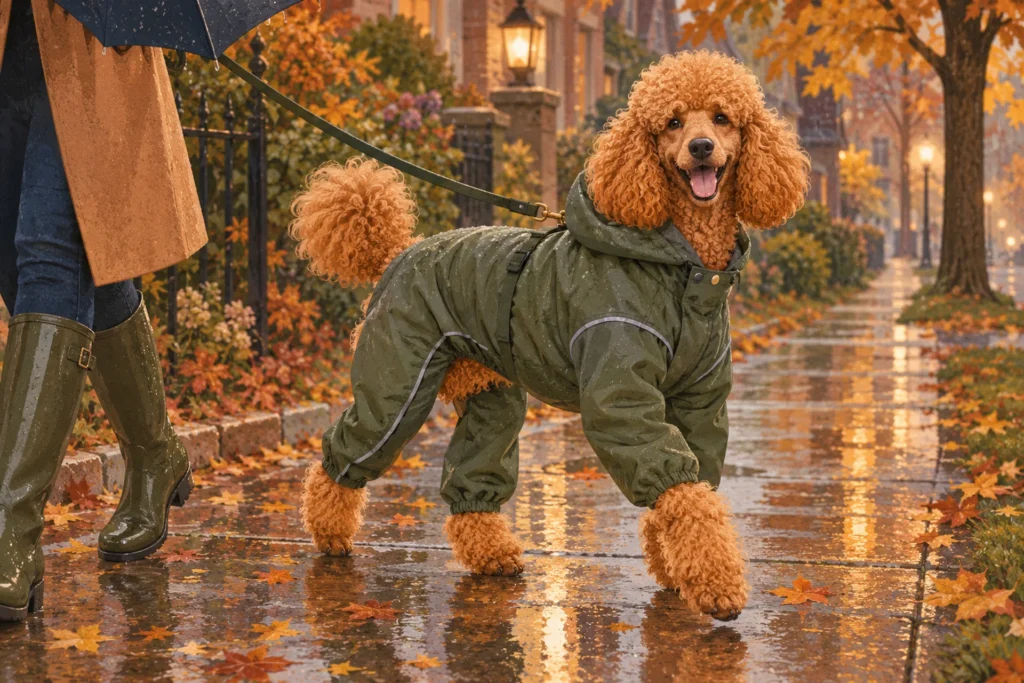
A poodle doesn’t need a raincoat to stay healthy on a wet walk, but it’s one of the breeds where a raincoat earns its place more often than people expect, and the same goes for curly-coated doodles. The reason is mostly what happens after the walk. A full curly coat holds rain, grit and mud, and if it isn’t dried and brushed out it mats. VCA’s veterinarians explain that matted fur prevents air from reaching the skin and retains water after a dog swims or gets caught in the rain. A raincoat means less of the coat gets soaked in the first place.
The other reason runs the opposite way. A poodle in a short clip has given up most of its insulation. VCA’s guide to dog jackets says dogs groomed to have short hair, like poodles, no longer have their natural insulation, so they need a jacket to do the job. A full-coated poodle in rain and a freshly clipped poodle in cold rain both have a case for one. A poodle on a short, mild, drizzly potty trip doesn’t.
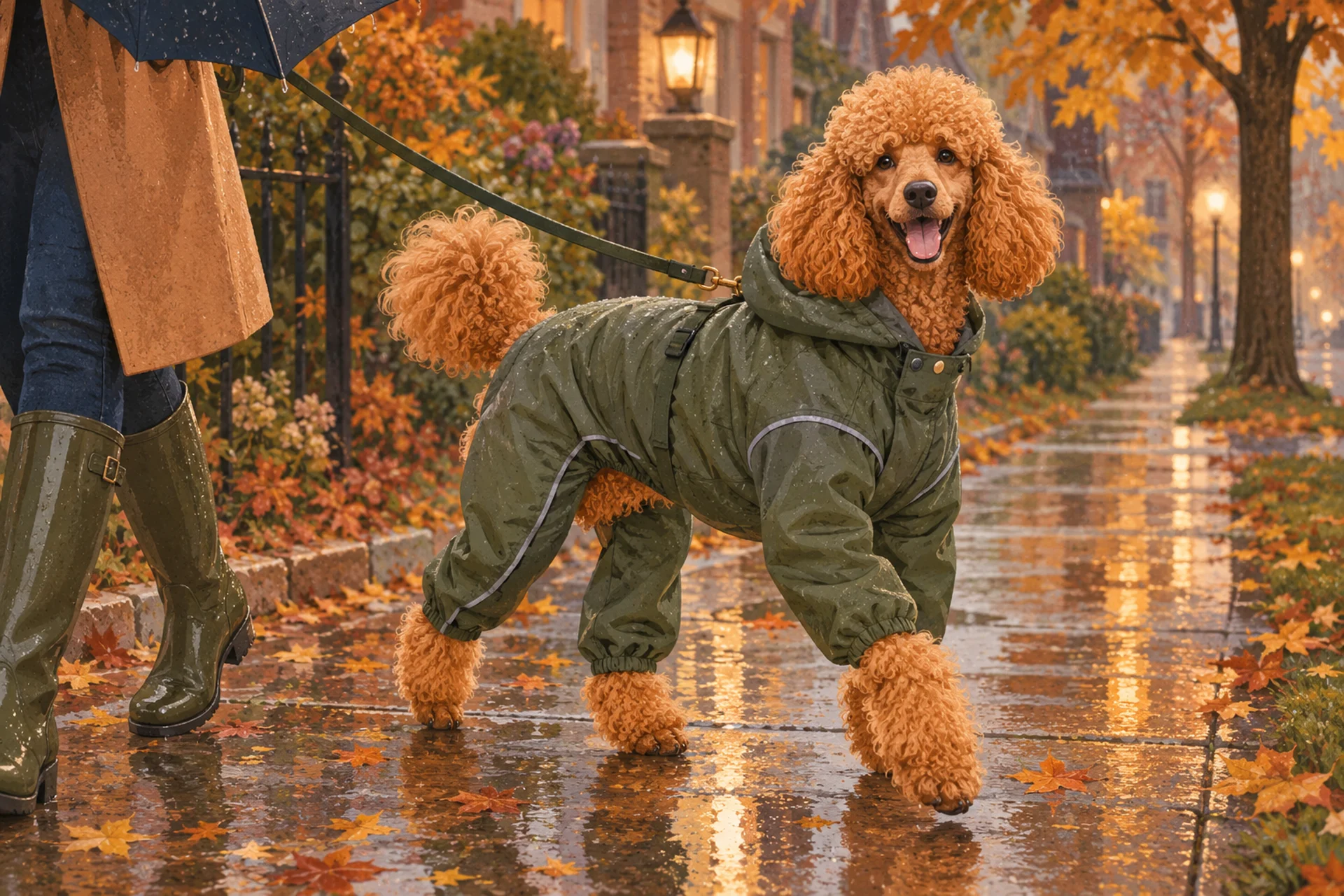
“But poodles were water dogs”
They were, and that’s the first thing someone will say. The AKC’s history of the breed says the name comes from the German word “pudeln,” meaning to splash in water, and describes the poodle as a sturdy water retriever. A healthy adult poodle getting wet is not in danger, and if you want the general answer to whether rain makes dogs ill, we cover it in can dogs get sick from rain?
The same history is also the best argument for thinking about the coat. When poodles retrieved waterfowl in cold water, the AKC says, the blanket of hair on the chest, hips and leg joints protected the dog’s vital organs, but a full coat often proved cumbersome in the water, so hunters trimmed the legs, neck and tail. It also says the breed’s natural coat is thick and heavy. In other words, the working poodle was never a dog whose coat simply shed water and stayed light. It was a dog whose owners managed the coat around the water.
That’s the difference from the other water dog people argue about. A Labrador’s short coat lets mud and rain run off, which is why we told Lab owners in do Labradors need raincoats? that most of them can skip one. A curly coat behaves differently on a city walk: leaves, grit and water work into the curls, and the coat stays wet long after the dog is home.
Why a wet curly coat is a grooming problem
This is the part that shows up in your grooming bill rather than at the vet. The AKC’s guide to drying dogs says proper drying prevents mats, tangles, and bacteria growth, and that the more hair a dog has, the more important it is to dry it well. It adds that thick fur can be difficult to dry fully with just a towel. A poodle or doodle in a full coat is exactly that dog.
The ASPCA puts the routine bluntly: for long hair that mats often, it recommends a daily grooming routine, gently teasing out tangles with a slicker brush. It also suggests trimming the hair between the toes to avoid painful matting. Rain makes all of this harder, because a coat that gets soaked and then dries on its own is the coat that tangles.
So the honest case for a raincoat on a full-coated curly dog is less water and less mud in the coat on every wet walk, which means less drying and less brushing out afterward. It doesn’t replace the drying and brushing. It shrinks them.
Mats, damp skin and hot spots
Mats are not just cosmetic. The ASPCA notes that dogs who aren’t groomed regularly and have matted, dirty coats can be prone to hot spots. The AKC’s veterinarian-written page on hot spots lists both a coat that is dirty or matted and moisture trapped in the coat among the triggers, says they’re more likely in warm, humid weather and in dogs that are often wet, and advises making sure the coat is thoroughly dry after each wet session.
Most curly dogs who get rained on and dried properly are fine. But a hot spot is a vet visit, not a grooming job. The AKC describes them as well-defined areas of redness, swelling and hair loss, painful and itchy, and says delaying treatment only makes them worse. VCA adds that you should check with your veterinarian before using any human medication on your dog. If you find a red, raw or oozing patch under the curls, or a tight mat sitting against the skin, don’t cut it out with scissors at home. Book the vet or a groomer. For crusty patches rather than raw ones, see can dogs get rain rot?
The clipped poodle: a warmth problem, not a mud problem
A poodle in a short pet clip or a fresh puppy cut is a different dog in the rain. There’s little coat to hold water, so mats aren’t the issue. Warmth is. VCA’s jacket guide is specific: groomed poodles no longer have their natural insulation. It also says small dogs lose heat very quickly from their tiny bodies, and that the very young and very old don’t regulate their body temperature as well as dogs in their prime.
Put those together and the toy poodle with a short clip, the elderly miniature, and the young puppy are the poodles most likely to be cold on a wet autumn walk. Rain matters here because wet fur insulates less than dry fur, and a short coat gets wet to the skin quickly. A raincoat is the layer that keeps the rain off; on a cold day a lined coat may suit better. We go through temperatures in what temperature does a dog need a coat? and the signs of a cold dog in how to tell if your dog is cold.
Doodles: it depends which parent the coat takes after
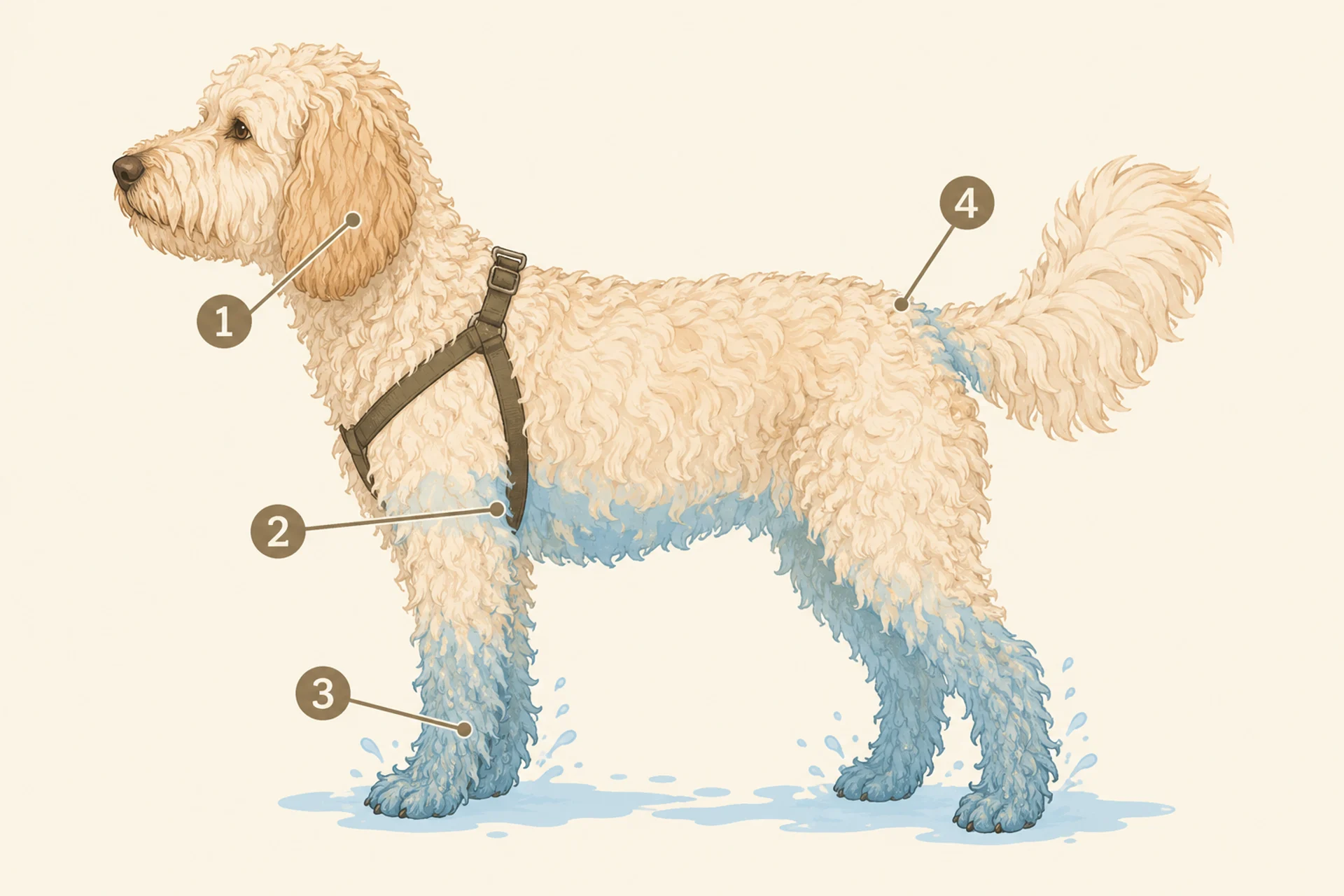
Goldendoodles, Labradoodles and other poodle crosses vary a lot. A doodle’s coat can come out anywhere from fairly flat and shaggy to tightly curled. If yours has a wavy or curly coat that mats when it’s wet, everything above about curly poodles applies, and doodle owners usually feel it most on the legs and belly, where the coat is long and closest to the puddles. If yours has a flatter, retriever-like coat, the reasoning in our Golden Retriever raincoat guide is closer: the underside and the feathering are the parts worth covering.
Whatever the coat, many doodles are big, active dogs. A raincoat that only covers the back leaves the legs, belly and chest, the parts that collect the most mud, uncovered. For a curly dog that mats on the legs, a suit with legs does more than a cape. Our guide to rain suits with legs covers what they protect and what they still leave wet.
Does your poodle or doodle need one? A quick decision table
| Your dog and your walk | Raincoat? | Why |
|---|---|---|
| Any poodle or doodle, short potty trip, light drizzle | No | A quick towel at the door is enough. |
| Full curly coat, regular wet or muddy walks | Often worth it | Less water and mud in the coat means less drying and brushing out, and fewer mats. |
| Short clip, cold or windy rain | Often worth it | VCA says groomed poodles no longer have their natural insulation. |
| Toy poodle, puppy or senior in cold rain | Usually yes | Small, very young and very old dogs lose heat faster. |
| Dog with recurring hot spots or ear trouble | Ask your vet first | Moisture is one factor, but there are many other causes that need treating. |
| Warm, humid day, active walk | Usually no | A shell adds heat. See do dogs overheat in coats. |
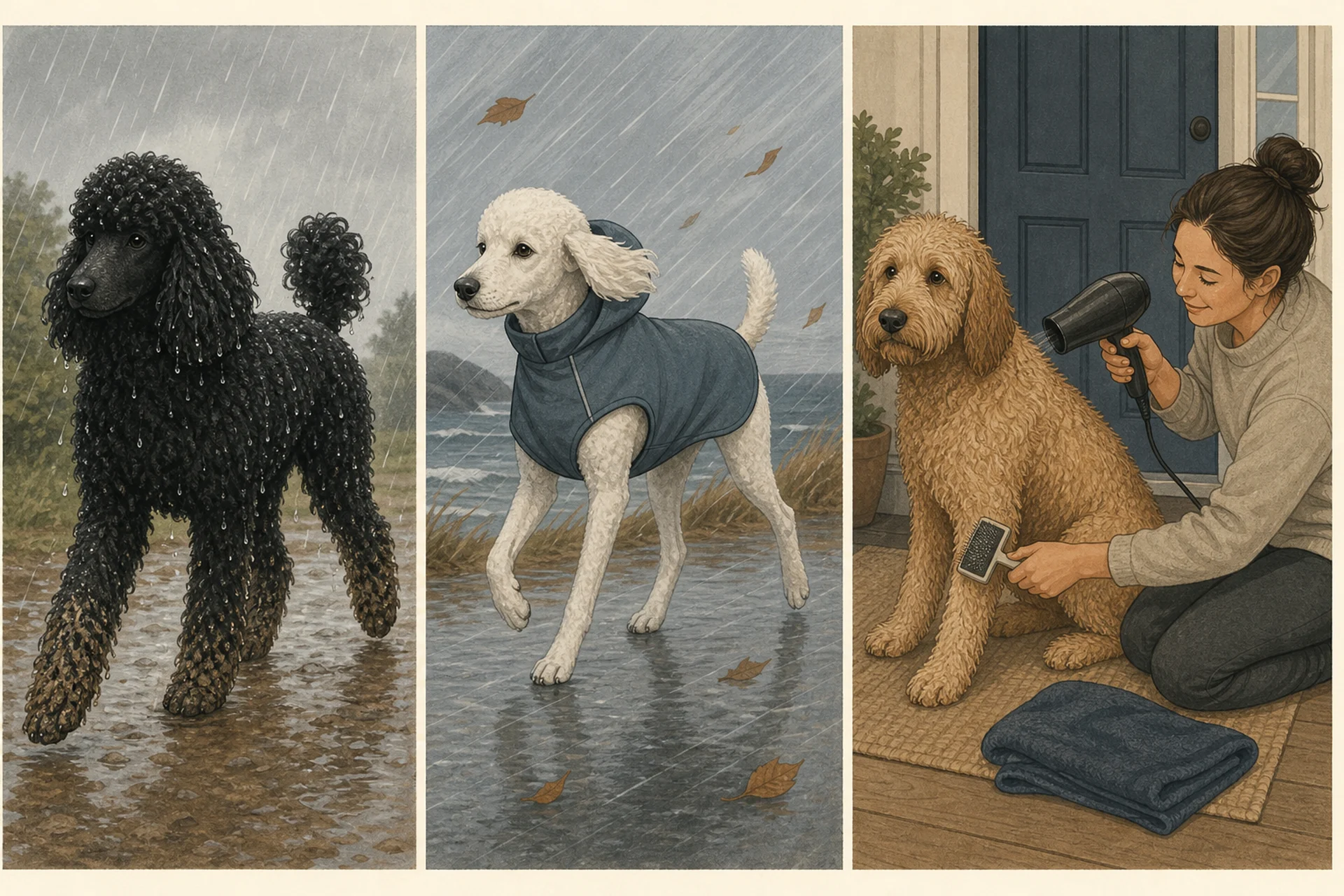
After every wet walk: the curly-coat routine
A raincoat cuts the work down. These steps are the work.
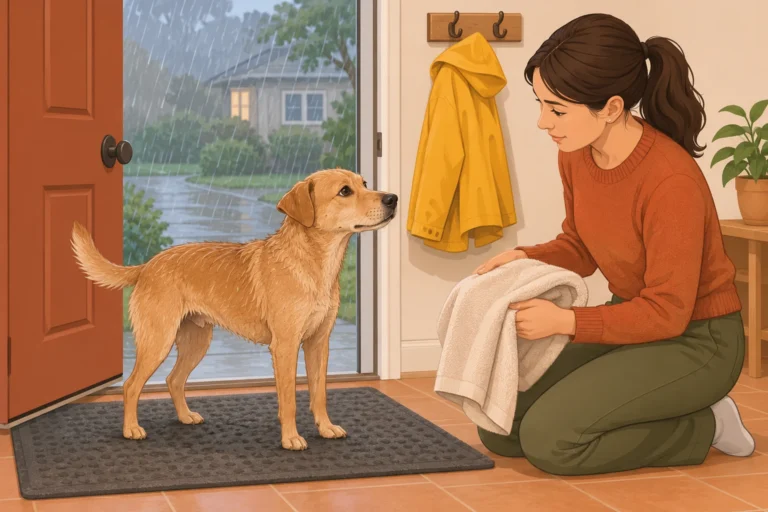
- Blot, then dry fully. Towel first, then finish with a dryer if your dog tolerates it. The AKC notes that it’s the airflow, not heat, that dries the fur, and to avoid heat because it might burn the skin. Keep the dryer away from the face and ears.
- Brush while you dry. Work through the legs, behind the front legs, under the collar or harness and the base of the tail, where tangles start. A slicker brush is what the ASPCA suggests for teasing out tangles.
- Check the skin. The AKC suggests using drying time to look for lumps, scrapes, scabs or irritation. Red, raw or oozing patches go to the vet.
- Dry the ears. Poodles and most doodles have drop ears. If your dog shakes its head, scratches an ear or you notice a smell after wet walks, see can rain cause ear infections in dogs? and call your vet.
- Don’t fight tight mats. If a mat sits against the skin, leave it for a groomer or your vet rather than cutting near the skin at home.
- Keep the feet tidy. The ASPCA suggests trimming the hair between the toes to avoid painful matting. Curly feet also carry the most mud indoors.
If you buy one: fitting a poodle or doodle
- Measure, don’t guess from the breed. Standard, Miniature and Toy poodles, and doodles of every size, need different raincoats. The AKC’s raincoat guide says to measure the circumference of your dog’s neck, chest, and stomach with a soft tape, plus the length from the neck to the base of the tail. Our full method is in how to measure your dog for clothes.
- Measure the coat you’ll have in rain season. A full coat and a fresh clip can be very different sizes around the chest. Measure in the coat your dog will actually be wearing.
- Check the straps. The AKC suggests the two-finger test: two fingers should slide under the straps, but not more than three.
- Legs for leg mats. If the legs are where your dog mats, a suit with legs covers them; a cape doesn’t. For a large curly dog, a hooded suit such as our Snap-Off Hood Four-Leg Dog Rain Suit covers the legs and has a hood you can take off. Check the size chart on the product page.
- A hood only if your dog accepts it. The AKC says hoods can help keep water out of a dog’s ears. If your dog hates it, leave it off; see hood or no hood.
- Introduce it indoors. The AKC suggests starting in a familiar room with treats and praise before the first wet walk. Our step-by-step is in how to get your dog used to wearing clothes.
Poodle raincoat FAQ
Do poodles need raincoats?
Not to stay healthy on an ordinary walk. A raincoat is worth it for full-coated poodles who get wet or muddy often, because a soaked curly coat needs a lot of drying and brushing and mats if it’s left. It’s also worth it for short-clipped, small, young or senior poodles in cold rain, because VCA says groomed poodles lose their natural insulation.
Are poodles waterproof?
No dog’s coat is waterproof. Poodles were bred as water retrievers, and the AKC describes the natural coat as thick and heavy. On a city walk the curls hold water and debris, and VCA notes that matted fur keeps water against the skin after rain.
Do doodles need raincoats?
It depends on the coat. A curly or wavy doodle coat that mats when wet behaves like a poodle’s, and a raincoat with legs saves a lot of brushing. A flatter, retriever-style coat sheds more mud, so the case is weaker. Size and activity matter too: big doodles get muddy on the legs and belly first.
Should I dry my poodle after rain?
Yes, all the way to the skin. The AKC says drying prevents mats, tangles and bacteria growth, and that thick fur is hard to dry with a towel alone. Towel, then use cool air if your dog tolerates a dryer, brushing as you go.
Does a toy poodle need a raincoat?
More often than a Standard. VCA says small dogs lose heat very quickly, and toy poodles are often kept in short clips. On cold, wet days a raincoat or a lined coat helps. If your dog shivers or doesn’t want to keep walking, head home.
What size raincoat does a Standard Poodle wear?
There’s no breed size. Measure neck, chest, stomach and neck-to-tail length in the coat your dog will be wearing, then compare with the size chart on the product page. Go by the chest and length measurements rather than weight, and remember a full coat adds bulk around the chest.
Curly coats hold the rain. A raincoat means less drying, fewer mats and a warmer clipped dog.
Poodles and doodles don’t get sick from a normal wet walk. A full curly coat holds water and mud and mats if it isn’t dried and brushed out, and a short clip loses the coat’s warmth. If your dog gets wet often, or is small, young, old or freshly clipped, a raincoat is a sensible tool. Dry and brush every time anyway, and take any raw or oozing patch under the coat to your vet.
Sources
- VCA Animal Hospitals — Hot Spots in Dogs (checked 2026-10-28)
- VCA Animal Hospitals — What to Consider When Choosing a Dog Jacket (checked 2026-10-28)
- American Kennel Club — Poodle History: From Water Retriever to Versatile Companion (checked 2026-10-28)
- American Kennel Club — How to Dry Your Dog (checked 2026-10-28)
- American Kennel Club — Hot Spots on Dogs (checked 2026-10-28)
- ASPCA — Dog Grooming Tips (checked 2026-10-28)
- American Kennel Club — Does Your Dog Need a Raincoat? (checked 2026-10-28)
Veterinary guidance is updated from time to time. Check the official pages, and ask your own veterinarian about your dog’s skin, ears and coat. Nothing here is a diagnosis. Product sizes vary by maker, so always check the size chart on the product page.