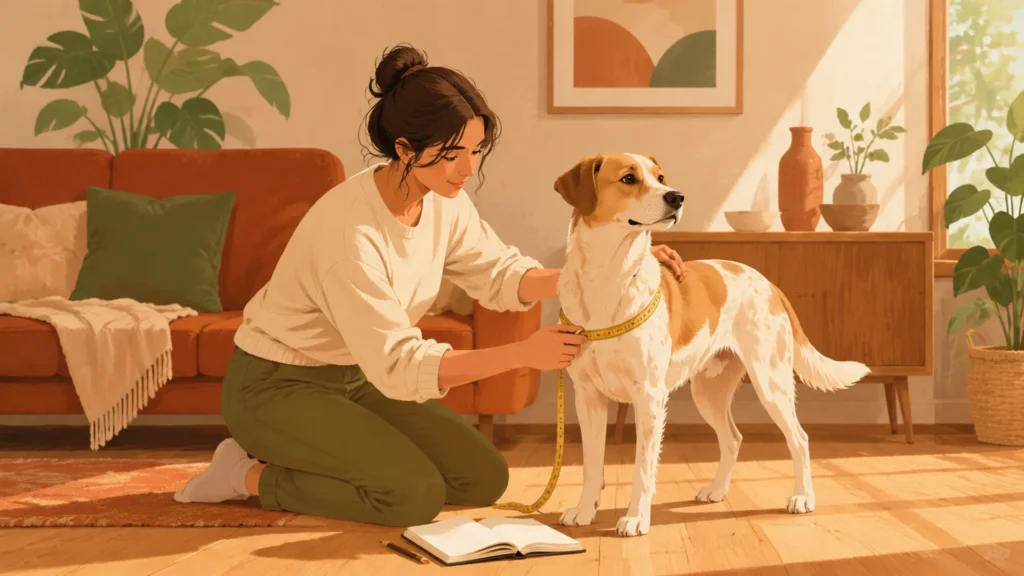
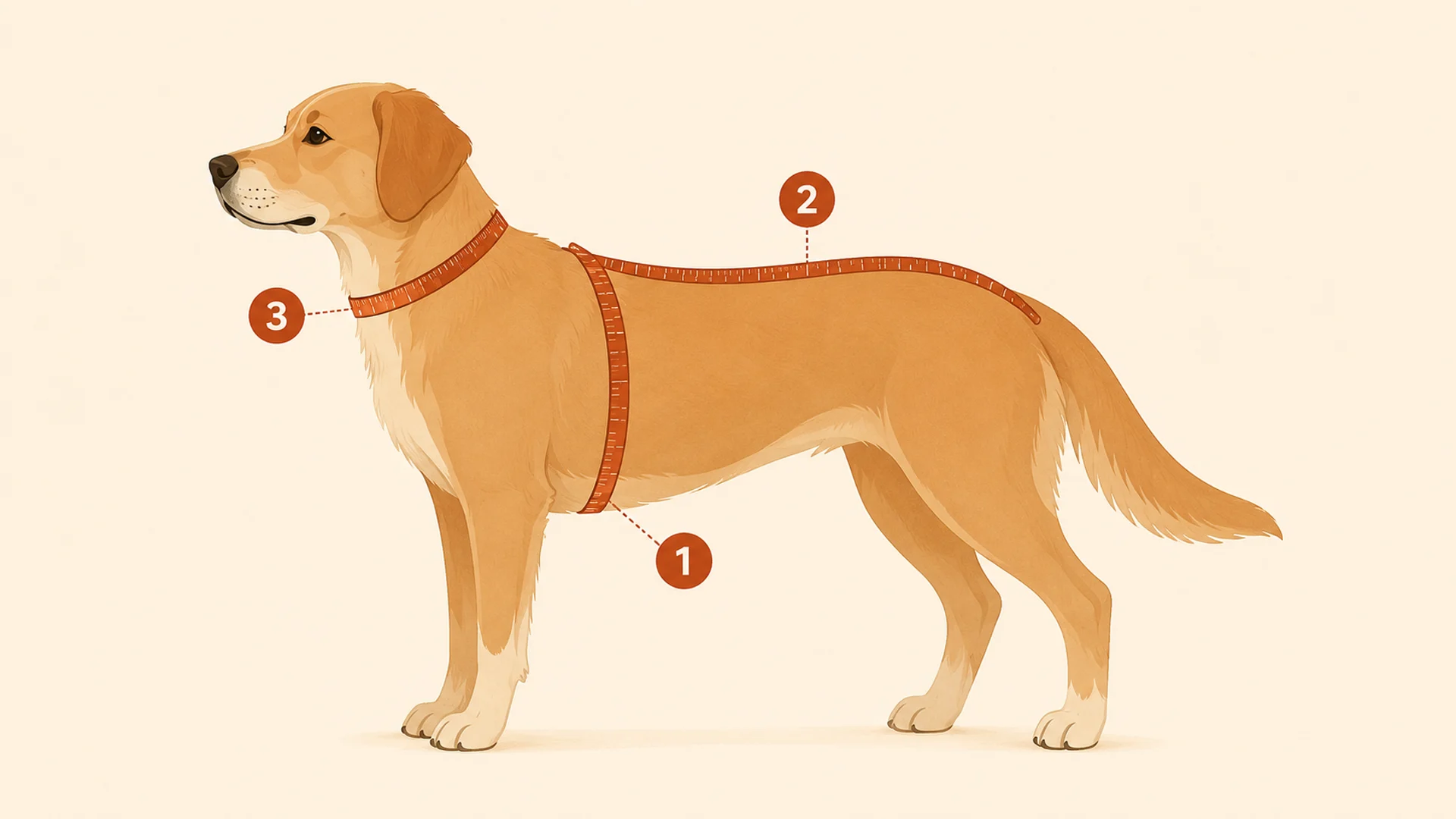
Take three measurements with a soft tape while your dog is standing: chest girth around the widest part of the rib cage just behind the front legs, back length from the base of the neck to the base of the tail, and neck girth where the collar sits. Those three numbers pick the size. Your dog’s weight does not.
Weight is the number every chart asks for and the number that fails most often, because two dogs on the same scale reading can carry very different amounts of fat around the ribs — and the ribs are exactly where a coat or harness has to close. The American Animal Hospital Association’s 2021 Nutrition and Weight Management Guidelines put a number on the gap: a dog scoring 8 out of 9 on the standard body condition scale is roughly 30% overweight compared with a dog scoring in the ideal range. Same breed, same scale reading, different girth.
Why the weight column on a size chart keeps lying to you
Body condition scoring is the tool vets use to describe shape rather than mass. On the nine-point scale used across small-animal practice, the AAHA guidelines note that “every incremental increase in BCS is equivalent to a 5% increase in BF%” — each single point up the scale is another 5% of body fat — and that each point above 5 out of 9 corresponds to being roughly 10% overweight. The Merck Veterinary Manual lists where that fat is assessed: “fat cover over the ribs, down the topline (waist), around the tail base, and ventrally along the abdomen.”
Read that list again and notice what it describes. Ribs, waist, belly. Those are not incidental places — they are the exact path a chest girth tape takes, and the exact surface a coat has to wrap. A dog carrying an extra two points of body condition has put all of it directly into the measurement the garment depends on, while barely moving the measurement nobody takes: back length. Skeleton length stays put; girth does not. Which is why a size chart built only on pounds is guessing at the number it actually needs.
Build changes girth too, and build has nothing to do with the scale
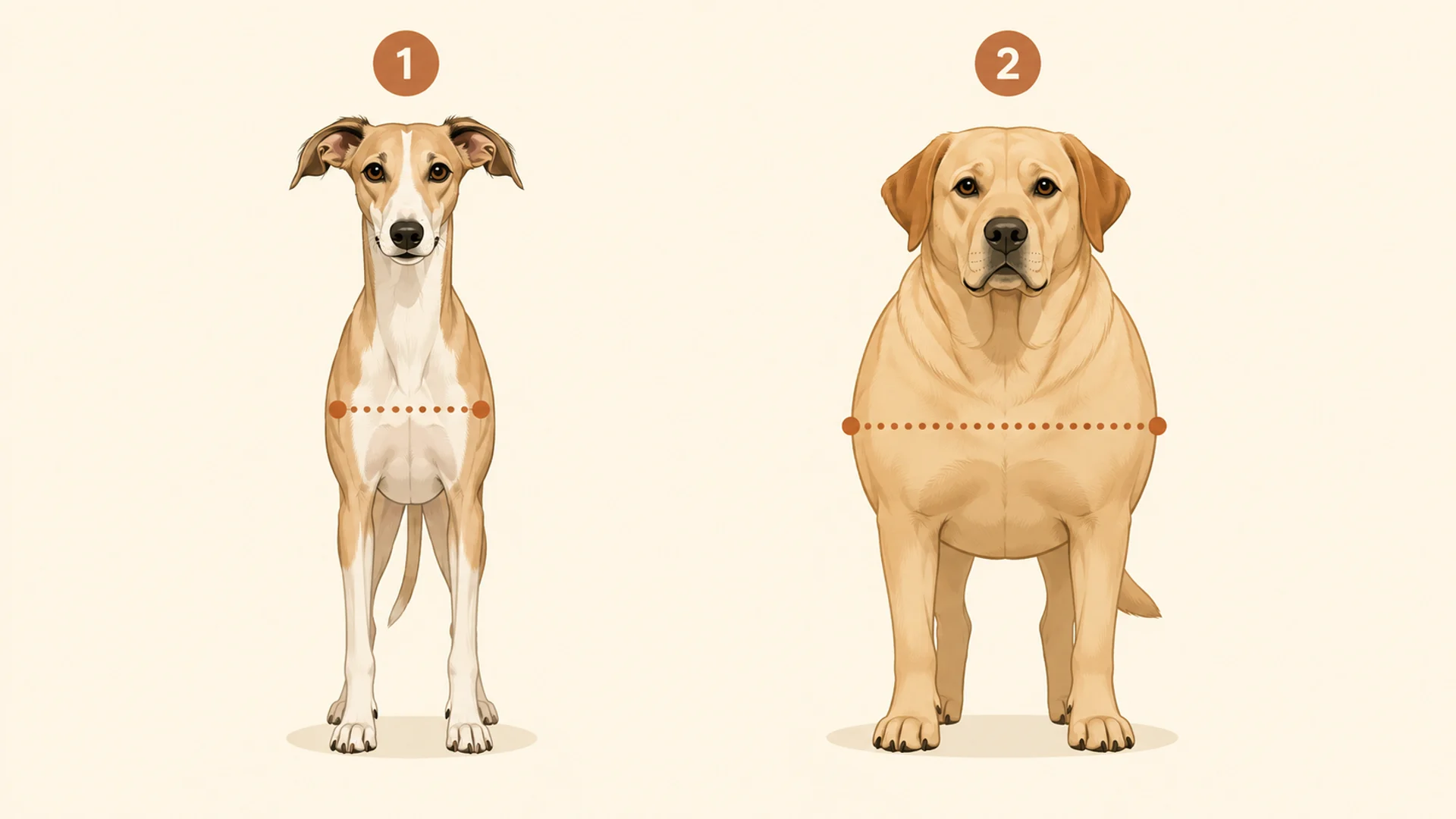
Fat is only half of it. Dogs vary in skeletal shape more than almost any other single species, and chest depth is one of the traits that varies most. A deep-chested, tucked-up dog and a barrel-bodied, level-bellied dog can weigh the same and need different girth sizes — and a long-backed dog can need a bigger back length than its girth would suggest, which is why sizing a dachshund or a corgi from a weight column so often produces a coat that fits the chest and stops halfway down the spine. If a rain layer stops short, the part it stops short of is the part that gets wet. Our guide to rain gear for long-bodied dogs goes further into how length and girth trade off.
A common objection: “46 pounds is called XL — that’s ridiculous”
People say a version of this constantly, and the frustration is fair. A letter on a pet garment is not a category anyone agreed on. There is no shared standard behind S, M, L, XL or 8XL in pet apparel the way there is a rough shared expectation in human clothing, so each brand sets its letters against its own chart. A dog that is an L on one chart can be an XL on the next one without either brand doing anything wrong — the letters simply are not the same units.
Where the objection has a real point is the top of the range. Charts that stop at a letter rather than a measurement genuinely leave giant-breed owners stranded, and “our biggest size fits up to X pounds” tells a Newfoundland or a Great Dane owner nothing about whether it will close around the chest. The fix on both sides is the same: ignore the letter, find the girth and length numbers the chart is actually built on, and compare those to your dog. If a chart does not publish girth and length, that chart cannot answer your question. And if your dog is past the top row entirely, the problem stops being a measuring problem and becomes a sourcing one — we worked through that case separately in dog coats for giant breeds.
How to take the three measurements
The American Kennel Club’s guidance on harness fit covers the method and the fit check together. Measure with your dog standing squarely — weight even on all four legs, spine aligned. A sitting dog compresses through the chest and gives you a number you cannot use.
- Chest girth. Wrap the tape around the largest part of the rib cage, usually just behind the front legs. Snug, not tight. This is the number that decides most garments and nearly every harness.
- Back length. Run the tape along the top of the spine, from the base of the neck where the collar sits to the base of the tail. This decides coverage — whether a coat reaches or leaves a gap.
- Neck girth. Measure around the base of the neck where a collar naturally rests. This decides whether a hood or a collared opening will pull.
- No tape? Use string or a shoelace, mark where it overlaps, then lay it flat against a ruler.
- Write the numbers down. Re-measure once a season. Coats get bought in autumn for a dog last measured in spring, and dogs change.
The two-finger rule, and where a strap should never sit
Once something is on, the fit check is physical rather than numerical. The AKC’s rule of thumb is that “you should be able to fit two fingers under the straps” — enough room to slide two fingers flat between strap and body, no more. Looser and the garment shifts or the dog backs out of it; tighter and it rubs.
Placement matters as much as tension. The AKC specifically warns that a girth strap should not be “sitting behind the rib cage towards the stomach or squeezing into the back of the front legs (elbows).” Both mistakes are easy to make when a harness is a size too small and you compensate by sliding it backward or letting it ride up into the armpits.
The consequences are not cosmetic. A poorly fitting harness, the AKC notes, can cause “overuse soft tissue injuries due to abnormal pressures or compensatory muscle overuse from using an unnatural gait” — the dog changes how it moves to get away from the pressure, and the changed movement is what does the damage. A dog that suddenly walks oddly in new gear is telling you something about fit.
What to do when your dog is between sizes
Between sizes is the normal case, not the exception, and the right answer depends on what the garment has to do.
| Garment | Between sizes? | Why |
|---|---|---|
| Rain coat or shell | Size up, and check length first | Coverage is the whole job. A slightly loose shell still keeps rain off; a short one does not. |
| Four-leg rain suit | Match back length, then girth | Leg position is set by body length. Getting girth right on a suit that is too short leaves the legs pulling. |
| Harness | Size to girth, use the adjusters | A harness is a restraint. Loose defeats it, so pick by girth and take up the rest on the straps. |
| Sweater or knit | Size down if the fabric stretches | Stretch fabric closes a small gap. A loose sweater bunches under the front legs. |
| Boots | Never size up | Paw gear is the one place where a loose fit is worse than none — it rotates and comes off. |
One more rule that applies to all of them: check the specific product’s own size chart every time, even within a brand you have bought from before. Charts are built per product, and the numbers on the chart are the only ones that describe that particular garment. Our own protection range is organised that way too — every listing on the protection shelf carries its own chart, and the chart on the product page is the one to trust.
If the numbers moved and you did not expect it
A girth measurement that has grown noticeably since last season, on a dog whose routine has not changed, is worth mentioning at your next vet appointment. Body condition is something owners are known to read generously on their own dogs, which is why the AAHA guidelines recommend that a body condition score be taken “on every pet at every visit” rather than left to the scale alone. Your vet can score it in about a minute and show you what to feel for. That is a conversation to have with them, not a judgment to make from a tape measure.
Measuring your dog for clothes FAQ
How do I know what size my dog wears?
Measure chest girth, back length and neck girth with your dog standing, then read those three numbers against the specific product’s size chart. Do not pick from the weight column or from the letter — the letters are set by each brand independently and are not comparable between them.
Where exactly do I measure a dog’s chest?
Around the largest part of the rib cage, usually just behind the front legs, with your dog standing and weight even on all four feet. Keep the tape snug but not tight. If you measure a sitting dog you will get a smaller number than the garment has to accommodate.
Should I size up or down if my dog is between sizes?
For rain gear and coats, size up and prioritise back length — coverage is the point. For harnesses, size to chest girth and take up the slack on the adjusters, because a loose harness is a harness a dog can back out of. For boots, never size up.
Why does my dog wear different sizes in different brands?
Because there is no shared standard behind pet apparel letters. Each brand maps its own girth and length ranges onto S, M, L and XL, so the same dog can honestly be two different letters in two catalogues. This is why the measurements, not the letter, are the thing to carry between brands.
How tight should a dog harness or coat be?
Two fingers flat under any strap. The girth strap should sit around the rib cage, not slid back toward the stomach and not riding up into the elbows. A dog that changes how it walks in new gear is usually reacting to pressure in the wrong place.
Can I just use my dog’s weight?
Only as a rough first filter. Weight does not tell you chest depth, and it does not tell you body condition — and body condition alone can move the girth measurement substantially at an unchanged weight. If a chart offers girth and length columns, use those and ignore the pounds.
Three numbers travel between brands. A letter does not.
Girth, length, neck — take them once, write them on your phone, and re-measure each season. Every size chart worth using is built on those numbers underneath, and once you have them the letter on the label stops mattering. Then check the fit with two fingers, and watch how your dog moves in it for the first few minutes.
Sources
- American Kennel Club — Dog Harness Sizes: The Importance of a Well-Fitting Dog Harness (checked 2026-09-03)
- American Animal Hospital Association — 2021 Nutrition and Weight Management Guidelines: Screening Evaluation (checked 2026-09-03)
- Merck Veterinary Manual — Overview of Nutrition: Small Animals (checked 2026-09-03)
Body condition scoring is a veterinary assessment, not a fitting tool — if you are unsure about your dog’s condition or a measurement that has changed, ask your veterinarian. Size charts are set per product and per brand; always confirm on the product page before you order.