
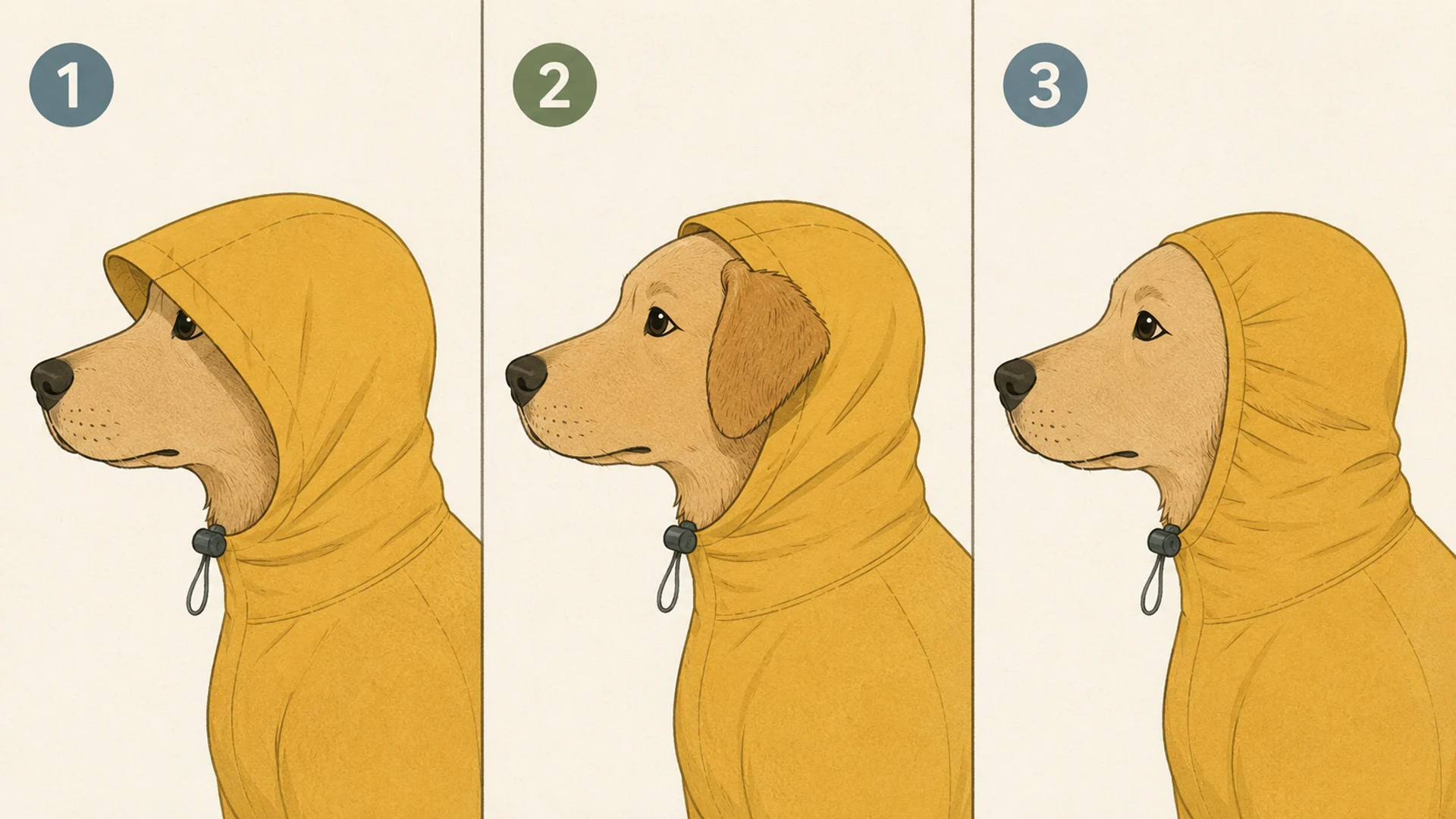
A hood is worth having if it is detachable, if it sits behind the eyes, and if it leaves the ear openings clear. It is worth skipping if your dog’s ears stand up, if the hood only stays put when it is pulled tight, or if your dog walks differently the moment it goes on.
That is a narrower answer than “hoods are good” or “hoods are silly,” and it is narrow on purpose. A hood is the one part of a rain suit that sits on the two organs a dog navigates the world with. Everything else on the garment covers muscle and fur.
“Dog raincoat no hood” is a real search, and it is not anti-raincoat
Type dog raincoat hood into a search box and the suggestions that come back include no hood and without hood alongside with hood and legs and clear hood. Those are not people rejecting rain gear. They are people who already own rain gear, who have watched their dog do something odd in it, and who are now shopping for the same thing minus one part.
What they usually watched is one of three things: the dog stopped mid-pavement and would not walk, the dog kept shaking its head, or the dog stopped noticing the cyclist coming up behind. All three are the hood, not the coat.
What a hood does to hearing, mechanically
The outer ear is not a decoration. According to the Merck Veterinary Manual’s page on ear structure and function in dogs, “the pinna catches sound and channels it down the ear canal to the eardrum,” dogs “can move the left and right pinna independently,” and on average dogs “hear roughly 4 times better than people.” The size and shape of that pinna varies by breed.
Put fabric over a moving funnel and two things change at once. The funnel stops aiming, and rain drumming on taut fabric adds noise directly over the canal. Neither is dangerous on a quiet garden path. Both matter on a street where the useful information — a bike, a jogger, a car reversing — arrives from behind, where the dog cannot see it and was relying on hearing it.
The ear-moisture argument, which cuts both ways
The strongest case for a hood is not warmth. It is keeping water out of the ear canal. The American Kennel Club’s guide to dog raincoats makes exactly this point, calling a detachable hood “particularly useful in preventing water from getting in your dog’s ears and causing infections.”
That is real. The Merck Veterinary Manual’s page on otitis externa lists “excessive moisture in the ears (from the environment or swimming)” among the predisposing factors, and explains that “chronic maceration impairs the barrier function of the skin, which predisposes the skin to opportunistic infection.”
But read the same page’s maintenance advice and the argument turns around: “ear canals should be kept dry and well ventilated.” A hood that keeps rain off an upright, open ear is doing the first half. A hood that traps a floppy ear flat against a damp head is doing the opposite of the second half — and Merck lists a “pendulous pinna” as its own predisposing factor. Cornell’s Riney Canine Health Center takes the practical line in its guide to cleaning a dog’s ears: dogs with “a history of allergies, recurrent ear infections, or floppy ears may need their ears cleaned more frequently,” and a routine cleaning is worth doing “if the ears get wet, such as after swimming or bathing.”
So the honest version is: a hood can help a dog whose ears stay open under it, and can hurt a dog whose ears end up sealed and wet under it. Which one you have is decided by ear shape, not by the hood’s marketing copy.
| Hood style | What it is good at | Where it fails | Best for |
|---|---|---|---|
| Detachable hood | You get to run the experiment. Off for the street, on for standing around in the wet | The attachment adds bulk at the neck; one more part to lose | Almost everyone — this is the default recommendation |
| Fixed hood with ear openings | Keeps the ear canal covered while the pinna stays out and mobile | Openings only line up if your dog’s ear set matches the pattern | Drop-eared dogs whose ears sit where the holes are |
| Fixed closed hood | Most rain kept off the head and neck in a downpour | Erect ears tent it or push out of it; ears pinned flat when it fits | Short, heavy-rain outings with a dog who demonstrably ignores it |
| Brimmed or clear visor front | Keeps rain off the face without a full head wrap; eyes stay uncovered | A brim that sits low is the single most common reason a dog freezes | Dogs who object to head coverage but hate rain in the eyes |
| No hood at all | Nothing on the head; nothing to fight about; fastest on and off | Head, neck and ears get wet — you towel them at the door | Erect-eared dogs, reactive dogs, anyone whose walks are on roads |
Ear shape decides this more reliably than breed does
Ignore the breed on the size chart and look at the ears. A dog with erect, mobile ears — the shepherd and husky pattern — is carrying two rigid structures that a closed hood has to either tent over or fold down. Tenting means the hood catches wind and slides; folding means pinning the ears, and pinned ears are what the head-shaking is about.
A dog with drop ears already has the pinna lying against the head. A hood there is not changing the geometry much, which is why hoods so often look fine on retrievers and spaniels and look like a wrestling match on a shepherd. The trade-off flips, though: the drop-eared dog is the one whose ear now has fabric holding warmth and damp against it, which is where Merck’s ventilation line applies.
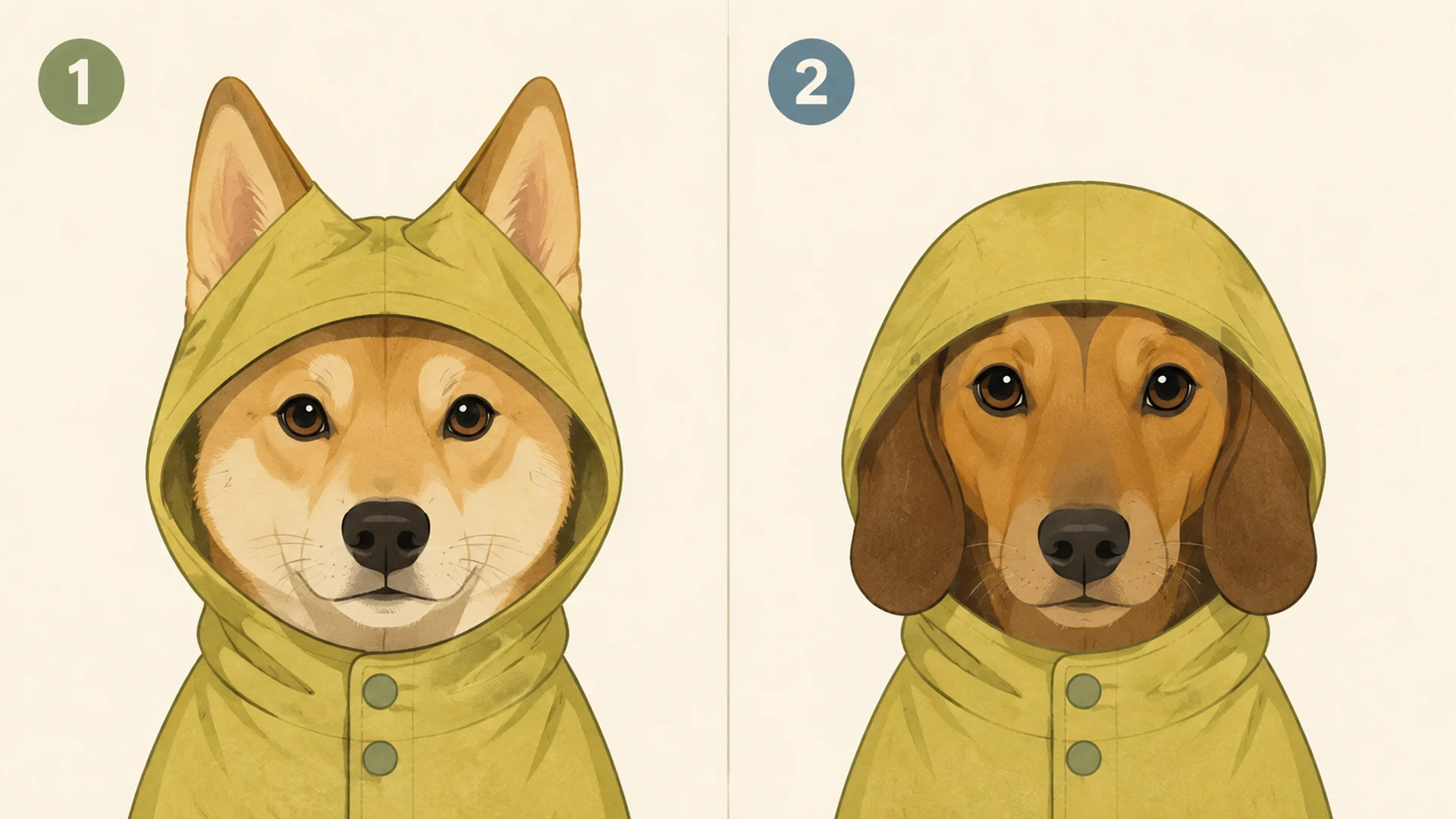
A common objection: “it is a dog, it does not need a hat”
This comes up every time anyone posts a picture of a hooded dog, and half of it is right. A healthy dog with a working coat does not need its head covered to survive a rainy walk, and dressing a dog for the photograph is not a reason to make it wear something.
What the objection misses is the small set of cases where a hood is doing a job rather than a costume. A dog on repeat courses of ear treatment, walked in real rain, has a reason. So does a dog with a thin or absent coat: the AKC names “senior dogs and many sighthounds” as benefiting from the warmth of a raincoat, and hairless dogs as benefiting from skin protection. And so does a dog who genuinely will not go out in rain, where covering up is what gets it outside at all. None of that makes a hood a default. It makes it a specific tool with a specific indication.
Test it in ten minutes, at home, before the rain
- Hood down first. Let the dog wear the suit with the hood off or folded back for a couple of ordinary walks. If the suit itself is a problem, the hood is not the variable you are testing.
- Fit it behind the eyes. Nothing should enter the field of view. If your dog stops dead and will not walk, the brim is usually the reason.
- Check the ears can still move. Make a noise from behind and watch. An ear that swivels is fine. An ear that cannot is the version to avoid.
- Go slowly and pay for it. Hood on for a few seconds, treat, hood off, indoors, several short rounds before you ask for a whole walk. Our guide to getting a dog used to wearing clothes walks through the full version of this.
- Watch behaviour, not tolerance. Head-shaking, freezing, rubbing along a wall, or trying to back out of it are all the same answer.
- Dry the ears at the door. Whether the hood was on or off. Especially if your dog has drop ears.
If your dog is large, the hood question sits inside a bigger one — which suit fits a big frame at all — and our comparison of rain suits for large dogs covers that. If your dog is double-coated and you are still not sure the whole exercise is necessary, we took that argument seriously in do double-coated dogs need raincoats.
TuckTrail pick
If you want the hood to be a real feature rather than an afterthought, the Trail Shark-Hood Large-Dog Rain Suit is built around a shaped hood on a large-dog cut. Check the size chart on the product page for your dog’s measurements before ordering.
Dog raincoat hoods FAQ
Do dogs need a hood on a raincoat?
No dog needs one. Some dogs benefit: dogs prone to ear infections walked in heavy rain, thin-coated and hairless dogs, and dogs who refuse to go out in the wet without cover. For everyone else it is optional, and a detachable one lets you find out which group you are in.
Does a hood block a dog’s hearing?
It changes it. Merck’s veterinary reference describes the pinna as catching sound and channelling it into the canal, with each ear moving independently. Fabric over that reduces its ability to aim, and rain hitting the fabric adds noise close to the ear. On a road walk that is worth taking seriously; in a garden it is not much.
My dog freezes as soon as the hood goes on. Why?
Usually the brim is sitting in the line of sight, or the hood is tight enough to pin the ears. Try refitting it further back with the ears free. If the freezing survives a correct fit and a slow introduction, that is your dog answering the question.
Do hoods prevent ear infections?
They can reduce how much water gets into the canal, which the AKC names as a reason to use a detachable one. But Merck’s guidance is that canals should be kept dry and well ventilated, and lists a pendulous pinna as a predisposing factor on its own — so a hood that seals a damp floppy ear against the head may not be helping. Ask your veterinarian about your dog’s ear history rather than treating a hood as a preventive measure.
Are hoods worse for dogs with pointed ears?
Generally yes, in the sense that they fit worse. Erect ears either tent the fabric, which makes the hood slide, or get folded flat, which most dogs object to. A hoodless suit, or one with genuine ear openings that line up with your dog’s ear set, is usually the better buy.
What about a clear visor instead of a hood?
A visor or brim keeps rain off the face without wrapping the head, which suits dogs who dislike head coverage. The failure mode is different: anything that sits low enough to enter the field of view will stop some dogs walking. Fit it high and check the dog moves normally before you rely on it.
Sources
- Merck Veterinary Manual — Ear Structure and Function in Dogs (the pinna catches sound and channels it down the ear canal; dogs move the left and right pinna independently; dogs hear roughly 4 times better than people; pinna size and shape vary by breed) (checked 2026-09-05)
- Merck Veterinary Manual — Otitis Externa in Animals (excessive moisture from the environment or swimming, and a pendulous pinna, as predisposing factors; ear canals should be kept dry and well ventilated; chronic maceration impairs the skin’s barrier function) (checked 2026-09-05)
- American Kennel Club — Does Your Dog Need a Raincoat? (a detachable hood as particularly useful in preventing water from getting in a dog’s ears; senior dogs, many sighthounds and hairless dogs as those that benefit; introducing a raincoat with positive reinforcement in short increments) (checked 2026-09-05)
- Cornell University College of Veterinary Medicine, Riney Canine Health Center — How to Clean Your Dog’s Ears (dogs with allergies, recurrent ear infections or floppy ears may need cleaning more often; clean routinely if the ears get wet) (checked 2026-09-05)
Veterinary guidance is updated periodically. Confirm on the official pages, and talk to your own veterinarian about your own dog — nothing here is a diagnosis, a medication recommendation, or a substitute for an exam.
Buy the detachable one and let the dog decide.
A hood is the only part of a rain suit that argues with the dog’s ears and eyes, so it is the only part worth buying in a form you can remove. Fit it behind the eyes, leave the ears free and mobile, watch what the dog does rather than what it tolerates, and dry the ears at the door either way.