A Golden Retriever’s back rarely needs a raincoat. The breed’s outer coat is meant to shed water: the official AKC breed standard describes it as “dense and water repellent with good undercoat”, and the Golden Retriever Club of America’s education director told the AKC that the top coat “should wrap around the body like a jacket.” The people who say a Golden already has a raincoat are right about that part.
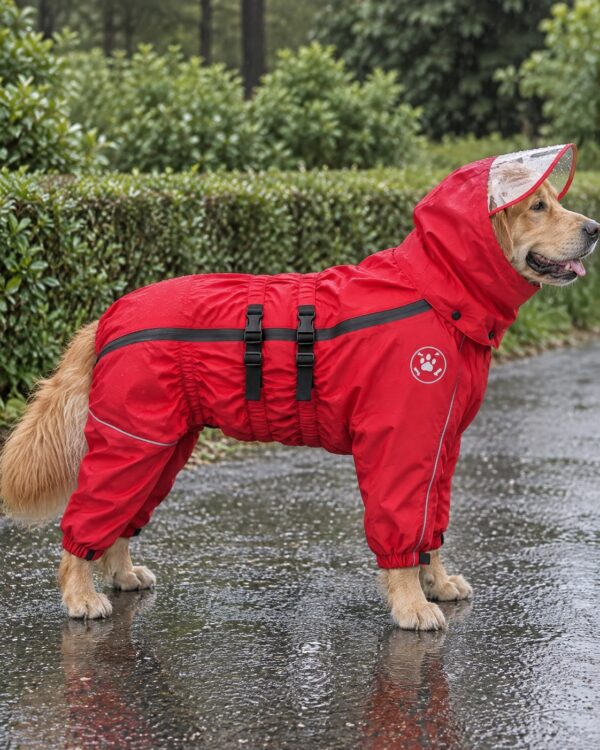
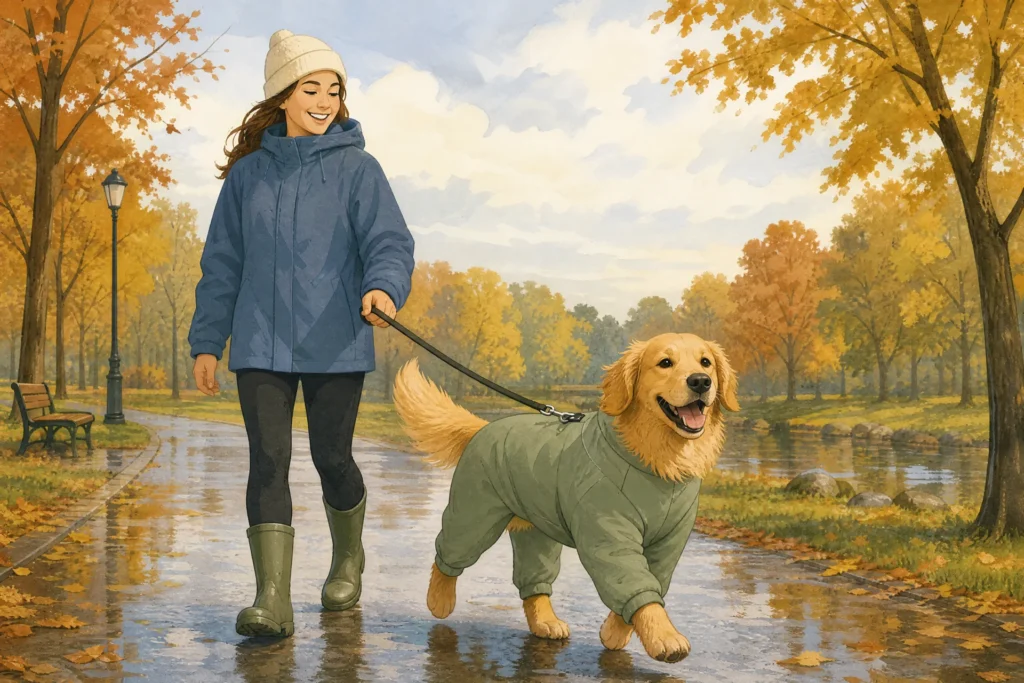
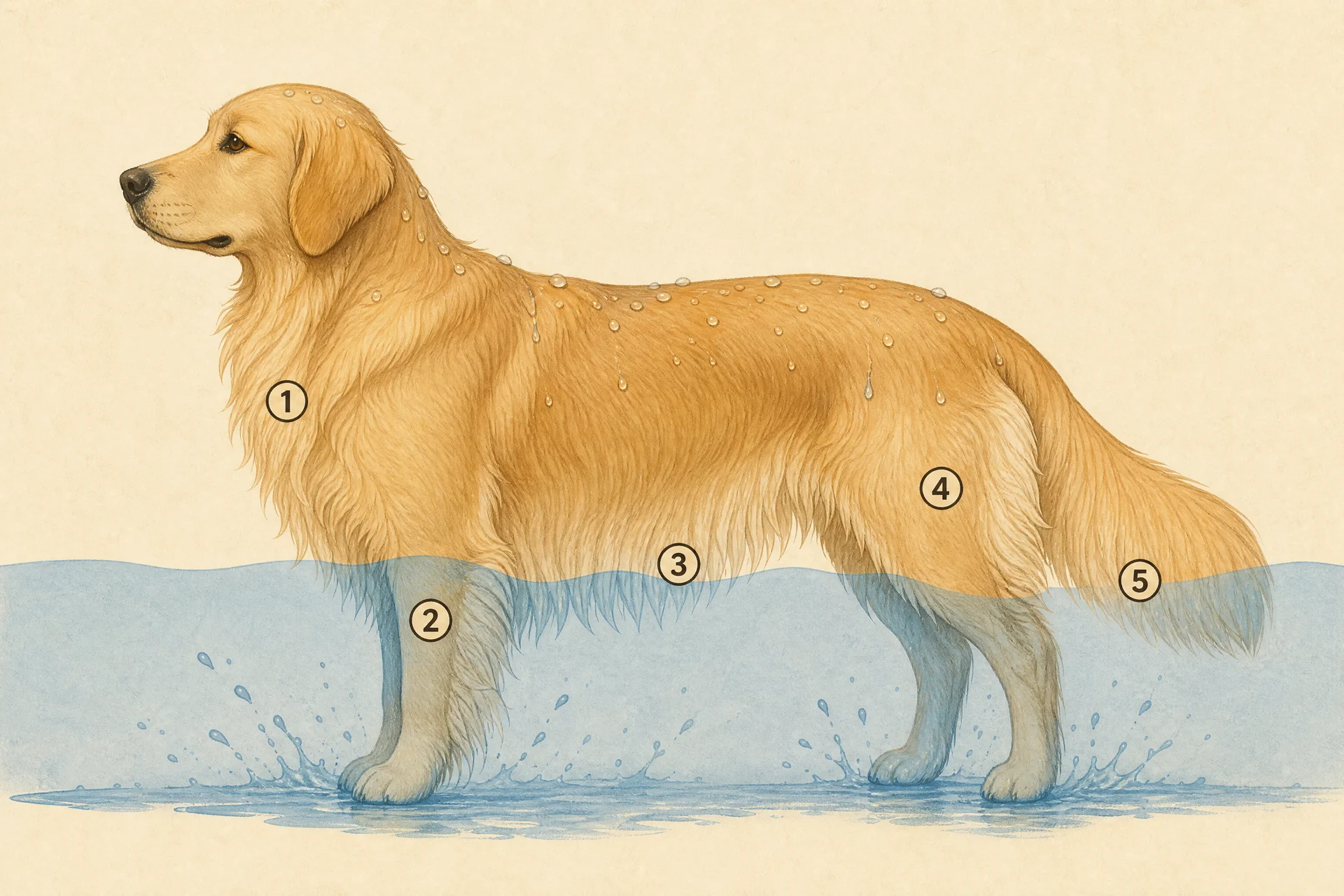
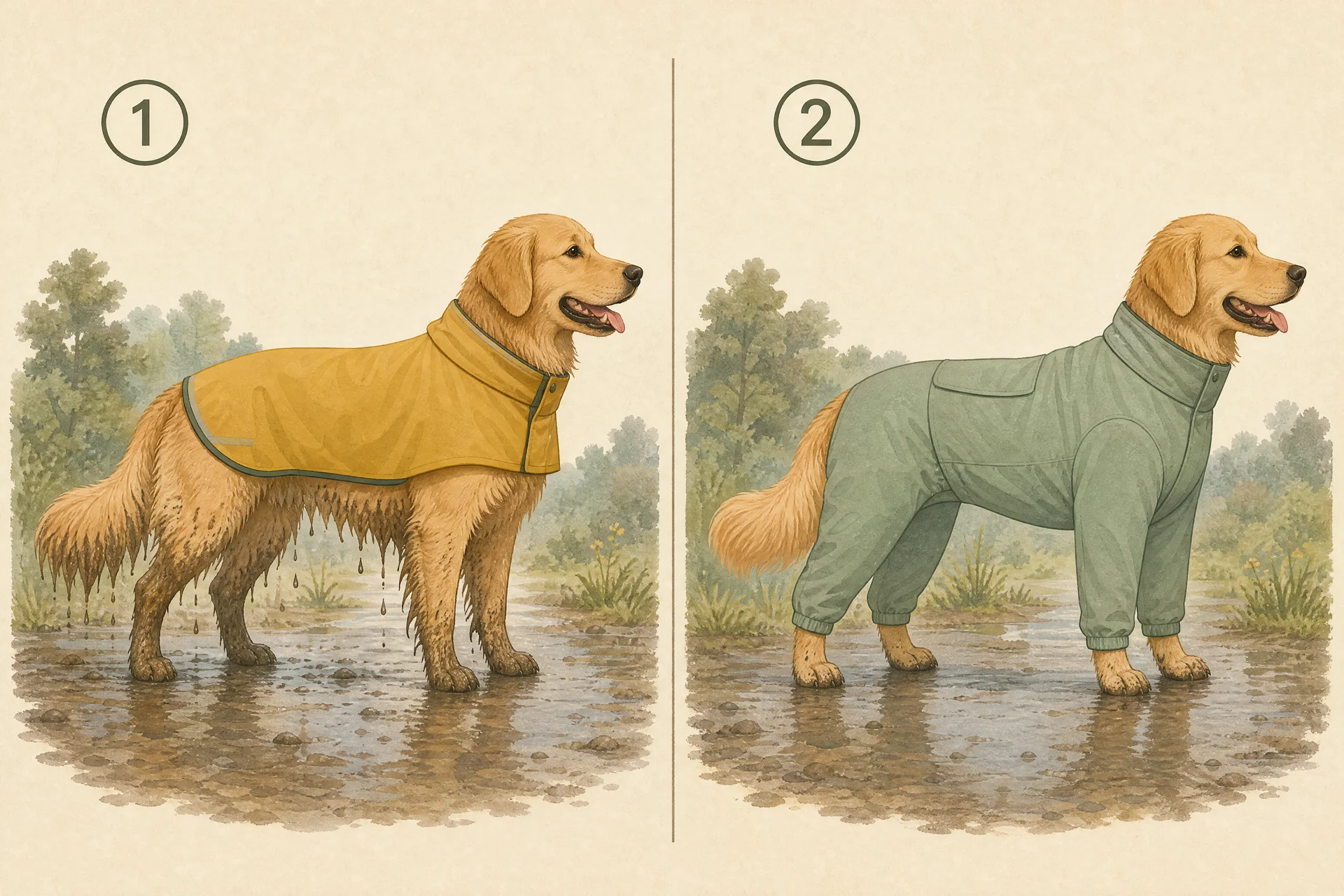
The wet part of a Golden is underneath. The same breed standard puts the long feathering on the back of the forelegs, the underbody, the front of the neck, the back of the thighs and the underside of the tail. On a wet path, that is exactly where the splash lands. So if you buy a raincoat for a Golden, buy it for the legs and belly. A cape that only covers the back protects the part that was already fine.
The objection is half right
If you have posted a Golden in a raincoat anywhere public, someone has told you the breed retrieves waterfowl for a living. That is true, and it is the right starting point. The top coat sheds rain, and a thick double coat handles cold better than a thin one. Cornell’s veterinary college says short and thinly coated breeds will not tolerate the cold as well as thick, double-coats. On a mild, drizzly walk around the block, a healthy adult Golden does not need anything on.
What the objection misses is the difference between a dog that is dry enough and a dog that is clean enough to come inside. A Golden owner who says the belly gets wetter than the back is describing the breed standard, not a fussy dog. Rain falls on the back. Mud comes up from the ground, and on a Golden the long hair is near the ground. If you want the general version of this argument, with huskies and the cold-weather cases, we cover it in do dogs need raincoats. A Labrador is the opposite case: no feathering, so the underside argument mostly falls away; see do Labradors need raincoats?
Where a Golden actually gets wet
| Area | What happens on a wet walk | Cape-style raincoat | Four-leg suit |
|---|---|---|---|
| Back and sides | Top coat sheds most rain | Covered | Covered |
| Front of neck, chest ruff | Drips collect; the ruff stays damp under the chin | Partly, if it has a high collar | Covered |
| Back of forelegs | Spray from the front paws hits it on every step | Bare | Covered to the ankle |
| Underbody feathering | Brushes wet grass and catches puddle splash | Bare, or only a strap | Covered, with an opening for toileting |
| Back of thighs (“pants”) | Splash from the rear paws, and mud when the dog sits | Bare | Covered |
| Underside of tail | Gets wet and picks up whatever the dog sits in | Bare | Usually bare; some suits add a tail sleeve |
| Paws | Wet and muddy whatever you buy | Bare | Usually bare; only some suits cap the foot |
The table explains a pattern that confuses a lot of Golden owners: they buy a rain jacket and the dog comes home almost as dirty. The jacket worked. It just covered the back. If paws are the bigger problem, that is a separate decision, and we take it apart in dog rain suits with the legs covered, and why paws are a separate question.
Why the underside is worth protecting
Drying a Golden takes a long time
The coat that sheds rain on top also holds water once it gets through. AKC grooming advice for the breed is to towel dry thoroughly, let the dog air dry for a few minutes, then use a canine dryer, which runs cooler than a human hairdryer and won’t burn the hair. That advice is written for bath day. A muddy underside after every rainy walk turns it into a daily job. Covering the feathering doesn’t make the dog waterproof, but it cuts down what you have to dry. For the door routine itself, see wet dog smell after rain.
Don’t trim the feathers to solve the mud
It is tempting to clip the leg and belly feathering short so there is less to get dirty. The same AKC grooming page advises against it: don’t shave or clip the coat, and avoid clipping the feathers under the body, legs and tail. The breed standard says the coat’s natural outline should not be altered by cutting or clipping, apart from neatening the feet. A raincoat leaves the coat alone and keeps the mud off. Clipping changes the coat and doesn’t protect it.
Wet toes and wet ears
Two smaller things follow the splash. The AKC notes that walking on a rainy day can make yeast problems more likely, because dirt and moisture get trapped between the toes. The ASPCA’s advice for winter walks is to wash and dry your dog’s feet and stomach after each walk and to check for redness between the toes. A suit won’t keep the paws dry, so that part of the routine stays. Our step-by-step for it is how to clean dog paws after a walk.
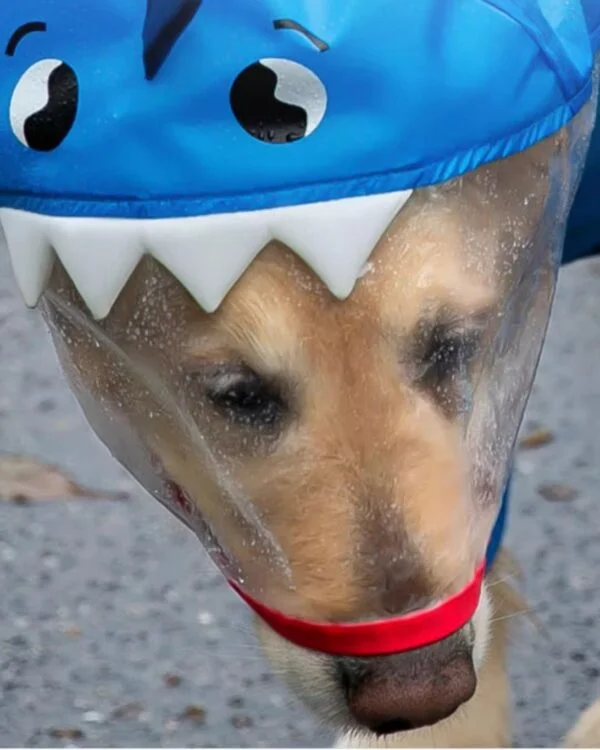
Ears are the other one. The GRCA’s education director told the AKC that the Golden’s “coated and floppy ears are susceptible to ear infections”. A separate AKC article on ear infections explains that frequent exposure to water can trap moisture and heat in the ear. That is the honest case for a hood on a Golden. The AKC’s raincoat guide suggests a detachable hood to help keep water out of the ears. If your Golden scratches at its ears, shakes its head a lot, or the ears smell, that is a question for your vet, not a gear problem.
What to look for in a raincoat for a Golden
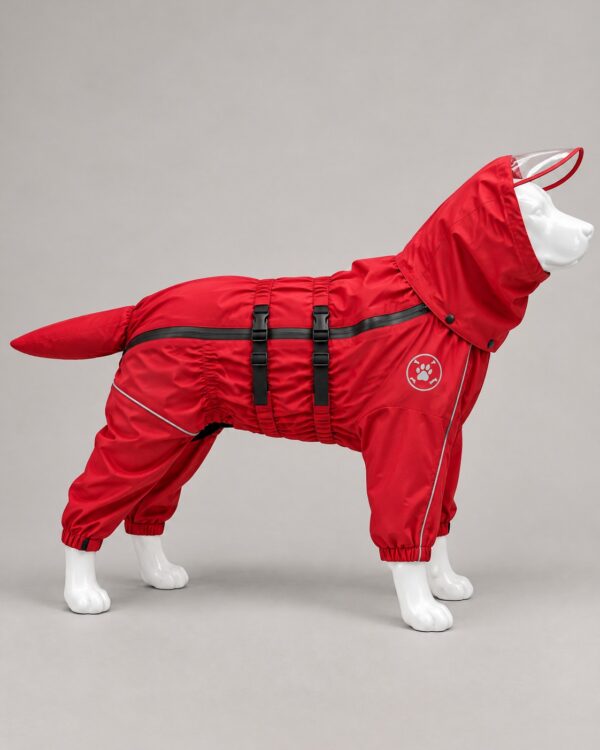
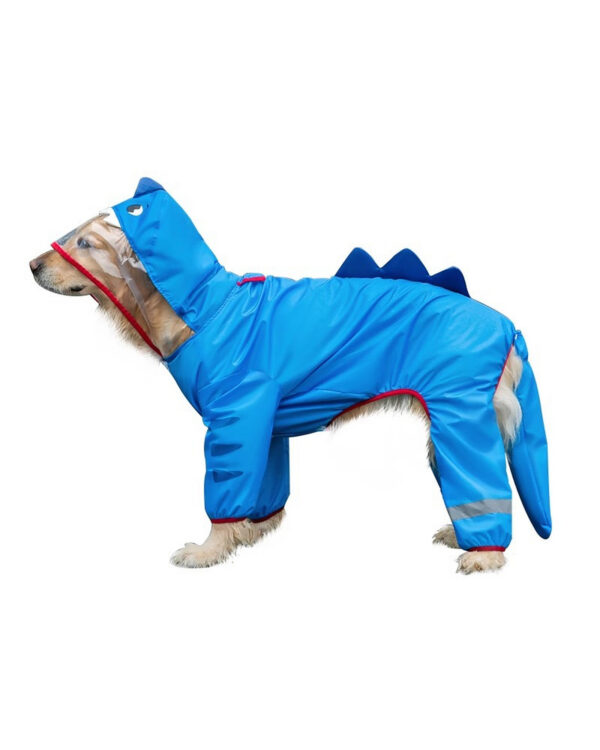
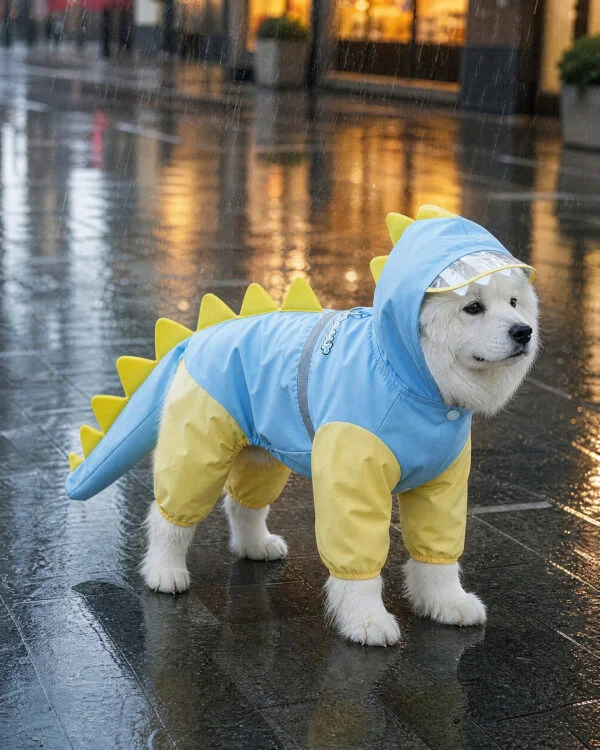
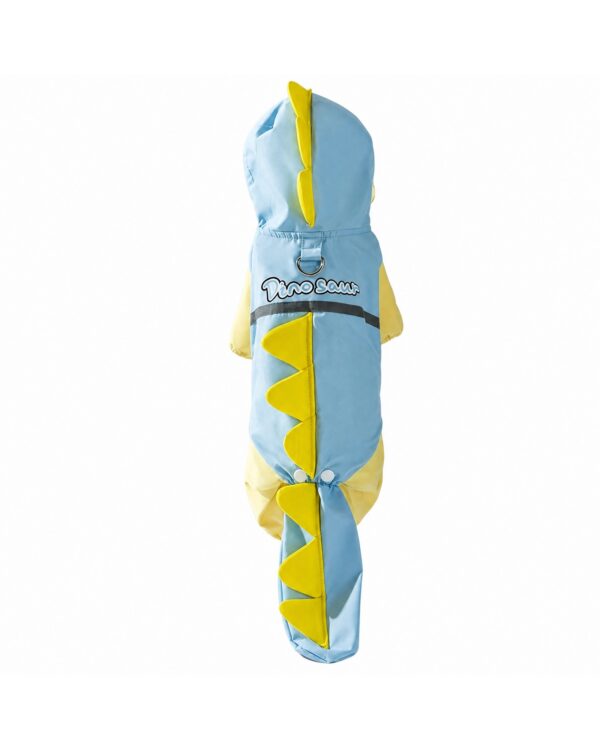
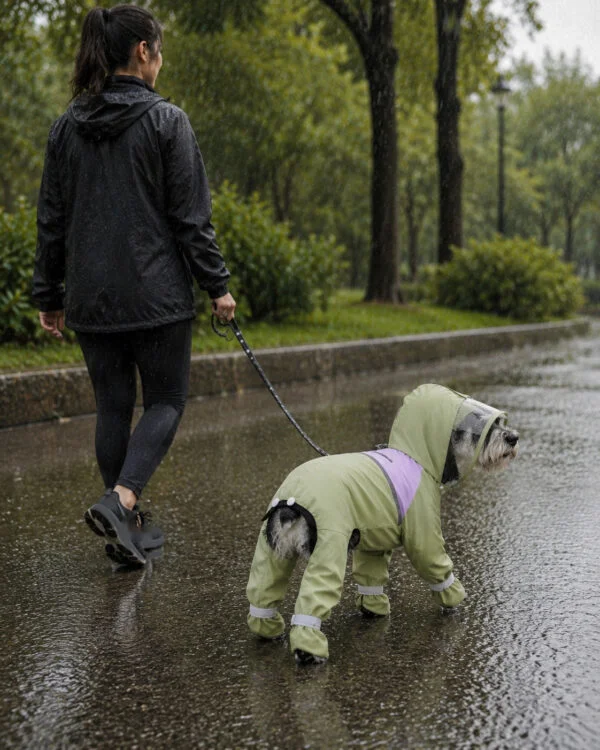
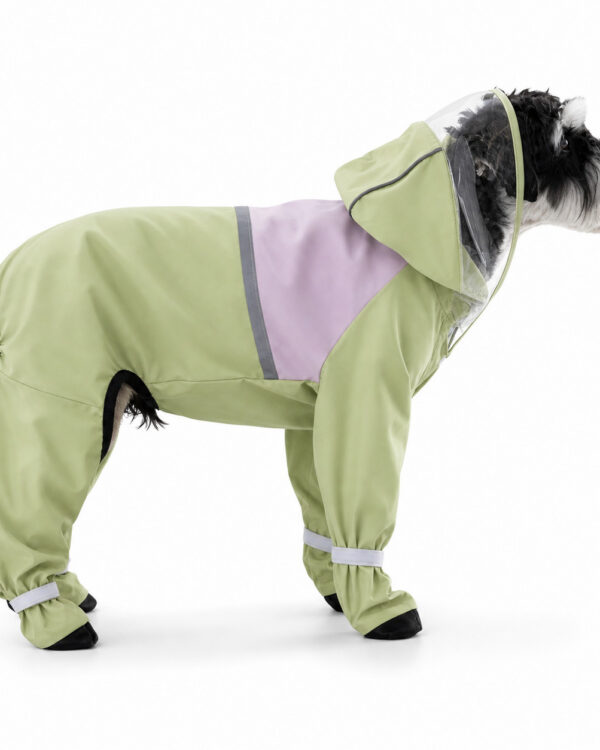
- Four legs, down to the ankle. This is where the feathering is. A suit with sleeves that stop at the elbow leaves the back of the forelegs exposed.
- A belly panel with a usable opening. The underbody feathering is the reason to buy a suit. The opening has to suit your dog: males and females need it in different places. Read belly coverage and what happens when your dog needs to pee before you order.
- Length to the base of the tail. The breed standard says a Golden is slightly longer, breastbone to buttocks, than it is tall at the shoulder. A coat sized by height or weight can stop short over the thighs.
- A hood that sits on the head, not on the muzzle. A Golden’s muzzle is long. A hood cut for a shorter face can sit on the nose, and most dogs hate that. A detachable hood is the safe choice. Dogs with upright ears are a different case; see German Shepherd raincoats.
- A way to clip the leash without opening the suit. Look for a port to a harness underneath or a ring on the coat. On a big dog, the difference matters; see harness holes on large dog raincoats.
- A shell, not insulation, for active dogs. A Golden working hard in mild rain can run warm in a lined suit. Our piece on whether dogs overheat in coats covers the signs.
Sizing a Golden Retriever for a raincoat
The AKC lists the breed at 23–24 inches at the shoulder and 65–75 pounds for males, 21.5–22.5 inches and 55–65 pounds for females. That tells you which end of a size chart to start at. It does not tell you the size. Two Goldens of the same weight can have very different chests, and a full ruff makes the neck look bigger than it is.
Measure instead. The AKC’s raincoat guide says to use a soft tape around the neck, chest and stomach, and to measure neck to the base of the tail. It also warns that buying by weight doesn’t always work. Then do its two-finger test with the coat on: you should be able to slide two fingers under the straps. Too tight restricts movement. Too loose lets rain in and soaks the fur, which on a Golden means the feathering you were trying to protect. Compare your numbers with the chart on the product page, not with the weight range. For the full method, including where to hold the tape, see how to measure your dog for clothes.
Puppies are a moving target. Buy for the dog you have this season, measure again before the next one, and don’t size up a long way “to grow into”. A suit that is too long trips the dog and lets water in at every opening.
When a Golden genuinely doesn’t need one
Skip it if your walks are short and paved, your dog is fit and adult, and drying off at the door takes five minutes. Skip it if your dog is going swimming, because that is what the coat is for. Buy a suit if you walk through wet grass, mud or slush, if your Golden is old or unwell and gets cold more easily, or if the honest reason is the daily wash and dry. That last one is a fine reason. Just buy for the underside.
Golden Retriever raincoat FAQ
Do Golden Retrievers need raincoats?
Not for warmth or to keep the back dry on an ordinary walk. Their outer coat is water repellent by breed standard. A raincoat earns its place on wet grass, mud and long rainy walks, where the feathering on the legs and belly gets soaked and dirty. In those cases it saves you a lot of drying.
Are Golden Retrievers waterproof?
Water repellent, not waterproof. The breed standard describes a dense, water-repellent outer coat over an undercoat. Rain beads on top during a normal walk. Long exposure, swimming or splash from below gets through, and the coat then takes a long time to dry.
Should a Golden Retriever’s raincoat have legs?
If you are buying one at all, yes. The feathering sits on the back of the forelegs and thighs and along the belly. A coat without legs leaves those areas bare, and they are where the mud collects. The paws will still need a wipe either way.
What size raincoat does a Golden Retriever wear?
There is no single size. The AKC breed range runs from about 55 pounds for a small female to 75 for a large male, and chest shapes vary. Measure neck, chest, stomach and neck-to-tail length, then check them against the product’s size chart and do the two-finger test.
Should I trim my Golden’s feathers so mud doesn’t stick?
AKC grooming advice for the breed is to avoid clipping the feathers under the body, legs and tail, and the breed standard says the natural outline shouldn’t be altered by cutting. Neatening the feet is fine. For mud, covering the feathering works better than removing it.
Does a Golden need a hood on its raincoat?
It’s optional, but there is a real reason for one. Golden ears are floppy and coated, and moisture trapped in the ear is a known setup for infection. Choose a hood that sits on the head rather than the muzzle, and ideally one that detaches. If your dog fights it, take it off.
A Golden’s back already has a raincoat. Its belly doesn’t.
The breed’s top coat sheds rain, so the objection is right about the back. The feathering on the legs, belly, thighs and tail sits in the splash zone, and that is what you end up drying. If you buy anything, buy coverage for the underside, size it with a tape, and keep the paw wipe.
Sources
- Golden Retriever Club of America — AKC Breed Standard (checked 2026-10-03)
- American Kennel Club — How to Groom a Golden Retriever (checked 2026-10-03)
- American Kennel Club — Golden Retriever breed information (checked 2026-10-03)
- American Kennel Club — Does Your Dog Need a Raincoat? (checked 2026-10-03)
- American Kennel Club — Dog Ear Infections (checked 2026-10-03)
- American Kennel Club — Yeast Dermatitis in Dogs (checked 2026-10-03)
- ASPCA — Cold Weather Safety Tips (checked 2026-10-03)
- Cornell University College of Veterinary Medicine — Winter safety tips (checked 2026-10-03)
Health questions about skin, ears or paws belong with your veterinarian. Product sizes vary by maker, so always check the size chart on the product page.