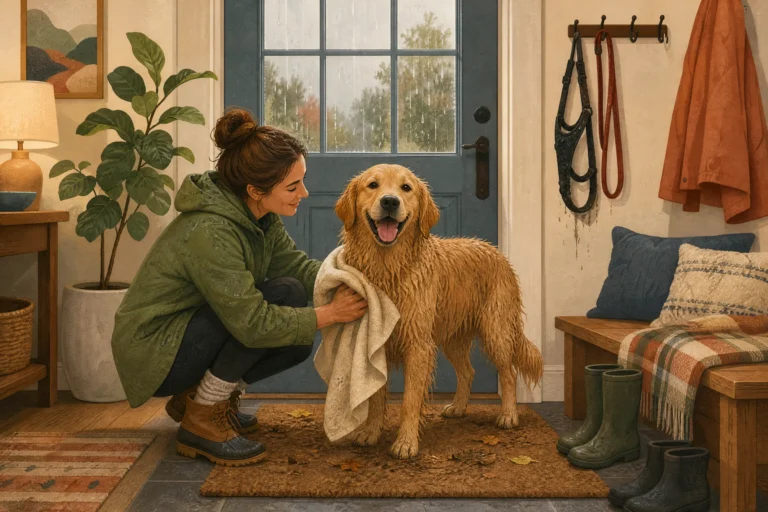

A raincoat is not what gives a dog heatstroke. But it does close off part of how a dog sheds heat, and that cost rises with air temperature, with humidity, and with how hard the dog is working. In cold, steady rain the trade is easy and the coat is close to free. In warm, sticky drizzle — or on a walk where your dog is moving fast — it stops being obviously worth it.
There is no clean temperature cut-off, and any number you find online is somebody’s guess dressed up as a rule. The reliable signal is your dog’s breathing, checked about ten minutes into the walk rather than at the door.
The question usually arrives in a slightly hostile form: why are you putting a coat on a dog, it’s an animal. The instinct behind it is sound. Dogs run warmer than we do, they cool themselves in ways we don’t, and dressing a dog for your comfort rather than theirs is genuinely getting it wrong. So the honest version of this article is not “raincoats are fine.” It is: here is what a layer costs, and here is the weather where the cost is real.
How a dog actually gets rid of heat
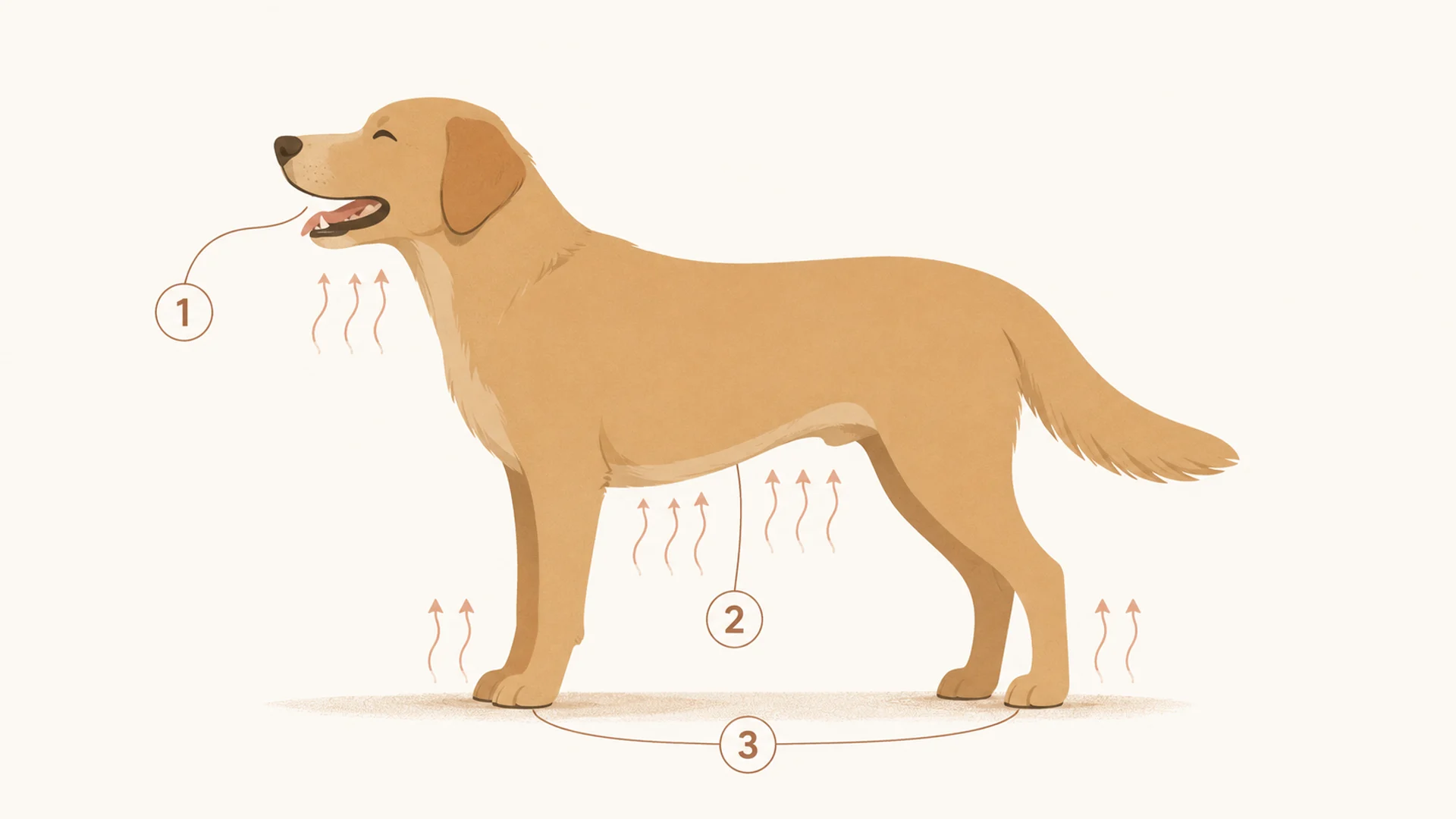
People tend to assume dogs sweat the way we do, only less. They don’t. The American Kennel Club describes the whole toolkit as “panting, blood vessel expansion, and, to a lesser extent, sweating through their paw pads”. Cornell’s Riney Canine Health Center puts it more bluntly: sweat glands sit on the paws, so panting is the primary method of dissipating heat.
That leaves the second route, the one nobody talks about: blood vessels near the surface open up and dump heat through skin, and they do it fastest where the fur is thinnest. You can see this in emergency guidance. The Merck Veterinary Manual’s instruction for a suspected heat stroke is to cool the head and body “especially on the belly”. Vets aim there because that is where heat comes out fastest.
Which is exactly the surface a full-cover rain suit is designed to wrap.
What a coat takes away, and what it doesn’t
Start with the good news, because it is real: a coat does not touch panting. The mouth stays open, the airway is unobstructed, and the largest cooling channel keeps working at full capacity. That is why a dog in a raincoat on a cold February walk is not in meaningful danger, and why the “you’re suffocating that dog” version of the objection overstates things.
What the coat takes is the second channel. A waterproof shell works by not letting water through in either direction, so warm air trapped against the underside has nowhere convenient to go, and the moving air that would otherwise carry heat off the skin is blocked. Add a hood and you cover more surface again. None of that is catastrophic alone. It becomes a problem when panting is already struggling.
Humidity is the part people leave out
Panting is evaporative cooling: water leaves the mouth and airway, and takes heat with it. Evaporation slows down when the surrounding air is already loaded with moisture. That is the whole basis of the National Weather Service’s heat index, which the NWS describes as “a measure of how hot it really feels when relative humidity is factored in” — at 96°F and 65% relative humidity, it feels like 121°F. The heat index is a human scale and shouldn’t be read across to dogs as a number, but the physics underneath it is not species-specific: damp air accepts less water vapour, so evaporative cooling does less work.
Here is the awkward part. Rain days are humid days by definition. The weather that makes you reach for the coat is the same weather in which your dog’s main cooling system is running at reduced efficiency. Cornell makes the same point about exertion, advising that strenuous activity be avoided during the hottest parts of the day and on very humid days.
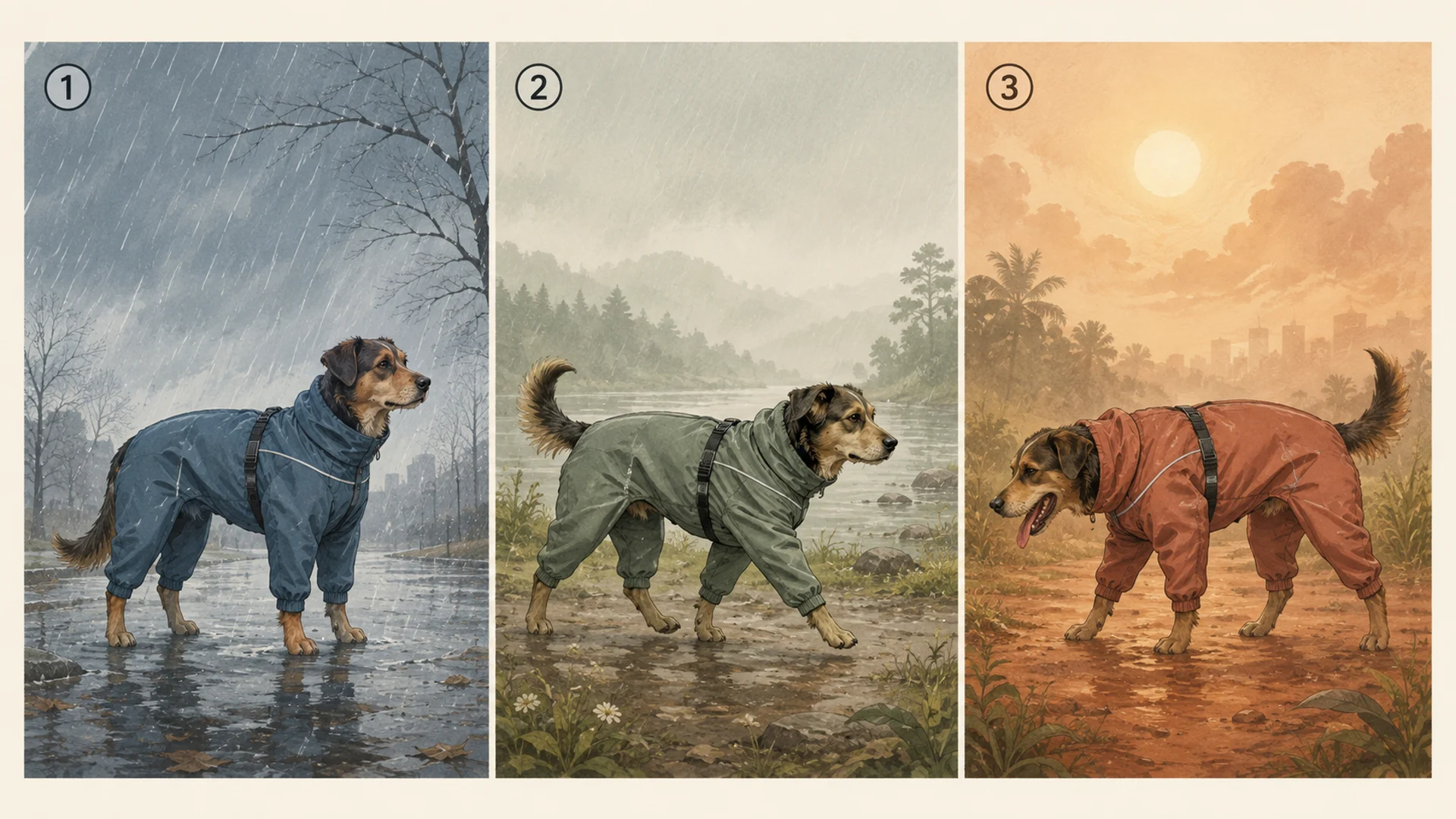
| Conditions | What the coat buys | What it costs |
|---|---|---|
| Cold, driving rain; wind | A dry dog, a shorter towel-off, and a coat that stays insulating instead of soaking flat | Very little — the air is doing your cooling for you |
| Cool drizzle, easy pace | Mostly cleanliness: less mud, less wet-dog smell in the car | Low for most dogs; check the breathing once mid-walk |
| Warm, humid rain or a summer shower | Dryness you probably don’t need — warm rain dries off on its own | Real. Panting is already less efficient, and you’ve covered the belly |
| Any weather, but a fast or long walk | Same as above | Higher than the thermometer suggests — the dog is generating heat, not just absorbing it |
The dogs who pay more for the same coat
The cost is not evenly distributed. Cornell’s heat-safety guidance singles out short-muzzled breeds — Pugs, Bulldogs, Boston Terriers, Boxers — noting they cannot pant as efficiently and are at higher risk in hot or humid weather. If the main channel is already narrowed, closing part of the second one matters more. The same page lists overweight and elderly dogs, dogs with heart or breathing conditions, and dogs with thick or dark coats as higher-risk; the AKC’s list adds puppies.
Which raises the objection you hear most: a double-coated dog is already waterproof, so why the coat at all? We went through what a double coat does and doesn’t do in do double-coated dogs need raincoats. For Huskies and Goldens in mild weather, the coat argument and the heat argument point the same way: less garment, not more.
The ten-minute check
Skip the thermometer debate and read the dog. Cornell lists heavy panting, seeking shade, whining, reluctance to play and drooling as early signs of overheating. About ten minutes into a walk, stop and run through this:
- Breathing: is the panting faster and deeper than it would be on the same walk without the suit? That is the single most useful comparison you have.
- Pace: has your dog started lagging, stopping, or steering toward shade and puddles when they normally push forward?
- Under the collar: open the neck of the suit for a moment. Damp warmth against the chest is expected; heat that feels notably hotter than the rest of the dog is a reason to take the layer off.
- Drool and gums: new heavy drooling, or gums that look brighter red than usual, mean stop and cool down, not “push on to the park.”
- Willingness: a dog who plants and refuses is telling you something. Take the suit off and see whether the refusal resolves.
If the answer to any of these is yes, take the suit off and carry it. A wet dog you towel off at home is a smaller problem than a hot one.
When it stops being “a bit warm”
Heat stroke is a different category of event, not the far end of a spectrum you can manage on the walk. The AKC puts the threshold at an internal temperature above 105.8°F and notes it can develop within minutes in hot, humid conditions. Merck’s emergency list includes hot skin, vomiting, drooling, rapid panting, distress, uncoordinated movement, collapse or unconsciousness.
If you are seeing that, this is an emergency: get your dog out of the heat and out of the layer, and contact your veterinarian or the nearest emergency clinic immediately rather than working through anything you read here. Merck’s emergency guidance is the page to have open while you call.
The other place a coat and a hot cabin meet is the car park. A parked car gains heat at a rate that has nothing to do with how mild the day feels — the figures are in is it safe to leave my dog in the car.
If you are choosing between styles, coverage is the variable that matters most here — our guide to four-leg suits goes through what each shape leaves exposed, and less coverage is a legitimate answer in mild weather.
Overheating and dog coats: FAQ
Can a dog really overheat in the rain?
Yes, and it surprises people because “rain” reads as “cool.” Rain in July is warm rain falling through saturated air. The temperature may be pleasant for you while your dog’s evaporative cooling is running slowly, and a full-cover suit removes part of what’s left. The risk is not the rain, it’s the humidity plus the layer plus the exercise.
Is a breathable raincoat safer than a fully waterproof one?
Directionally, more airflow is better in warm weather — but “breathable” is a marketing word with no test behind it on pet products, so treat it as a hint rather than a specification. The variables you can actually check are how much of the dog the garment covers, whether the underside is open or closed, and whether the fit is loose enough for air to move. Coverage tells you more than any fabric claim.
Does a light-coloured suit run cooler than a dark one?
Cornell lists thick or dark coats among the risk factors for heatstroke, but that refers to the dog’s own fur, not the garment. We’re not aware of any veterinary finding on garment colour specifically, so it isn’t a reason to choose one suit over another. Pick on coverage and fit instead.
How long can my dog wear a rain suit?
As long as the walk, and off at the door. There is no benefit to leaving a waterproof layer on a dog indoors, in a heated car, or in a crate, and every one of those is a warmer, stiller environment than the street you put it on for. Cornell’s warning about parked cars is worth repeating on its own: even at 70°F outside, the interior can climb about 40 degrees in an hour.
My dog seems completely fine in it. Do I still need to worry?
Not worry — just check. The early signs are quiet ones: a slower pace, more drool, a preference for the shady side of the street. Run the ten-minute check a few times in different weather, learn where your dog’s line sits, and after that you’ll mostly stop thinking about it.
Is my flat-faced dog safe in a coat at all?
In cold rain, most are fine. In warm or humid weather the margin is smaller, because short-muzzled dogs can’t pant as efficiently to begin with — Cornell names them as a higher-risk group in hot or humid conditions. If your dog is brachycephalic, has a heart or airway condition, is elderly, or is carrying extra weight, the coat decision is one worth putting to your own vet rather than to a buying guide.
Bottom line
The objection is half right and worth taking seriously: a coat does take something away from a dog, and the thing it takes away is heat loss through the belly. It just doesn’t take away panting, which is why cold-weather use is close to free and warm-weather use isn’t. Decide by the air rather than the calendar, check the dog rather than the forecast, and be willing to carry the thing home in your hand.
Sources
- Cornell University College of Veterinary Medicine, Riney Canine Health Center — Summer heat safety tips for dogs (checked 2026-09-01)
- American Kennel Club — Heatstroke in dogs: signs, treatment and prevention (checked 2026-09-01)
- Merck Veterinary Manual — What to do in a dog or cat emergency (checked 2026-09-01)
- National Weather Service — Heat forecast tools and the heat index (checked 2026-09-01)
Nothing here is a diagnosis or a substitute for your own veterinarian’s advice. If your dog is brachycephalic, elderly, overweight, or has a heart or airway condition, ask your vet where their line sits before you dress them for a warm-weather walk. Suspected heat stroke is an emergency — call a veterinarian immediately.