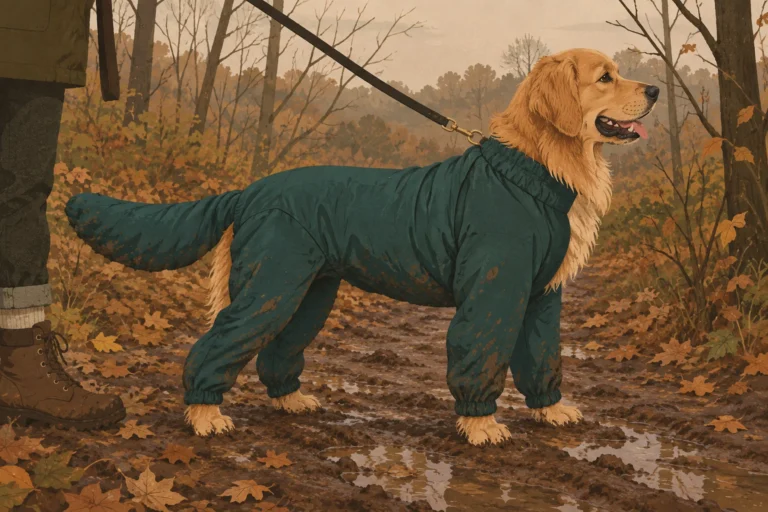
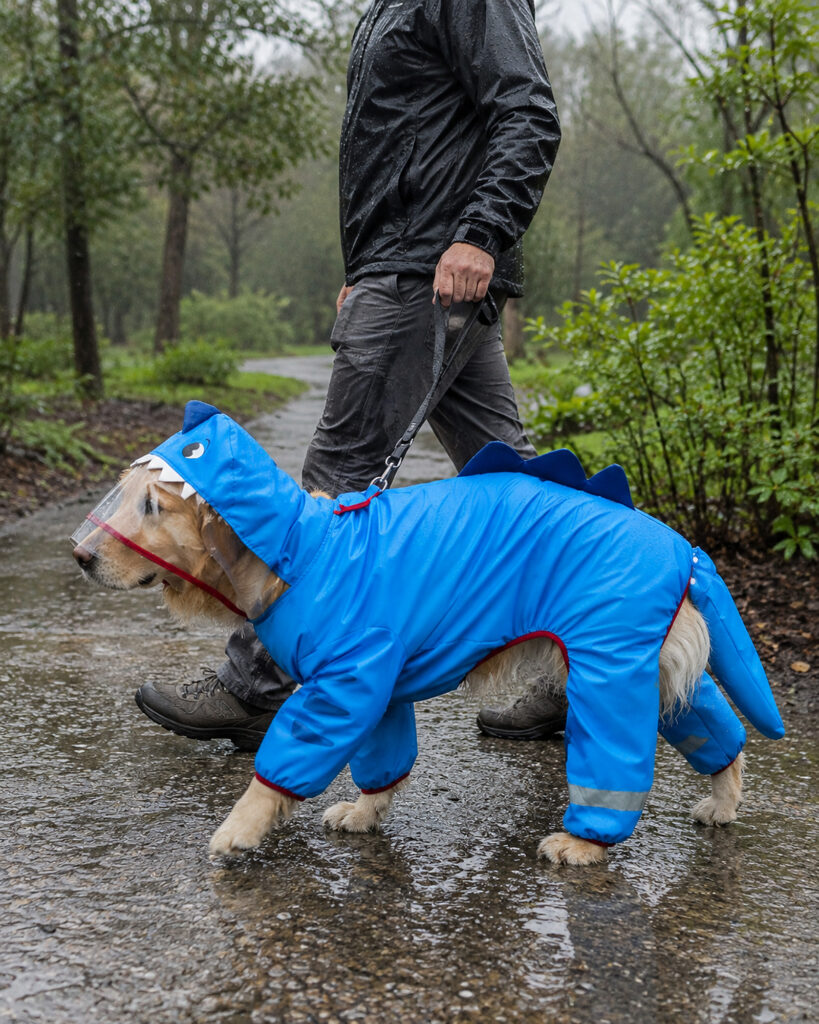
Cover the legs when your dog walks through wet grass, mud or slush, or when the coat is long enough to hold what it picks up. On paved streets with a short-coated dog, a body layer does nearly the same job in a quarter of the dressing time.
There is a second decision hiding inside the first, and almost no listing separates them. Most four-leg rain suits stop at the ankle. Only some put a cap over the paw itself. A suit can cover all four legs and still walk four wet feet across your floor.
Four shapes, and what each one leaves wet
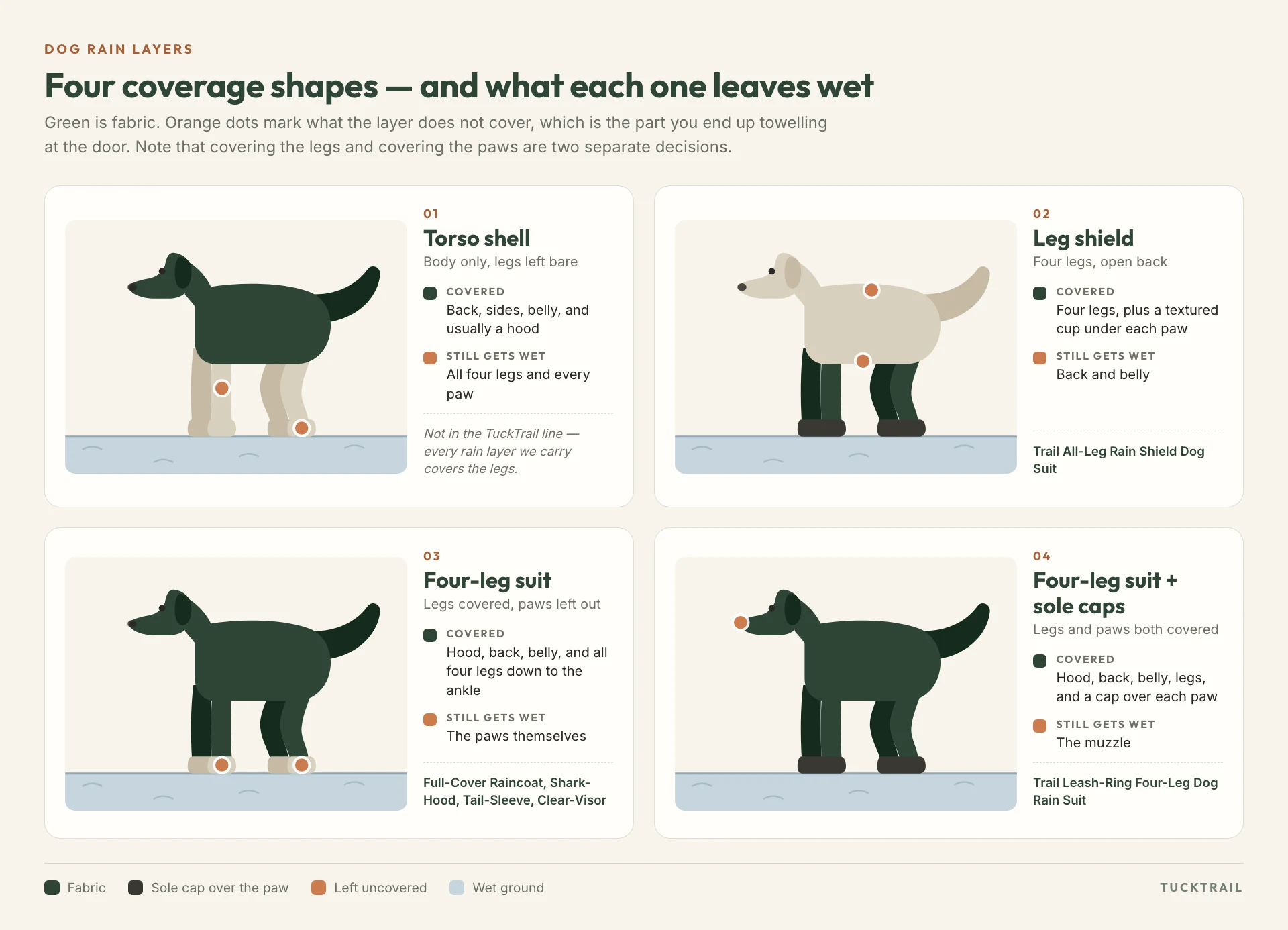
Rain layers for dogs sort into four coverage shapes. Names vary between listings, so read the shape rather than the title — “raincoat”, “rain suit” and “rain jacket” are used interchangeably by most sellers.
| Shape | What it covers | What stays wet | Best for |
|---|---|---|---|
| Torso shell | Back, sides, belly, usually a hood | All four legs and every paw | Short coats, paved routes, dogs who will not tolerate sleeves |
| Leg shield, open back | Four legs plus a cup under each paw; the back stays open | Back and belly | Warm wet days, double coats that overheat under a full suit |
| Four-leg suit | Hood, back, belly, legs down to the ankle | The paws themselves | Wet grass and puddles, where splash matters more than mud |
| Four-leg suit with sole caps | Everything above, plus a cover over each foot | The muzzle | Mud, trails and slush, and long coats between the pads |
We do not carry a torso shell. Every rain layer in the TuckTrail line covers the legs, because the scenarios we design around — trailheads, park paths, wet campsites — are the ones where bare legs are the problem. If your walk is a block of pavement and back, a simple body layer from anywhere is the honest recommendation, and you will use it more often than a suit you have to schedule.
“Covers the legs” is not “covers the paws”
This is the detail that decides how much of your dog you dry at the door, and it is almost never stated plainly. Zoom in on where a sleeve ends and there are three different constructions in common use.
And if the answer turns out to be that you want the paws genuinely covered, that is a separate purchase with its own failure mode — boots come off, and usually for reasons a tighter strap will not fix. Our guide to why dog boots fall off covers the sizing detail that causes most of it.
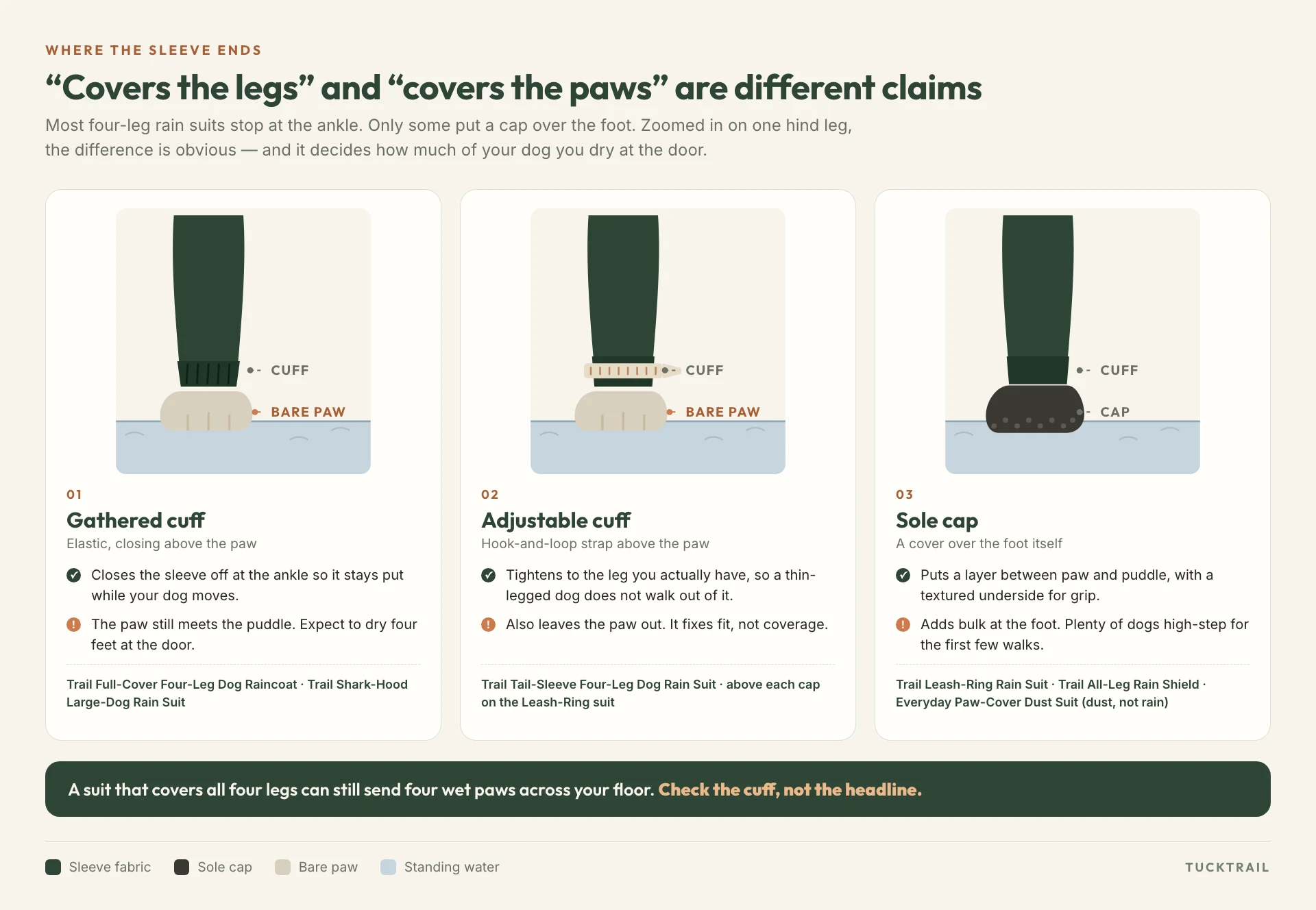
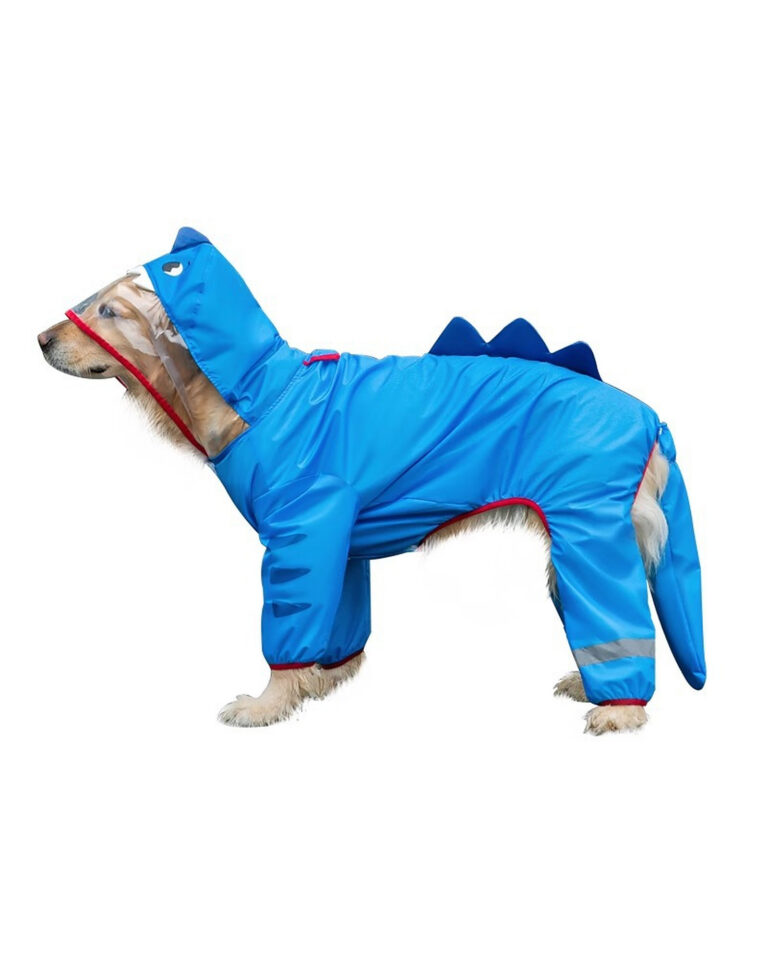
A gathered cuff closes the sleeve above the ankle so it stays where you put it. The Trail Shark-Hood Large-Dog Rain Suit uses elastic cuffs that gather above the paws; the Trail Full-Cover Four-Leg Dog Raincoat closes each leg with a dark cuff at the same point. Both leave the paw itself out.
An adjustable cuff adds a hook-and-loop strap so the sleeve tightens to the leg you actually have. That matters more than it sounds for thin-legged and deep-chested dogs, who otherwise size up for the chest and then walk out of the sleeves. The Trail Tail-Sleeve Four-Leg Dog Rain Suit uses one on each leg. It is still a fit fix, not a coverage one.
A sole cap is the only one that covers the foot. On the Trail Leash-Ring Four-Leg Dog Rain Suit each sleeve ends in a black cap that puts a layer between paw and puddle; the Trail All-Leg Rain Shield Dog Suit uses textured cups with grip on the underside. These are soft covers sewn onto the sleeve, not dog boots — do not expect boot-grade abrasion resistance, and do expect the first few walks to involve some high-stepping while your dog works out what is on their feet.
When covering the legs earns the extra minute
- Wet grass and standing water, where splash arrives on the forelegs and the belly line rather than the back
- Long or feathered coats, where leg fringe wicks water upward and holds grit for hours
- Mud and slush, where the material collects between the pads and takes real work to get out
- Flats and lifts, where the walk from door to door happens across a carpeted corridor
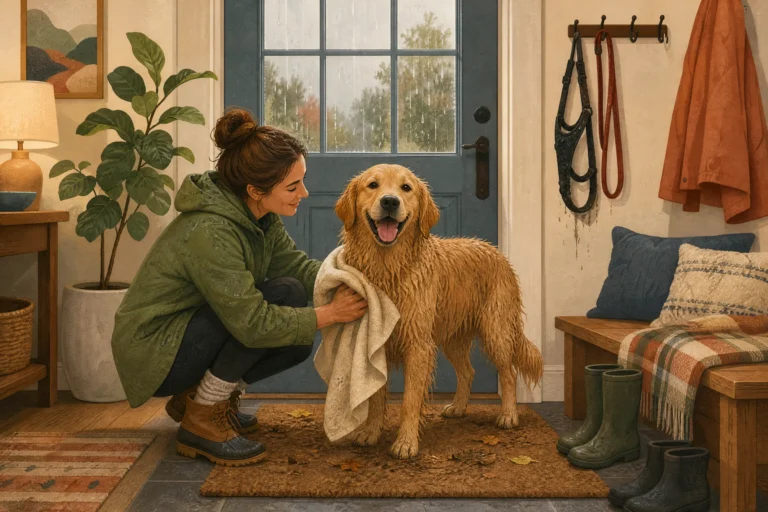
- Dogs who get a bath every time they come home muddy — one minute of dressing beats twenty of drying
When it is the wrong buy
A four-leg suit is also a warm layer. On a mild wet afternoon a short-coated dog is often more comfortable in less of it, and a double-coated dog can overheat inside a full shell even when the air feels cool to you. That is the case for an open-back leg shield: it covers the half that gets dirty and leaves the coat breathing. If your dog is a Husky, Malamute, Golden or anything else with a proper undercoat, it is worth reading what that coat actually does in the rain before you buy any of this — and how much heat a full suit actually costs a dog before you use it in warm weather.
The other honest limit is time. Four sleeves take real effort on a dog who already knows the word “walk”, and no coverage helps if the suit means the walk gets skipped. If you have a dog who braces at the sight of clothing, start with a body layer, work up to sleeves at home over a few weeks, and treat the suit as a trail item rather than a daily one — there is a rung-by-rung version of that in how to get a dog used to wearing clothes.
Pick by the ground you walk on and the coat you have to dry
If the mess you are fighting is mud rather than rain, the naming gets confusing fast — mud suit, slush suit and splash suit are mostly the same garment under different shop words. We untangle that, and what mud does to a dense coat, in dog mud suits: what they actually solve.
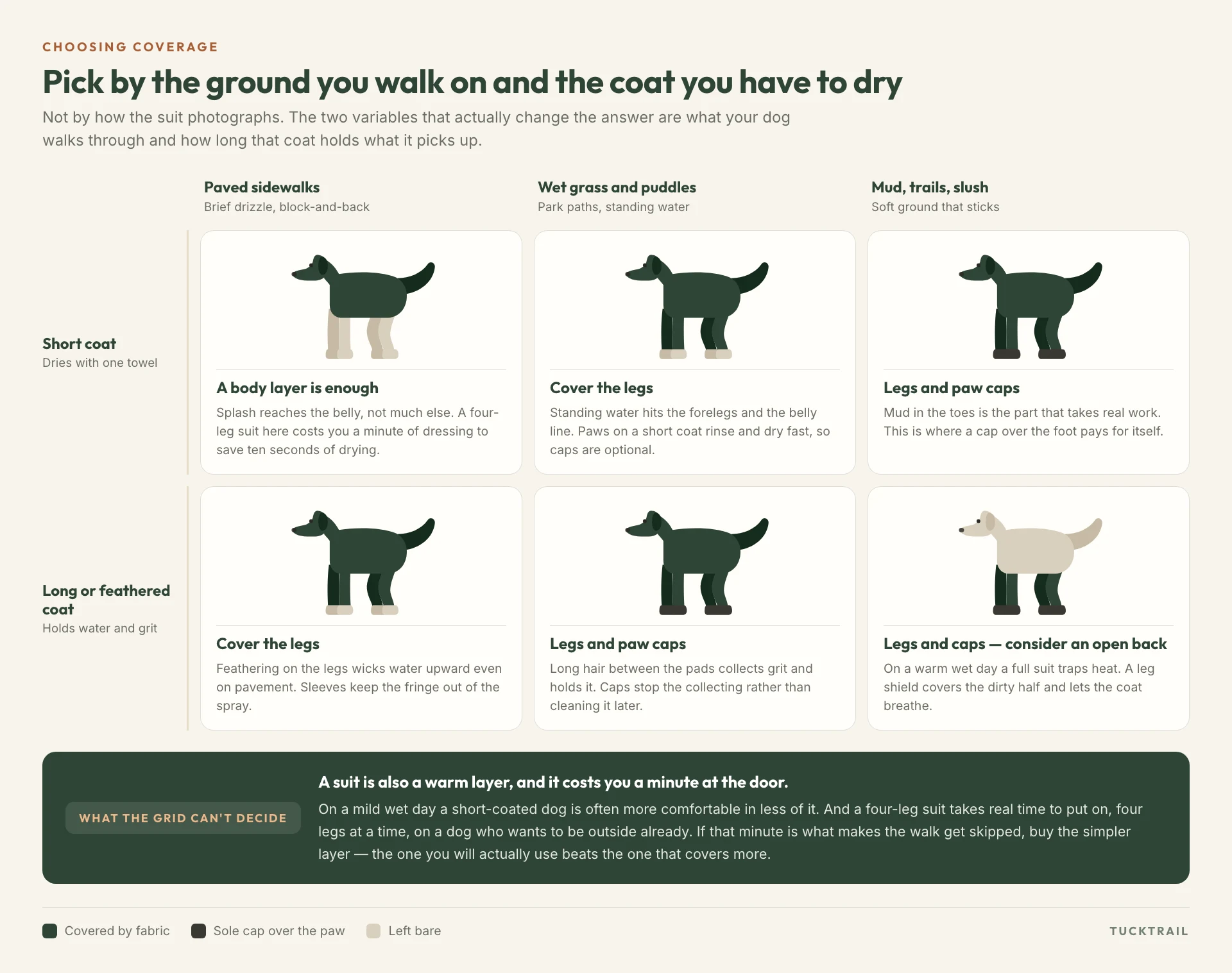
Read the grid as a starting point, then adjust for the dog in front of you. A Cocker Spaniel on a paved commute still benefits from sleeves because of the leg feathering. A Boxer on a muddy trail may be fine in a shell and a towel, because there is nothing on those legs for mud to cling to.
The parts of a suit that decide whether you use it
Coverage is what gets compared in listings. These three details are what determine whether the suit stays in rotation.
How the leash attaches
If clipping a lead means opening the suit or digging for a harness underneath, the suit becomes a project. Look for a leash port before you look at anything else. The Leash-Ring suit stitches a metal D-ring through the shell on the upper back; the Shark-Hood suit runs a bound opening through the back panel so you can clip to the collar or harness underneath without uncovering your dog; the Clear-Visor suit builds in its own ring; and the All-Leg Rain Shield carries a D-ring on its adjustable harness strap. Those are two different arrangements — clipping to your own harness underneath versus clipping to the coat itself — and on a big dog the choice matters more than it looks; our guide to what a “harness hole” actually means on a large dog raincoat works through it. If you are choosing the lead as well, our guide to when a retractable leash helps and when it does not covers the length question.
Whether your dog can relieve themselves in it
A full-body suit that has to come off for a bathroom break is a suit you will stop using by the second week — the belly coverage question deserves its own look before you buy. A U-shaped or arched belly opening, bound at the edge, is what makes the difference — the Clear-Visor and Tail-Sleeve suits both use one, and both keep the belly panel closed with snaps around it.
Whether your dog can see out
A hood that flops over the eyes is the most common reason a dog plants their feet at the door. A clear brim or moulded visor holds the fabric out in front of the face instead: rain stays off the muzzle, the path stays visible, and you can see whether your dog is actually comfortable. The Tail-Sleeve, Clear-Visor, Leash-Ring and Shark-Hood suits all use a transparent brim for this reason.
Sizing: three measurements, and one trap
Every one of these suits sizes on back length, chest girth and neck girth. Weight ranges in listings are a filter, not a fit. Measure back length from the base of the neck to the base of the tail with your dog standing, chest girth around the widest point behind the front legs, and neck girth where the collar sits.
Two things routinely go wrong. First, tail panels and rear covers add coverage but also add length — if your dog measures near the top of a size, take the next one up. Second, sewn-in factory tags do not always match the chart: on the Full-Cover Raincoat the tag can read one size larger than the size ordered, because our chart is relabelled from the maker’s. Go by the size-guide measurements, never the tag. And because these are measured by hand, allow about an inch either way.
Which one for which walk
Small dogs, wet grass and puddles. The Trail Tail-Sleeve Four-Leg Dog Rain Suit covers roughly 1–22 lb, with adjustable cuffs, a wide clear brim and a belly opening that stays usable. The Trail Clear-Visor Full-Cover Dog Rain Suit covers about 3–22 lb with a detachable rear cover for lighter days.
Mud, trails and long coats. The Trail Leash-Ring Four-Leg Dog Rain Suit is the one in our line that covers the paws, in six sizes from XS to 2XL, with a back D-ring and a tail sleeve that snaps off.
Big dogs. The Trail Shark-Hood Large-Dog Rain Suit fits roughly 20–88 lb with a moulded clear visor and a leash port through the back panel. For a heavier shell with a two-way zip and reflective piping along the seams, the Trail Full-Cover Four-Leg Dog Raincoat covers back lengths from 15.4 to 24 in.
Warm rain, or a dog who will not wear a full suit. The Trail All-Leg Rain Shield Dog Suit covers the legs and paws only, leaving the back open, across six sizes from under 6 lb to over 55 lb. More on choosing gear by trip in the Walk & Hike guide, or browse everything in Protective Gear.
Dog rain suit FAQ
Do dogs actually need their legs covered in the rain?
Need is strong. Most dogs are fine wet. What leg coverage buys is your time afterwards, and it buys the most of it when the ground is soft, the coat is long, or the route home runs across something you would rather not muddy.
Are dog rain suits waterproof?
Treat them as water-resistant. A taffeta shell with a laminate beads rain and sheds a normal walk’s worth of it, but seams, openings and a long enough downpour will find their way through. They are built to keep a walk pleasant, not to keep a dog dry indefinitely.
Are sole caps the same as dog boots?
No. A sole cap is soft material sewn onto the end of the sleeve — it puts a layer between paw and puddle and adds some grip, but it is not a boot and will not stand up to boot-level wear on rough ground. Most dogs need a few short walks to stop high-stepping in them.
My dog hates being dressed. Is a four-leg suit hopeless?
Often, at first. Work in the order the dog can accept: a body layer for a week or two, then sleeves indoors with the suit unfastened, then a short walk. Suits that close with snaps or side-release buckles let your dog stay standing, which is usually easier than anything requiring them to be held still.
What size dog rain suit should I buy?
Measure back length, chest girth and neck girth, and compare all three against the chart on the product page. Size up if your dog is near the top of a range or if the suit has a tail panel. Do not go by the sewn-in tag, and do not rely on the weight range alone.
Can my dog wear a harness under a rain suit?
Yes, and it is usually the better setup — put the harness on first, then the suit, and clip through the suit’s leash port or back opening. Suits with their own D-ring let you skip the harness for short walks, though a collar or harness underneath is still the more secure attachment for a dog who pulls.
Buy for the ground, then check where the sleeve ends.
Legs covered or not is decided by what your dog walks through and how long that coat holds it — pavement and a short coat need less than most listings imply, mud and feathering need more. Then read the cuff, because a suit that covers all four legs may still leave all four paws out. The layer you will actually put on beats the one that covers the most.