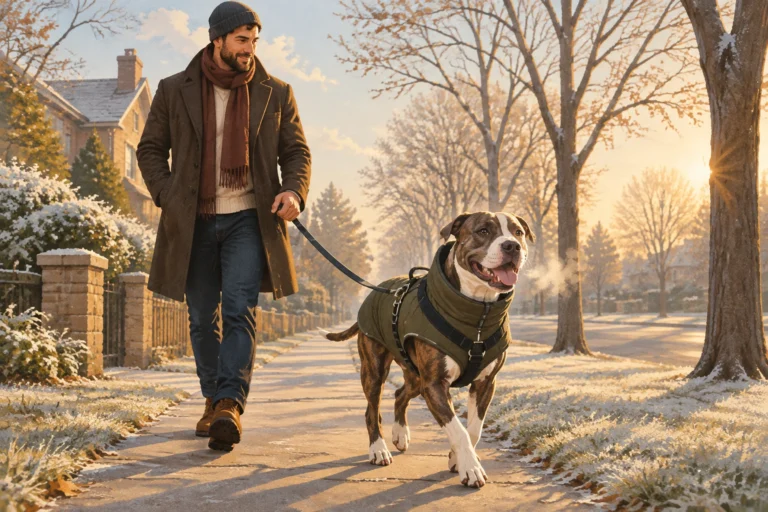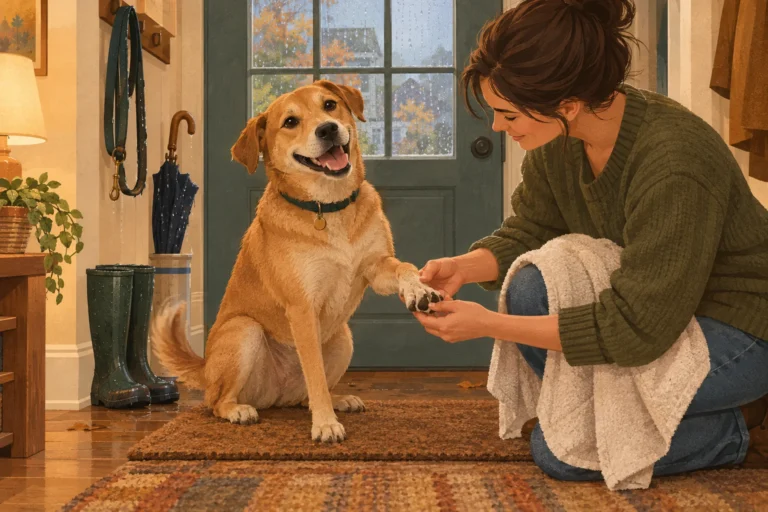
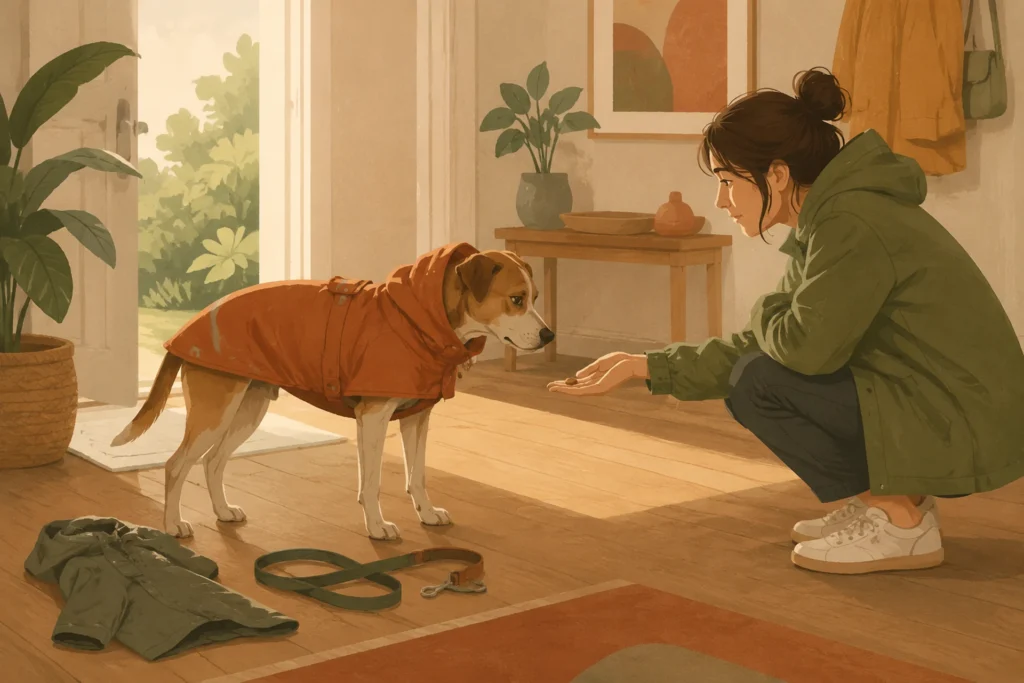
A dog who freezes solid the moment a coat goes on is not being dramatic and is not “protesting.” Something novel and restrictive arrived on their body without warning, and standing still is the cheapest way to find out what happens next. The fix is not more coat — it is less coat, delivered slower, paired with something the dog likes. That protocol has a name in veterinary behavior: desensitization and counterconditioning, described by a panel of board-certified veterinary behaviorists as gradual, systematic exposure “until the stimulus no longer triggers an emotional response,” paired with something that creates a positive one.
Two things have to happen before any of that, though. Rule out pain, and check the fit. And keep one honest exit on the table: some dogs, and some garments, are a no. That is a legitimate outcome, not a training failure.
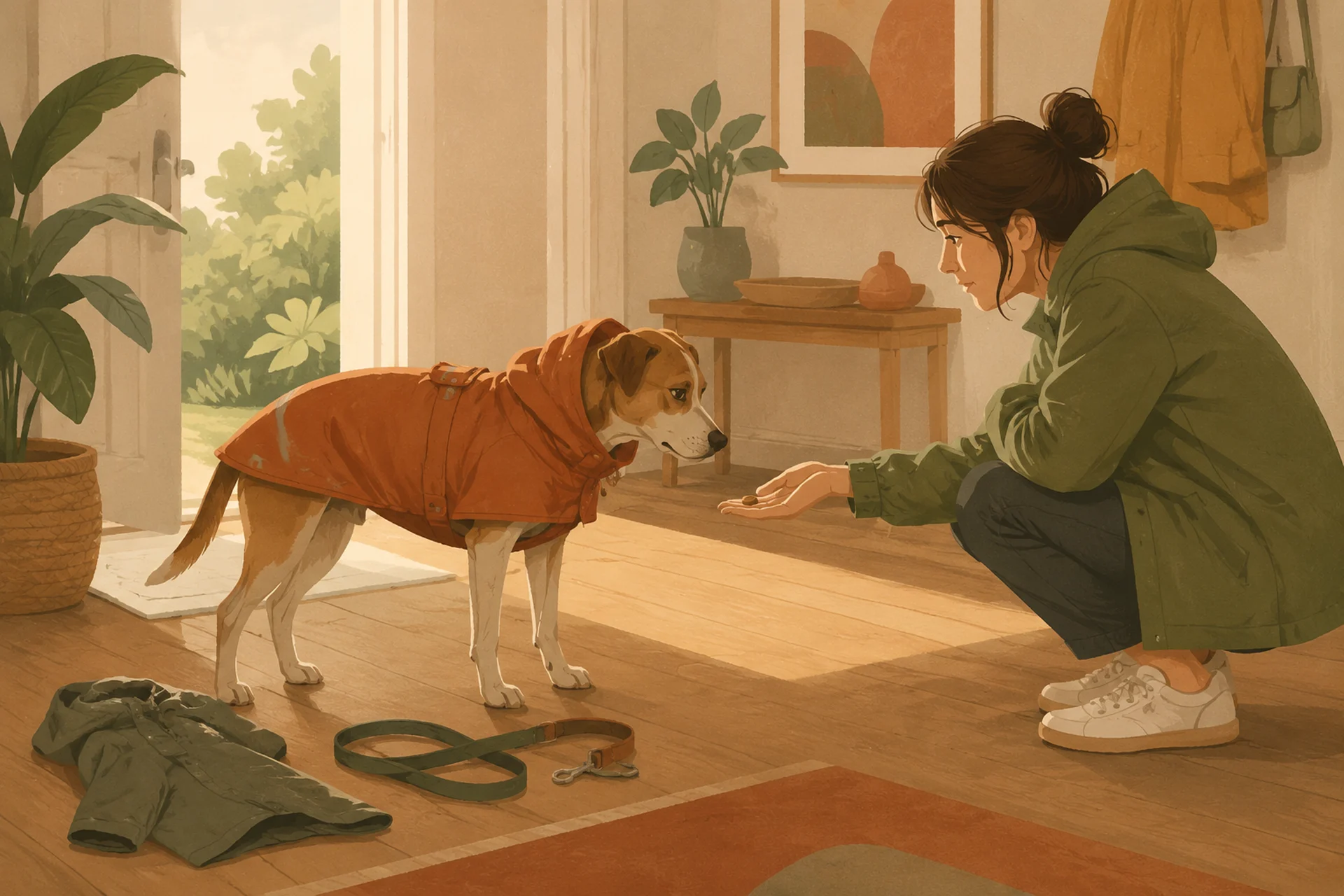
Before you train anything: pain, then fit
Pain first. A dog who used to tolerate a harness and now dodges it is telling you something that no amount of treats will fix. The ASPCA is blunt about the order of operations here — “some behavior problems can be caused or exacerbated by physical problems,” and “only licensed veterinarians can diagnose medical conditions.” Sore shoulders, an ear infection, a healing skin patch, arthritis in an older dog: all of them turn a routine garment into a routine unpleasantness. A sudden change in tolerance is a vet question, not a training question.
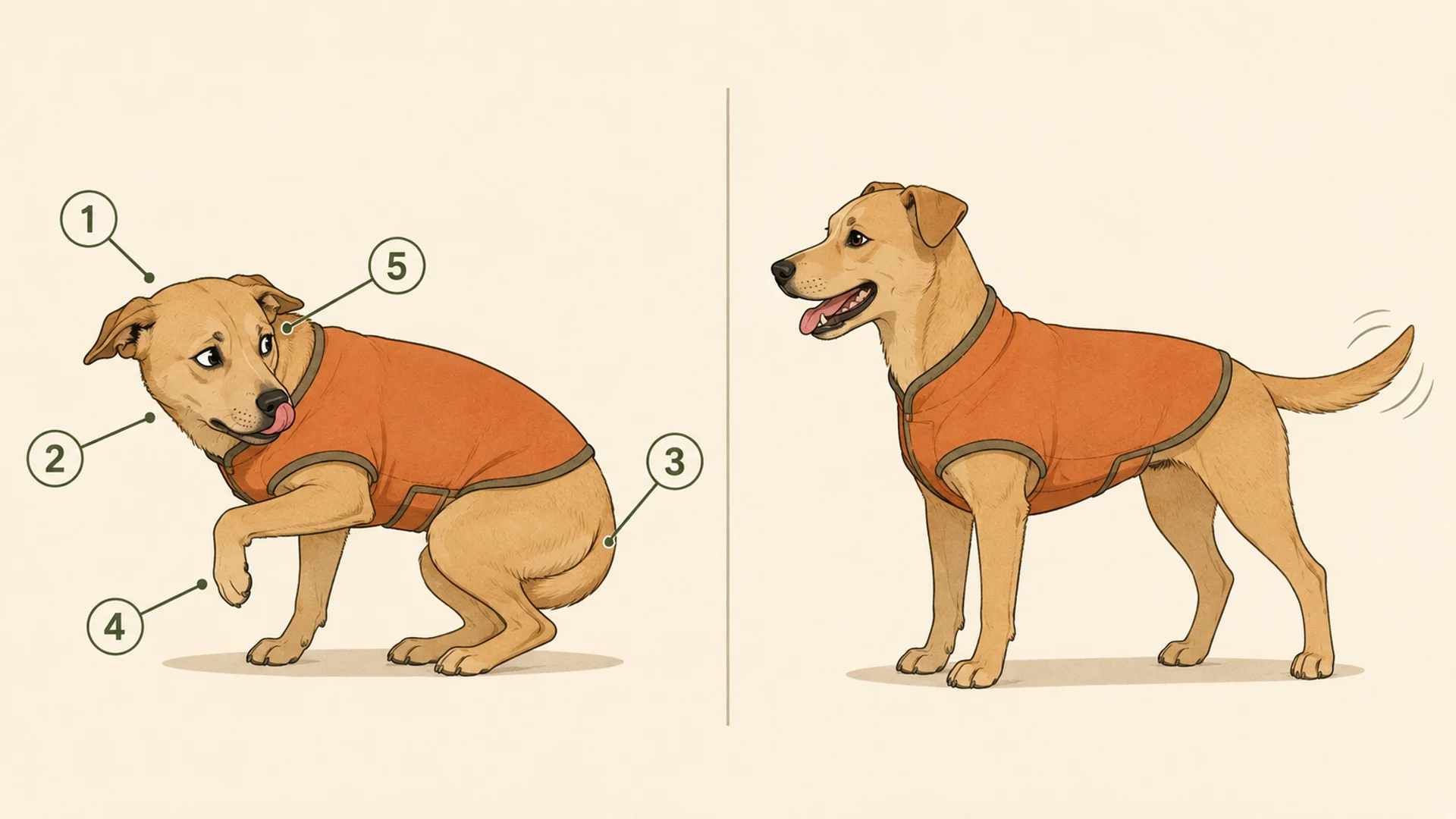
Then fit. A surprising share of “my dog hates clothes” is really “my dog hates this garment.” The AKC’s rule of thumb for straps is simple enough to do in the hallway: “you should be able to slip two fingers underneath any strap,” snug but not tight. Watch the three places that go wrong most: armpits, where a seam saws with every step; the shoulders, where a panel that does not open wide enough limits the front legs; and the belly, where a strap that has crept back gets tighter every time the dog sits.
Why your dog freezes, or won’t walk, the moment the coat goes on
This is the single most common version of the problem: the coat goes on and the dog turns into a statue, or plants its feet at the door and won’t take a step. It looks like stubbornness. The behavior literature reads it differently. VCA’s veterinary behavior team lists freezing alongside pacing, fidgeting, hiding and fleeing as the ways frightened dogs signal that they are afraid. Their guide to dog body language adds that an uneasy dog will often stop wagging or freeze when touched, as a signal that it wants the pressure to stop.
The trigger is usually smaller than people expect. The AKC’s trainer guide to winter clothes points out that for many dogs the feel of fabric on the back, or the sound of Velcro, can be startling on its own. It also notes that gear that is too tight, too loose or too restrictive is uncomfortable, and an uncomfortable dog understandably won’t want to wear it.
So when the freeze happens, do three things in this order:
- Don’t drag the dog forward on the leash. A dog that is frozen with worry and then pulled learns that the coat predicts being hauled. Stand still, wait, and offer a treat at nose height.
- Check the fit before you check the dog. Run two fingers under every strap, look at the armpits and the front of the shoulders, and watch whether the legs can swing freely. A freeze that only happens in one garment is usually about that garment.
- Take it off and drop a rung. If the dog doesn’t loosen up within a few seconds, end the session on something easy. The freeze tells you that you skipped ahead on the ladder below, not that the dog needs more time in the coat.
Most dogs thaw quickly once the coat stops being a surprise. One that stays frozen, trembles, or freezes harder each session is the dog to slow right down with, and to talk to your vet about if nothing changes.
How to put a coat on a dog without a wrestling match
A lot of the trouble starts with the mechanics, not the coat. If putting it on takes thirty seconds of reaching over the dog’s head, fiddling with straps and tugging a leg through a hole, the dog has had thirty seconds of being handled in ways it doesn’t like before it has even taken a step. Make the dressing itself short and predictable:
- Pick a calm moment. Not the minute before the walk when the dog is already spinning at the door. The AKC’s harness guide says it’s best to do this when your dog is calm, with you standing, sitting or squatting behind the dog while it stands or sits. The same goes for a coat.
- Open everything first. Undo every strap, zip and clip before the coat goes near the dog, so the only thing you do on the dog is lay it on and close it. Peel Velcro apart away from the dog if the ripping sound bothers it.
- Back first, head last, or not at all. Lay the coat over the back, then close the chest and belly. If your dog dislikes things coming at its face, the AKC’s advice for gear-shy dogs is to choose a coat that is easy to put on and doesn’t have to be pulled over the head.
- Reward while it goes on, not just after. A treat for the back panel, a treat for the first strap. The coat going on should predict food, every time.
- Check the fit before you leave. Two fingers under every strap, legs swinging freely, nothing pressing into the armpits.
- If the dog pulls away, take it off. The AKC’s instruction is that if your dog pulls away or tries to take the coat off, gently remove it and go back to an earlier step. Wrestling it on teaches the opposite lesson (more on that below).
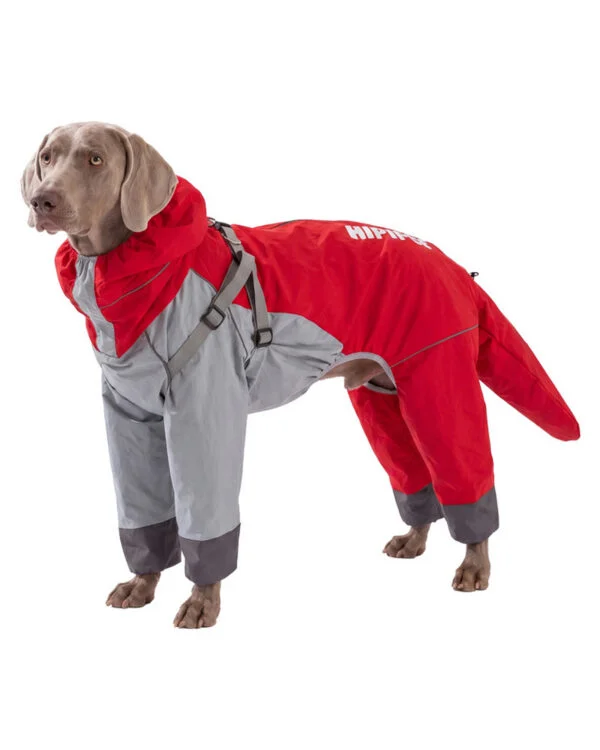
Leg sleeves and full-cover suits are the hard version of this, because each leg has to be guided through a hole. Treat them as a later project once a plain coat is easy, and see the table further down.
The ladder, one rung at a time
The whole method is one idea: expose the dog at a level so low there is nothing to be afraid of, pay well, and only move up when the current rung is boring. The veterinary-behaviorist guidance is to start at an intensity “low enough that any reaction is minimal” — and, critically, “do not continue with a session if your pet shows signs of fear or arousal.” Pushing past that point risks sensitization, where the dog’s reaction gets worse on future exposures. That is the failure mode that turns a two-week job into a two-month one.
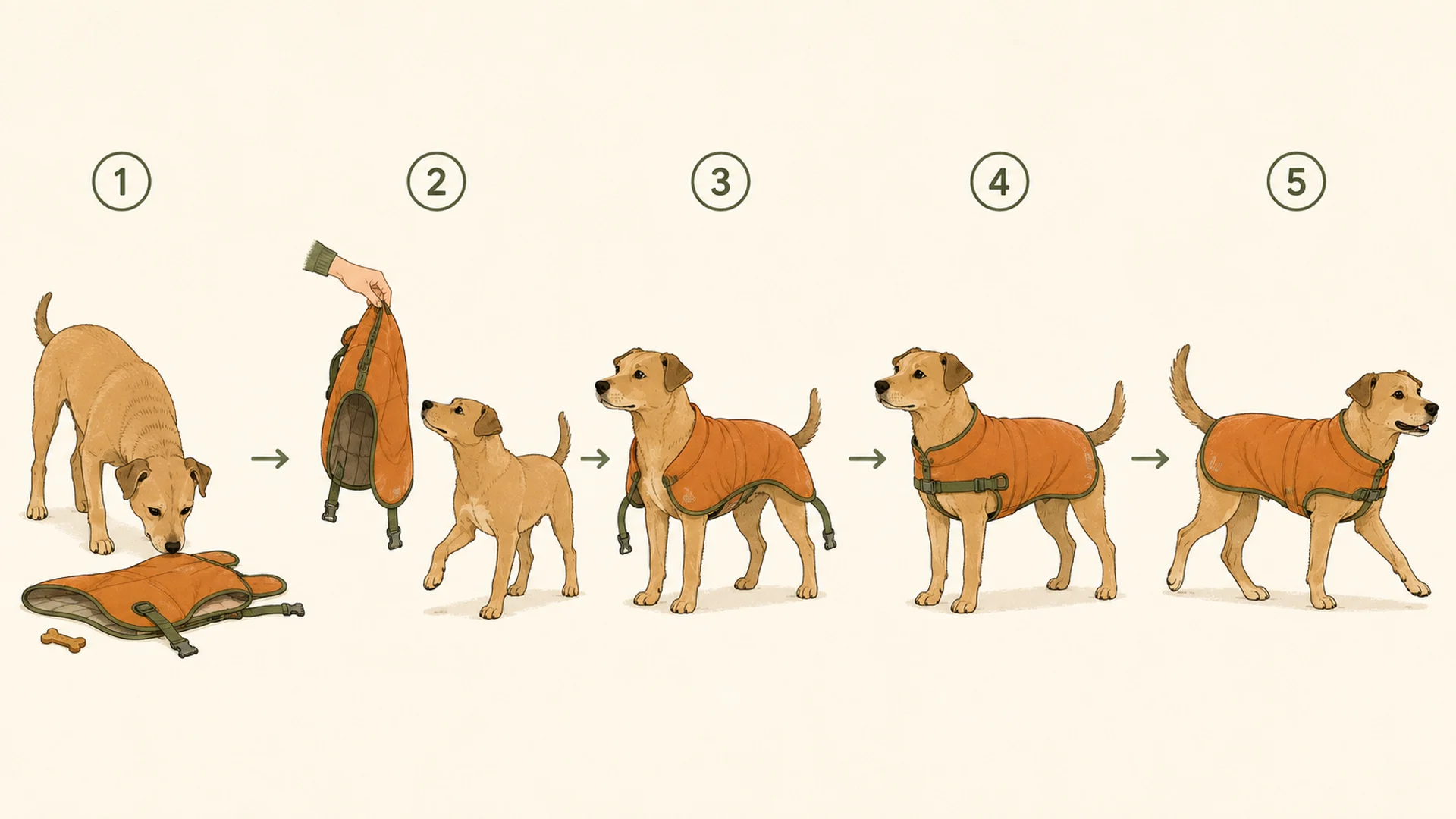
- Rung 1 — the object exists. Coat on the floor, treats scattered around and on it. You are not putting anything on anybody today.
- Rung 2 — the object moves. Pick it up, let it rustle, treat. Put it down. The sound of a shell fabric is half of what bothers dogs about rain gear.
- Rung 3 — contact without commitment. Drape it over the back for two seconds, treat, take it off before the dog reacts. Two seconds, not twenty.
- Rung 4 — one fastener. Clip a single strap, feed continuously while it is clipped, unclip. Repeat until the clip sound predicts chicken.
- Rung 5 — movement. Fully on, then immediately do something the dog loves — the door opens, the ball comes out, dinner appears. Wearing it has to be the thing that causes the good thing.
- Frequency beats duration. The clinical guidance is to practise “at least twice weekly; daily is even better” — three good minutes a day beats one heroic half-hour.
- End on a rung the dog can do. If a session goes sideways, drop back two rungs, get one easy win, stop.
Starting with a puppy
A puppy is the easiest dog to get used to clothes, as long as you treat it as socialization rather than dressing up. The AKC’s puppy socialization guide describes the first three months of life as a socialization period that permanently shapes how a dog reacts to its environment as an adult. Its main warning is to take baby steps and avoid doing too much, too fast, because overwhelming a puppy can produce exactly the fearful response you’re trying to prevent.
For clothes, that means the same ladder at puppy scale. A harness or a light layer on the floor with treats. A two-second drape. One strap. Short sessions that end while the puppy is still happy. Getting the puppy comfortable with having its feet and body handled matters more than getting any particular garment on. The AKC’s boot advice says that if a dog doesn’t like having its feet handled, that’s the place to start.
Two puppy-specific points. First, start before the weather does. The AKC recommends introducing winter gear before the cold weather starts, so the first time the coat goes on isn’t the first freezing morning. Second, puppies grow out of things fast. A coat that was fine last month and now pinches at the armpits will undo good training, so recheck the fit often. Our guide on how to measure your dog for clothes shows where.
Boots get their own, slower ladder
If coats are a project, boots are a bigger one. The AKC says plainly that dog boots are often the most difficult item for dogs to get used to wearing. Its step-by-step version is worth following closely, because the most common mistake is putting on all four boots on day one:
- Feet first. If your dog pulls its paws away when you touch them, work on that before any boot appears.
- Boots on the floor. Let the dog sniff and investigate, and reward the curiosity.
- One boot, then off. Put on one boot, reward, and take it off right away. Build up the time slowly over sessions, with treats or play the whole time it’s on.
- If the dog tries to pull it off, you went too long. The AKC’s fix is to shorten the time and go back to rewarding more often.
- Two boots, then four, still indoors. Only add the next pair once the dog eats and plays without fussing at the first.
- Then short walks. Once the dog is comfortable in all four at home, go outside for short walks and let the confidence build.
How long does that take? There’s no fixed number. It depends on the dog, the boot and how often you practice. The honest measure is the one the AKC uses: move on when the dog is eating and playing in the boots without trying to get them off. A boot that keeps coming off once you’re outside can also be a fit problem rather than a training one. Our guide to dog boots that keep falling off covers how to tell the two apart.
Why holding the dog down and zipping it up backfires
The tempting shortcut is to get it over with: hold the dog, fasten everything, and let them “get used to it.” Sometimes the dog does stop struggling, which reads like success. It usually is not — it is a dog who has learned that struggling does not work, and the next garment will be harder, not easier.
The American Veterinary Society of Animal Behavior’s position is unambiguous on which side of that line to stay: “based on current scientific evidence, AVSAB recommends that only reward-based training methods are used for all dog training, including the treatment of behavior problems.” Wrestling a dog into a coat is not training, but it teaches the same lesson an aversive method does: hands and gear predict something you cannot escape.
The garments that break the process, and what to do instead
Most dogs adapt to a simple coat fairly quickly. The AKC’s guide says that in most cases introducing a coat can be done relatively easily. The trouble starts with the garments below. Boots have their own ladder above.
| Where it goes wrong | What the dog is objecting to | The change that usually fixes it |
|---|---|---|
| Anything that goes over the head | A hand and a hole approaching the face; brief loss of vision | Switch to a garment that doesn’t have to be pulled over the head. The AKC recommends exactly that for gear-shy dogs. See the coat designs that don’t go over the head |
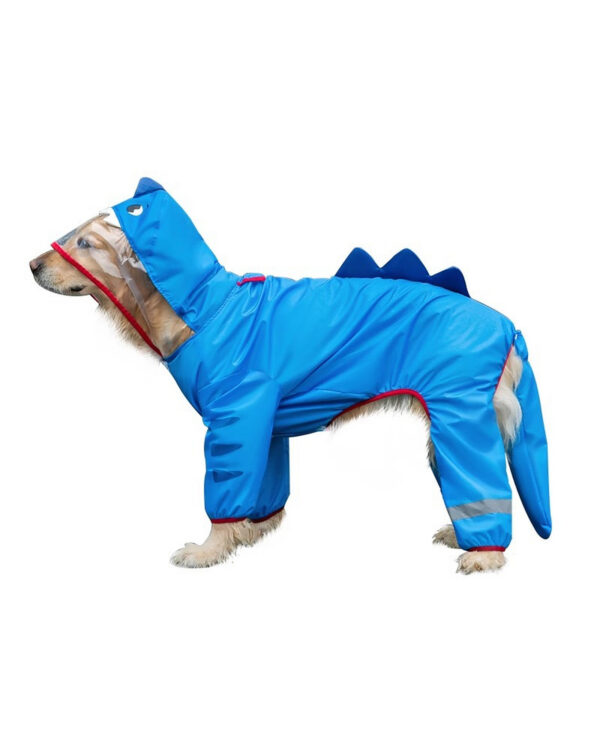
| Leg sleeves and full-cover suits | The gait changes — the dog cannot feel where its own legs end | Split the job: body first, legs only once the body layer is boring. The AKC notes that dogs already used to a coat adjust to a snowsuit faster |
| Boots | Every step feels different, and the feet have to be handled to put them on | One boot, indoors, for a few seconds. Then two. All four on day one is the classic mistake (see the boot ladder above) |
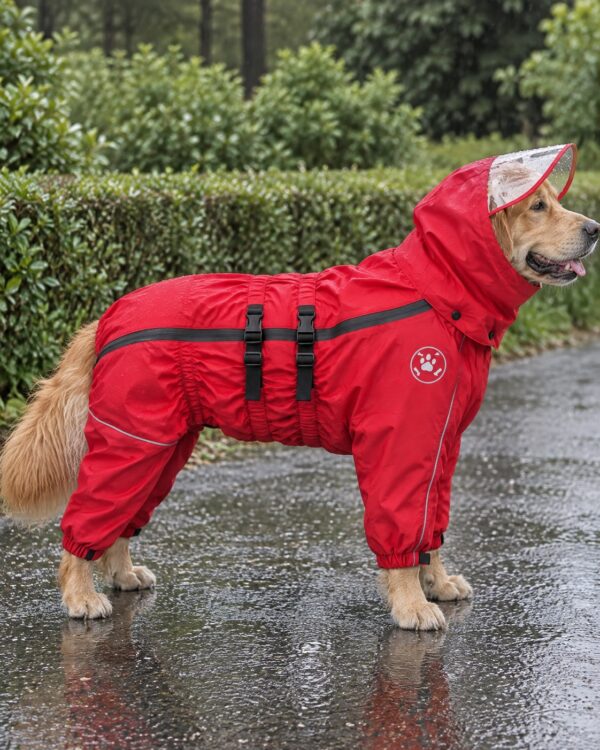
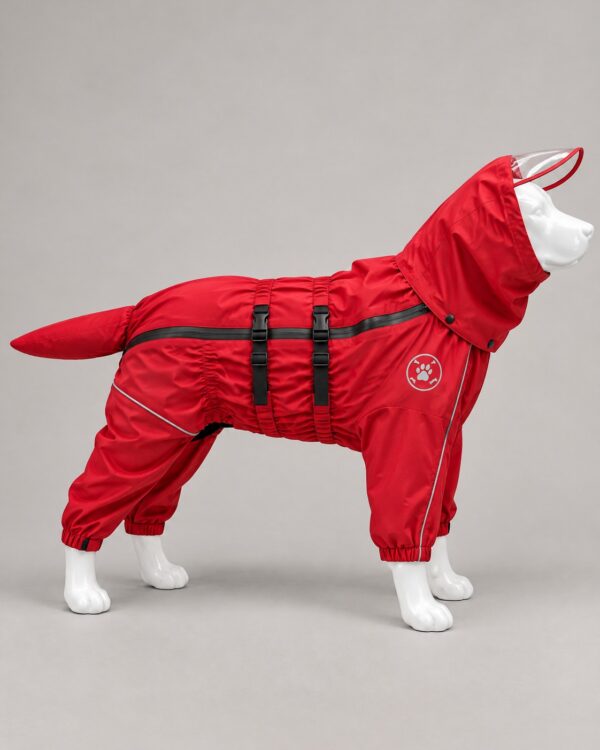
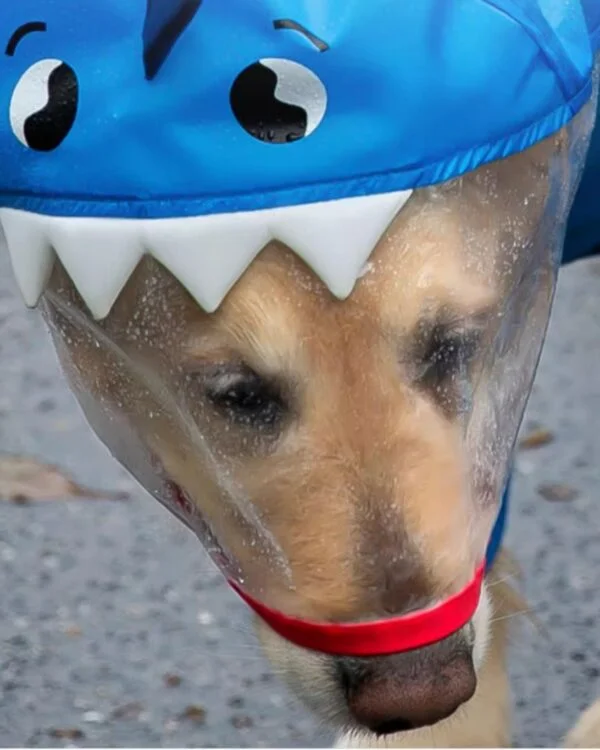
| Hoods | Muffled hearing and reduced peripheral vision at once | Leave the hood down for the first several outings; it is optional on almost every design |
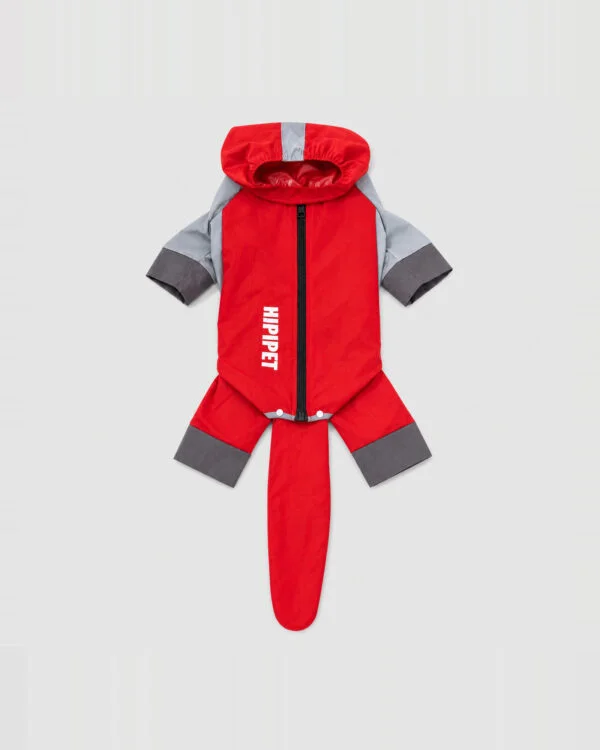
That first row is worth taking seriously when you are choosing gear rather than fighting with gear you already own. Entry style is not a marketing detail — for a head-shy dog it is the whole difference between a two-day job and a two-month one. In our own rain line, the Trail Back-Zip Large-Dog Rain Suit closes along the spine rather than pulling over the head, which is the easier shape to teach; the rest of the range sits on the Protection shelf.
When the answer is genuinely no
Three situations where the right call is to stop trying:
The dog does not need it. A healthy, thick-coated dog on a fifteen-minute drizzle walk is not gaining much from a shell — we went through that argument and its real exceptions in do double-coated dogs need raincoats. If the garment is not solving a problem, the training is not worth the relationship cost — that is also the honest core of the is it cruel to dress a dog argument, and it is worth reading before you spend a fortnight on this. (If you are reaching for a coat because your dog will not go out in the rain to toilet, treat that as its own problem first — gear helps only once the coat itself is a non-event.)
The weather is warm. A coat is insulation as well as a rain barrier. On a mild damp day with an active dog, adding a layer can be the bigger risk, and a dog that is hot in a garment will never learn to like the garment.
The dog is old, sore, or short-nosed. Reduced mobility, arthritic joints and compromised breathing all change the maths, and all of them are conversations to have with your own veterinarian rather than to solve with treats. Nothing here is a diagnosis, and a dog whose tolerance changed suddenly should be seen before being trained.
And if the dog’s fear looks bigger than the garment — panic, freezing that does not thaw, defensive snapping — that is the point to bring in help. The ASPCA notes that some veterinarians “seek specialized education in animal behavior and earn certification through the American College of Veterinary Behaviorists,” and those are the people to ask.
Getting a dog used to clothes FAQ
Why does my dog freeze and refuse to move when I put clothes on?
Freezing is one of the ways dogs show they’re unsure or afraid, and a coat is a sudden new feeling all over the body. The fabric or the sound of Velcro alone can startle some dogs. Check the fit, don’t pull the dog forward, take the coat off and go back a step on the ladder. It usually fades within a few short, well-paid sessions. If it gets worse over time, you are moving faster than the dog is.
How long does it take to get a dog used to a coat or harness?
For a confident dog with a well-fitting garment, often a few days of three-minute sessions. For a head-shy or previously-forced dog, weeks. The variable that matters is not the calendar — it is whether every single session ended before the dog got worried.
Why does my dog hate wearing clothes? Is it real or just novelty?
Usually it is one of three things: the garment is new, it doesn’t fit, or it hurts somewhere. Both real dislike and novelty exist, and they look different. Novelty fades with repetition and pays off with food. A genuine dislike does not fade — the dog is as unhappy on session twenty as on session one, which is the signal to check fit, check for pain, and then accept the answer.
Should I leave the coat on so my dog gets used to it faster?
No. Leaving it on past the dog’s comfort point is the flooding version of this, and the clinical guidance is the opposite: stop the session at the first sign of fear or arousal, because going too fast risks a stronger reaction next time, not a weaker one.
My dog is fine with a harness but hates a raincoat. Why?
Coverage and sound. A harness touches a few narrow bands; a shell covers whole panels of skin and rustles while it does it. Treat them as two separate training projects, and start the coat one at the rung where the coat is still on the floor.
What about boots — is the process the same?
Same idea, smaller steps. The AKC calls boots often the most difficult item for dogs to get used to. Start with handling the feet, then one boot on and straight off, then longer, then two, then four, all indoors with treats or play, and only then short walks outside. If the dog tries to pull a boot off, shorten the time and reward more often.
How do I get a puppy used to wearing clothes?
Treat it as part of socialization. Use the same ladder in very short steps, get the puppy comfortable with having its body and feet handled, and stop while it’s still happy. The AKC warns against doing too much, too fast during the first three months. Start before the weather turns, and recheck the fit often, because puppies outgrow clothes quickly.
What’s the easiest way to put a coat on a dog?
Do it when the dog is calm, open every strap first, lay the coat over the back, then close the chest and belly, and reward as each part goes on. For a dog that dislikes things near its face, choose a design that doesn’t go over the head. If the dog pulls away, take the coat off and go back a step rather than holding it still.
Does picking my dog up to dress them make it worse?
It can, if the lift itself is a surprise. Announcing lifts with a consistent word and supporting the dog properly makes the whole handling category easier — the same principle covered in how to carry a dog.
Go slower than feels necessary, pay better than feels necessary, and let no be an answer.
Rule out pain, fix the fit, then work a ladder where every rung is boring before the next one starts. Stop at the first worried lip lick rather than after it. And if the garment is not actually solving a problem for this dog on this day, the winning move is to leave it on the hook.
Sources
- VCA Animal Hospitals — Introduction to Desensitization and Counterconditioning, by Ellen Lindell VMD DACVB, Monique Feyrecilde BA LVT VTS (Behavior), Debra Horwitz DVM DACVB and Gary Landsberg DVM DACVB DECAWBM (definitions, starting below threshold, stopping at signs of fear, practice frequency) (checked 2026-08-27)
- American Veterinary Society of Animal Behavior — What are Reward-Based Training Methods for Dogs (and Cats)? (AVSAB’s recommendation that only reward-based methods be used) (checked 2026-08-27)
- ASPCA — Behavioral Help for Your Pet (ruling out physical causes; what a veterinary behaviorist is) (checked 2026-08-27)
- American Kennel Club — How to Put on a Dog Harness (the two-finger fit check; do it when the dog is calm, from behind, with the dog standing or sitting) (checked 2026-10-23)
- American Kennel Club — How to Teach Your Dog to Wear Winter Clothes, by Sassafras Patterdale CPDT-KA (updated Jan 13, 2026): badly fitting gear is uncomfortable; introduce gear before the cold weather starts; fabric on the back and the sound of Velcro can startle; choose a coat that doesn’t go over the head for gear-shy dogs; coat-familiar dogs adjust to snowsuits faster; boots are often the most difficult item, with a step-by-step boot method; if the dog pulls away, gently remove the coat and go back a step (checked 2026-10-23)
- VCA Animal Hospitals — Fears, Phobias, and Anxiety in Cats and Dogs (frightened dogs may pace, fidget, freeze, or try to hide or flee) (checked 2026-10-02)
- VCA Animal Hospitals — Canine Communication: Interpreting Dog Language (uneasy dogs may stop wagging or freeze when touched) (checked 2026-10-02)
- American Kennel Club — Puppy Socialization: Why, When, and How to Do It Right (updated Aug 11, 2026): the first three months are a socialization period that shapes adult behavior; take baby steps and avoid too much, too fast (checked 2026-10-02)
Veterinary and behavior guidance is updated periodically. Confirm on the official pages, and talk to your own veterinarian about your own dog — nothing here is a diagnosis or a substitute for an exam.