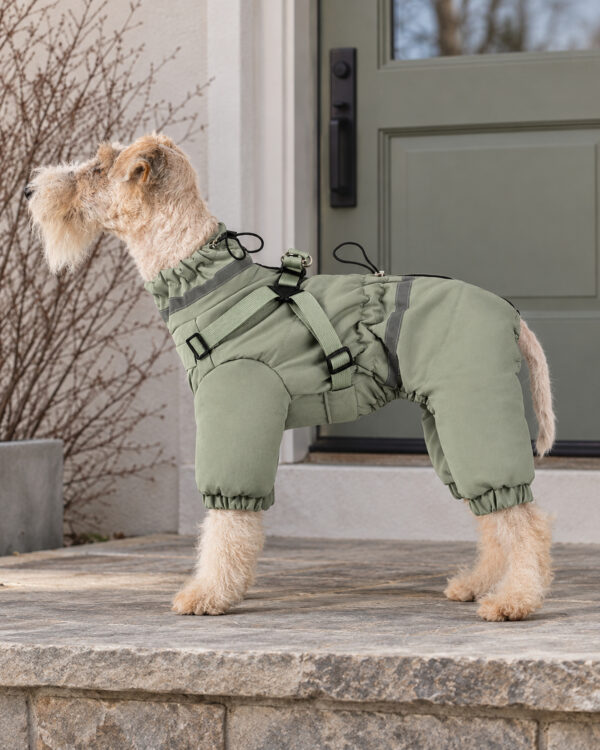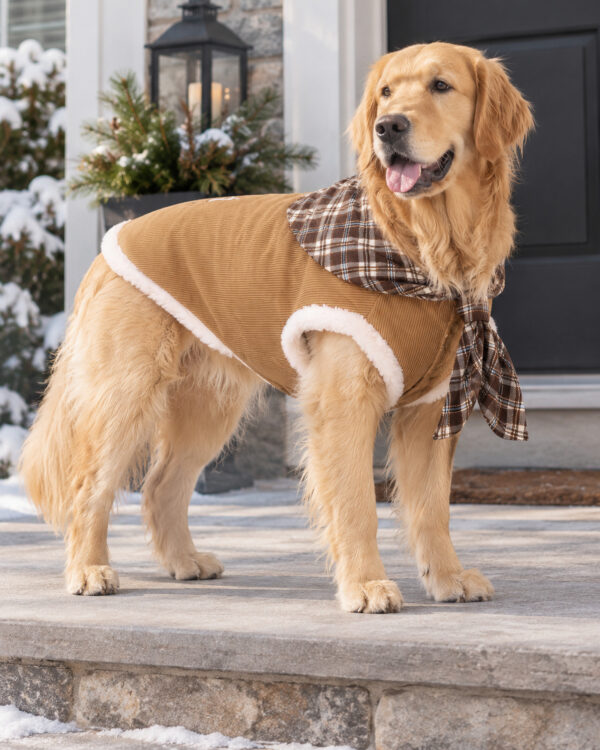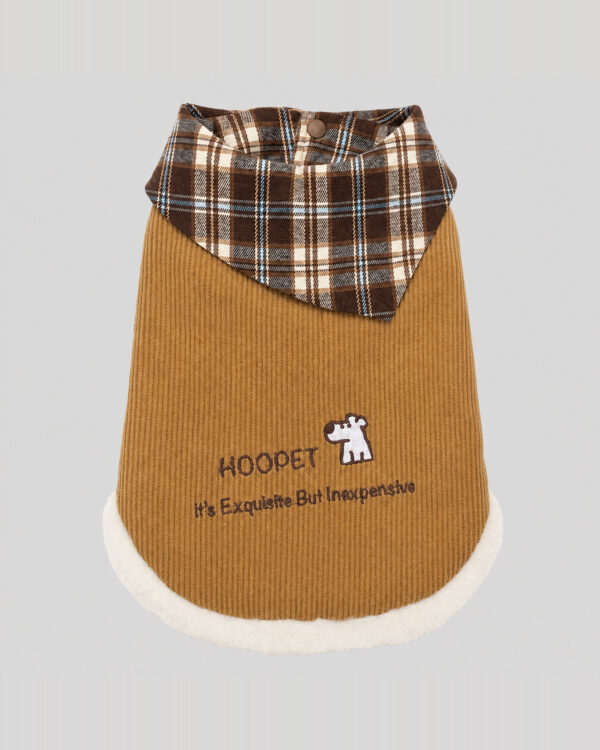
Snug, not tight, and never in the way. The American Kennel Club’s test is simple: put the coat on, then slide two fingers under the straps. If two fingers won’t go, it’s too tight. If more than three go in easily, it’s too loose. And whatever the fingers say, your dog should be able to move normally and walk, run and play in it without the coat getting in the way.
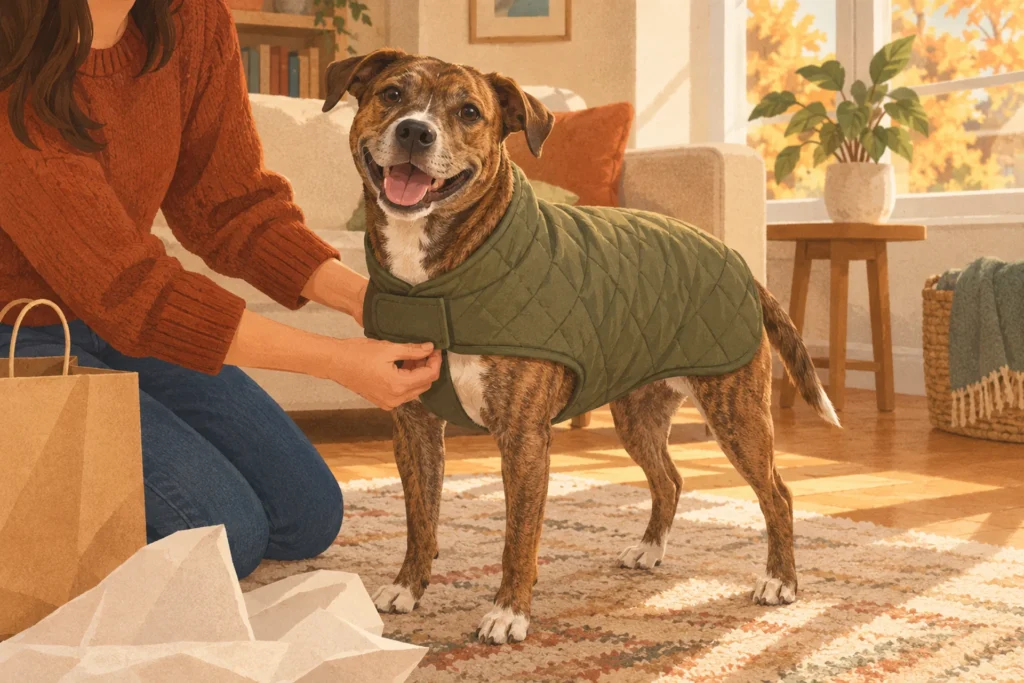
The rest of a good fit is length and coverage. A coat or sweater should cover the back, chest and belly, says VCA Animal Hospitals, and for a short-haired dog the ASPCA suggests one with coverage from the base of the tail to the belly. Below is the try-on we’d do on the living room floor, before the tags come off and before the first cold walk.
Why a coat can be the “right size” and still not fit
You measured, you read the chart, you picked the size that matched. It arrived and it’s wrong anyway. This happens all the time, and it usually isn’t your fault.
The first reason is that size letters don’t travel. The AKC points out that, just like with people’s clothes, the same size in different brands will likely fit differently, and VCA says the same thing about checking each maker’s own chart. A Medium from one brand can be a Small from the next.
The second is body shape. Charts that sort by weight are the worst offenders: the AKC’s own example is that a 30-pound French Bulldog and a 30-pound Basset Hound have very different measurements. Even charts built on chest and back length can’t know that your dog has a deep chest and a narrow waist, short legs, or a long back for its girth.
So the chart gets you into the right neighbourhood. The try-on tells you whether you’re at the right house. If you haven’t measured yet, start with how to measure your dog for clothes; this guide picks up the moment the parcel is open.
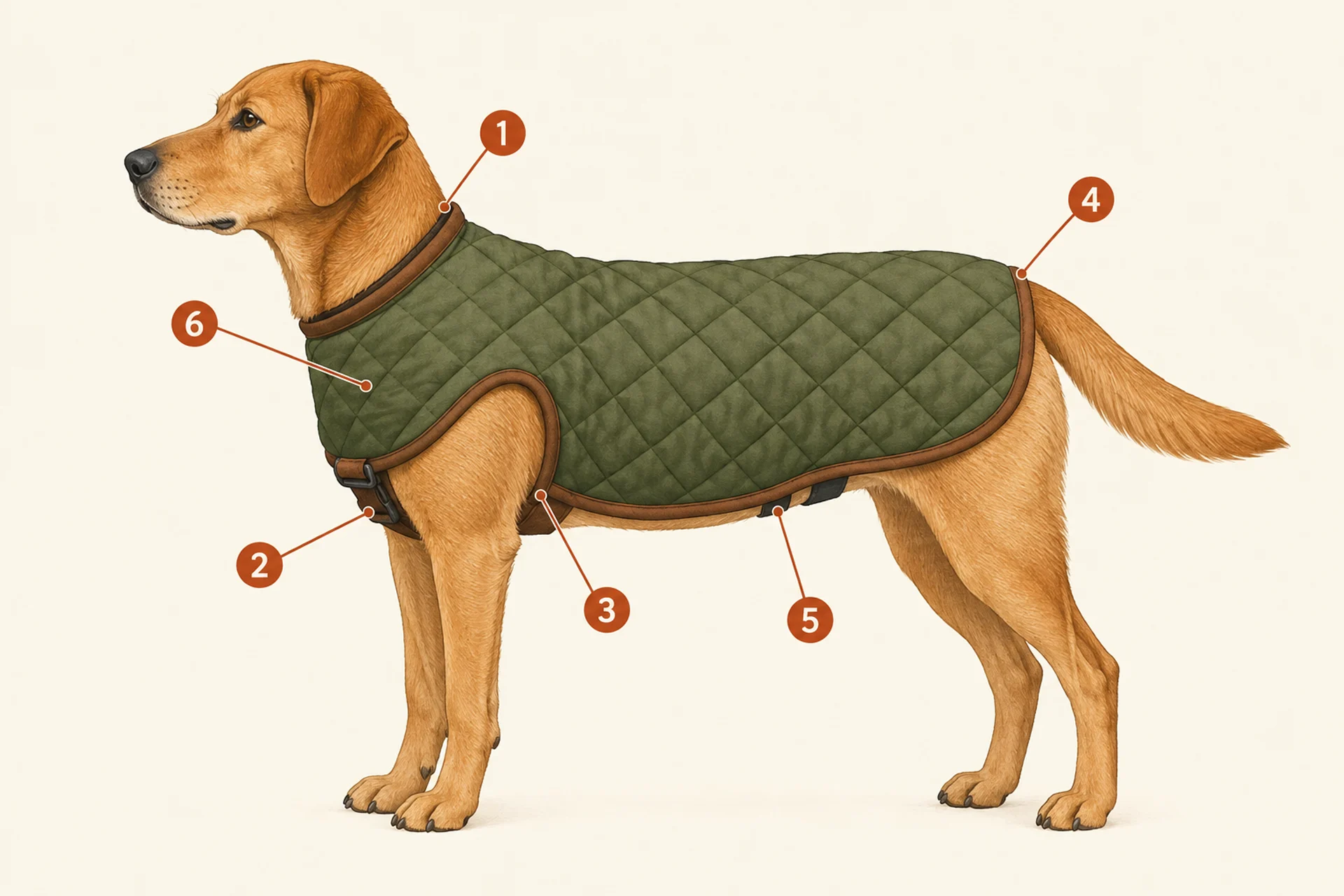
The try-on, zone by zone
Do this indoors, on a calm dog, with treats in your pocket. Put the coat on, fasten everything the way you would for a walk, and work from the head back.
| Zone | A good fit | Too tight | Too loose |
|---|---|---|---|
| ① Neck | Sits at the base of the neck, where a collar would. Your dog can lower its head to sniff and drink | Pulls at the throat when the head drops; your dog keeps stretching its neck | Gapes open; rain and cold air run straight down the back |
| ② Chest and straps | Two fingers slide under the strap | Fingers won’t go under, or the fastening strains | More than three fingers; the coat twists sideways after a few steps |
| ③ Armpits | Edges sit clear of the inside of the front legs | The edge cuts into the armpit when the leg swings back | Fabric bunches there and catches the leg |
| ④ Length | Ends at about the base of the tail | Stops mid-back, leaving the loin and hips bare | Hangs over the tail or past the hips onto the back legs |
| ⑤ Belly | Covers the belly, with the edge ending well forward of where your dog pees | Rides up and leaves the belly bare | Sags low enough to drag in snow or get wet when your dog pees |
| ⑥ Shoulders | Front legs reach forward fully at a trot | Stride shortens; your dog walks stiffly or won’t move | The coat slides forward or back with every step |
Two zones are easy to miss. The belly edge matters most on male dogs: a coat that is too long underneath gets peed on, every walk. The AKC notes that jackets with sanitary cut-outs make it easier for dogs to relieve themselves while wearing them. For more on that, see how much belly a rain suit should cover.
The armpits are the other one. They’re where a coat that looks fine standing still starts to rub once the dog is moving, so the movement test below matters more than how it looks in the mirror.
If the coat has legs
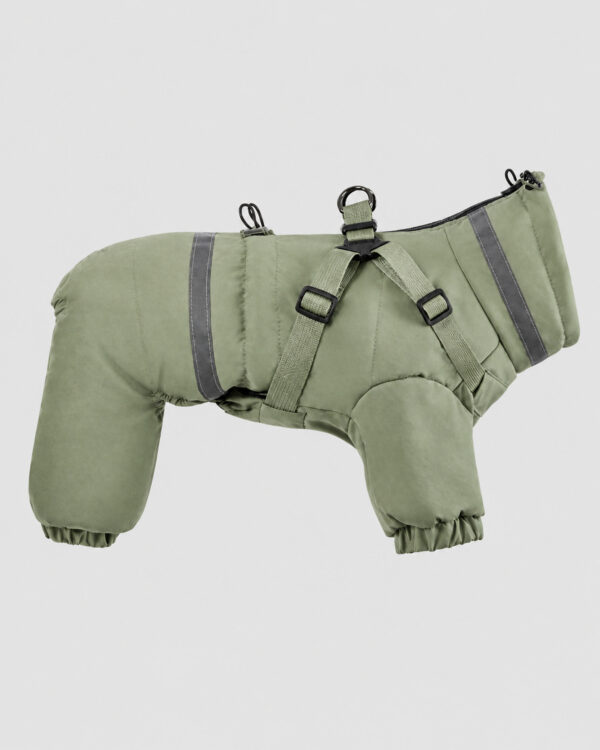
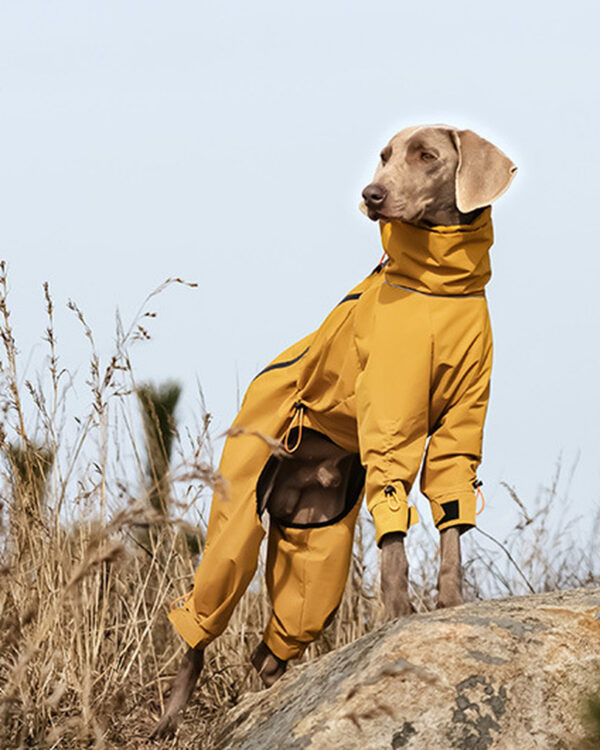
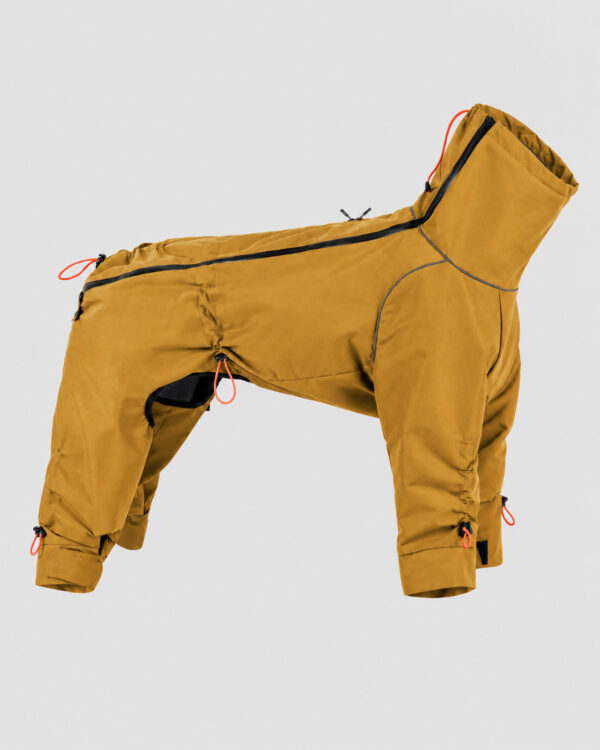
Four-leg snowsuits and rain suits add a problem: leg length. Legs that are too long bunch at the ankle or slide down over the paw every few strides. Legs that are too short pull at the elbow and knee when your dog sits. If the leg is a little long but the body fits, an elastic or strap cuff can often take up the slack. If the body is tight, longer legs won’t help, because you can’t adjust your way out of a tight chest.
If the coat has a hood
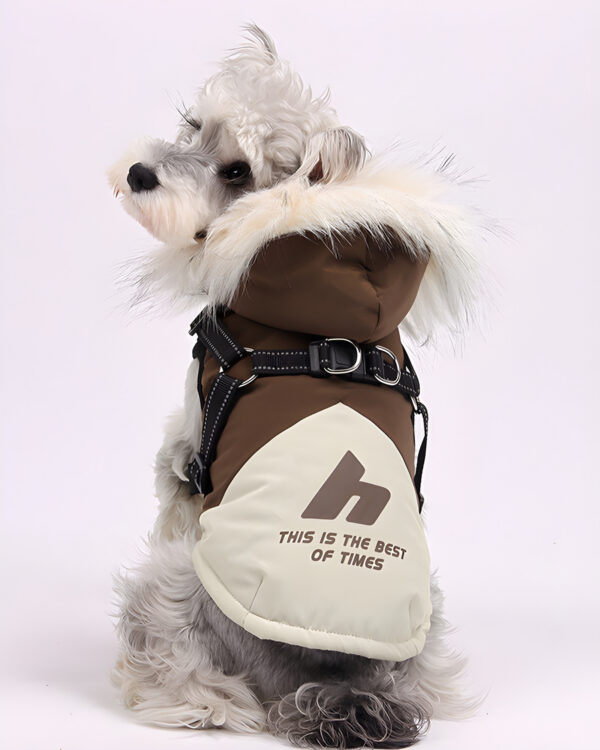
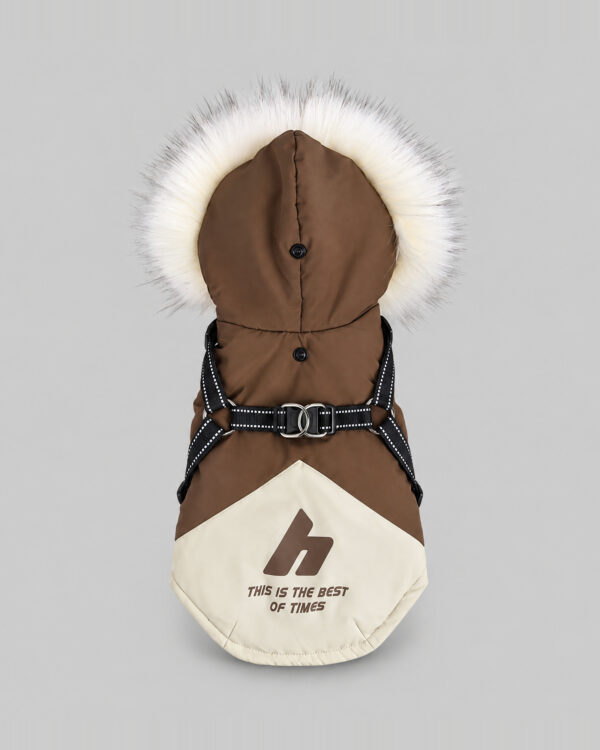
A hood should sit on top of the head, not over the eyes or the muzzle. Many dogs won’t put up with one at all. The AKC suggests a detachable hood, mainly to keep water out of the ears. Our hood or no hood guide goes into when it’s worth it.
The movement test: walk, sit, lie down, shake
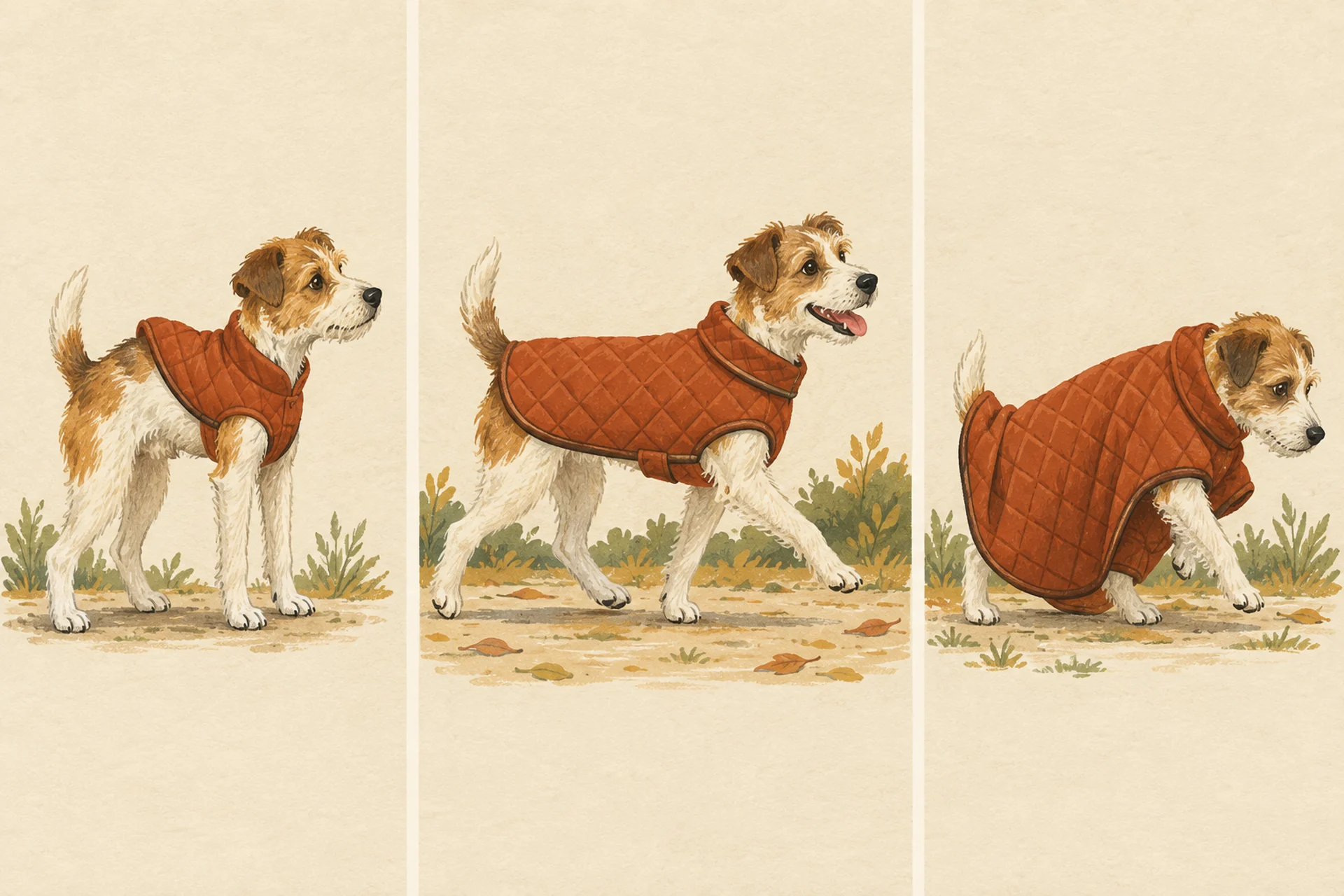
A coat can pass every finger check and still fail the moment your dog moves. Before you decide, spend five minutes watching it.
- Walk and trot down a hallway. Watch the front legs. They should reach as far forward as they do without the coat.
- Sit. The back of the coat shouldn’t pull tight over the hips, and the belly edge shouldn’t dig in.
- Lie down. Look for the coat pressing into the armpits or the neck riding up under the chin.
- Let your dog shake. A good fit settles back into place. A loose one ends up halfway round the body.
- Stairs or a step, if you have one. Tripping on a hem shows up here first.
The AKC lays out what you’re watching for on both sides. Clothes that are too tight restrict movement and can lead to injuries, and overly baggy clothing can make a dog trip or get caught on something, which can be frightening or painful. Its sweater guide adds that a baggy sweater can leave a dog caught or tangled.
One thing to allow for: a new coat in stiff, waterproof fabric often feels tighter on day one than it will after a few wears. Stiffness that eases is normal. A chest that fails the two-finger test isn’t going to relax into a fit.
Between two sizes: which problem can you live with?
When the try-on lands between sizes, ask which part is wrong rather than going one size up or down by reflex.
- Chest tight, length fine: go up a size. The chest is the one measurement you can’t adjust, and a tight chest is the fit that restricts movement.
- Chest right, a bit long: usually keep it, as long as the belly edge stays clear when your dog pees and nothing drags. Straps and cuffs can take up some extra length. They can’t add chest room.
- Chest right, a bit short: keep it for cold, dry walks. In rain or snow, a coat that stops mid-back leaves the hips wet, and wet fur loses heat. The AKC notes that wet body parts are more prone to frostbite.
- Everything loose: go down a size. Twisting, tripping and snagging get worse outdoors, not better.
Four-leg suits are the exception. The legs only line up if the body length is right, so with a suit, match back length first and then check girth. Our sizing guide covers what to do between sizes for each type of garment before you order. Giant breeds have problems of their own, covered in dog coats for giant breeds.
Layering changes the fit
If your dog will wear a sweater under a rain shell, or a light rain suit under a padded coat, do the try-on with both layers on. A shell that fits perfectly over bare fur can fail the two-finger test over a sweater. The outer layer usually needs to fit the dog as it will actually be dressed in January, not as it is in October.
Whether your dog needs a layer at all is a separate question. What temperature does a dog need a coat? covers the lines vets actually draw. Cornell’s veterinary college notes that smaller breeds, older dogs and thin-coated dogs are the ones a jacket or sweater helps most.
After the first few walks
A fit that passed the living-room test still needs one more check, after real walks.
- Look under the armpits and along the strap line when the coat comes off. Flattened or thinning fur, or skin that looks red, means something is rubbing. If the skin looks sore, leave the coat off and have your veterinarian take a look.
- Feel underneath. Damp fur under a coat after a dry walk can mean the dog is too warm in it. Our overheating guide has the ten-minute check.
- Wash it. The AKC says dog sweaters need regular washing. A veterinarian quoted in its winter coat guide adds that coats collect hair and dander and can become a breeding ground for bacteria, especially if they’re put away damp after snow.
- Take it off when you leave. A coat that fits isn’t something to leave on unsupervised. The AKC’s advice is not to leave clothes on a dog that is crated or left unattended, because clothing can snag and become a choking hazard.
If your dog freezes, sits down or tries to back out of every coat, that’s usually about getting used to clothing rather than fit. How to get your dog used to wearing clothes walks through it step by step.
Before the first walk: the checklist
- Try it on indoors, every fastening done up, before tags come off.
- If your dog fights anything pulled over the head, choose by how the coat goes on first. Our guide to dog coats that don’t go over the head compares the designs.
- Two fingers under each strap; not more than three.
- Neck at the base of the neck; head can drop to sniff.
- Back covered to about the base of the tail; belly covered, edge clear of where your dog pees.
- Watch a walk, a trot, a sit, a lie-down and a shake.
- Planning to layer? Try the outer coat over the inner one.
- After the first few walks, check the armpits and strap line for rubbing.
Dog coat fit: FAQ
How tight should a dog coat be?
Snug enough that you can slide two fingers under the straps, and not so loose that more than three fit. That’s the AKC’s rule of thumb. Your dog should still be able to walk, trot, sit and lie down normally.
How do I know if my dog’s sweater is too small?
Fingers won’t go under the edges, the sweater rides up the back and leaves the hips bare, the armholes cut in when the front legs swing back, or your dog walks stiffly or won’t move. Any of those means go up a size.
How long should a dog coat be?
Measured along the back, it should end at about the base of the tail. Shorter leaves the hips exposed. Longer drapes over the tail or the back legs and can get in the way. Underneath, it should cover the belly without reaching the spot your dog pees from.
Should a dog coat cover the belly?
For warmth, yes. VCA says a jacket or sweater should cover the back, chest and belly, and the ASPCA recommends coverage from the base of the tail to the belly for short-haired dogs. On male dogs, the belly panel has to stop short of where they pee.
Should I size up or down for a dog coat?
For a coat or sweater, size for the chest. If the chest is tight, go up, even if the coat ends up a little long, because extra length can usually be strapped in and a tight chest can’t be fixed. If everything is loose, go down. Four-leg suits are different: match the back length first.
Can my dog wear its coat in the house or in the crate?
Not unsupervised. The AKC advises taking clothes off before a dog is crated or left alone, because a coat can snag or tangle. Indoors with you watching is a different matter, but most dogs that need a coat outside don’t need one in a heated house.
The chart gets you close. The dog decides.
Measuring well gets you to the right size most of the time. The few minutes on the floor tell you whether this coat suits this dog: two fingers under the straps, the back covered to the tail, a belly edge that stays dry, and a dog that trots off without noticing it’s dressed.
Sources
- American Kennel Club — Does Your Dog Need a Raincoat? (two-finger test, weight-based sizing, detachable hoods) (checked 2026-10-05)
- American Kennel Club — Does Your Dog Need a Sweater? (fit, brand-to-brand sizing, washing, supervision) (checked 2026-10-05)
- American Kennel Club — Does My Dog Need a Winter Coat? (movement, entanglement, sanitary cut-outs, laundering) (checked 2026-10-05)
- American Kennel Club — How to Get Your Dog Comfortable Wearing Clothes (too tight, too baggy, crated or unattended) (checked 2026-10-05)
- American Kennel Club — Can Dogs Get Frostbite? (checked 2026-10-04)
- VCA Animal Hospitals — Do Dogs Need Coats in the Winter? (measuring, coverage, brand sizing) (checked 2026-10-05)
- ASPCA — Cold Weather Safety Tips (checked 2026-10-05)
- Cornell University College of Veterinary Medicine, Riney Canine Health Center — Winter safety tips (checked 2026-10-05)
Every brand cuts differently, so always check the size chart on the product you’re buying. If a coat leaves sore or broken skin, or you’re unsure whether your dog needs one, ask your veterinarian.