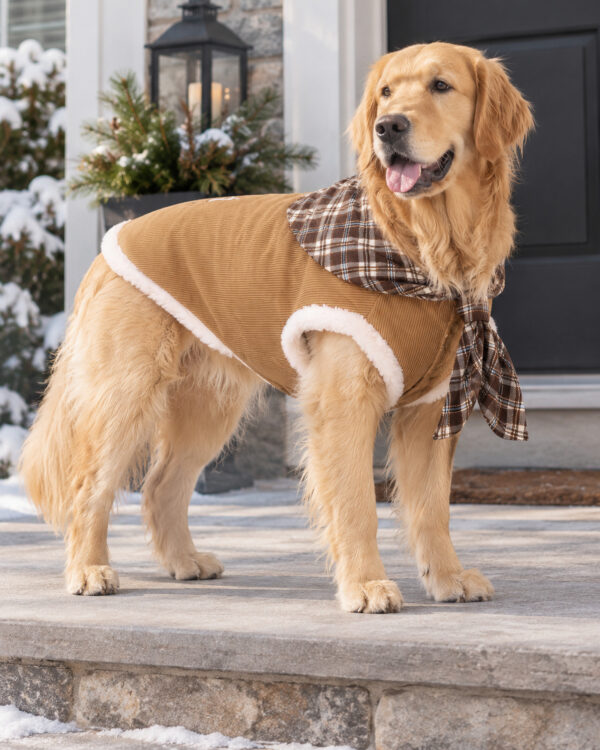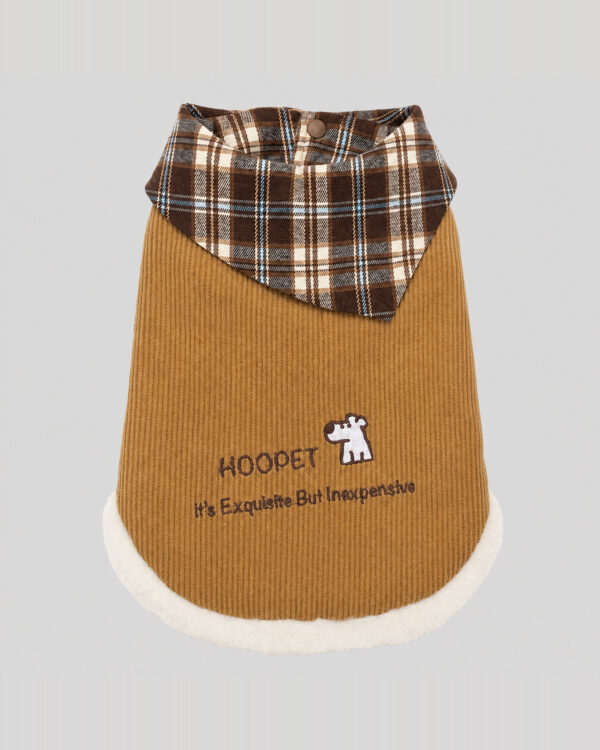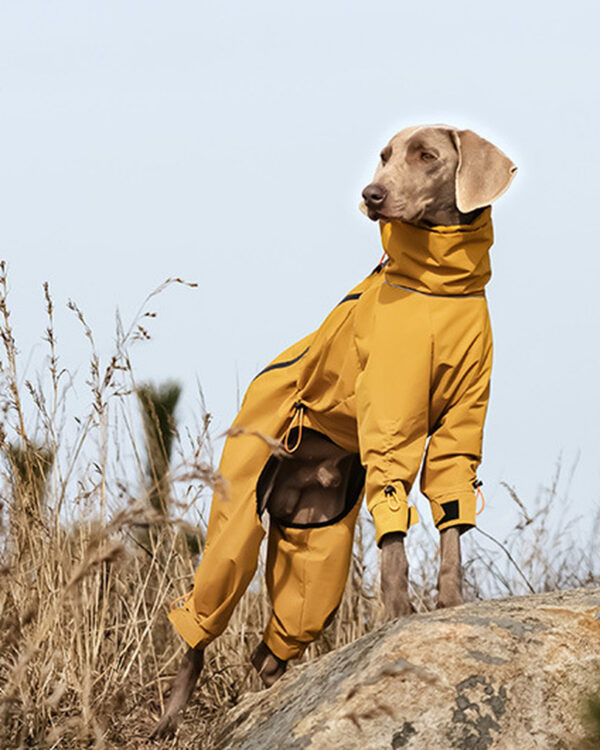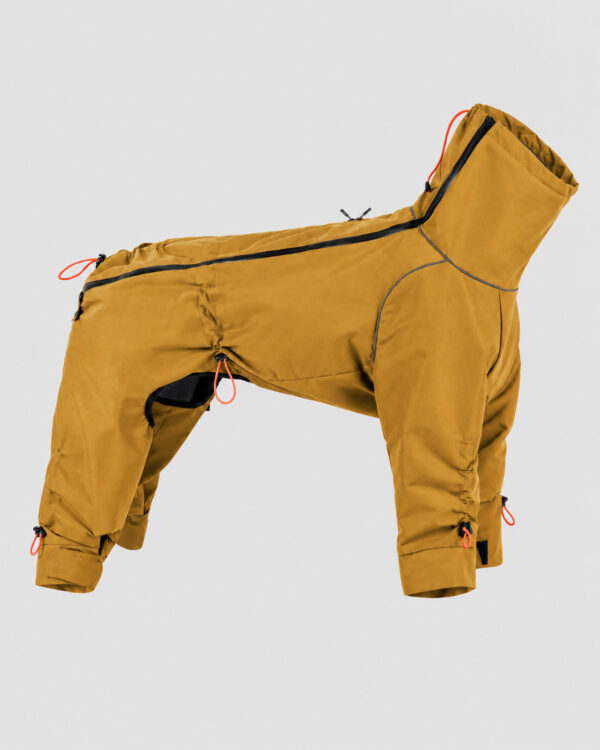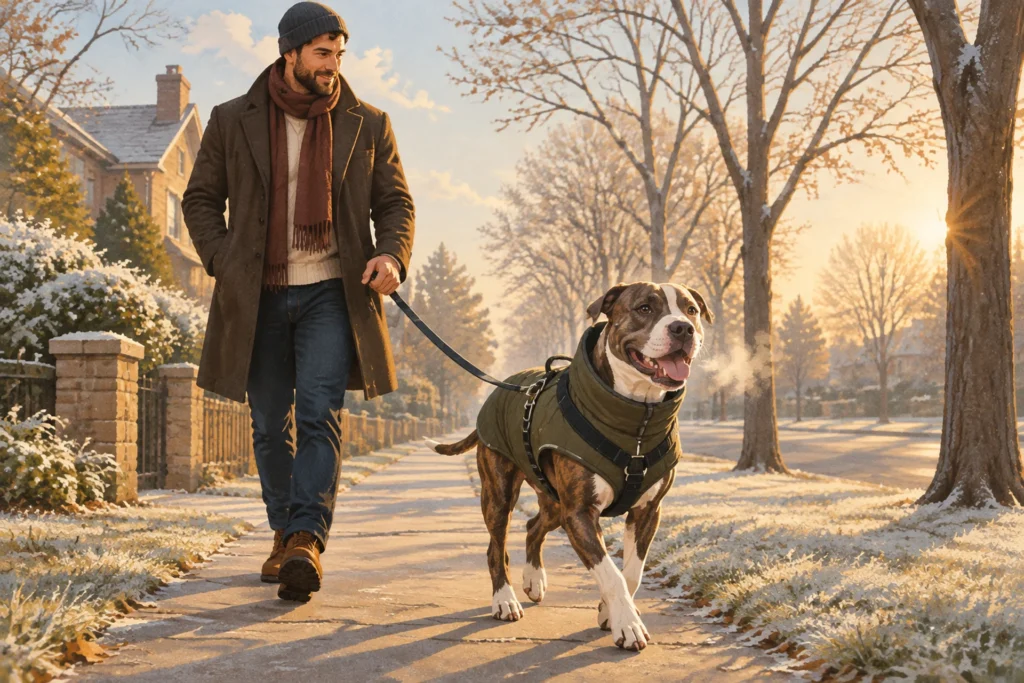
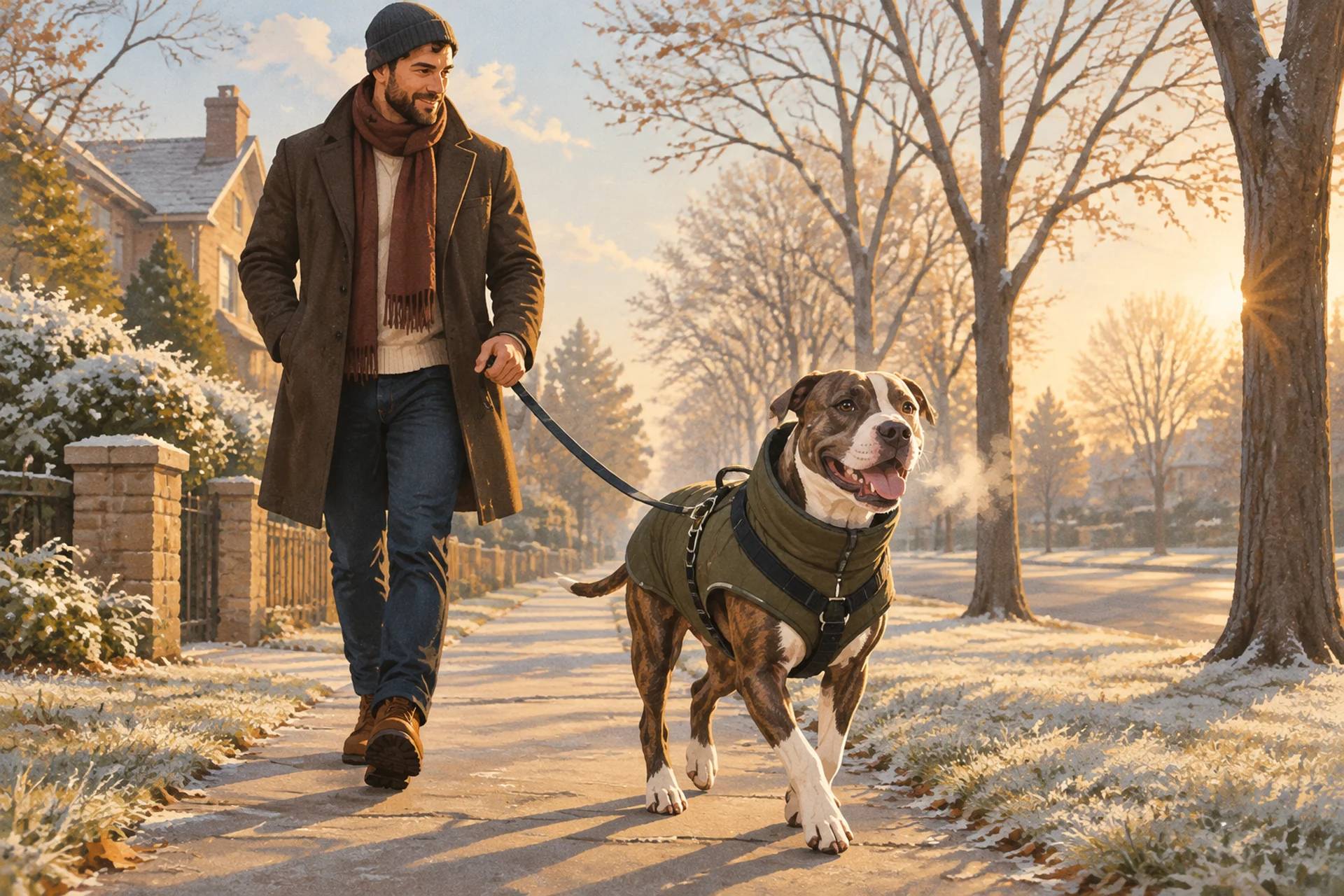
For real winter walks, most pit bulls are better off with one. The reason is the coat, not the dog’s toughness. The AKC breed standard for the American Staffordshire Terrier calls for a coat that is short, close, stiff to the touch, and glossy, and VCA Animal Hospitals says the pit bull’s short coat is not suited to living outside. The AKC puts short-coated dogs on its list of dogs at higher risk of rapid loss of body heat.
That doesn’t mean every pit bull needs a jacket for every trip outside. VCA also says the breed enjoys cold-weather outings. A quick trip to the yard, or a brisk walk on a dry, still day, is often fine without one. The coat earns its place when it’s below freezing, windy or wet, or when you’ll be out long enough for a short-haired dog to lose more heat than it makes.
Why a muscular dog can still get cold
People often say pit bulls are solid, stocky dogs, so they can handle the cold. That’s a reasonable instinct, and it’s half right. Size and condition do matter: Cornell’s Riney Canine Health Center says a dog’s cold tolerance varies with age, size, nutritional status, health and coat thickness. A healthy adult pit bull in good condition does have some things going for it compared with a toy breed.
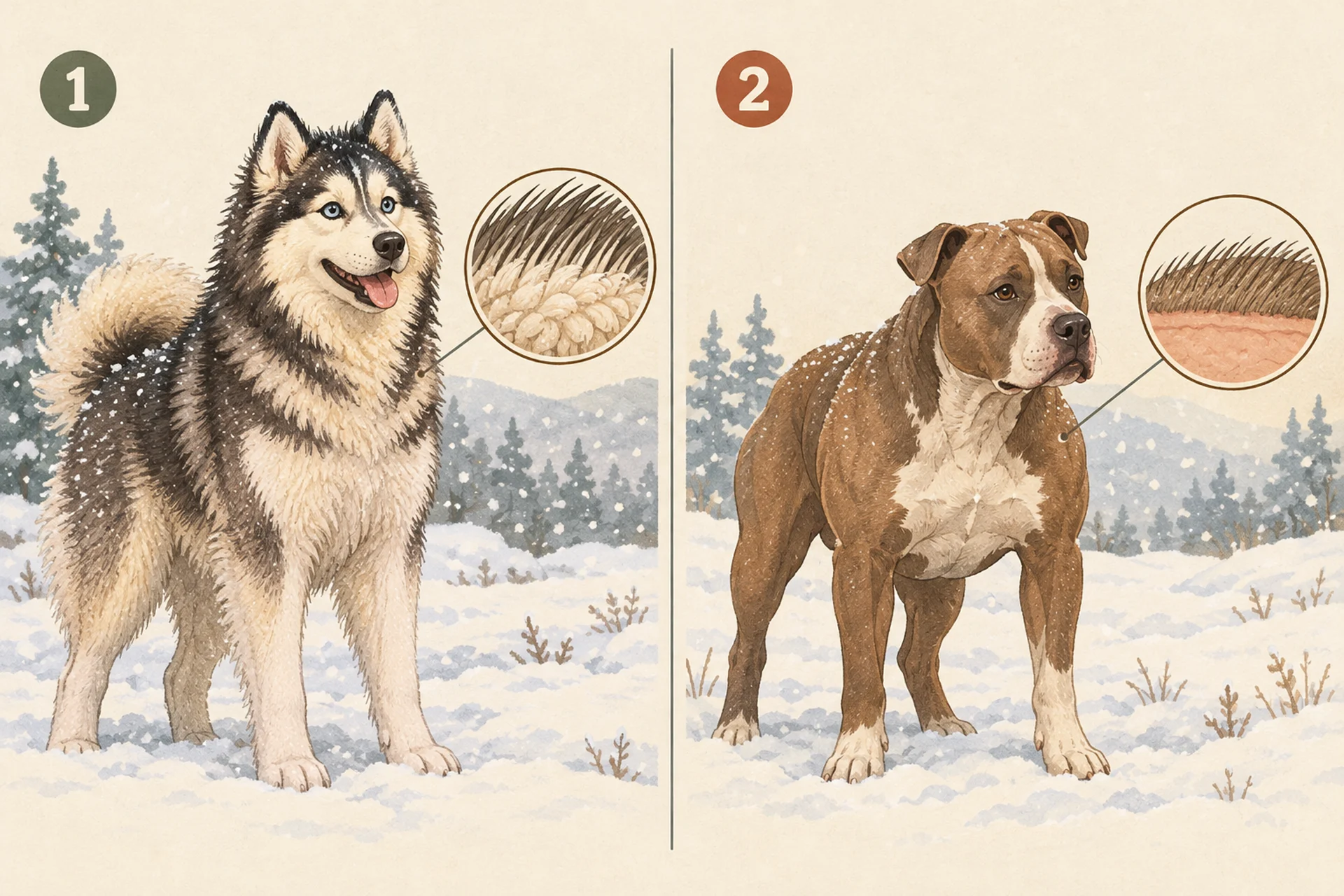
The part the instinct misses is the last item on Cornell’s list. The dogs the AKC describes as built for cold are the thick double-coated breeds, the Siberian Husky, Samoyed, Malamute, Newfoundland and Bernese Mountain Dog. The AKC says those breeds have adapted to extremely cold temperatures because of their thick double coats. A pit bull’s coat is the opposite: short and close to the skin. There is very little fur standing between the skin and the wind.
The AKC’s own coat guide makes the same point from the other side. Among the dogs it says may need a winter coat are high-energy short-coated dogs and lean-bodied dogs. A fit, athletic pit bull often fits both descriptions.
“Pit bull” isn’t one breed, so look at your own dog
“Pit bull” is an everyday name, not one tightly defined breed, and plenty of dogs called pit bulls are mixes. VCA’s breed page for the American Staffordshire Terrier uses the term throughout and describes a dog of about 17 to 19 inches with a short, glossy coat. Your dog may be leaner, heavier, younger, older, or have a slightly denser coat from a mixed background.
So rather than asking what the breed needs, ask what your dog is like on a cold day. These things make a coat more useful:
- A very short or thin coat, where you can see skin through the fur on the belly and inner legs.
- A lean build. The AKC lists lean-bodied dogs among those that may need a coat.
- Age. The AKC lists young puppies and senior dogs, and Cornell lists very young and older dogs, among those that handle cold less well. Our guide on whether older dogs get cold more easily goes into the senior side.
- Health conditions. The AKC’s coat guide mentions dogs with chronic conditions such as arthritis.
- Not used to cold. Cornell says dogs not already conditioned for cold, such as a dog that just moved from a warm climate or a sudden cold snap, are less prepared for it.
When a coat helps and when it doesn’t matter
The AKC is clear that there’s no single number. A veterinarian quoted in its coat guide says there isn’t an exact temperature that’s too cold for all dogs, and as a general recommendation, when the wind chill is below 20 degrees, playtime should be kept to about 15 to 20 minutes at a time, with time indoors to warm up. Our guide on what temperature a dog needs a coat goes through why the online numbers disagree.
For a short-coated dog, here’s how that plays out in practice:
| Situation | Coat? | Why |
|---|---|---|
| Quick yard trip on a cool, dry, still day | Usually not needed | Not out long enough to lose much heat |
| Brisk walk, cold but above freezing and dry | Depends on the dog | Watch for the cold signs below. Lean, young or older dogs are more likely to want one |
| Below freezing, or windy, or wet | Yes, for most pit bulls | Wind and damp take heat from a short coat fast. The AKC lists short-coated dogs as higher risk |
| Wind chill below 20°F | Yes, and keep it short | The AKC’s vet guidance is 15 to 20 minute sessions, then warm up inside |
| Long stretches outdoors or living outside | A coat isn’t the answer | VCA says the short coat isn’t suited to living outside, and the AKC says never leave clothing on an unattended dog |
One number you may see quoted is that dogs can stay out 30 minutes to an hour below 32°F. In the AKC article it comes from, that figure is about the thick double-coated breeds, not short-coated dogs. Don’t borrow it for a pit bull.
Signs your pit bull is cold
Your dog will usually tell you before the thermometer does. Cornell lists the signs to bring a dog inside: shivering, whining or barking, a tucked tail, a hunched stance, lifted paws, reluctance to keep walking, or sudden anxiety. The AKC says shivering and curling up for warmth are among the first signs of mild hypothermia.
With a pit bull, the hunched stance and the lifted paw are worth watching for. They’re easy to miss in a dog that keeps pulling forward. Our guide on how to tell if your dog is cold covers each sign in more detail.
What kind of coat works for a pit bull
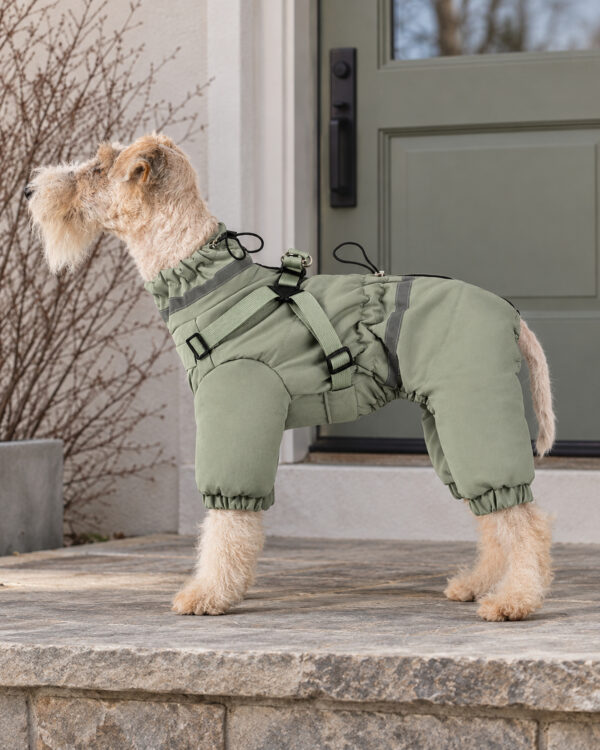
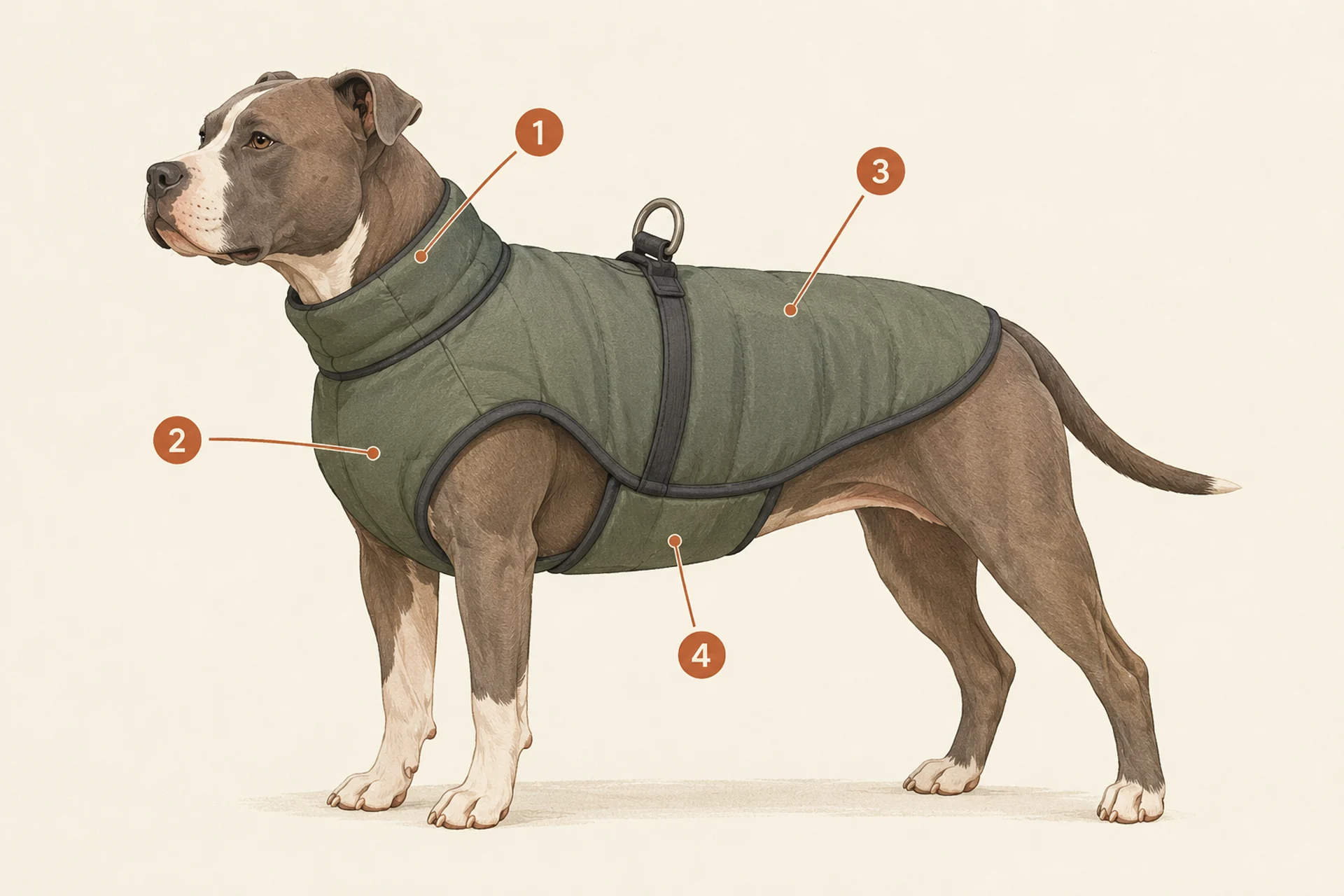
The main fit problem is the chest. The AKC standard describes the chest as deep and broad, and many pit bull type dogs have a broad chest and a narrow waist. A jacket that fits the chest can hang loose at the belly. One sized by length can pinch across the shoulders.
- Measure first. The AKC says to measure the length of the body and the widest part of the chest before buying. For this build, let the chest decide the size. Our guide on how to measure your dog for clothes walks through it.
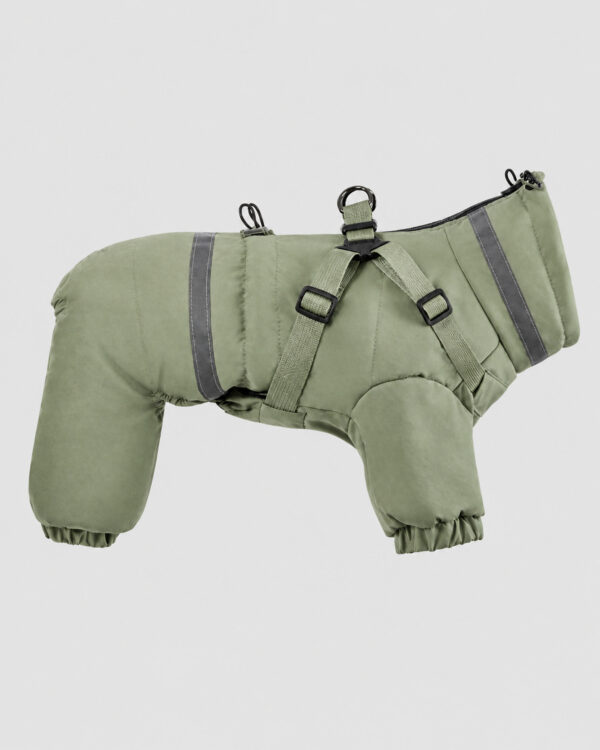
- High collar. For short-haired dogs, the ASPCA suggests a coat or sweater with a high collar or turtleneck.
- Belly coverage. The ASPCA also suggests coverage from the base of the tail to the belly. That’s the part a back-only jacket misses.
- Room to move. The AKC says a good fit lets a dog walk, run and play without restriction, without being so loose that it could get tangled. Check the shoulders when your dog trots.
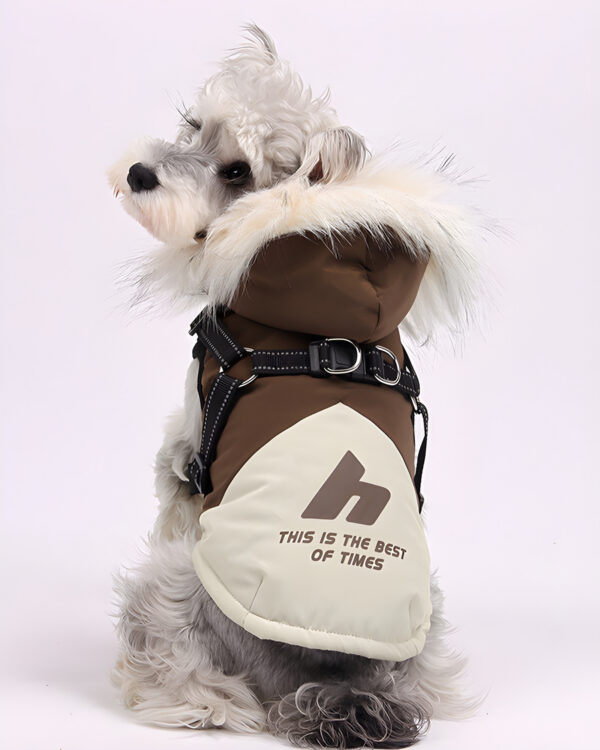
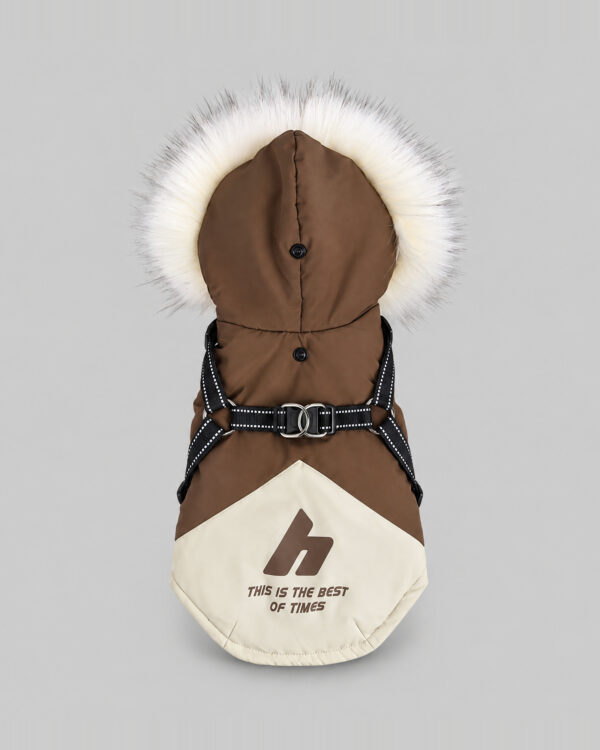
- Insulated for real cold, lighter for cool days. The AKC separates lightweight jackets for cool weather from insulated jackets for snow and extreme cold. Some owners keep one of each.
- A way through for the leash. If your dog walks in a harness, a coat with a leash opening means you don’t have to put the harness over the coat.
Beyond the coat: dry, short and supervised
- Start dry. The AKC says to make sure your dog is dry before taking it out for a walk. Wet fur leaves skin more exposed to frostbite.
- Towel off when you get in. The ASPCA recommends towel drying as soon as you come inside, and Cornell suggests wiping or washing the paws.
- Never leave the coat on an unattended dog. The AKC is direct about it: clothing should never be used on an unattended dog. A coat is for walks with you, not a reason to leave a dog outside.
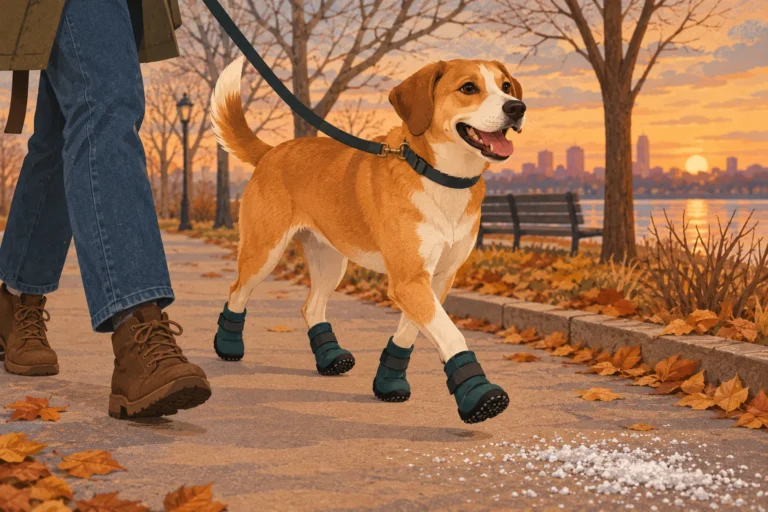
- Think about paws too. Cornell notes that ice and road salt can crack or cut pads. Our guide on whether dogs need boots in winter covers that part.
When it’s a vet call, not a coat question
Most cold dogs warm up fine once they’re inside and dry. The Merck Veterinary Manual says pets that act weak or disoriented, breathe shallowly, or have a slow pulse should be seen by a veterinarian immediately. For frostbite, Merck says affected skin may be pale or red, swollen and painful. The AKC adds: when in doubt, consult your veterinarian. If your dog has a health condition or is very young or old, ask your vet what cold-weather limits make sense for it.
Pit bulls and cold weather FAQ
Do pit bulls need coats in the winter?
For walks in freezing, windy or wet weather, most do. The AKC breed standard describes a short, close coat, VCA says the pit bull’s short coat isn’t suited to living outside, and the AKC lists short-coated dogs among those that lose body heat quickly. For a quick yard trip on a mild, dry day, many don’t need one.
Do pit bulls get cold easily?
More easily than thick-coated breeds. VCA rates the pit bull’s cold tolerance as middling and says it enjoys cold-weather outings but isn’t suited to living outside. Cornell says cold tolerance also depends on age, size, nutrition, health and whether the dog is used to cold, so it varies from dog to dog.
Do pit bulls have double coats?
The AKC standard for the American Staffordshire Terrier describes a short, close, stiff, glossy coat, nothing like the thick double coats the AKC credits for cold tolerance in Huskies and Malamutes. Mixed dogs vary, so look at your own dog’s fur.
How cold is too cold for a pit bull?
There’s no single number. A vet quoted by the AKC says there isn’t one temperature that’s too cold for all dogs, and recommends keeping play to 15 to 20 minutes at a time when the wind chill is below 20°F. For a short-coated dog, bring it in at the first signs of cold, such as shivering, lifted paws or a hunched stance.
Can a pit bull live outside in winter if it has a coat?
No. VCA says the pit bull’s short coat isn’t suited to living outside, and the AKC says clothing should never be used on an unattended dog. A coat is for supervised time outdoors with you.
Should a pit bull wear a jacket or a sweater?
It depends on the weather. The AKC suggests lightweight jackets for cool days and insulated jackets for snow and extreme cold. For short-haired dogs, the ASPCA suggests a high collar and coverage from the base of the tail to the belly, whichever type you choose.
Sources
- American Kennel Club — Official Standard of the American Staffordshire Terrier (checked 2026-10-26)
- VCA Animal Hospitals — American Staffordshire Terrier (checked 2026-10-26)
- American Kennel Club — Hypothermia in Dogs: How Cold Is Too Cold? (checked 2026-10-26)
- American Kennel Club — Does My Dog Need a Winter Coat? (checked 2026-10-26)
- American Kennel Club — How Long Can You Keep Your Dog Outside? (checked 2026-10-26)
- Cornell University College of Veterinary Medicine, Riney Canine Health Center — Winter safety tips (checked 2026-10-26)
- ASPCA — Cold Weather Safety Tips (checked 2026-10-26)
- Merck Veterinary Manual — Keeping Pets Safe During Cold Winter Months (checked 2026-10-26)
This guide is general information, not veterinary advice. If your dog has a health condition, ask your veterinarian what cold-weather limits make sense for it.
Tough dog, thin coat. Dress for the coat.
A pit bull’s muscle doesn’t make up for a short, close coat. Skip the jacket for quick trips on mild days, put a fitted one on for freezing, windy or wet walks, keep the coldest outings short, and never leave a coated dog outside alone. Watch for shivering, lifted paws or a hunched stance, and head home when you see them.