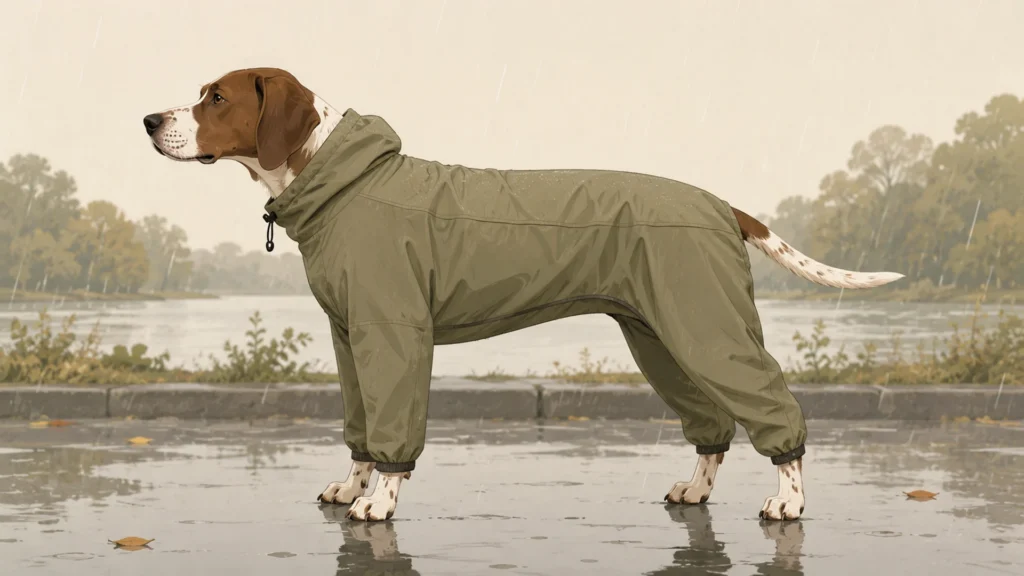
Your dog toilets in a full-body rain suit the same way they toilet without one — provided the suit’s underside hem ends somewhere useful. Nothing about the posture changes. What changes is whether a panel of fabric is sitting in the path.
Which means the question “does it cover the belly?” has no single right answer. A closed belly panel keeps road spray off the undercarriage and gets in the way at the lamp post. An open or short underside stays clear and lets spray up. Where your dog’s stream actually leaves the body decides which trade-off you want, and that differs between a male and a female dog.
Why the listing photo never answers this
Full-body rain suits are photographed from the side and from above, standing still, on dry ground. The one view that would settle the question — the dog from underneath — is the one nobody shoots. So you buy the suit, walk out into actual rain, and discover the answer at the first lamp post.
It is a fair question and it comes up constantly, usually phrased more bluntly than this. It also has a real answer, and the answer is geometric rather than a matter of opinion.
Three underside cuts, and what each one does
Strip away the marketing names and full-coverage suits resolve into three underside treatments. Everything else — hood, tail sleeve, closure style — sits on top of this choice.
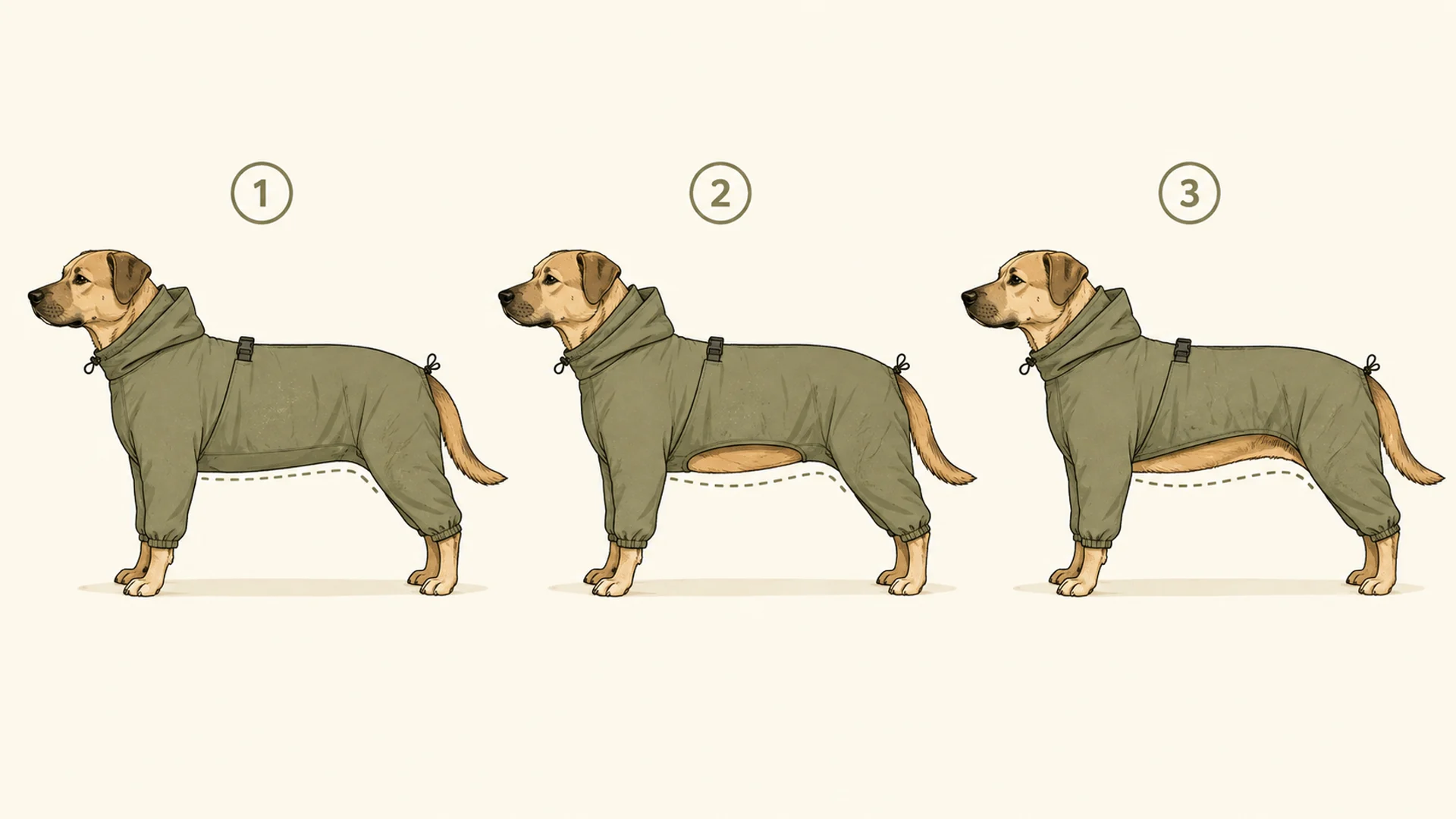
| Underside cut | What it solves | What it costs | Suits |
|---|---|---|---|
| Closed belly panel | Road spray and mud thrown up from below; warmth on a thin-coated dog | Sits directly in the path for a male dog; damp fabric held against skin | Female dogs, low-slung dogs, short walks in heavy spray |
| Belly cutout | Keeps flank and chest coverage while leaving the middle of the underside open | An opening is a gap — spray gets through it | Male dogs who need real coverage everywhere else |
| High-cut short underside | Nothing to unfasten, nothing to soil, quickest on and off | Undercarriage stays wet and muddy; you still towel the belly at the door | Tall dogs with ground clearance; dogs who are only out briefly |
Note the middle row. A cutout is not a compromise design — it is the specific fix for the specific problem, and it is the one the American Kennel Club’s guide to measuring a dog for clothes and gear names outright: if the clothing has no cutout for the belly area, the AKC advises shortening the underside fit slightly to prevent accidents. That advice is aimed at male dogs, and it is the whole answer to the question in one sentence — either the garment has the opening, or you buy one whose underside ends higher.
Where the hem has to clear depends on your dog
The two toileting postures put the pressure on completely different parts of the garment, which is why one suit can work perfectly for one dog in a household and fail for the other.
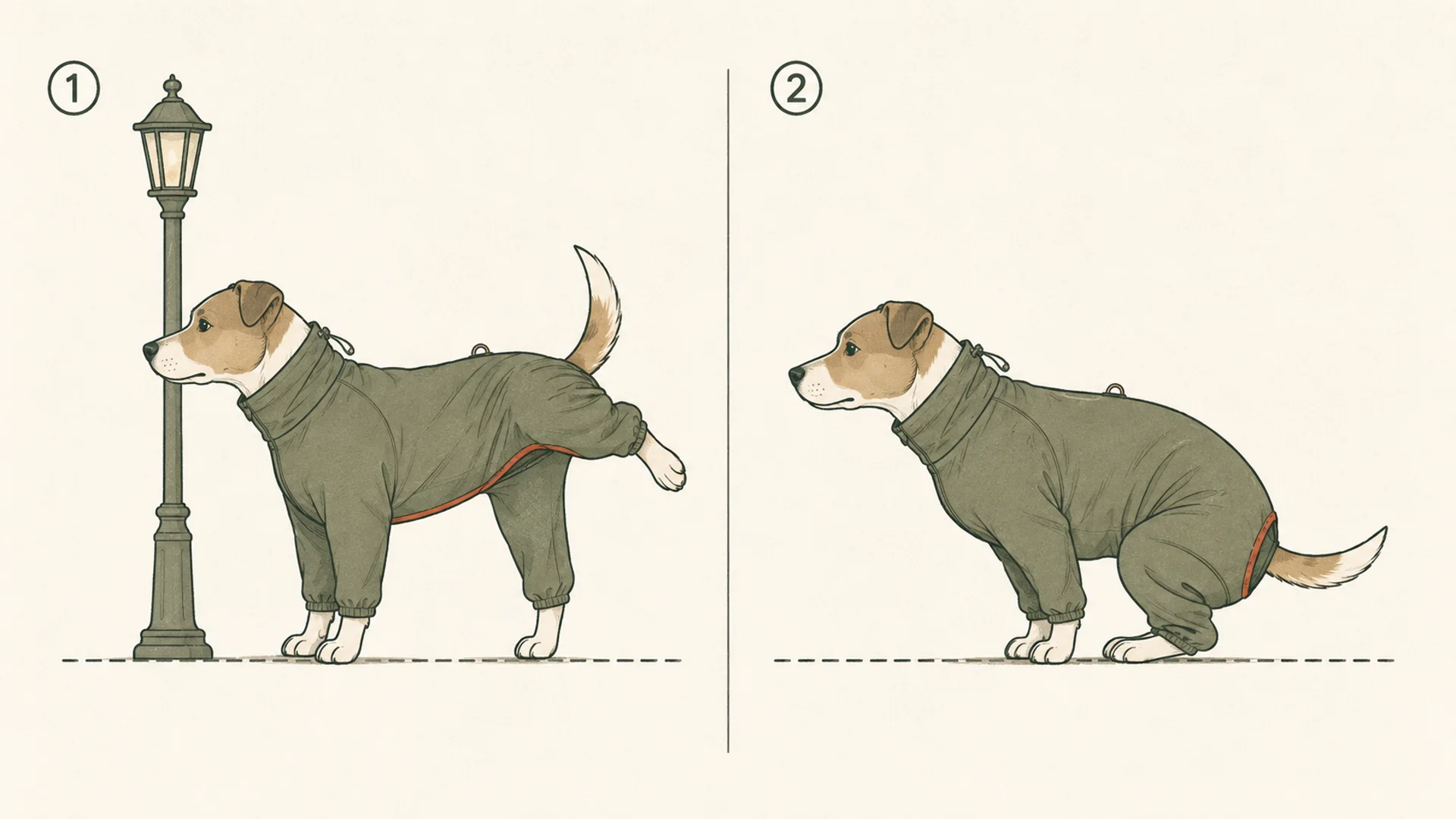
For a male dog, the relevant anatomy sits forward, roughly under the mid-belly, which is exactly where a closed panel runs. For a female dog it sits at the rear, under the tail, which is why the failure mode there is a rear hem cut too long or a tail sleeve that closes too far down. The Merck Veterinary Manual, discussing dogs who leak urine, describes the outcome in plain terms: “The coat around the vulva or prepuce can be wet, and perivulvar or peripreputial dermatitis can result from urine scalding.” That passage is about incontinence rather than raincoats, but it names the mechanism precisely, and the mechanism does not care why the coat is wet.
This is a skin question, not just a laundry question
The reason to get this right is not the smell. It is that a rain suit is, by design, a layer that holds moisture against the dog for the length of a walk. Merck’s discussion of pyoderma is blunt about what that does: “Any condition that changes the normally dry environment of the skin to a more moist one can predispose the host to overcolonization of the skin by resident and transient bacteria.” The same page lists the areas already at higher risk — among them vulvar folds and tail folds, which is to say the exact region under discussion.
None of that makes a rain suit a bad idea. It makes the after-walk step non-optional. The ASPCA’s cold-weather guidance already asks owners to wash and dry a pet’s feet and stomach after each walk to clear ice, salt and chemicals; if the suit’s underside got soiled, that towel is doing a second job. Take the suit off at the door rather than letting it dry on the dog, and hang it where it will actually dry before the next outing.
And to state the obvious boundary: a dog straining, going more often than usual, or suddenly unable to hold it is not a garment problem. Take any sudden change in toileting to your veterinarian, who can examine the dog — nothing on this page is a diagnosis.
What to check before you buy
- Is there a photograph or diagram of the underside? If the seller will not show you the belly of the garment, assume it is a closed panel.
- For a male dog: does the suit have a cutout, or does its underside stop short? One of the two, or keep looking.
- For a female dog: how far down does the rear hem sit, and does the tail opening leave the area under the tail clear?
- Can the belly closure be opened one-handed, in the rain, with a leash in the other hand? A closure that needs two hands and good light is a closure you will stop using.
- Check the fit before you judge the cut. The AKC’s test is to slide two fingers under the straps: fewer than two and it is too tight, more than three and it is too loose. A suit sagging loose under the belly will catch what a correctly fitted one clears.
- Does it dry quickly, and can you get it off without turning it inside out over the dog’s head?
If your dog is long-backed, the arithmetic tightens further — the coat that finally reaches the base of the tail is the same coat with the longest underside — and our guide to raincoats for long-bodied dogs covers how to read the size chart for that shape. Whether the legs need covering at all is a separate decision, laid out in our comparison of rain suits with the legs covered or not.
TuckTrail pick
If the sex-specific cut is the deciding factor, the Trail Boy-or-Girl Cut Large-Dog Rain Suit is built around it rather than treating it as an afterthought. Check the size chart on the product page for the measurements that matter for your dog.
Dog rain suit belly coverage FAQ
Can a dog pee with a full-body rain suit on?
Yes. The posture is unchanged. Whether it stays clean depends on where the suit’s underside hem ends — on a male dog, a closed belly panel that runs the full length of the underside is the design that causes trouble, and either a belly cutout or a shorter underside solves it.
Do I have to take the suit off for my dog to go?
With a cutout or a high-cut underside, no. With a closed belly panel, you either unfasten the belly closure first or accept that the panel may need washing. This is worth testing in the garden before you rely on it on a walk.
What about pooping — does the suit get in the way?
Less often, because the squat loads the rear of the garment rather than the middle. The two things to look at are how far the rear hem drops and whether a tail sleeve closes too far down the tail. A hem that clears when the dog is standing can still be in the way when the dog crouches.
Is a belly cutout a design flaw?
No — it is a deliberate answer to a real constraint. An opening does let spray through, so a cutout suit is a slightly less complete rain barrier than a closed one. That is the trade you are making, and for a male dog it is usually the right one.
My dog’s suit got urine on it. Does that matter?
For the garment, wash it before the next wear. For the dog, the concern is fur held damp against skin: Merck’s veterinary guidance links a persistently wet coat around the prepuce or vulva to urine scalding and dermatitis. Dry the area, take the suit off indoors rather than letting it dry on the dog, and ask your veterinarian about any redness or soreness.
Is a “mud suit” different from a rain suit down there?
No — mud suit, slush suit and splash suit are shop names for the same four-leg shape, and the belly question is identical whichever word the listing uses. The comparison is in dog mud suits: what they actually solve.
Should I just skip belly coverage entirely?
On a tall dog with real ground clearance, often yes — there is less spray reaching the undercarriage and less to gain. On a short-legged dog walking through standing water, the belly is the part getting wettest, and giving up on it defeats most of the point of a full suit.
Sources
- American Kennel Club — How to Measure Your Dog for Clothes and Gear (back length, chest girth and neck girth; measure standing; size up when between sizes; if there is no belly cutout, shorten the underside fit to prevent accidents) (checked 2026-09-04)
- American Kennel Club — Does Your Dog Need a Raincoat? (the two-finger slide test for straps; quick-drying interiors; towelling a dog dry after rain) (checked 2026-09-04)
- Merck Veterinary Manual — Disorders of Micturition in Dogs and Cats (a wet coat around the vulva or prepuce, and perivulvar or peripreputial dermatitis resulting from urine scalding) (checked 2026-09-04)
- Merck Veterinary Manual — Pyoderma in Dogs and Cats (moisture changing the skin’s normally dry environment predisposes overcolonization by bacteria; vulvar and tail folds among the higher-risk areas) (checked 2026-09-04)
- ASPCA — Cold Weather Safety Tips (coverage from the base of the tail to the belly for short-haired dogs; wash and dry your pet’s feet and stomach after each walk) (checked 2026-09-04)
Veterinary guidance is updated periodically. Confirm on the official pages, and talk to your own veterinarian about your own dog — nothing here is a diagnosis, a medication recommendation, or a substitute for an exam.
Buy the underside, not the outside.
Hoods and colours are the easy part. The line that decides whether a full-body rain suit is a daily habit or a drawer ornament is the one running along the belly — closed for a female dog who needs spray protection, cut out or shortened for a male dog, high-cut for a tall dog who is only out for ten minutes. Look at that line before anything else, and take the suit off at the door.