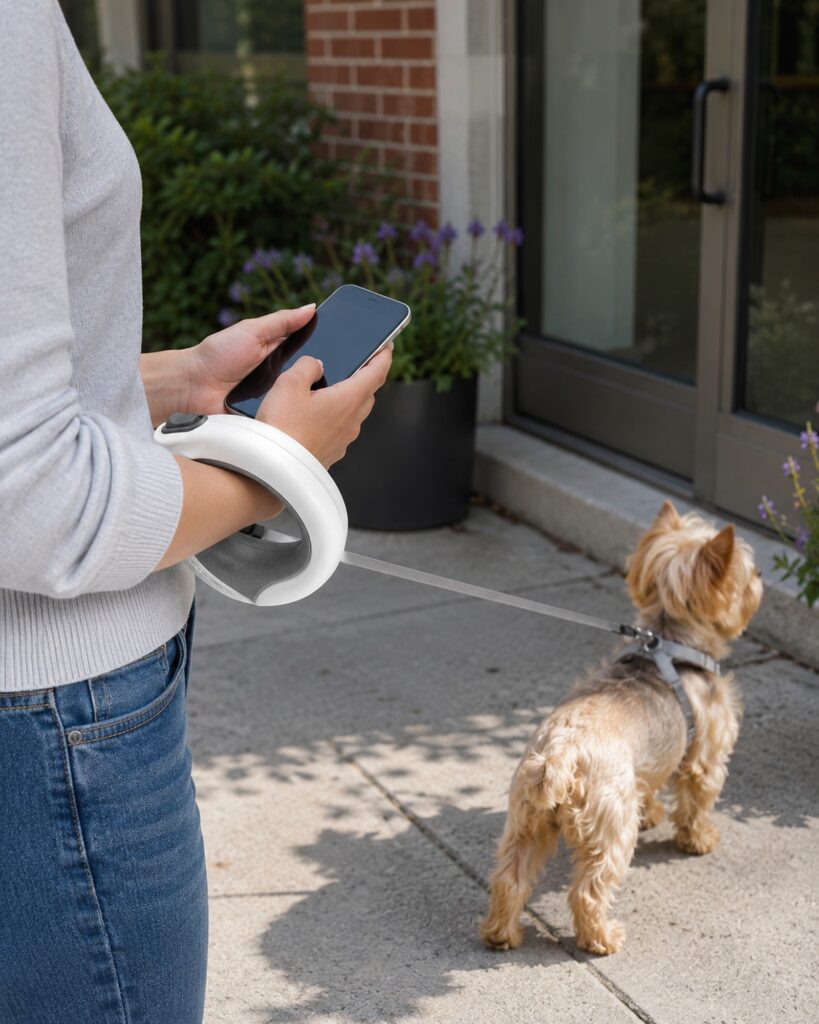
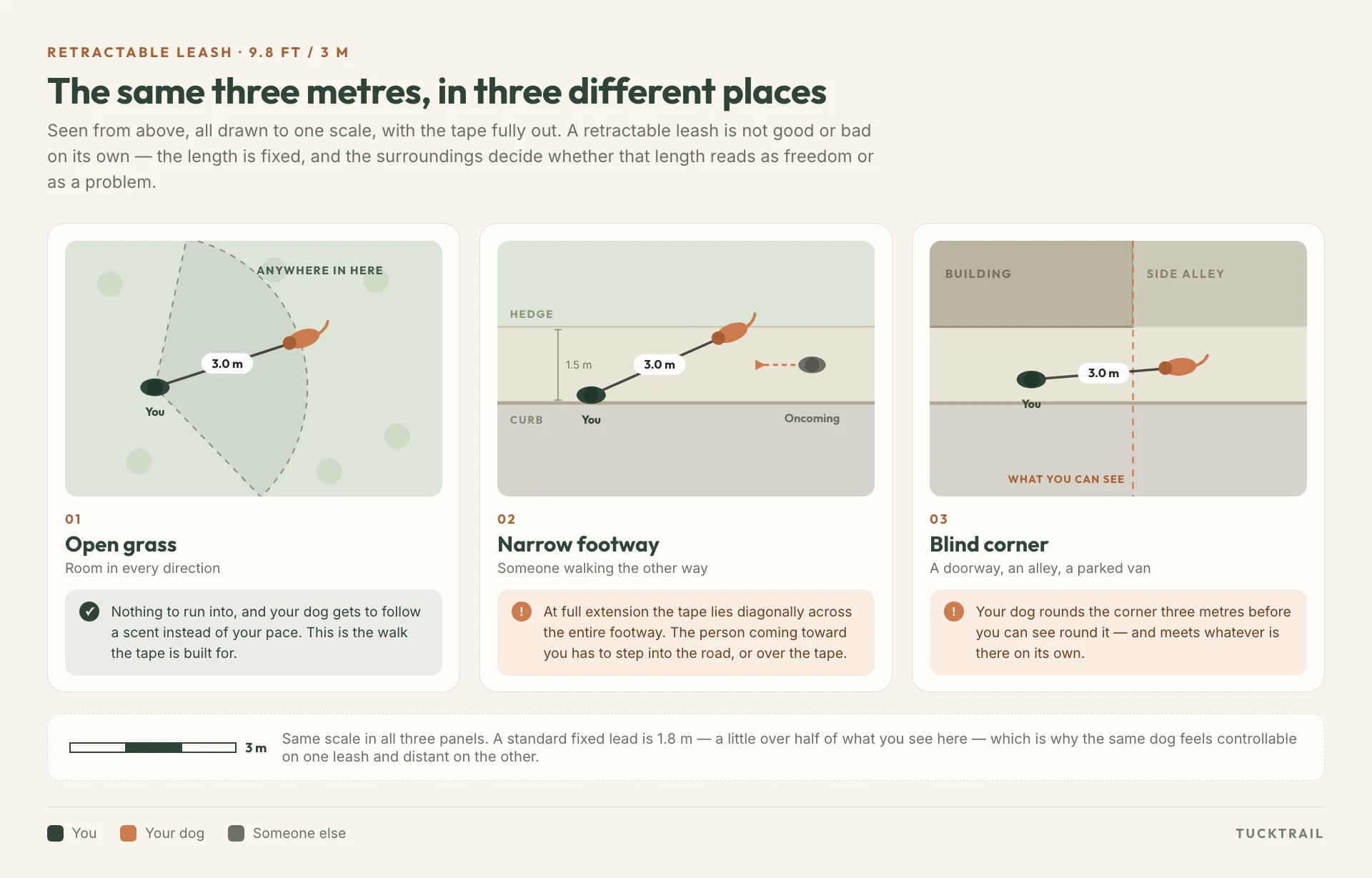
A retractable leash is not good or bad on its own. The tape is a fixed length — ours runs 9.8 ft, or 3 m — and the street decides whether that length reads as freedom or as a problem. On open ground it lets your dog follow a scent instead of your pace. On a narrow footway it lies across the whole path, and at a blind corner it puts your dog somewhere you cannot see.
Which means the skill is not choosing between leash types. It is knowing how much tape should be out where, and reeling in before you get there rather than after.
What the length is actually for
Sniffing is not a delay in a walk; for most dogs it is the walk. A fixed 1.8 m lead keeps a dog inside your stride, which is what you want beside traffic and exactly what you do not want in a field. Three metres lets a dog drift to a hedge, work it out, and come back without you stopping. That is the real argument for a retractable leash, and it is a good one.
It works on the condition in the first panel: room in every direction and nothing your dog can reach before you do. Take that condition away and the same length starts to cost you something.
Where it goes wrong, specifically
The footway
A typical residential footway is about 1.5 m wide. With 3 m of tape out and a dog quartering ahead, the tape sits diagonally across the entire width of it. Anyone walking toward you has to step into the road or step over the line — and a cyclist coming the other way has no good option at all. This is where most of the public dislike of retractable leashes comes from, and it is earned.
The blind corner
Doorways, alley mouths, parked vans, the corner of a building. Your dog rounds it three metres before you can see round it, and meets whatever is there on its own — another dog on a short lead, a child, a cyclist. No brake helps here, because by the time you have the information, your dog has already had the encounter.
The junction
The same geometry with worse consequences. Three metres is roughly the distance from a footway to the middle of a traffic lane. There is no version of a thumb brake that resolves that after the fact.
The brake locks the drum. It does not stop the dog.
This is the mechanical fact worth understanding before buying one, and it is the source of most disappointment with the category.
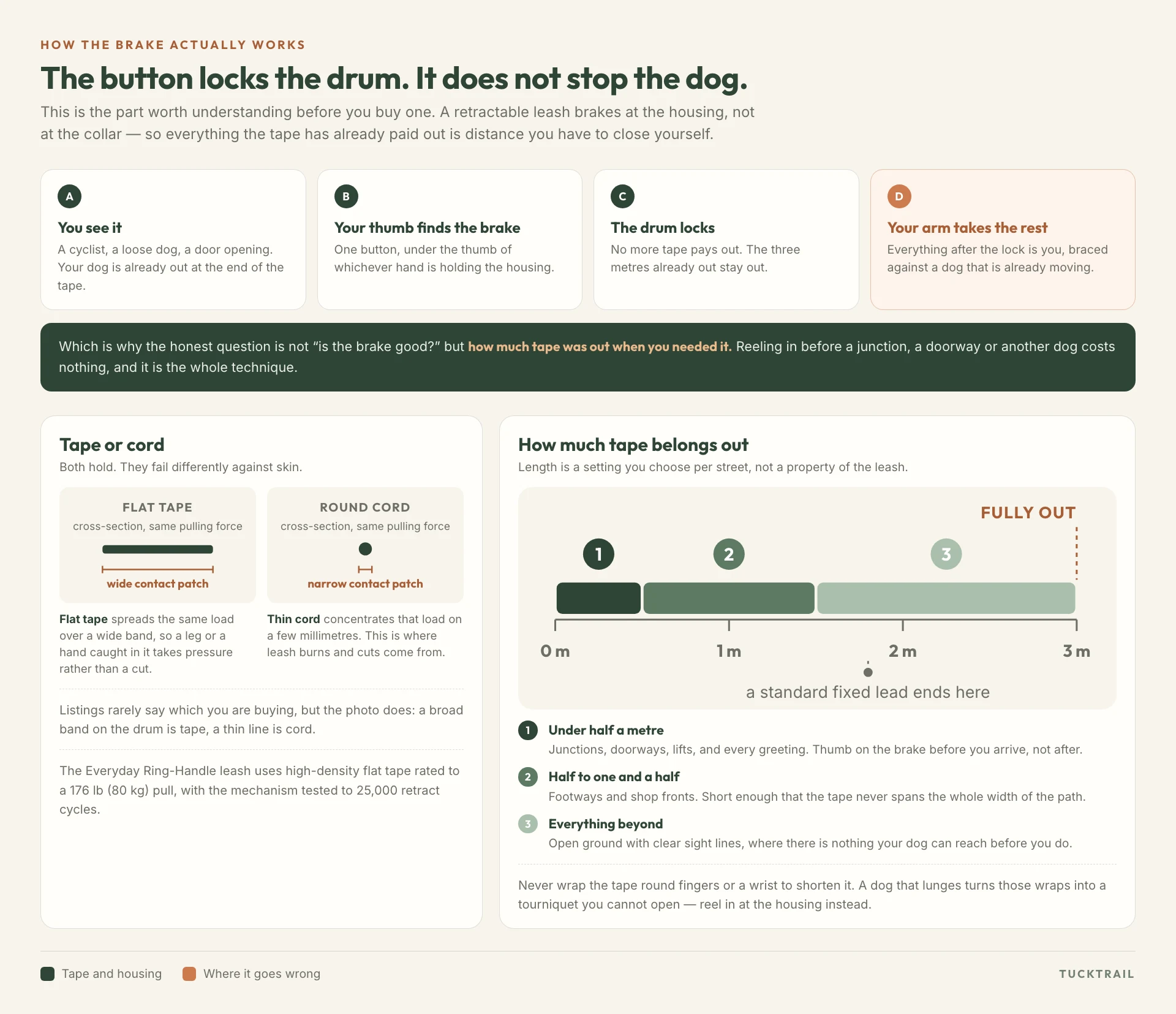
You see something. Your thumb finds the button. The drum locks. And the three metres already out stay out — everything from there is you, braced against a dog that is already moving. A retractable leash brakes at the housing, not at the collar.
So the honest question is never “is the brake any good?” It is how much tape was out when you needed it. Reeling in as you approach a junction, a doorway or another dog costs nothing and takes a second, and it is essentially the entire technique. If you find yourself grabbing the tape itself to control your dog, the length was wrong for that street.
Tape or cord
Both hold. They fail differently against skin. A thin round cord concentrates a load onto a few millimetres, which is where leash burns and cuts come from — to a leg, a hand, or another person’s ankle. Flat tape spreads the same load across a wide band, so contact means pressure rather than a cut. Listings rarely say which you are getting, but the photo does: a broad band wound on the drum is tape, a thin line is cord.
Either way, never wrap the tape around fingers or a wrist to shorten it. A dog that lunges turns those wraps into a tourniquet you cannot open. Reel in at the housing instead.
How to read the numbers on the box
| Spec | What it tells you | What it does not |
|---|---|---|
| Pull rating (ours: 176 lb / 80 kg) | What the tape is rated to take without failing | What size dog you can hold. A sprinting dog generates a peak force well above its own weight, and your arm is the part that has to absorb it |
| Cycle test (ours: 25,000 retracts) | That the recoil mechanism was tested for a long service life | That a spring cannot fail. Retract the tape by hand rather than letting it snap back, and it lasts longer |
| Tape length (ours: 9.8 ft / 3 m) | Maximum reach when fully extended | Anything about the length you should be walking at, which is a setting you change per street |
| Weight class (“small and medium dogs”) | The band the housing and mechanism were designed around | Whether your particular dog pulls. A determined 40 lb dog is harder to manage than a calm 70 lb one |
The rating that matters most is not printed anywhere: whether you can stop this dog with one hand while the other is holding something. If the answer is no, the length is not your first problem.
When a fixed lead is simply the right tool
- A dog still learning to walk on a loose leash — constant light tension teaches pulling, which is the opposite of the lesson
- Any dog stronger than you can hold one-handed without bracing
- Dense city blocks, shop fronts, markets, anywhere the footway is shared at close quarters
- Vet waiting rooms, lifts, public transport, and any indoor space with corners
- Reactive dogs, or dogs who have not met the dog coming the other way
None of that makes a retractable leash a bad object. It makes it a second leash: the one that goes in the bag for the open part of the walk, alongside the fixed lead you use to get there. Plenty of people carry both, and that is the setup we would recommend over trying to make one leash cover every street. A third option sits alongside them for anyone who wants both hands back — see whether a hands-free waist leash is actually safe, and what the emergency-room data says about the trade. For the wet half of the year, the same logic applies to what your dog wears — see how much rain coverage a walk actually calls for.
Collar or harness
A retractable leash keeps light tension on the line at all times — that is how the recoil works. On a flat collar that tension sits on the neck for the whole walk, and any sudden hit at the end of 3 m lands there too. Clip to a well-fitted harness instead. The attachment point moves the load onto the chest and shoulders, and it also means a dog who hits the end of the tape is turned rather than jolted at the throat.
About the light
Lit retractable leashes are worth being precise about. The glow band on our housing and the lamp at the front do two useful things: they show you where the handle and the near path are on a dark street, and they make the leash itself visible at close range. What they are not is a way to be seen by a driver at distance. If you walk near traffic after dark, that job belongs to a reflective vest or a clip-on beacon on you and on your dog — not to a leash light.
The TuckTrail pick
The Everyday Ring-Handle LED Retractable Dog Leash is built for small and medium dogs: 9.8 ft (3 m) of high-density flat tape rated to a 176 lb (80 kg) pull, with the mechanism tested to 25,000 retract cycles and a thumb control on top of the housing. The open ring sits in the palm as a handle or slips over the wrist when you need a hand free.
The lit version carries a curved glow band along the housing plus a separate front lamp for the nearby path, both running off a built-in battery that charges over USB-C — no coin cells. Choose With LED for the lit version or No LED for the same ring-handle leash without it, in Pearl White or Mint Green. Browse the rest in Leashes & Harnesses, or see how we pack for trail days in the Walk & Hike guide.
Retractable leash FAQ
Are retractable leashes bad?
They are bad in the wrong place, which is most of a city walk. On open ground with sight lines they do something a fixed lead cannot. The failure mode is treating one leash as correct for every street rather than changing the length as the street changes.
Can I train loose-leash walking on a retractable leash?
No — it works against the lesson. The recoil means there is always slight tension, so your dog never gets the clear “tension means stop, slack means go” signal that loose-leash training depends on. Train on a fixed lead, then add the retractable for the parts of the walk where range is the point.
How long should a dog leash be?
Around 1.8 m for streets and close quarters, well under a metre through junctions, doorways and greetings, and as much as you like on open ground with clear sight lines. A retractable leash is one leash that covers all three, provided you actually change the setting.
Should a retractable leash clip to a collar or a harness?
A harness. The constant light tension of the recoil, and any sudden stop at the end of the tape, both sit better on the chest than on the neck.
What does the pull rating actually mean?
It describes the tape, not your grip. A rating well above your dog’s body weight is normal and necessary, because a dog hitting the end of a line at speed briefly generates far more force than it weighs. It is not a statement that you can hold that much.
Does a leash light make us visible to drivers?
Not at any useful distance. Treat a leash light as something that helps you see the handle and the ground near you. Being seen by traffic is a job for reflective or lit gear worn on you and your dog.
Three metres is a setting, not a property of the leash.
Buy a retractable leash for the open part of your walk and carry a fixed lead for the rest, or accept that the retractable one has to be reeled in before every junction, doorway and greeting rather than after. Choose flat tape over thin cord, clip to a harness, keep a thumb on the brake as you approach anything you cannot see past — and remember that the button stops the drum, never the dog.