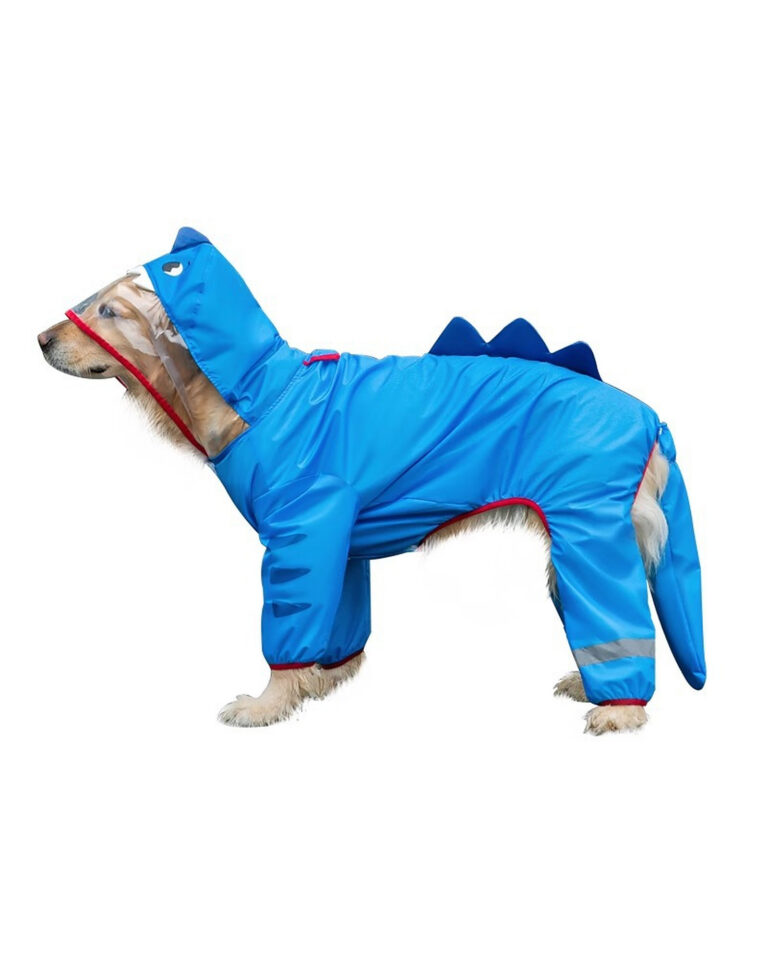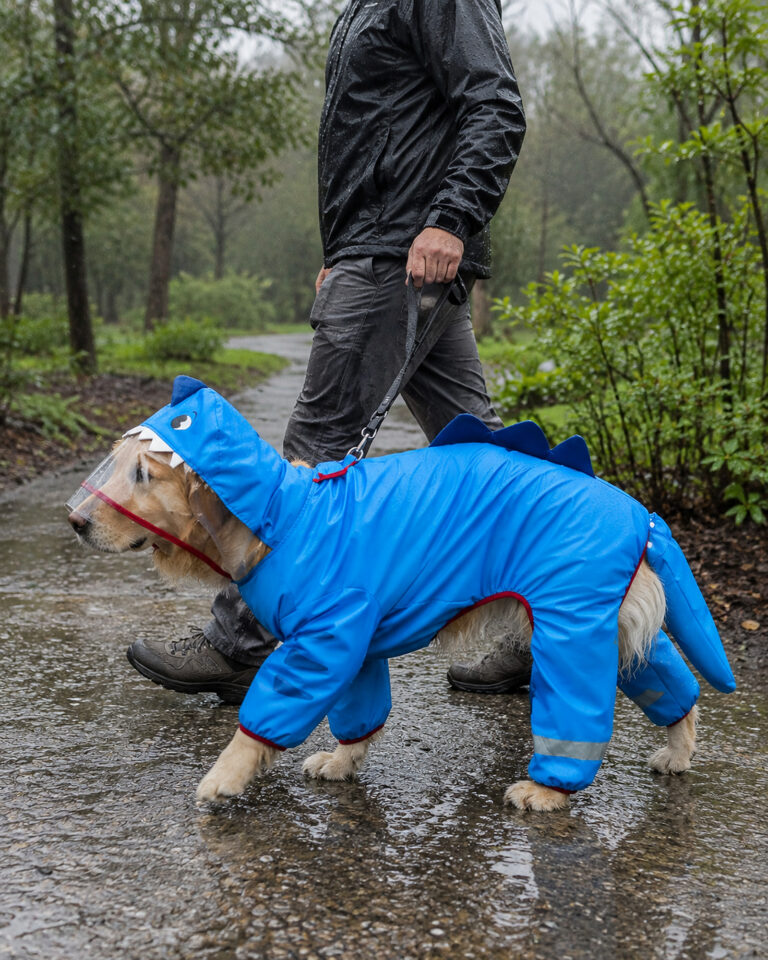
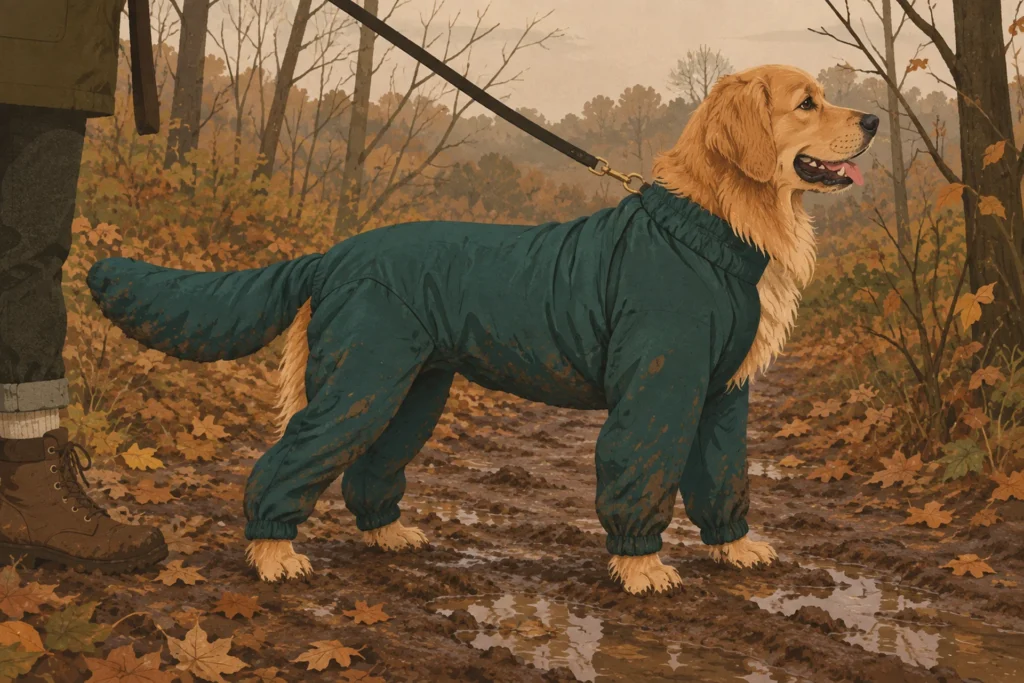
Mud suit, slush suit, splash suit, puddle suit, rain suit — for dogs, those are five shop words for roughly one garment. No standards body defines any of them, so the label tells you almost nothing. What separates a suit that gets used from one that lives in a drawer is two physical things: how far down the leg the fabric actually ends, and whether you can get it off a filthy dog without wearing the mud yourself.
Rain is a comfort problem — most dogs cope with being rained on. Mud is a cleaning problem, and on a long-coated dog it can quietly become a skin problem. That difference, not the word on the tag, is what should decide whether you buy one.
The words on the label do not sort the products
Search “dog mud suit” and you will get the same racks as “dog rain suit,” plus a few regional names. UK listings lean on mud suit; Canadian ones on slush suit; a handful of brands have invented splash suit and puddle suit. “Dog drysuit” is a term borrowed from human diving and means nothing consistent in pet gear at all.
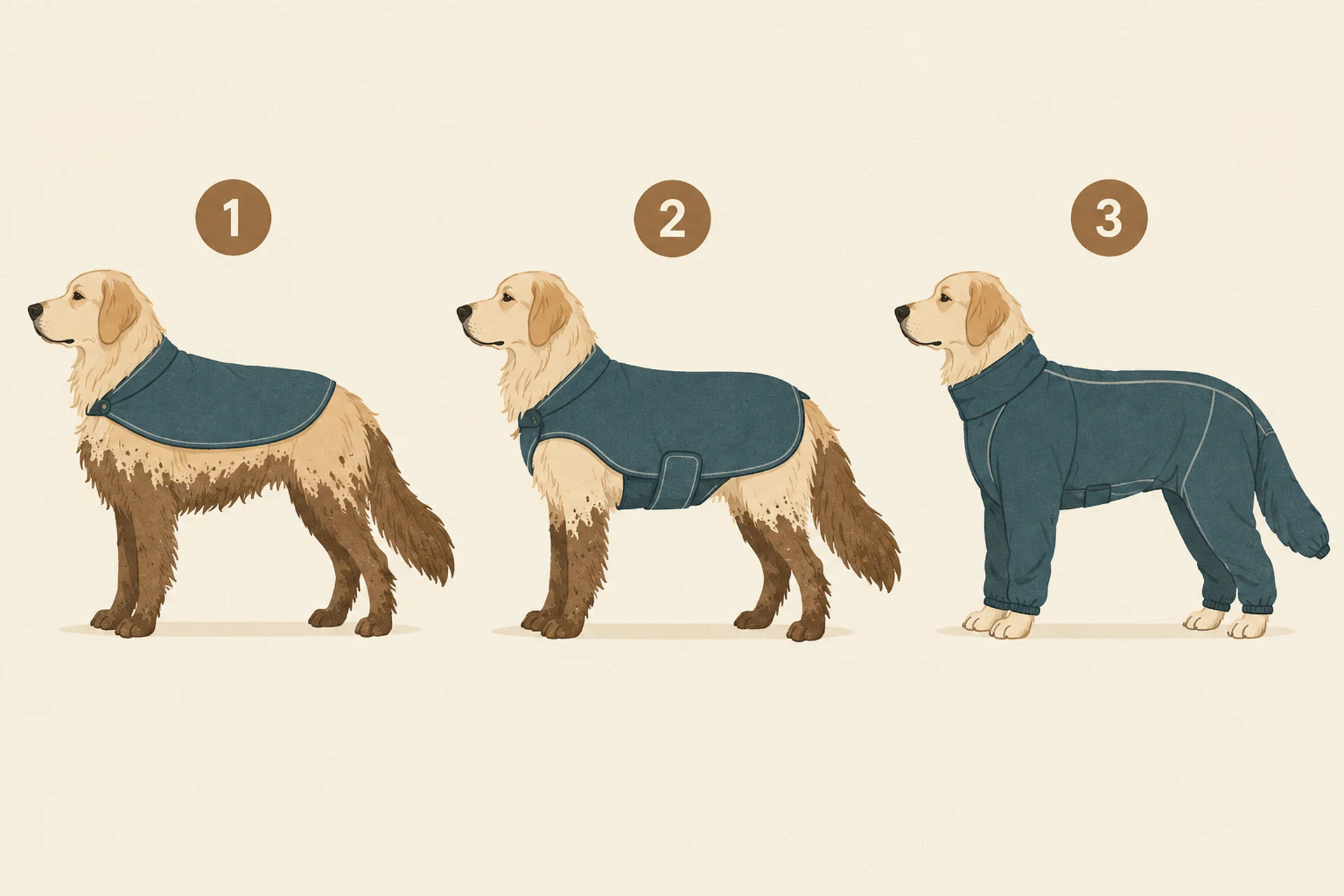
What is genuinely different between products is coverage. Sorted by that instead, the category collapses into four honest shapes.
| What it is | Names you will see | What it covers | What stays muddy |
|---|---|---|---|
| Cape or back-only coat | Raincoat, rain cape, poncho | Spine, shoulders, sometimes the rump | Belly, chest, all four legs, tail |
| Wrap coat with belly panel | Rain jacket, full-coverage coat | Back, sides and some of the underside | All four legs, tail, chest ruff |
| Four-leg suit | Rain suit, mud suit, slush suit, splash suit | Back, belly and the legs — how far down varies a lot | Paws, and whatever the sleeve does not reach |
| Four-leg suit with sole caps or a tail sleeve | Full-cover suit, all-leg suit | As above, plus the paws or the tail | Very little — at the cost of a longer dress-up |
Rain is a comfort problem. Mud is a cleaning problem — and sometimes a skin one
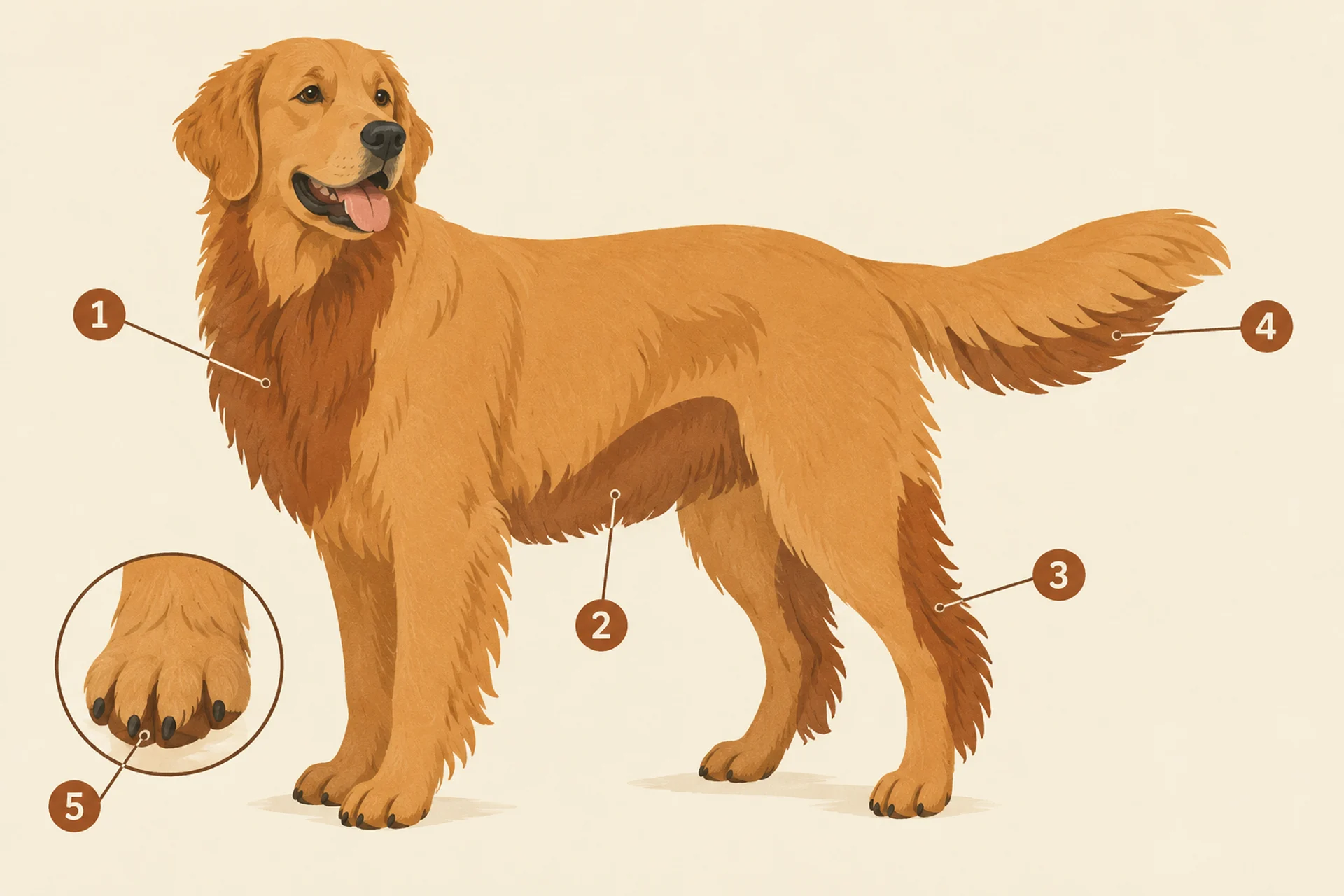
A short-coated dog shakes off rain and is dry in twenty minutes. A dense double coat is different: it holds water against the skin for hours, and mud gives that water something to cling to. The Merck Veterinary Manual notes that “warm, moist areas on the skin, such as lip folds, facial folds, armpits, feet, and neck folds, often have higher bacterial counts than other areas and are at an increased risk for infection”. A wet, matted armpit or a packed-in paw is that kind of area, made by your walk rather than by anatomy. Drying those spots properly is also what takes care of the smell, which we cover in wet dog smell after rain.
That is the everyday version. The one worth knowing about is leptospirosis. Washington State’s Department of Health lists the environments where the bacteria are found as “lakes, streams, puddles, vegetation, and mud” — including fenced yards contaminated by rodents or raccoons. The American Kennel Club adds that the excreted bacteria “can survive in water, mud, and urine for extended periods of time”, and that some strains can enter through the skin. The US Centers for Disease Control and Prevention notes that dogs are at higher risk where they may meet infected wildlife or contaminated water sources, and that a vaccine exists but does not cover every strain.
Read that carefully, because it is easy to over-read. None of it says mud is dangerous or that a suit is a medical device. It says standing water and mud are one of the recognised exposure routes, which is why the lepto vaccine is considered core in many parts of the country. A suit is a laundry tool that happens to keep a bit less of that off your dog’s skin. The actual protection is the conversation with your vet about whether lepto is core where you live.
The five things that decide whether the suit gets used
- Where the sleeve ends. “Covers the legs” ranges from a token cuff at the elbow to a closed tube reaching the paw. On a muddy walk the difference is the whole point — look for a photo of the dog standing, not a flat-lay.
- How it comes off. This is the test everyone forgets. A suit that has to be pulled over the head sends the dirty face of the fabric past the dog’s ears. A back-zip or front-zip that opens flat lets you peel it dirty-side-in and carry it to the sink. If you only check one thing in the photos, check this.
- Whether the belly closes. An open underside keeps toileting simple and dries fast; a closed one keeps the chest ruff and inner thighs clean. Neither is wrong, and we walk through the trade-off in detail in our guide to belly coverage on a dog rain suit.
- The tail. On a feathered tail, mud wicks up the underside and sets like plaster. A tail sleeve solves it; a tail sleeve is also one more thing to persuade a dog into. Decide before you buy, not in the hallway.
- How long the lining takes to dry. A suit that is still damp at the next walk is a suit you skip. Unlined shells dry fastest; fleece-backed ones are warmer and slower.
If you want the full breakdown of leg and paw coverage — including why sole caps are not the same thing as boots — that lives in our guide to dog rain suits with the legs and paws covered.
When a mud suit is the wrong buy
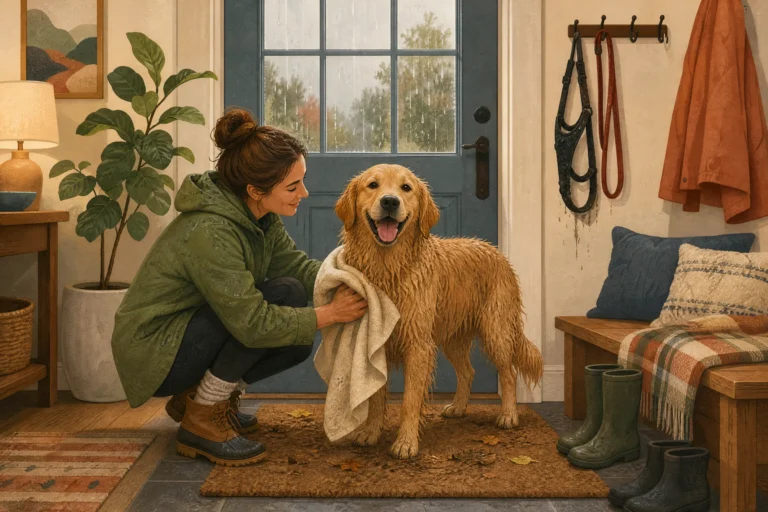
Three honest cases. First, a short-coated dog on suburban pavement: a towel by the door is faster than dressing an animal twice a day, and cheaper. Second, a dog who is going in the water anyway — a suit around a swimming dog is a wet bag, not protection. Third, warm weather. A full-body layer on a mild autumn afternoon is a heat question before it is a mud question, which we cover in do dogs overheat in coats.
There is a fourth case that is about the dog rather than the weather: a dog who has never worn clothes will not accept a four-leg suit on the day you need it. That is a two-week job done in the living room, not a five-minute job done in the rain — the method is in getting your dog used to wearing clothes.
If you want the mud-suit shape
Full leg and tail coverage, for the dogs that get filthiest. The Trail Tail-Sleeve Four-Leg Dog Rain Suit is the shape people are looking for when they search “mud suit”: closed leg tubes and a sleeve for the tail, so the feathering that takes longest to wash is the part that stays clean. Check the size chart on the product page against your own measurements — leg length varies far more between dogs of the same weight than chest girth does.
Dog mud suit FAQ
Is a dog mud suit the same thing as a rain suit?
Usually yes. The names are shop language rather than product categories — the same four-leg garment is sold as a mud suit in the UK, a slush suit in Canada and a rain suit in the US. Compare coverage and closures, not names.
Does my dog need a mud suit if they already have a raincoat?
Only if the mess you are trying to prevent is below the spine. A raincoat handles rain falling from above; mud arrives from underneath, off the ground and off the dog’s own moving legs. If your washing problem is belly, legs and tail, a coat was never going to fix it.
Are dog mud suits waterproof?
Treat every such claim sceptically. Outer fabrics vary, seams and openings leak, and a dog rolling in a puddle defeats most of them. Assume a suit keeps the bulk of the mud and the bulk of the water off, and check the individual product page for what its maker actually claims.
Can mud actually hurt my dog?
Mud itself is mostly a laundry issue. Two real risks sit alongside it: damp trapped under a dense coat raises the odds of a skin infection, and standing water and mud are among the environments where leptospira bacteria are found. Both are questions for your vet — the second one specifically as a vaccination question.
How do I get a muddy suit off without covering the house?
Buy for it. A suit that opens along the back or the front can be unzipped, folded dirty-side inward and walked to the sink as a parcel. Anything that has to come off over the head will drag its outside surface across your dog’s face and your floor.
What about the paws?
A suit with sole caps keeps grit out of the spaces between the toes, which is the hardest place to rinse and the easiest to miss. If your dog will not tolerate anything on the feet, a rinse bucket at the door does the same job with more effort and no negotiation.
Sources
- Merck Veterinary Manual — Pyoderma in Dogs (warm, moist areas of skin carry higher bacterial counts and are at increased risk of infection) (checked 2026-09-12)
- Washington State Department of Health — Canine Leptospirosis (contaminated environments include lakes, streams, puddles, vegetation and mud; vaccination guidance) (checked 2026-09-12)
- American Kennel Club — Leptospirosis in Dogs (bacteria survive in water, mud and urine for extended periods; some strains enter through skin; vaccination considered core in high-prevalence areas) (checked 2026-09-12)
- US Centers for Disease Control and Prevention — Leptospirosis in Animals (transmission routes, higher-risk dogs, limits of the vaccine) (checked 2026-09-12)
Veterinary guidance and local disease prevalence change. Confirm anything health-related on the official page and, for your own dog, with your veterinarian — particularly whether the leptospirosis vaccine is recommended where you live.
Buy the coverage and the closure. Ignore the name.
There is no such thing as a mud suit standard, so read the product like an engineer: how far down the leg does it go, does the belly close, is there a tail sleeve, and can you peel it off dirty-side-in. Get those four right and the word on the label never mattered.