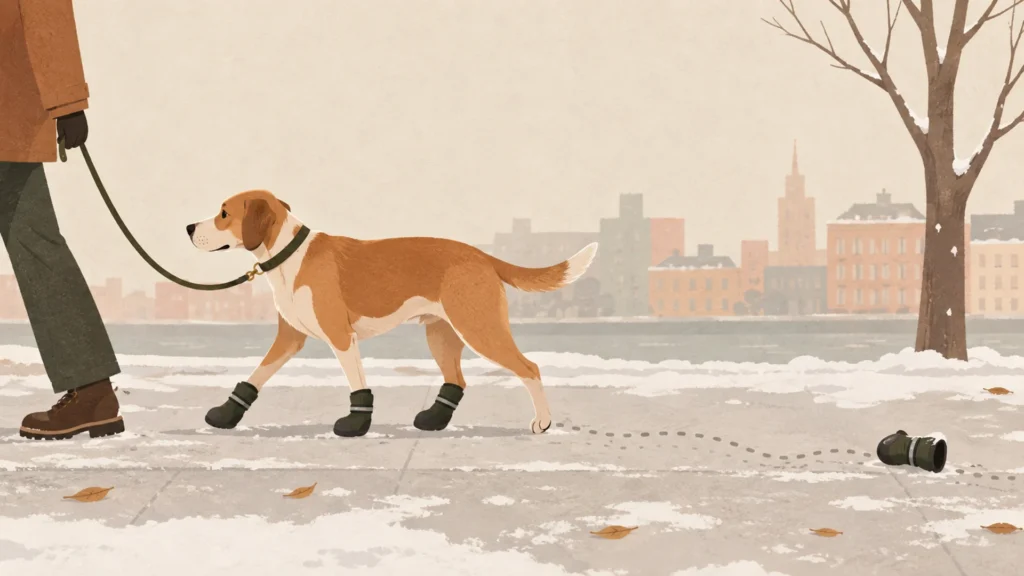
Boots come off for two completely different reasons, and they need opposite fixes. Either the boot never seated on the paw in the first place — almost always because it was sized from a paw held up in the air — or the boot fits and the dog is actively shaking it off, which is a training problem that no amount of strap tension will solve.
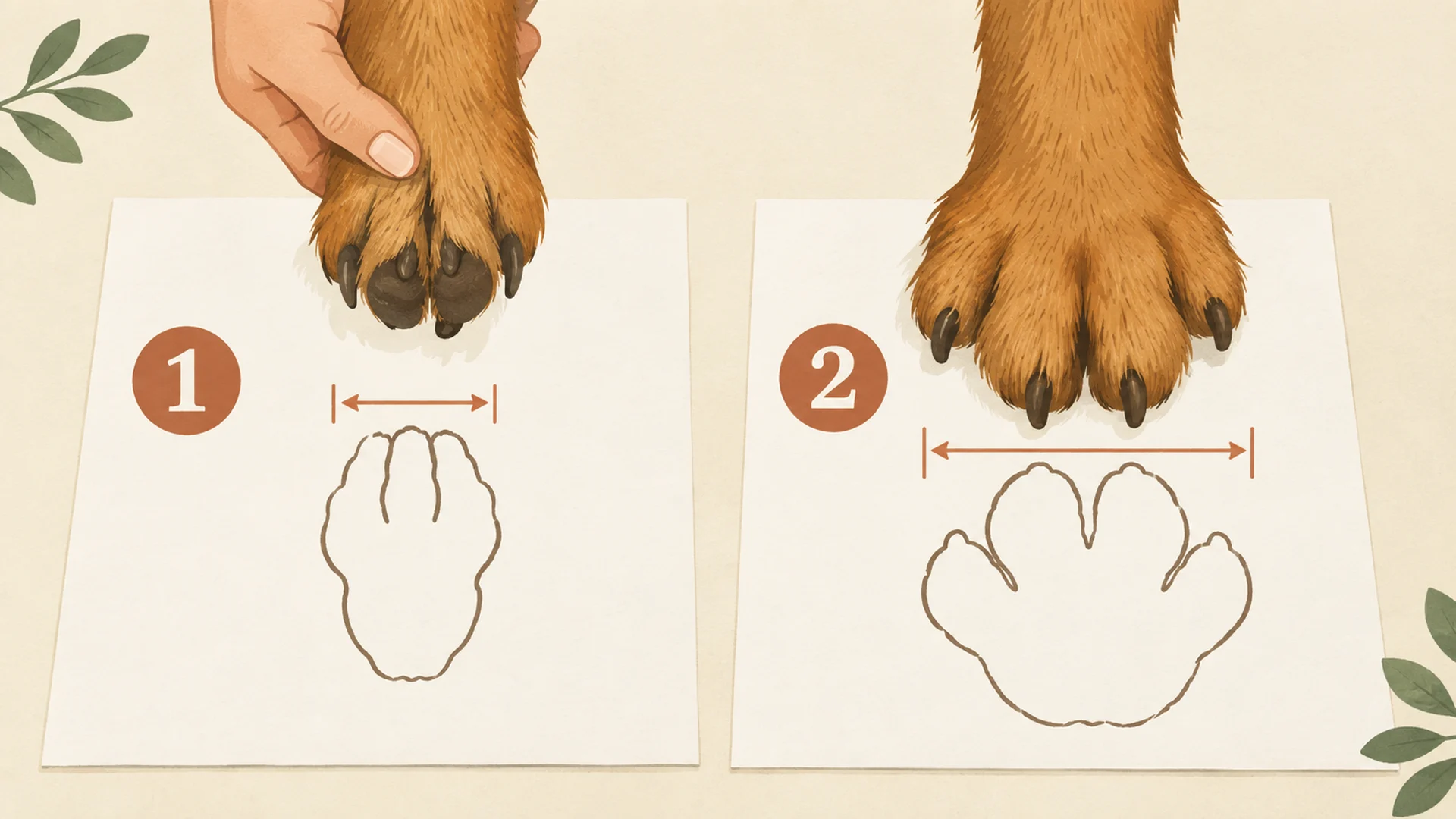
The fix that gets recommended most often, tightening the strap, addresses neither. The single detail worth changing first is how you measure: the American Kennel Club’s boot-fitting guidance says to press your dog’s paw into a sheet of paper, because that “mimics the splay of your dog’s foot while walking.” A paw dangling in your hand is narrower than the same paw carrying your dog’s weight. Size to the splayed width and half the problem disappears.
Why a dog’s leg gives a boot almost nothing to hold on to
Take a look at your own boot. It stays on because your heel sticks out backwards and your ankle is narrower than both the heel below it and the calf above it. The boot is trapped in a groove. Nothing has to be tight.
Now look at your dog’s leg from the side. There is no heel down at ground level, and above the paw the leg narrows steadily into the pastern — a smooth taper with no groove anywhere on it. A dog boot is a tube on a cone. Gravity and every forward stride are trying to slide it downward and off, and the only things resisting are friction against the paw inside and a strap wrapped around a section of leg that is narrower than the paw the boot is supposed to retain.
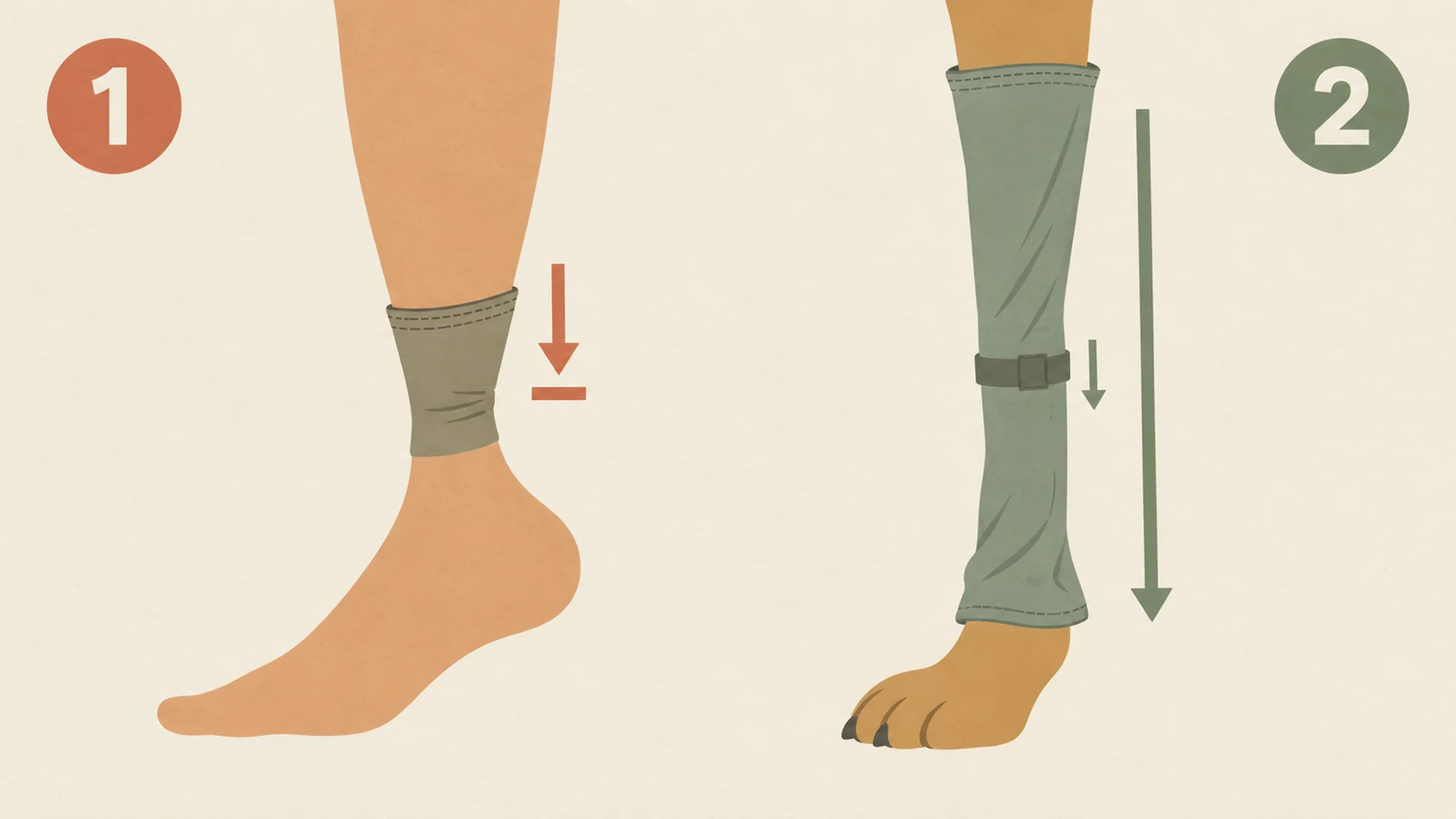
That geometry explains why tightening fails. Cinching a strap harder onto a taper mostly encourages it to migrate to the narrowest point it can find, and it makes the boot less comfortable at the same time, which brings on the shaking that throws boots clear. Friction is the lever you actually have, and friction comes from the paw filling the boot properly — which is a sizing question, not a tension question.
The measurement almost everyone takes wrong
Most people size boots the intuitive way: lift the paw, hold a ruler or a tape against it, read the width. That measurement is wrong in a specific and predictable direction. A lifted paw is a relaxed paw with the toes drawn together. A paw carrying a quarter of a dog’s body weight spreads, and that is the shape the boot has to accommodate for the entire walk.
Hence the AKC’s paper method: press the paw into the sheet so it splays, trace the indentation, then “draw a line across the widest part of the paw tracing and measure it.” Do it on the front paws and again on the back, because they are not usually the same size on the same dog.
The other thing worth abandoning is the weight-based size chart. Paw shape varies by build in ways body weight does not predict — the Merck Veterinary Manual notes in its discussion of interdigital furunculosis that some breeds have “wider paw conformations and a greater distance between digital pads,” naming the Labrador Retriever, English Bulldog, German Shepherd Dog and Pekingese among them. Two seventy-pound dogs can need different boot widths. Weight ranges are a filter for narrowing the shortlist; the tracing is the fit.
Four ways a boot leaves the paw, and what each one means
The symptom is always the same — a boot in the snow twenty feet back. What differs is where in the stride it let go, which is the part worth noticing on the walk.
| What you notice | What it usually means | What to change |
|---|---|---|
| The boot rotates so the sole ends up on the side or top of the paw | The boot is too wide for the paw — the paw is swimming rather than filling it | Size down in width, or choose a model with a shaped left/right sole rather than a symmetrical tube |
| The boot works its way off gradually over ten minutes, strap still fastened | Classic lifted-paw sizing — the paw never seated deep enough for the strap to sit above the widest point | Re-measure from a pressed tracing; the paw needs to go fully in before the strap is closed |
| It comes off in the first thirty seconds, usually with a shake or a kick | The dog is removing it. Fit may be fine | Stop the walk and go back to indoor acclimation — this is the training failure, not the gear failure |
| Only the back boots go, and only in deep snow or mud | Suction and drag exceed what friction alone can hold | A taller cuff that closes above the hock-side taper; expect to re-seat mid-walk in those conditions |
If the boot is coming off gradually and the fit tracing checks out, the AKC’s own remedy is blunt and worth repeating: if “your dog’s paws don’t securely fit the boots, you may need to consider purchasing a different size.” Not a tighter strap. A different boot.
One thing to skip entirely: taping boots to the leg, which circulates widely as a fix. It converts an adjustable closure into a fixed one on a limb you are not watching, and a wrap that is too tight on a leg is a problem you will not see until the walk is over. If a boot needs tape to stay on, it is the wrong boot. A closure that cinches above the paw — the mechanism our Everyday Cinch-Top Dog Paw Boots are built around — is trying to solve the same geometry problem, but it still only works on top of a correct width.
The dog that throws them off on purpose
A dog wearing boots for the first time will often freeze, or high-step like a show pony, or sit down and refuse. This is normal and it is not stubbornness — paws are dense with sensation, and you have just wrapped all four of them. A dog in that state shakes, kicks and chews, and boots come off no matter how well they fit.
The AKC’s step-by-step protocol for boots and winter gear is one boot at a time, and it is slower than most people expect:
- Put the boots on the floor and let your dog investigate them. Reward curiosity before anything goes on a foot.
- Put one boot on, reward, and take it straight back off. One boot, seconds long.
- Repeat with that single boot, stretching the time a little each session while treats or play keep going.
- Only when one boot is boring do you add the second, then the third, then the fourth — repeating the same build-up each time.
- Go outside only once all four are comfortable while your dog eats and plays at home.
- If your dog tries to remove a boot, shorten the time and go back to rewarding more often. AKC’s instruction is to “decrease the amount of time you’re asking your dog to keep it on.”
Two additions worth making. Train somewhere quiet, because a dog processing a strange sensation has no attention left for a busy street. And if your dog dislikes having their feet handled at all, that comes first — AKC says to desensitise the dog to you touching their feet before boots enter the picture. The same slow-introduction logic applies to everything else you put on a dog, which is why it shows up again in our guide to getting a dog used to wearing clothes.
Do you actually need boots?
Worth asking honestly, because a dog who hates boots and a household that fights them every morning may be better served by a different tool.
Winter is the strongest case. Snow, as the AKC’s paw care guidance puts it, “quickly turns to balls of ice between the pads of your dog’s feet” — uncomfortable, and dogs hurt themselves getting them out. The chemical side is the part people underrate. The ASPCA’s guidance on the dangers of ice melts lists sodium, potassium, calcium and magnesium chloride as common ingredients, and notes pets get exposed when they “lick their feet after walking through a recently treated area, or by eating snow that may have ice melts in it.” The usual result is stomach upset, vomiting or diarrhoea; larger ingestions can raise sodium levels enough to cause tremors and seizures, and calcium chloride products can ulcerate the mouth. Note that “pet-friendly” is not the same as harmless — the ASPCA says those products typically use urea or magnesium chloride and “may also cause stomach upset.”
Hot pavement is the case people forget. The AKC reports that when “the air temperature is 86 degrees, the asphalt temperature registers 135 degrees,” and offers a test that costs nothing: put the back of your hand on the pavement for ten seconds. If it’s too hot for your hand, it’s too hot for your dog’s paws.
The alternatives are real. The ASPCA notes that “paw wax or doggie booties provide an excellent barrier” for dogs whose pads are getting irritated — wax is genuinely useful against salt and moisture, though it does nothing about sharp ice or hot asphalt. And the cheapest measure of all is wiping paws at the door, which removes the chemicals before your dog licks them off. If boots are losing the fight in your house, wax plus a diligent wipe-down is a defensible answer rather than a cop-out.
When it isn’t a boot problem at all
A dog who wore boots happily for two winters and suddenly won’t tolerate them, or who licks and chews at one foot in particular, or who limps once the boot is off, is telling you something about the foot rather than the footwear. Sore pads, split webbing, a lodged foreign body and interdigital lesions all present roughly this way, and a boot pressing on any of them turns a walk into something worse.
Interdigital furuncles — which Merck describes as “deep pyoderma lesions that form between the toes of dogs,” most commonly caused by deep bacterial infection — are one reason a previously boot-tolerant dog stops cooperating. Sorting out which of these it is, and what to do about it, is a job for your veterinarian; the useful thing you can do beforehand is note which foot, when it started, and whether anything about the walking surface changed. Don’t keep training through a refusal that appeared suddenly.
How do I keep my dog’s boots from falling off?
Get the width right first, measured from a paw pressed into paper so the toes splay as they do under load, and make sure the paw is seated fully in the boot before the strap closes. Then check whether your dog is removing them, which looks different — boots that disappear in the first thirty seconds with a shake or a kick are a training issue, and the answer there is going back to indoor acclimation, not tightening anything.
Should dog boots be tight?
Snug enough not to rotate, but tension is not what holds a boot on. A dog’s leg tapers above the paw with no heel to catch behind, so cinching harder mostly makes the strap migrate and makes the dog more likely to shake the boot off. If a boot only stays on when it is uncomfortably tight, the AKC’s advice is that you probably need a different size.
Can I tape my dog’s boots on?
It’s a popular suggestion and it isn’t a good one. Tape turns an adjustable closure into a fixed wrap on a limb, and a wrap that is too tight is not something you’ll notice mid-walk. Treat a boot that needs tape as the wrong boot — usually the wrong width — rather than a boot that needs more adhesive.
How do I measure my dog’s paws for boots?
Press the paw down onto a sheet of paper so it splays the way it does while walking, trace around the indentation, then measure across the widest part of that tracing. Do the front and back paws separately — they often differ — and use that width against the maker’s chart rather than your dog’s body weight, since paw conformation varies between dogs of the same size.
Why does my dog walk weird in boots?
Because the sensation is new and paws are full of nerve endings. High-stepping, freezing and shaking a foot are ordinary first reactions, not a verdict on the boots. They usually fade with short indoor sessions built one boot at a time. What isn’t ordinary is a dog who was previously fine and suddenly objects, or who targets one specific foot — that’s worth a look from your vet rather than more training.
Is paw wax as good as boots?
For different things. The ASPCA describes both wax and booties as barriers for irritated pads, and wax handles salt and de-icer residue well while being far easier to get onto a reluctant dog. What it cannot do is insulate against cold, block hot asphalt, or stop sharp ice cutting a pad. Wax plus wiping paws at the door is a reasonable winter plan for a dog who genuinely will not wear boots.
Measure the paw that’s carrying weight, not the one in your hand.
A dog’s leg offers a boot no heel and no groove, so the boot stays on by filling the paw properly rather than by being cinched down onto a taper. Trace the pressed paw, buy to that width, seat the paw fully before closing the strap, and treat a boot that vanishes in the first thirty seconds as a training project instead of a fit one. If boots still lose, wax and a wipe at the door protect against most of what winter actually does to paws. Summer has its own paw problem, and boots only cover part of it — see how to protect your dog from foxtails.
Sources
- American Kennel Club — Choosing the Right Dog Boots or Shoes for Your Dog (checked 2026-09-19)
- American Kennel Club — How to Care for and Clean Dog Paws and Paw Pads (checked 2026-09-19)
- American Kennel Club — Dog Winter Clothes: How to Get Your Dog to Wear Them (checked 2026-09-19)
- American Kennel Club — How to Protect Dog Paws From Hot Pavement (checked 2026-09-19)
- ASPCA — Keeping Pets Safe during Winter: The Dangers of Ice Melts (checked 2026-09-19)
- Merck Veterinary Manual — Interdigital Furunculosis in Dogs (checked 2026-09-19)
Guidance and product formulations change. Anything involving a sore, swollen or suddenly boot-intolerant foot is a conversation for your veterinarian, not a checklist.