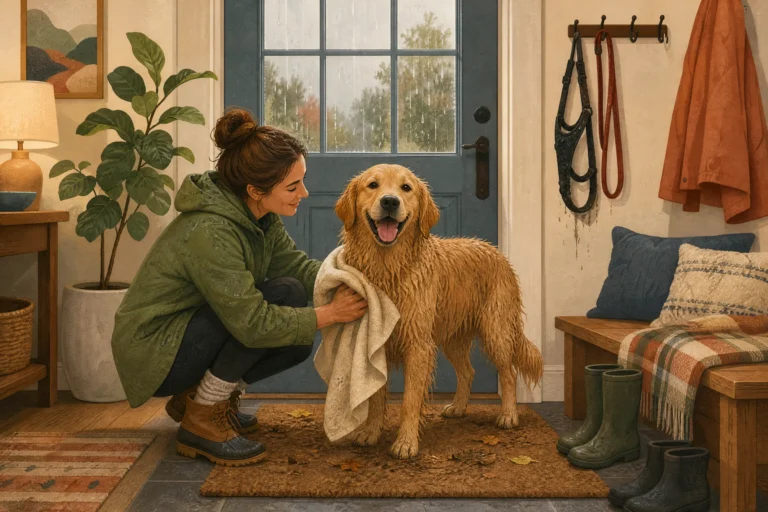
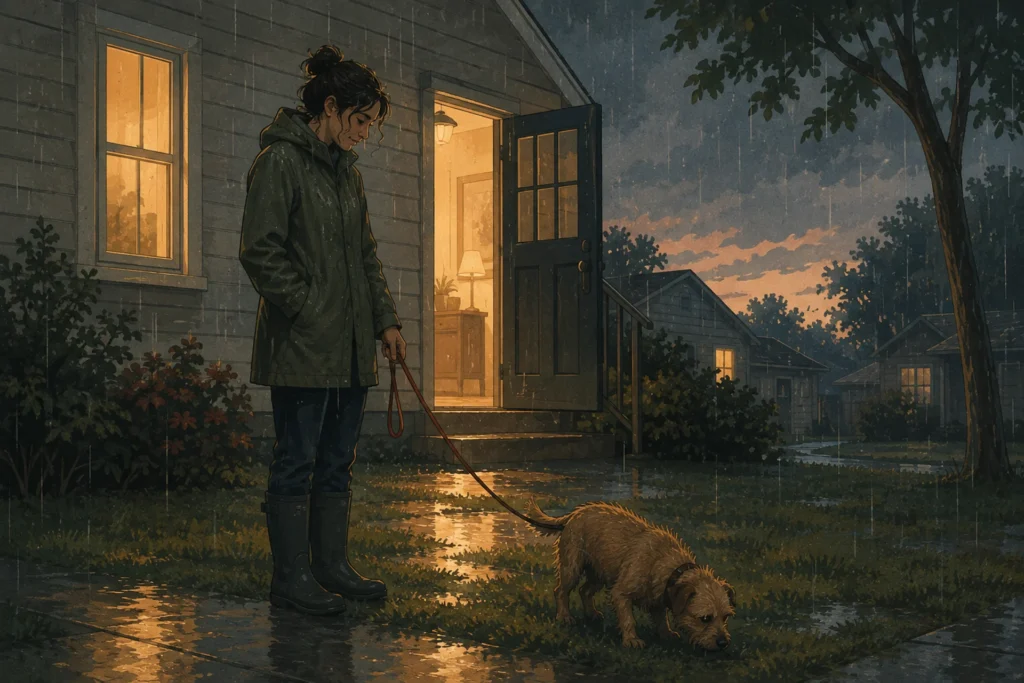
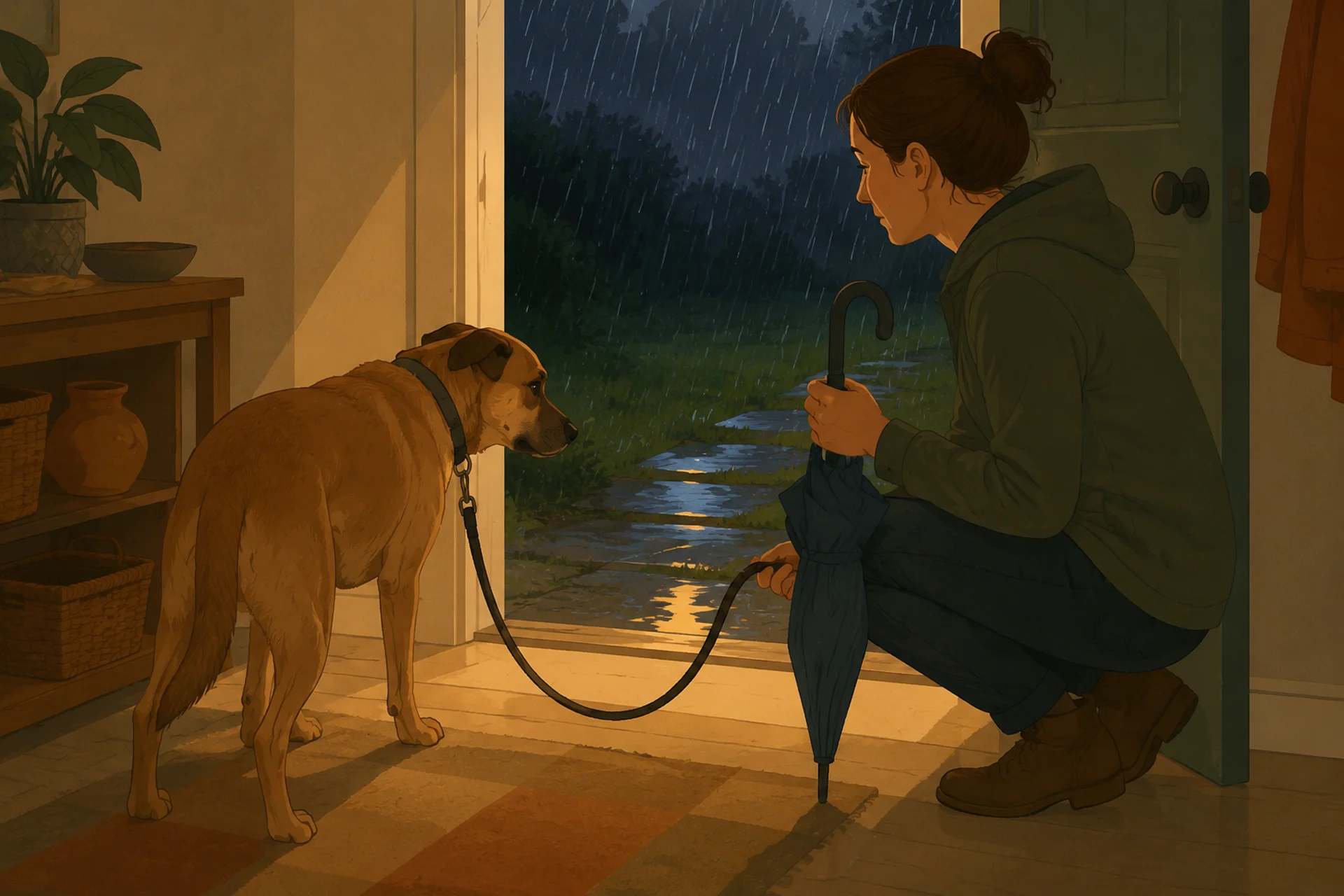
A dog who suddenly won’t go out in the rain is usually not being stubborn. The Merck Veterinary Manual puts rain on the short list of things that get in the way of a dog toileting outdoors at all — “Barriers to outdoor elimination (frightening outdoor stimuli such as rain, fireworks, neighbor animals, etc) should also be considered as causes of or contributors to house soiling.” The yard your dog knows has genuinely changed.
Which means the fix is two-part, in this order: rule out the medical explanations that no amount of training will touch, then rebuild the habit with a cue, a bit of cover, and your own company. Waiting it out at the back door is the one approach that reliably fails.
First, the part that isn’t training
It is tempting to treat a dog standing frozen on the step as a motivation problem. Veterinary behaviour guidance says to check something else first. Merck is blunt about the order of operations: “pain, sensory decline, cerebrocortical disease (including cognitive dysfunction), or any medical condition that leads to increased volume of urine, more frequent elimination, pain on elimination, or lack of control, must first be excluded as potential causes or contributing factors.”
In plain terms: a dog with sore hips may be refusing the wet step, not the rain, and a dog whose toileting changed in every kind of weather does not have a weather problem. An older dog who was reliable for years and is now leaving puddles indoors may be showing something else again — Cornell’s Riney Canine Health Center counts house soiling among the six signs in the DISHAA cognitive assessment and advises starting with a vet visit “to rule out bladder infections.”
| What you’re seeing | What it usually points to | First move |
|---|---|---|
| Holds it for hours in rain, completely normal on dry days | Weather aversion — the surface, sound and smell of the yard have changed | Rebuild the routine (below) |
| Goes out, stands, comes back in, then goes indoors | The trip outside stopped meaning “toilet” | Escort rather than send; reward outdoors, on the spot |
| Hesitates at a wet step or ramp specifically | Footing or joint discomfort, not weather | Vet check; add traction to the route |
| Was reliable, now soiling indoors in all weather | Not a rain problem | Vet first — medical causes get excluded before training |
| Senior dog, new indoor accidents plus other changes | Possible cognitive decline | Vet visit; keep walks on a fixed schedule |
| Straining, posturing repeatedly, producing little or nothing | Possible urinary obstruction | Emergency vet now — this is not a training question |
That last row is the one worth memorising. Everything else on this page can wait until morning. A dog who keeps trying to urinate and produces nothing should be seen the same day.
What the rain actually changed
Dogs choose where to go partly by surface and partly by scent, and rain interferes with both at once. Housetraining is built on preference — a learned pull toward a particular surface in a particular place. Rain takes that familiar patch of grass and makes it cold, loud underfoot and largely scent-free, so the anchor the habit hung on is temporarily gone. The mechanics compound it: wet grass reaches the belly of a short dog long before the ankles of a tall one, which is one honest reason small and long-bodied dogs object more loudly than retrievers do. None of that makes a dog fragile. It makes the dog accurate.
What actually works
The AKC’s guidance, written by trainer Sassafras Patterdale (CPDT-KA, CTDI), lands on a handful of moves that reinforce each other. The through-line: build the skill in easy conditions, spend it in hard ones.
Teach a potty cue when the weather is pleasant. AKC’s advice is to “Teach our dog to potty on cue” during comfortable weather first, then use it in the rain with high-value rewards ready. A cue learned in a downpour is a cue learned badly.
Go out with your dog, not instead of your dog. The single most common failure is opening the door and waiting inside. AKC’s framing is to “Plan to spend some time out in the rain doing things your dog enjoys” — the rain stops being a punishment when it is also when fetch happens.
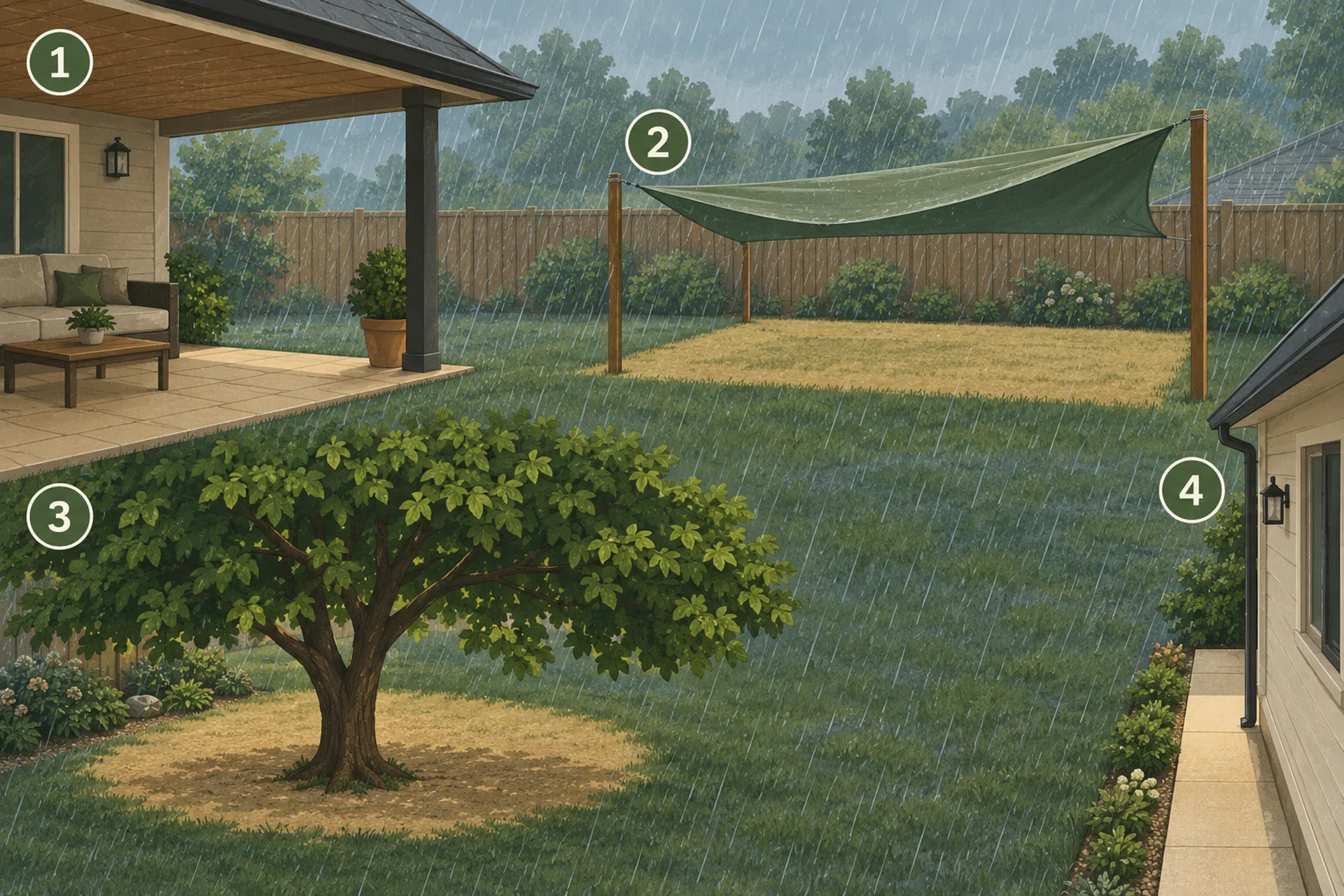
Make one sheltered spot. A covered patio corner, a tarp over a stretch of fence, the dry ground under a dense tree. You are not trying to keep the dog dry — you are giving the habit somewhere to live while the yard is unusable.
Use rain gear only if the gear is already boring. AKC names a “Properly-fitted raincoat” and boots among the things that help dogs feel protected — but a coat your dog still distrusts adds a second problem to a rainy night. Make the coat a non-event indoors first (how to get a dog used to wearing clothes), and if your dog is double-coated, check whether a raincoat is the right call at all before buying one from the protection shelf.
Pay on delivery. Reward outside, the moment the dog finishes — not at the back door thirty seconds later, which rewards coming inside.
Run the confine-and-retry loop. If nothing happens, AKC’s approach is to “Confine your dog to a smaller area” or keep them leashed to you indoors, with frequent opportunities to go back out. Ten minutes in, ten minutes out, repeat. The point is to remove the option of quietly going behind the sofa.
The rainy-night routine
- Go first. Step out ahead of your dog so the doorway is not a decision they make alone.
- Head for the sheltered spot, on leash, even in your own yard — a leash keeps the trip purposeful instead of a lap of the lawn.
- Give the cue once, then stop talking. Chatter is interesting; silence is boring, and boredom is what you want.
- Wait about five minutes. Longer than that and you are both just standing in the rain.
- Reward instantly and generously if it happens — outdoors, before the walk back.
- If nothing happens, back inside, confined or leashed to you, ten minutes, try again. No scolding on the way in.
- Do one fun thing in the rain that week that has nothing to do with toileting.
Three things that make it worse
Scolding the indoor accident. A dog told off for going indoors does not conclude “I should have gone outside.” It concludes that going where you can see it is dangerous — which is how you end up finding puddles behind furniture.
Waiting them out at the door. A dog who learns that refusing ends the trip has learned exactly what you taught.
Switching permanently to indoor pads. A reasonable bridge for a puppy, a sick dog or a genuine storm night. As a standing solution, pads undo the surface preference housetraining is built on, and you start over in spring.
Dogs and rain: FAQ
Why won’t my dog pee in the rain when they used to?
Most often because the surface and scent of their usual spot have changed, which removes the cue their habit was built on. The Merck Veterinary Manual explicitly lists rain as a barrier to outdoor elimination. If the change also shows up in dry weather, treat it as a medical question and see your vet.
How long can a dog safely hold it?
There is no single safe number — it varies with age, size and health, so ask your own vet rather than trusting a chart. Practically, a dog holding it all evening is uncomfortable and more likely to have an accident indoors, which is a reason to fix the routine rather than wait out the weather.
Will a raincoat fix it?
Sometimes, and the AKC does name a properly fitted raincoat among the things that help. But it only works if the coat is already unremarkable to your dog. Introducing new gear on the night you need it usually adds a second refusal on top of the first.
My dog will pee but won’t poop in the rain. Is that different?
Common, and consistent with the surface-and-scent explanation: dogs are typically fussier about where they defecate and spend longer choosing, so a cold, washed-out lawn rules out more candidate spots. Same routine — just allow a little more time under cover.
When is this an emergency rather than a training problem?
If your dog is repeatedly posturing to urinate and producing little or nothing, contact a vet immediately — that can indicate a urinary obstruction, which is painful and time-critical. Straining, obvious pain on elimination, or blood are all same-day calls, not things to work on with treats.
Is it cruel to make a dog go out in the rain?
No — but dragging one out is both cruel and ineffective. What works is going out together, keeping it short, giving the dog somewhere sheltered to stand, and paying well when it happens. That is a different activity from hauling a braced dog across a wet lawn.
Rule out the vet reasons, then go outside with your dog.
Rain refusal is a real, documented barrier to a dog toileting outdoors, not a character flaw. Check the medical explanations first — especially in an older dog or one whose habits changed in every kind of weather. Then rebuild the routine deliberately: a cue taught in good weather, one sheltered spot, your company, and a reward paid outdoors before the walk back in.
Sources
- Merck Veterinary Manual — Behavior Problems of Dogs (checked 2026-08-31)
- American Kennel Club — Training Dogs to Potty in Rain, Snow, or Other Bad Weather (Sassafras Patterdale, CPDT-KA, CTDI) (checked 2026-08-31)
- Cornell University College of Veterinary Medicine, Riney Canine Health Center — Senior dog dementia (checked 2026-08-31)
Nothing here is a diagnosis or a substitute for your own veterinarian’s advice. Take any sudden change in your dog’s toileting — and any straining, pain, or blood — to a vet rather than treating it as a training problem.