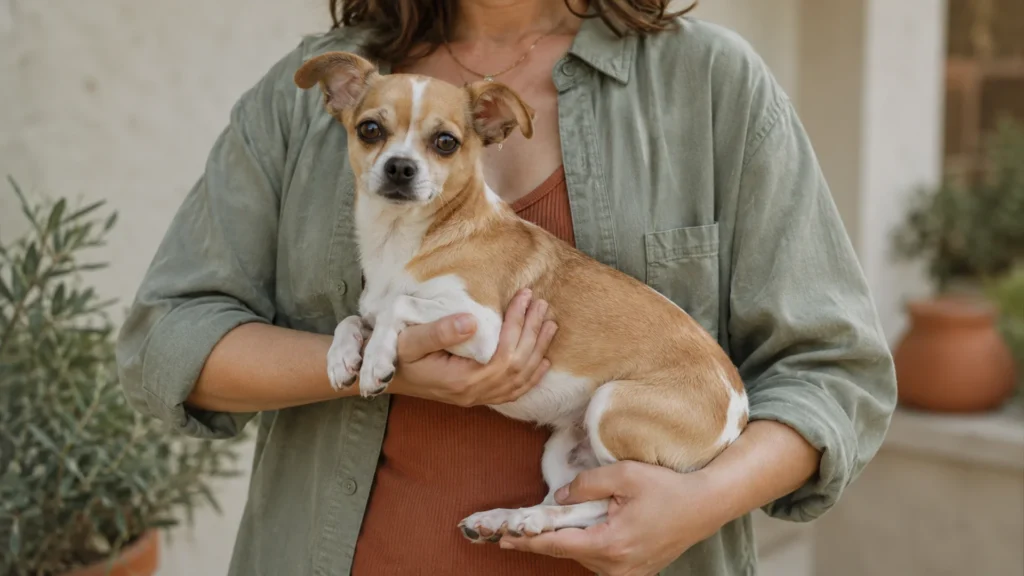
Carry a small dog with two points of support: one hand or forearm under the chest, between the front legs, and the other supporting the rear — under the hindquarters, so the spine stays level and no single joint takes the weight. Held like that, against your body, most dogs relax. Held under the armpits like a toddler, most dogs are right not to.
Arms are for moments. For anything longer than a few minutes — stairs are fine, a commute is not — the kind answer for both of you is equipment that does the holding: a sling, a chest carrier, or a backpack, depending on how your dog likes to ride.
Size changes the grip but not the principle. A long-backed dog needs a forearm running the whole length of the underside; a big dog needs one arm across the front of the chest and one behind the hind legs. And for any dog with a diagnosed back, the hold is a question for your own vet before it is a question for the internet.
The in-arms carry, step by step
- Approach from the side, not looming from above — a hand appearing over a small dog’s head reads as a grab.
- Slide one hand under the chest, palm flat, fingers between or just behind the front legs.
- Scoop the rear with your other hand or forearm so the hindquarters sit supported, not dangling.
- Bring the dog against your torso. Your body is half the support; arms alone tire and loosen.
- Keep the spine roughly level — especially for long-backed breeds, where a vertical dangle loads the back badly.
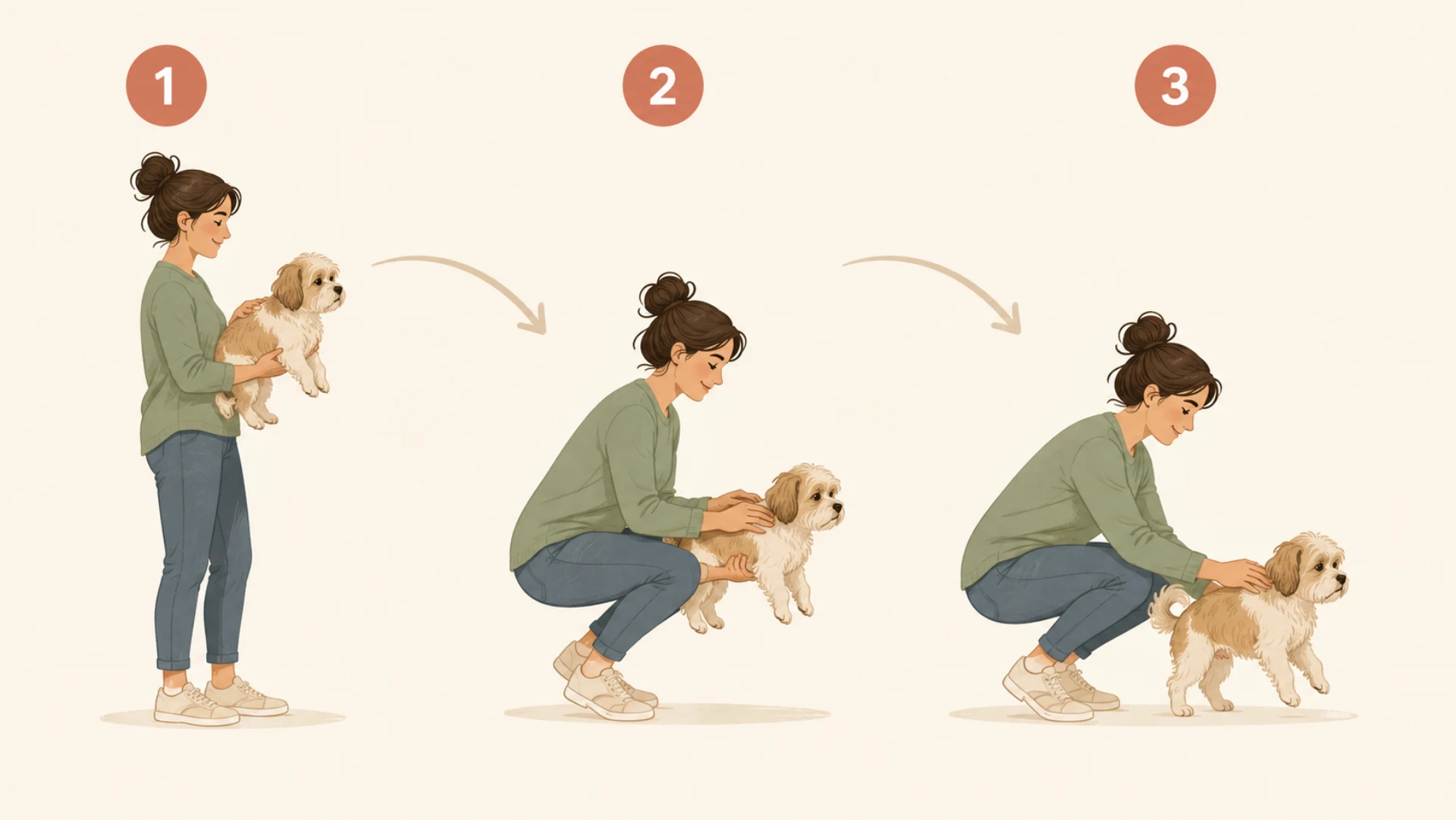
- Put them down before they decide to get down: rear feet first, on ground you chose.
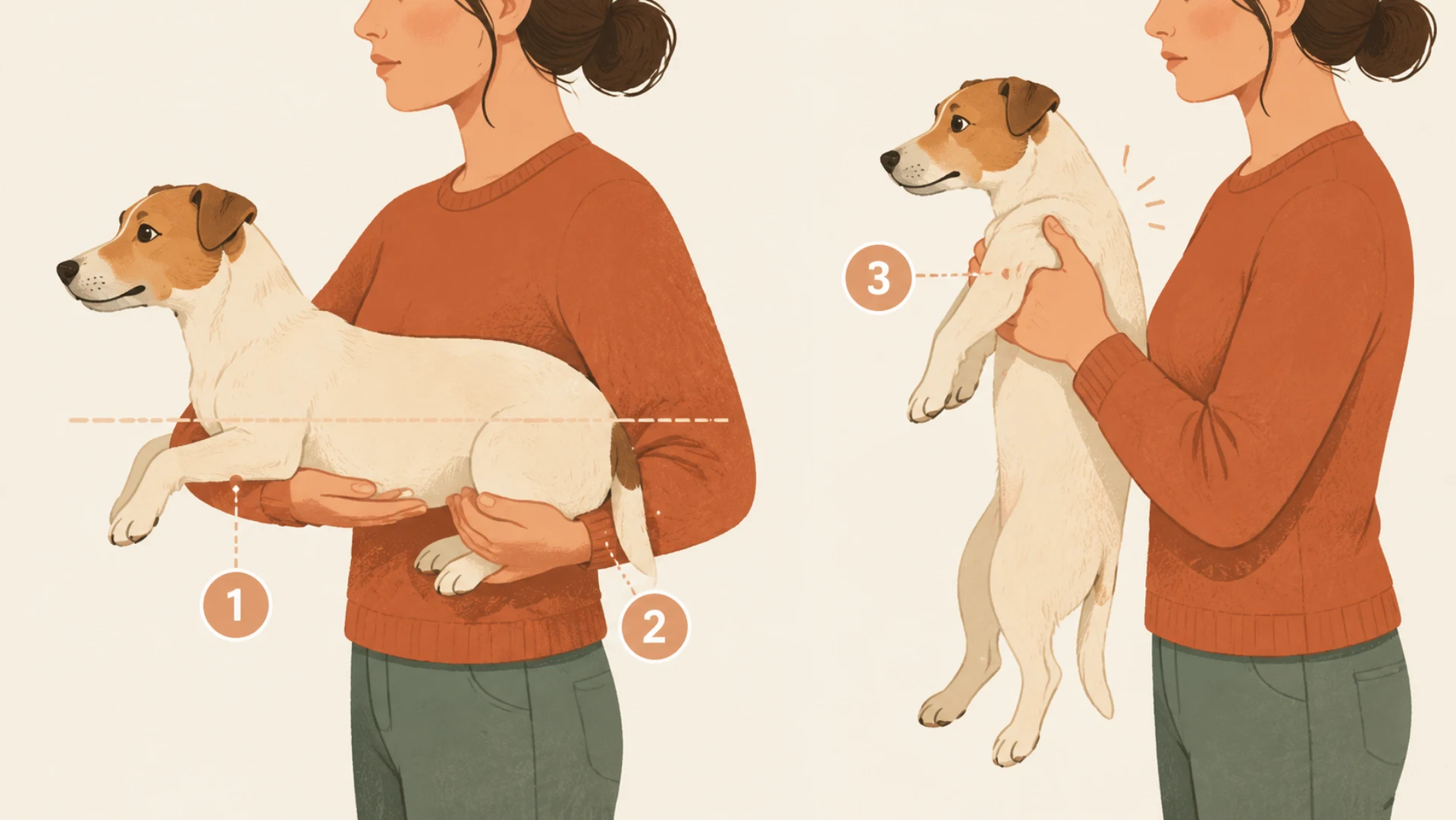
The two carries to retire: lifting under the front armpits, which hangs the whole body from two shoulder joints, and grabbing the scruff, which is for mother dogs moving puppies, not adults being moved. Neither is a disaster once; both are a reason dogs learn to dodge hands.
If the dog you are carrying is still a puppy, carrying is doing a second job as well as a first: it is how a young dog gets to see the world during the weeks before its vaccination series finishes. Our guide to how far a puppy can walk covers that window, and what the evidence says about the five-minute rule.
The real risk is the jump down
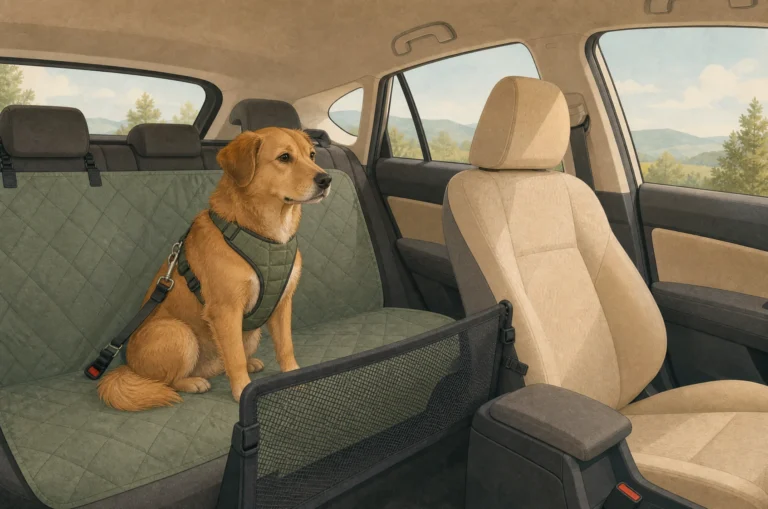
Small dogs are rarely hurt by being carried. They are hurt by leaving the carry — a twist and a leap from chest height onto hard ground is a genuinely bad fall at that scale. So the rule is less about grip strength and more about commitment: carry against your body where a launch has nowhere to start, keep a hand over the shoulders when something interesting passes, and lower them the last stretch rather than letting them decide. If your dog is a known leaper, that is not a reason to squeeze harder — it is the case for a carrier with a tether clipped to the harness.
Bigger dogs and longer backs: same rule, different arms
Two points of support is the principle. What changes with size is which parts of you provide them.
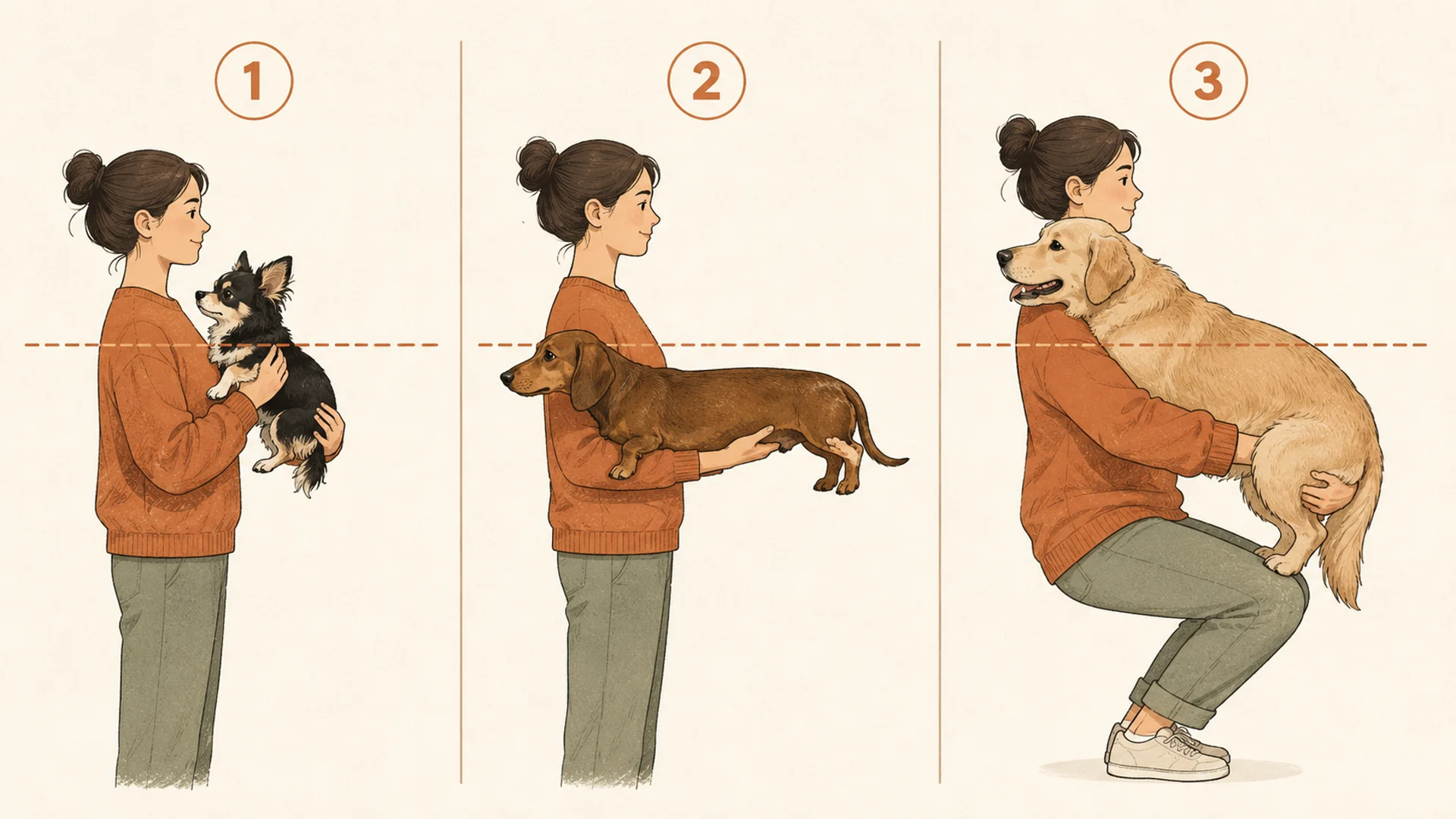
For a medium or large dog, the failure mode is not the dog’s spine — it is yours. Get the dog against your torso before you stand, bend at the knees, and do not take the lift at all if you cannot also put it down under control. A dog dropped from chest height by a person whose grip gave out is a worse outcome than a dog who walked.
Long backs: why the hold matters more for some dogs
Intervertebral disc disease is not an edge case in small dogs. Cornell’s Riney Canine Health Center lists Dachshunds, Toy and Miniature Poodles, Pekingese, Lhasa Apsos, German Shepherd Dogs, Doberman Pinschers, Beagles and Cocker Spaniels among predisposed breeds, and the American College of Veterinary Surgeons puts the concentration starkly: “chondrodystrophoid breed dogs (Dachshund, Pekinese, Beagle, Lhasa Apso, etc.) account for the vast majority of all disc ruptures, with the Dachshund accounting for 45-70% of all cases.” The Merck Veterinary Manual notes that in these breeds “spinal discs can begin degenerating in the first few months of life.”
Which reframes the carry. For a long-backed dog, being picked up badly is not the main risk in their week — the jumping is. Cornell’s own management advice is to “minimize time spent going up and down stairs, and jumping on and off a deck, bed or sofa,” keep the dog trim, and remember that “walking is safe for any dog. Leaping for a thrown toy, not so much.” Carrying, done properly, is one of the tools that replaces a leap — off the bed, down the porch steps, out of the car.
So the hold for these dogs is the forearm hold in Figure 3: the underside supported end to end, the back flat, nothing hanging. No vertical dangle, ever, and no letting them launch out of your arms. If your dog has been diagnosed with anything spinal, ask your vet to demonstrate the hold on your dog rather than working from a diagram — and watch for the signs Cornell describes owners noticing first, like a dog who will “avoid turning their head in one direction” or who walks over to a bowl and then just looks at it.
After surgery, or a dog who is sore
Post-operative and painful dogs are where carrying stops being a convenience and becomes part of the treatment plan. ACVS describes typical aftercare for disc disease as “exercise restriction to ‘bed rest’ for at least 4 weeks,” with lifestyle changes that may include “weight loss, switching to a body harness instead of neck lead, and minimizing jumping off furniture.” Merck makes the reason plain: “if the dog increases its activity, the disc(s) may extrude further and worsen the spinal cord compression.”
In that window every trip to the yard is a carry, and the instructions that matter are the ones on your discharge sheet, not here. Two general points still hold: pain makes gentle dogs bite, so approach a sore dog slowly and from the side, and support the body so that nothing bends at the sore part. If you are unsure whether to move a dog at all, that is a phone call to the clinic, not a judgement call to make in the driveway.
If the problem is not the carry but the walk — a leash that ties up a hand you need — that is a different fix, and one with its own trade-offs: see are hands-free dog leashes safe.
When arms stop being the answer
| Situation | Better than arms | Why |
|---|---|---|
| Crowds, transit, tight aisles | Chest carrier | Dog rides high and visible, buckled to you, both hands back in play |
| Errands with lots of in-and-out | Sling | Seconds to load, dog curls at your hip, one hand steadies |
| Distance, heat, a heavier dog | Backpack carrier | Weight moves to your frame; airflow beats a chest press on warm days |
| Mixed walk-and-carry outings | Handle vest worn by the dog | Lift for stairs and curbs, leash for the rest — no bag to stow between |
| Post-surgery or senior dogs | Whatever your vet says, then a flat-bottomed carrier | Level support and no compression on the sore bits |
Choosing between those styles is its own decision — the chest carrier guide covers the front-carry options, and the sling vs backpack vs purse comparison maps all three against trip type.
Teaching a dog to like being picked up
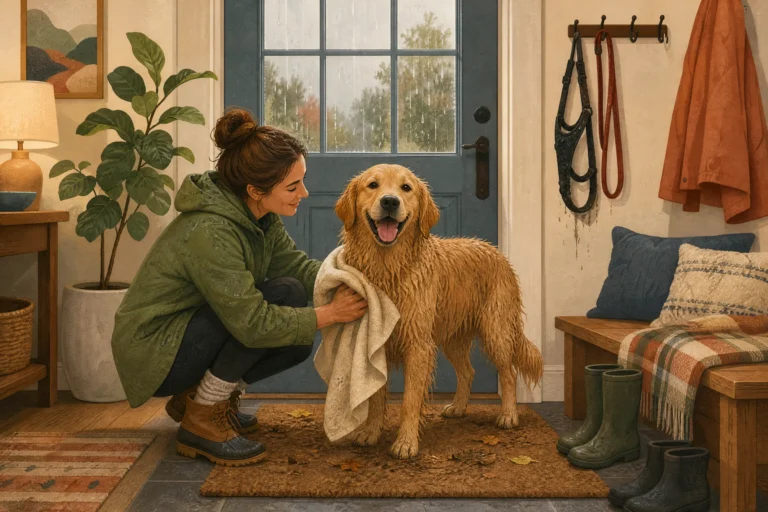
Most dogs that hate being carried hate the surprise, not the height. The AKC’s advice is the same: “one way to help the dog to accept being picked up is to give a verbal cue before you pick up the dog, so they know what to expect” — anything, as long as it is consistent. Pair the first few announced lifts with a treat delivered while airborne, put them down before they wriggle, and stop lifting them for things they dislike (nail trims, baths) without a buffer in between, or the word starts predicting the bad thing.
Worth saying plainly, because it is the part most guides skip: the AKC also notes that not all small dogs enjoy being picked up, and that for some dogs it can be “disorienting, frightening, uncomfortable, or painful.” A dog who used to tolerate lifting and suddenly does not is a vet question first. And there is a situational trap too — scooping up a small dog when a large dog is fixated on them and close can, per the same guidance, “add to the arousal of the other dog,” and a frightened dog in your arms is well placed to redirect a bite onto you. Lifting is a tool with a context, not a reflex.
For dogs new to equipment, the same patience applies to the gear: floor time and treats in a sling before the sling ever leaves the house. If your dog objects to wearing things generally — coats, harnesses, boots — that is its own project, worked one rung at a time in how to get a dog used to wearing clothes.
Carrying a dog that cannot walk
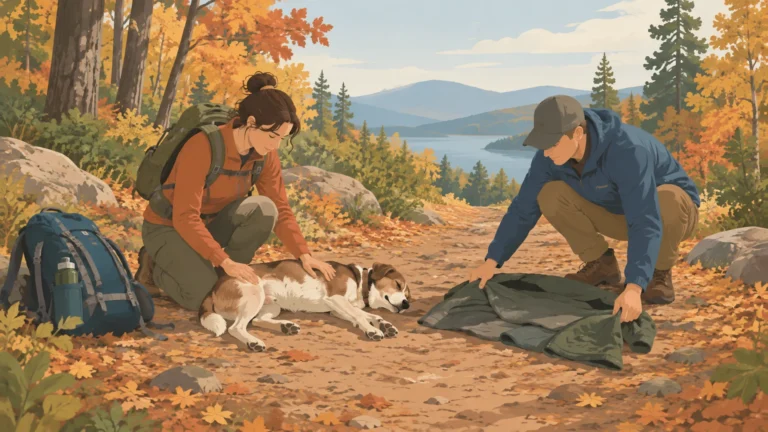
Everything above assumes a dog who is fine and simply needs a lift. A dog who has collapsed, been hit, cut a pad open two miles from the trailhead, or suddenly lost the use of its back legs is a different problem, and it is the one people search for at the worst possible moment. Three things change: your own safety comes first, the spine stops being a preference and becomes the whole point, and arms are usually the wrong tool.
Start with the bite. The Merck Veterinary Manual puts it first for a reason: “any injured or painful animal might bite or scratch, so protect yourself first.” Cornell says the same about dogs in spinal pain — “even a sweet dog may snap or growl” — and it is not a character flaw, it is a reflex. Muzzling helps, with two exceptions that come from different sources and both matter: Merck says “never muzzle a dog with chest injuries or a short-nosed breed (like a pug or a bulldog). Also do not leave a muzzled dog alone,” and the AKC adds to “avoid it if your dog is vomiting to prevent choking.”
- Phone before you lift. Call the clinic or emergency hospital on the way to the dog, not after you have moved them. They will tell you whether to move at all.
- Assume the spine is involved whenever there has been a fall, a car, or sudden hind-leg weakness. Merck’s instruction is to “minimize movement of its head, neck, and spine.”
- Use a flat surface, not your arms. Merck lists “a flat, firm board, thick cardboard, or a folded blanket” as the support; the AKC’s version is “a sturdy flat object, such as a board, that will hold your dog’s weight,” because “the goal of a stretcher is to keep your dog immobilized and prevent twisting of your dog’s neck and back, which could cause further injury.”
- For a leg, not a back, a blanket sling may be enough. The AKC describes putting “the blanket under their abdomen and lift, taking your dog’s weight off a sore or injured leg as they move towards the car” — a walking aid rather than a carry, and far less risky than hauling a heavy dog off the ground.
- Get a second pair of hands. Plainly, from the AKC: “large dogs may require more than one person to lift safely.” One at each end of the blanket, lifting together, keeps the dog level in a way that one person hugging a fifty-pound body never will.
- Keep the head level or slightly raised if the dog seems dazed, avoid jerking movements, and keep nothing pressing on the neck — all three are Merck’s, and all three are easy to get wrong while hurrying.
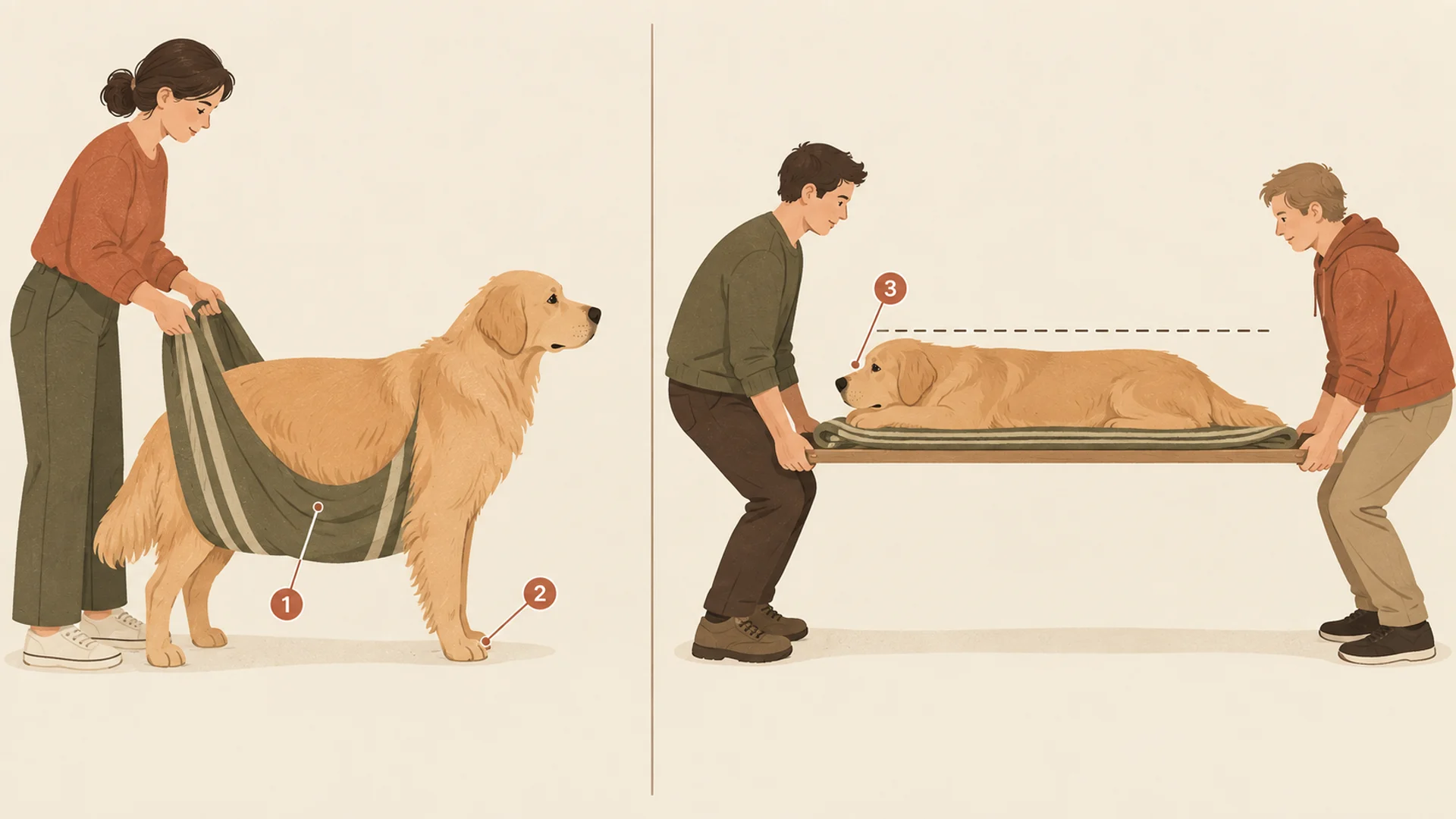
Two things are worth having before you ever need them, if you walk somewhere a car cannot reach: something that can act as a stretcher — a folded emergency blanket is light and does the sling job too — and the phone number of the nearest emergency veterinary hospital to where you actually walk, saved in advance. On a trail the honest planning question is not how you would carry your dog out, but how far you could carry them before you could not. For most people, with most dogs over about twenty pounds, that distance is shorter than the walk they just did.
None of this is first aid, and none of it is a diagnosis. It is how to move a dog without making things worse on the way to someone who can actually treat them.
The gear that replaces your arms
For the dog who mostly walks. The Everyday Four-Leg Lift-and-Go Dog Carrier Vest stays on the dog all outing: a padded top handle turns stairs, curbs and shop thresholds into one smooth lift, and the same vest clips to a leash for the stretches they trot. Which thresholds you are actually allowed to cross is worth knowing before you set out — we mapped it in can I bring my dog into stores.
For the dog who rides to rest. The Everyday Mesh-Comfort Sling Pet Carrier is an all-mesh pouch with a padded strap and harness clip — the closest thing to carrying in arms, minus the tired arms.
For the dog who wants the view. The Road Legs-Out Front & Back Dog Carrier buckles them upright against your chest, legs out, with padded air-mesh straps — and turns to ride on your back when the outing runs long. Compare more options in Carriers or the small-dog carrier guide.
Carrying a dog FAQ
What is the correct way to pick up a small dog?
One hand flat under the chest between the front legs, the other supporting the hindquarters, then bring them against your body with the spine level. Announce the lift with a consistent word, and set them down rear-feet-first before they squirm.
Is it bad to carry my small dog everywhere?
Carrying is not the problem — skipped walking is. Dogs need ground time for joints, weight and confidence. Carry for crowds, heat, danger and distance, and let them walk the parts of the world that are theirs to sniff.
Why does my dog hate being picked up?
Usually because lifts arrive as ambushes, or because they predict something unpleasant. Announce every lift, reward mid-air, and audit what the carry usually leads to. If a dog who tolerated lifting suddenly stops, rule out pain first.
Should I carry my dog under the armpits?
No — that hangs their full weight from the shoulder joints with the spine dangling. It is the human-toddler carry, and dogs are not built for it. Chest and rear, always both.
How long can I carry a dog in my arms?
As long as your form holds, which for most people is a few minutes before the rear-support hand starts drifting. The dog sags, the grip tightens, everyone gets grumpy. Past the five-minute mark, a sling or chest carrier does the same job better.
What is the safest way to carry a dog with back problems?
Level and supported end to end — chest and rear at the same height, against your body, no vertical dangling, no jumps down ever. For a long-bodied dog that means a whole forearm running the underside rather than two hands at the ends. For diagnosed backs, ask your vet to show you the hold for your specific dog, and favour flat-bottomed carriers over slings.
How do you carry a big dog?
One arm across the front of the chest, the other behind the hind legs, dog pulled in against your torso before you stand. Lift with your legs and keep your back upright. If you cannot also lower them under control, do not lift — for a heavy dog that cannot walk, a firm flat surface and a second person beat arms.
Should I carry my dachshund up and down stairs?
Cornell’s veterinary guidance is to minimise stairs and jumping on and off furniture for dogs prone to disc disease, so a carry that replaces a leap is doing useful work. Carry them flat and level, and keep the walking — the same guidance notes walking itself is safe for any dog.
How do you carry a dog with a suspected spinal injury?
You do not carry it in your arms. Merck’s guidance is to minimise movement of the head, neck and spine and to use a flat, firm board, thick cardboard or a folded blanket as support. The AKC’s stretcher advice is the same, and for a large dog it takes two people, one at each end, lifting together so the body stays level. Call the clinic before you move the dog at all.
My dog got hurt on a hike and cannot walk — how do I get them out?
If it is one sore leg and the dog is otherwise steady, the AKC describes passing a blanket under the abdomen and lifting so the dog walks out with the weight taken off that leg. If a fall, a hard impact or sudden hind-leg weakness is involved, treat it as a possible spinal injury: a rigid flat surface, two people, and no twisting. Muzzle if it is safe to — but not a short-nosed breed, not a dog with chest injuries, and not a dog that is vomiting.
How should I carry my dog after surgery?
Exactly as your discharge instructions say, which for spinal cases often means strict rest for weeks. Approach slowly and from the side, support the body so nothing bends at the sore part, and call the clinic rather than guessing if you are unsure whether to move them at all.
Two points of support, zero surprise exits.
Chest and rear, level spine, against your body, down before they decide — that is the whole technique, and it scales from a four-pound dog to a fifty-pound one by changing which parts of you do the holding. The judgment call is duration: arms for moments, equipment for outings, and ground under their own four feet for as much of the day as the world allows.
Sources
- American Kennel Club — When You Should (or Shouldn’t) Pick Up Your Small Dog, by Sassafras Patterdale CPDT-KA CTDI (verbal cue before lifting; when lifting makes things worse) (checked 2026-08-27)
- Cornell University College of Veterinary Medicine, Riney Canine Health Center — Intervertebral disc disease (predisposed breeds; minimising stairs and jumping; early signs owners notice) (checked 2026-08-27)
- American College of Veterinary Surgeons — Intervertebral Disc Disease (share of cases by breed; bed-rest aftercare) (checked 2026-08-27)
- Merck Veterinary Manual — What to Do in a Dog or Cat Emergency (protect yourself first; when not to muzzle; minimising movement of head, neck and spine; board, cardboard or folded blanket as support) (checked 2026-09-13)
- American Kennel Club — How to Transport an Injured or Sick Dog to the Veterinary Hospital (muzzling and vomiting; blanket under the abdomen as a walking aid; makeshift stretcher and why it prevents twisting; large dogs needing more than one person) (checked 2026-09-13)
- Merck Veterinary Manual — Disorders of the Spinal Column and Cord in Dogs (early disc degeneration; why increased activity worsens compression) (checked 2026-08-27)
Veterinary guidance is updated periodically. Confirm on the official pages, and talk to your own veterinarian about your own dog — nothing here is a diagnosis or a substitute for an exam.