
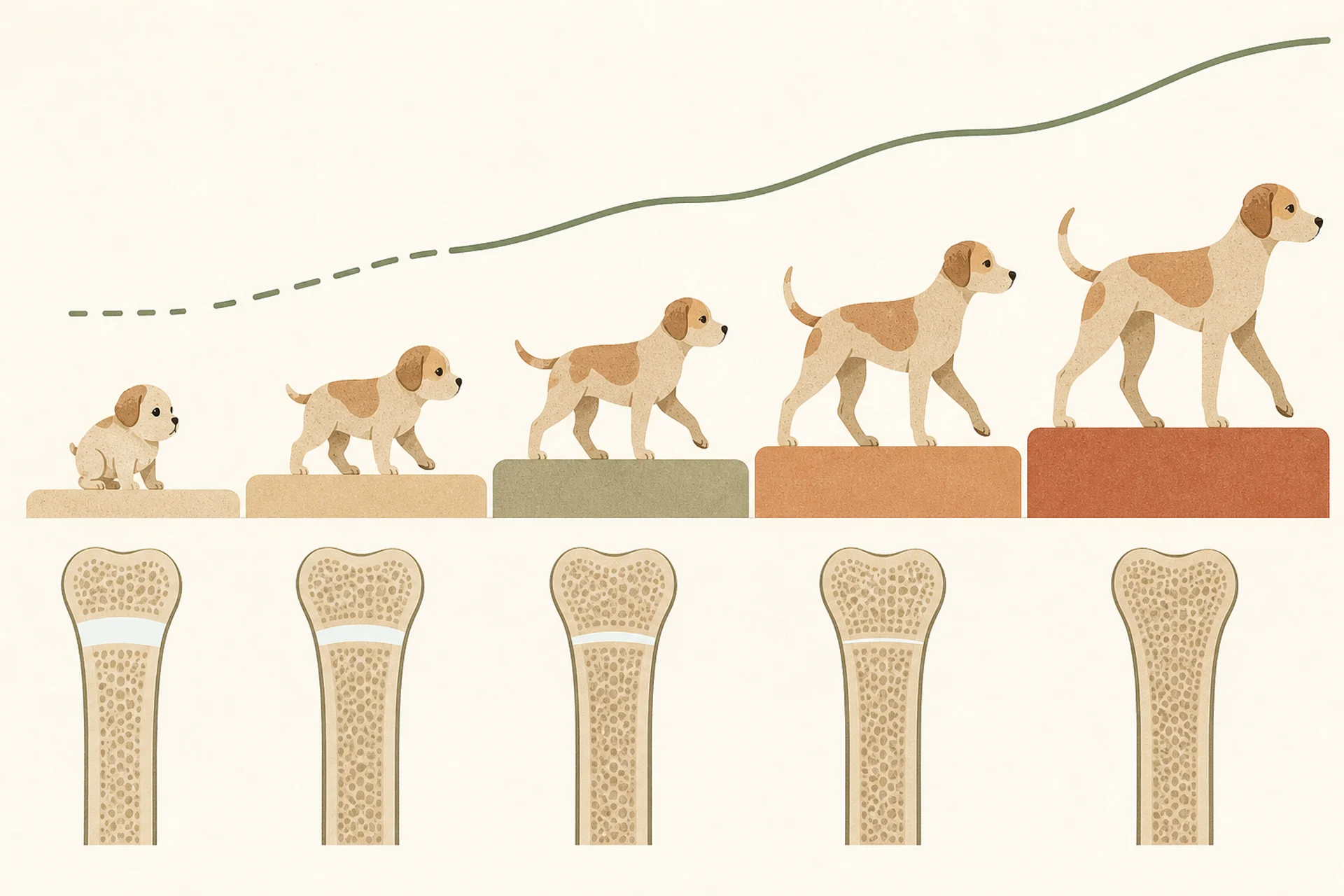
Roughly five minutes of walking per month of age, once or twice a day — so about 10 minutes a session at 10 weeks, 15 at three months, 30 at six months, and up to double that as a daily total. The American Kennel Club states it in exactly those terms. Note that the guidance is in minutes, not miles: nobody credible publishes a distance, because the same twenty minutes is a different load on grass than on concrete. The chart below converts it age by age.
What the rule is not is a research finding. It is a rule of thumb, and the largest study to look at puppy exercise and hip development found something it doesn’t capture. That study followed 501 puppies to their hip X-rays. The ones that got off-leash outdoor exercise in their first three months had less hip dysplasia, not more. The ones that used stairs in those months had more. So the honest answer to “how far” is that distance matters less than surface and impact.
Where the five-minute rule comes from
The rule is a brake, and brakes are useful. A twelve-week-old is three months old, so it gives about fifteen minutes once or twice a day; at six months, thirty. The point isn’t the arithmetic — it’s to stop an owner taking a four-month-old Labrador on a five-mile hike because he seemed happy for the first mile.
There’s a structural reason for the caution: puppy long bones grow from soft plates near each end, and those plates stay soft until they close. The AKC’s puppy growth timeline puts closure at roughly six to eight months in small breeds, twelve in medium breeds, twelve to eighteen in large breeds, and up to twenty-four in giant breeds.
The Merck Veterinary Manual’s account of hip dysplasia names growth rate, exercise, nutrition and heredity together, and describes the core problem as a mismatch between how fast bone develops and the muscle available to hold the joint steady. That reframes the question: the risk isn’t movement, it’s load the joint isn’t built to absorb yet.
What the one large study actually found
In 2012 a Norwegian group published a prospective cohort study in the American Journal of Veterinary Research — Krontveit and colleagues on exercise-related risk factors for hip dysplasia. They followed 501 dogs from 103 litters — Newfoundlands, Labradors, Leonbergers and Irish Wolfhounds — from birth to hip screening at twelve or eighteen months.
- Stairs, birth to three months: higher risk. Puppies using stairs in that window had increased risk of radiographically detectable hip dysplasia. The authors’ conclusion is blunt — puppies under three months should not have access to stairs.
- Off-leash exercise, birth to three months: lower risk. The same window, the opposite direction — and the paper recommends outdoor exercise on soft ground in moderately rough terrain.
One study on four large breeds isn’t the last word, and the authors framed it as advice for those breeds rather than universal law. But it doesn’t support the folk version of the rule — the one where a puppy is kept nearly still until his first birthday. Free movement on forgiving ground looked protective; repetitive impact on hard edges did not.
How long to walk a puppy, age by age
Two numbers, because people ask for both and they are not the same: what one walk should be, and what a day should add up to. The AKC frames the rule as five minutes per month of age once or twice a day, so the daily total is the session figure times one or two — closer to one on pavement or in heat, closer to two if the walks are slow and sniffy on soft ground.
| Age | One walk | Per day | What the evidence flags |
|---|---|---|---|
| 8 weeks | about 10 min | 10–20 min | Often still pre-vaccination for outdoor walking — carried outings count. No stairs. |
| 10 weeks | about 10 min | 10–20 min | Let the puppy set the pace; sitting down or lagging is the stop signal. |
| 12 weeks | about 15 min | 15–30 min | Soft ground. Paws are not conditioned to concrete yet. |
| 14–16 weeks | 15–20 min | 20–40 min | Grass and packed sand over sidewalk. Free running beats leashed distance. |
| 5 months | about 25 min | 25–50 min | No repeated jumping — balls thrown straight up, dock diving. |
| 6 months | about 30 min | 30–60 min | Small breeds may have closed plates; large and giant breeds have not. |
| 9–12 months | 45–60 min | up to about 2 hours | Still no sustained jogging for large and giant breeds. |
| 12–24 months | Rule stops being useful | Jogging waits for maturity: about 12 months medium, 12–18 large, 18–24 giant. | |
The AKC’s surface and activity guidance lives in that right-hand column: grass and packed sand over pavement, no leashed jogging until maturity, no repetitive jumping games. Those are the levers; the minute count is the coarse one.
How many walks a day, and does it have to be a walk?
Once or twice is the published frame, and there is a reason not to stretch it into four. The AKC’s point about leashed walking is easy to miss: “When tethered to a leash, a puppy doesn’t have the option to stop.” A puppy on a lead will keep going past the point where they would have quit on their own, which is exactly the loading the five-minute rule exists to cap.
The same guidance says the best exercise for a puppy is safely free running — a fenced yard, or a long line of about fifteen feet held slack in a safe space — because a puppy choosing their own speed self-regulates. That is also the finding the Norwegian cohort landed on from the other direction: off-leash outdoor exercise in the first three months tracked with less hip dysplasia. If your puppy needs more than the clock allows, the honest answer is usually more sniffing and more off-leash pottering, not a longer leashed walk.
When can a puppy start running with you?
Later than most people expect, and the threshold is set by breed size rather than by energy level. The AKC asks you to hold off on jogging or running a puppy on a leash until they are mature: roughly 6 to 8 months for small breeds, 12 months for medium, 12 to 18 months for large, and 18 to 24 months for giant breeds. The reason is the same soft growth plate that governs everything else here — sustained running on hard surfaces before the plates harden is the case the AKC specifically warns about.
A five-month-old Labrador can physically keep up with a slow jog. That is not the question. The question is what repeated impact on blacktop does to a joint whose bone is still growing faster than the muscle holding it.
The window nobody plans for: socialization versus vaccination
Here’s what makes “when can my puppy go on walks” harder than it looks. The Merck Veterinary Manual’s puppy care guidance puts the important socialization stretch between two and four months — and notes in the same breath that puppies are vaccinated every two to three weeks until about four months, and should be kept from dogs of unknown vaccination status until then.
Those windows overlap almost perfectly: the weeks a puppy most needs to meet the world are the weeks shared ground carries the most risk. That’s why so much advice sounds contradictory — one source is optimising for behaviour, the other for infectious disease.
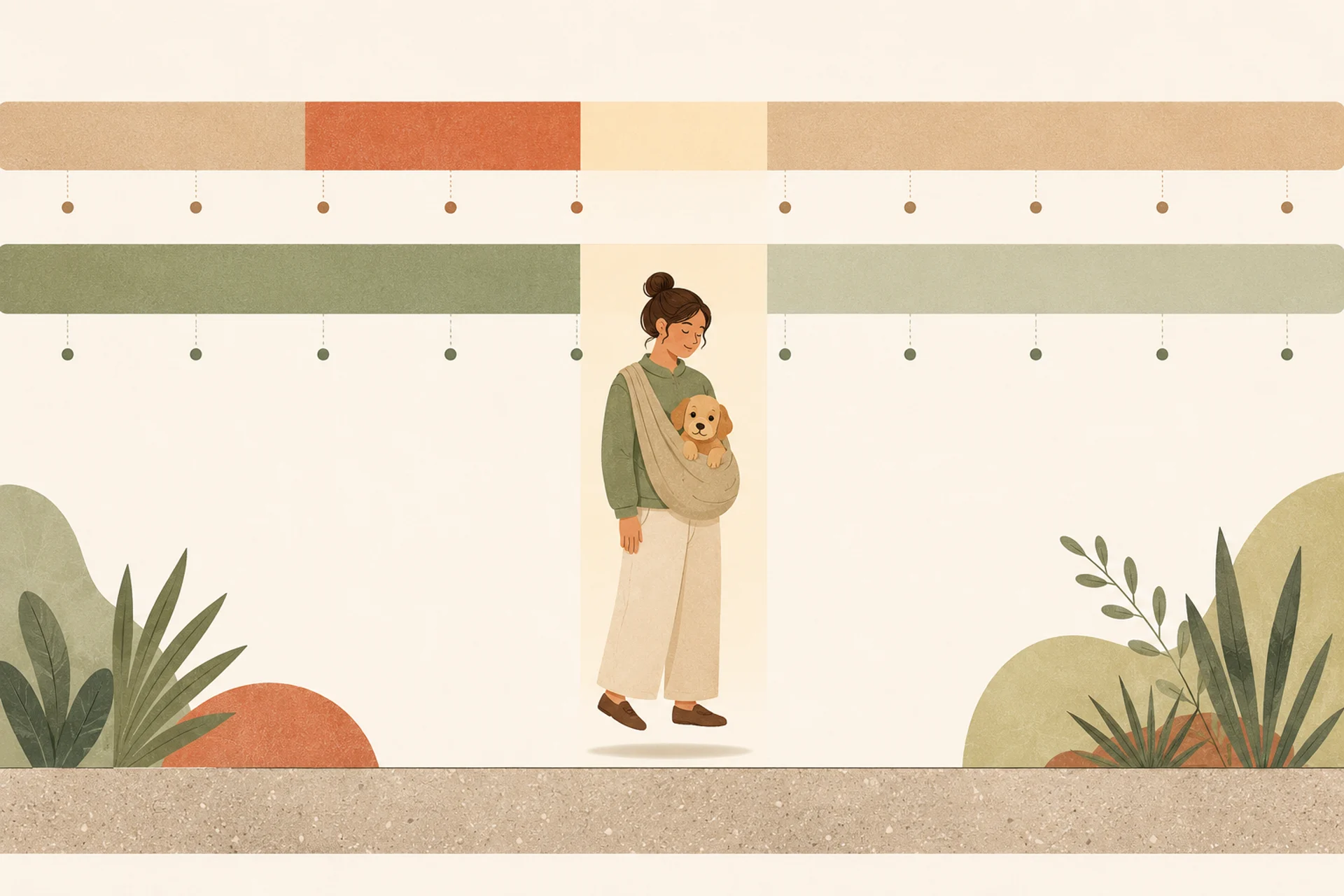
The way out is to separate exposure from ground contact. A puppy can see traffic, hear a bus and meet a calm vaccinated adult dog without putting paws on the pavement — carrying is the mechanism, which is why a sling like the Everyday Mesh-Comfort Sling Pet Carrier earns its place in these weeks and then largely stops mattering. Merck also notes some training classes take vaccinated puppies from eight weeks; a controlled setting beats an uncontrolled sidewalk. Your vet knows the local risk picture, and that call belongs with them.
The other half of the answer: what your puppy jumps off
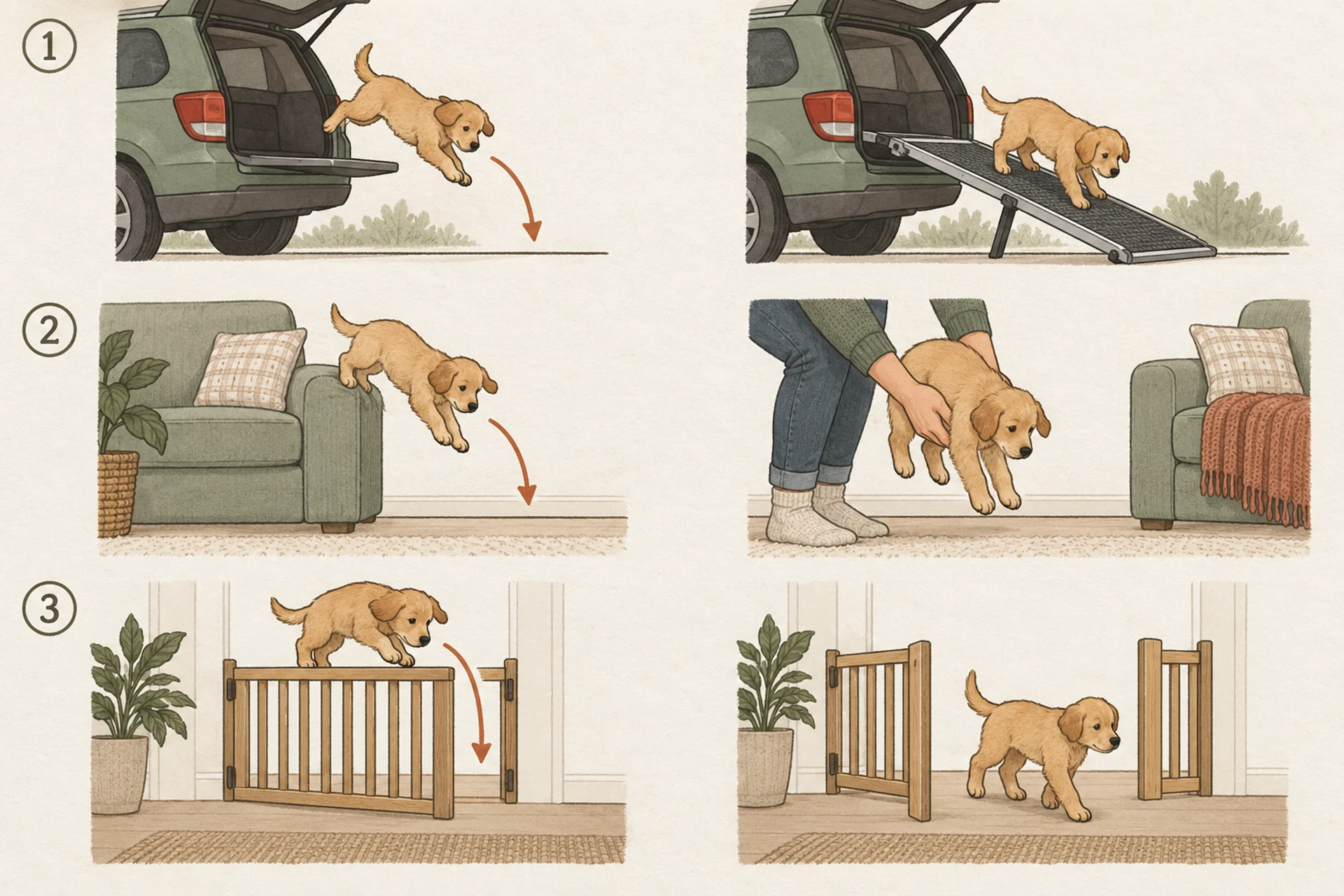
The finding above — that the type of loading matters more than the minute count — has an awkward consequence. Most of the loading in a puppy’s day doesn’t happen on the walk. It happens in the six seconds a day the puppy drops out of the back of the car, off the sofa, or over a baby gate. Owners measure the walk carefully and never count those.
The AKC is direct about the mechanism: “puppy growth plates aren’t closed until at least 12 months of age and jumping on open growth plates can cause long term damage.” It puts competitive or extreme jumping off the table until “at least 12-15 months old (or older for giant/slow-maturing breeds)” — and then, in the same piece, points at the ordinary stuff: “it’s also important to limit your young dogs jumping in day to day activities, like jumping on beds, over baby gates, and out of the car.”
The reason to take that seriously isn’t that one jump snaps something. It’s that the bad version is quiet. The Merck Veterinary Manual notes that “joint and growth plate fractures are relatively common in young, growing dogs and cats,” that they “usually result from traumatic events such as falls, car accidents, or rough play,” and that the crush-type physeal injuries are “often difficult to diagnose initially and commonly associated with growth disturbances.” The complications it lists — angular limb deformities, limb length discrepancies, osteoarthritis — are the kind you find out about a year later.
The lever most owners underuse is the food bowl
Here is the part that reframes the whole exercise question. Cornell’s Riney Canine Health Center describes canine hip dysplasia as “a genetic condition that can be modified by environmental influences, such as nutrition and growth rate” — and adds that “overfeeding and rapid growth in puppies can worsen the condition in dogs already predisposed to CHD while restricted growth can reduce expression of the trait.”
Read that next to the walking rule and the ranking changes. An owner counting minutes on the leash while free-feeding a fast-growing Labrador is being careful with the smaller lever. Growth rate is something you influence every day, in a way that is measurable at the next vet weigh-in. It is also the one to discuss with your own vet rather than adjust on your own — restricting a growing puppy’s food without guidance is its own way to get it wrong.
What to do instead of letting them jump down
- Lift or ramp out of the car, every time. The AKC’s ramps-versus-stairs comparison favours ramps for vehicles — they are “easier to fold down and are often lighter than quality dog stairs, making them the better choice if you want to use them in your car” — and notes that “sloping ramps are also gentler on sore joints.”
- Help the ones who look clumsy. The same page’s framing is the useful one: “offering a helping hand to small or ungainly puppies reduces worries about them injuring themselves.”
- Handle the descent, not the climb. Going up loads the back legs against gravity; coming down puts the whole drop through the front ones. Under three months, keep the puppy off stairs entirely — that is the one thing the Norwegian cohort above tested and found.
- Decide about the furniture now. A puppy allowed on the sofa will get off it a dozen times a day for the next fifteen years. Either it doesn’t go up, or something is there to come down onto.
- Skip the vertical fetch games. Balls thrown straight up and frisbees caught mid-leap are the repetitive-impact version of the same problem, and they are easy to swap for a rolled ball.
Signs you went too far
- Lagging or sitting down mid-walk. Puppies don’t ration themselves, which is why the rule exists.
- Stiff or sore the next morning. The signal people miss, because the walk itself looked fine.
- Any limp at all. Call your vet rather than resting it a few days to see.
Once walks stretch out, how often to stop on a road trip with a dog applies the same instinct to car time, and how to carry a small dog covers the carrying mechanics. If the plan is eventually to hike with a dog who carries its own pack, the growth-plate timing above is the first constraint — how much weight a dog should carry in a backpack covers the rest — and once the outings get long enough to need supplies, how much water a dog needs on a hike sets the other number people guess at.
Puppy walking distance FAQ
How far can a puppy walk at 10 weeks?
About ten minutes at a time, once or twice a day — a ten-week-old is two and a half months, so the rule lands just above ten minutes. In practice the clock matters less than the surface and the stopping: soft ground, no stairs, and home when they sit down or start lagging.
How long should I walk my puppy each day?
Take the session figure — five minutes per month of age — and multiply by one or two, because the AKC frames it as once or twice daily. A four-month-old therefore lands somewhere between twenty and forty minutes of walking across the whole day, not in one go.
How far can a puppy walk at 5 months?
Around twenty-five minutes a session, so twenty-five to fifty minutes across the day. Five months is also where owners start jogging with a puppy who seems willing; for medium, large and giant breeds that is too early, and the AKC’s thresholds are 12, 12–18 and 18–24 months respectively.
How far can a puppy walk at 12 weeks?
About fifteen minutes once or twice a day. More useful at this age: keep it off stairs and on soft ground, and let the puppy set the pace — the Norwegian cohort data speaks directly to this birth-to-three-months window.
How far can a puppy walk at 16 weeks?
Roughly twenty minutes once or twice daily on the rule. Sixteen weeks is also around when many puppies finish their vaccination series, so it’s often when shared ground opens up — confirm the timing with your vet rather than assuming a date.
How far can a puppy walk at 6 months?
About thirty minutes once or twice a day by the rule. But here breed size matters more than the formula: a small breed may have closed growth plates already, while a large or giant breed has a year or more to go and should stay off jogging routes and hard surfaces.
Is the five-minute rule based on science?
It’s stated as guidance by the AKC, but it’s a rule of thumb, not a study result. The best available evidence — a cohort of 501 dogs — didn’t test walk length at all. It found stair use in the first three months associated with more hip dysplasia and off-leash exercise with less, suggesting the type of loading matters more than the minutes.
When can puppies go on walks outside?
Physically, almost immediately on your own secure ground. The limiting factor is infectious disease, not legs: Merck advises keeping puppies away from dogs of unknown vaccination status until the series finishes around four months. Since socialization matters most from two to four months, carrying through public places is the usual compromise. Ask your vet about local risk.
Is jumping bad for puppies?
Repeatedly jumping down is the part to limit. The AKC’s position is that growth plates stay open until at least 12 months and that jumping on open plates can cause long-term damage, and it names the everyday cases specifically — beds, baby gates, and out of the car. Extreme or competitive jumping waits until 12–15 months, and longer for giant and slow-maturing breeds. A ramp or a lift removes almost all of it.
Can you over-exercise a puppy?
Yes. Merck describes hip dysplasia as a mismatch between fast bone growth and the muscle holding the joint stable, so high-impact repetitive loading — stairs, jumping games, running on pavement — is the pattern to avoid. Long free play on grass is a different thing. Any limp is a vet visit, not a walk-length adjustment.
Ask what kind of movement, not how many minutes.
Use the five-minute rule as a ceiling if it helps you resist a long hike. Then spend your attention on what the evidence flagged: no stairs in the first three months, soft ground over pavement, no repeated jumping, no leashed jogging until the growth plates close, and as much unforced free play as your puppy wants. When you’re unsure — especially about a limp — ask your vet.
Sources
- American Kennel Club — How much exercise does a puppy need? (checked 2026-08-30)
- American Kennel Club — Puppy growth chart: when does my puppy finish growing? (checked 2026-08-30)
- Krontveit RI, Nødtvedt A, Sævik BK, Ropstad E, Trangerud C. Housing- and exercise-related risk factors associated with the development of hip dysplasia… Am J Vet Res 2012;73(6):838–46 (PMID 22620698) (checked 2026-08-30)
- Merck Veterinary Manual — Hip dysplasia in dogs (checked 2026-08-30)
- Merck Veterinary Manual — Puppy care (checked 2026-08-30)
- American Kennel Club — Is It Safe for Puppies to Jump? (growth plates open until at least 12 months; limiting everyday jumping off beds, over gates and out of the car) (checked 2026-09-06)
- Merck Veterinary Manual — Joint Trauma in Dogs and Cats (growth plate fractures in young growing dogs; causes and long-term complications) (checked 2026-09-06)
- Cornell University College of Veterinary Medicine, Riney Canine Health Center — Canine hip dysplasia (genetics modified by nutrition and growth rate) (checked 2026-09-06)
- American Kennel Club — Dog Stairs vs. Ramps (ramps for vehicles; gentler on joints; helping ungainly puppies) (checked 2026-09-06)
Veterinary guidance and vaccination schedules change, and local disease risk varies. Nothing here is a diagnosis or a substitute for your own veterinarian’s advice — bring specific questions about your puppy, especially any limp or lameness, to them.