
There is exactly one kind of store where the law decides for you, and it is anywhere food is sold or served. Under the FDA’s model Food Code — the document your state’s own food code is built from — § 6-501.115 “Prohibiting Animals” says live animals “may not be allowed on the premises of a food establishment,” with a short list of exceptions: service animals in customer areas, patrol dogs, fish in tanks, pets in the dining rooms of care facilities, caged animals in a pet store — and, new in the 2022 edition, pet dogs in outdoor dining areas where the health department approves it.
Everywhere else — the hardware store, the bookshop, the garden centre, most of the big boxes — no law is deciding anything. It is store policy, it is often set per location, and it can change with the manager on duty. Which is why the answer to “can I bring my dog in?” is genuinely different at two branches of the same chain, and why the only reliable way to find out is to ask that store.
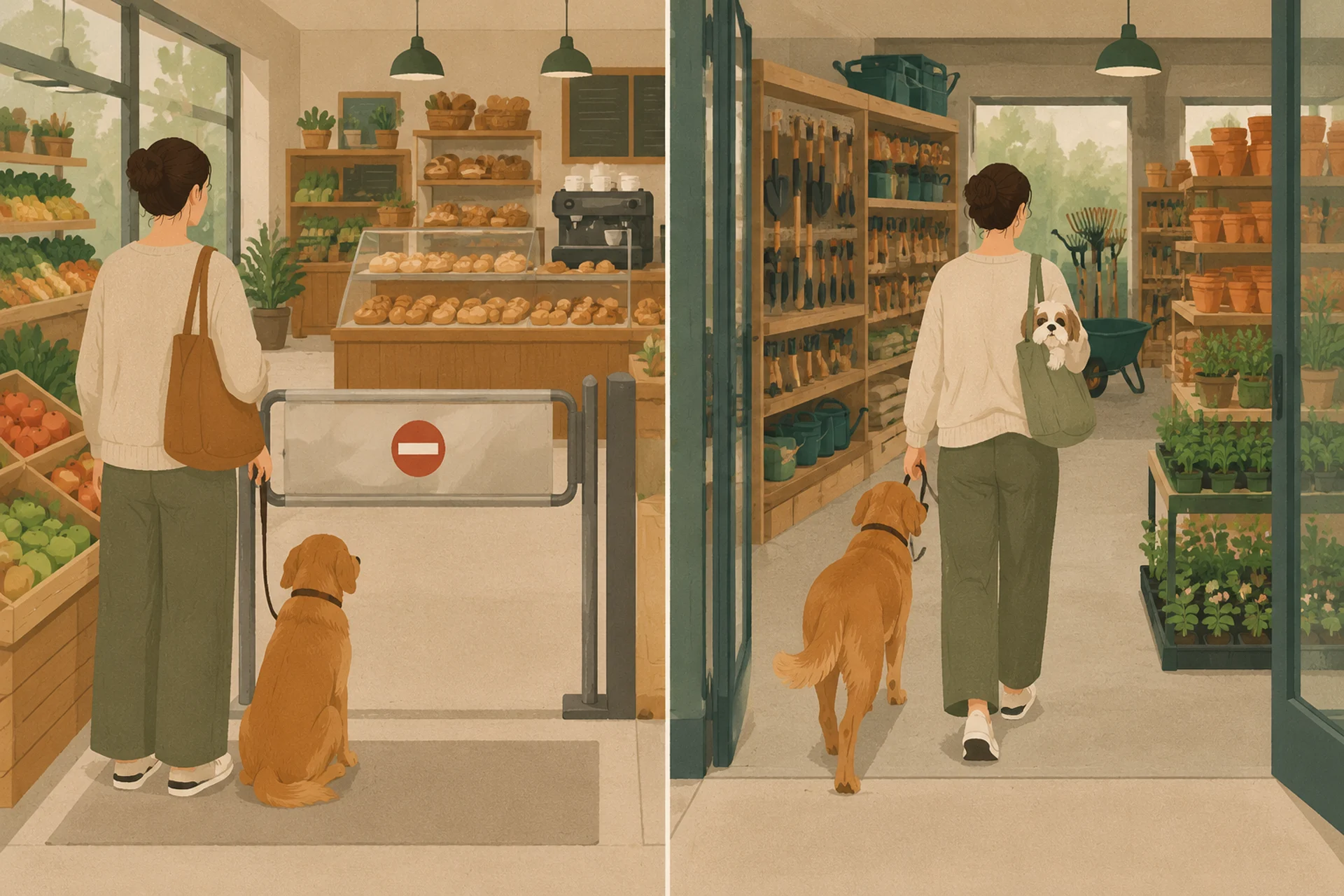
A carrier, tote or stroller does not move a grocery store into the “allowed” column. It frequently does move a policy store there.
Why groceries and cafes are not a policy question
The FDA does not regulate your local supermarket directly. It publishes the Food Code as a model, and each state adopts some edition of it into its own law — which is why FDA maintains a state-by-state list of retail food codes. That list is the single most useful link on this page, because it takes you to the actual rule that applies where you live rather than to somebody’s blog post about it.
California’s adopted version is a good worked example, because it is public and readable. Health & Safety Code § 114259.5 opens with “live animals may not be allowed in a food facility” and then lists the same narrow exceptions. Note the word premises in the federal text and facility in California’s: neither one says “the part of the shop where the cheese is.” A deli counter inside a general store can pull the whole floor under the food code, which is one reason a store that used to wave you in stops doing it after a remodel.
Two practical consequences fall out of this:
- Staff at a grocery store, cafe or restaurant are not being difficult when they stop you. They are the ones who get written up at inspection, not you.
- A closed carrier is not a loophole in these places. The code prohibits the animal on the premises; it does not distinguish between a dog walking and a dog riding.
Who decides, by type of place
| Type of place | Who is deciding | Does a carrier change the answer? |
|---|---|---|
| Grocery, convenience, cafe, restaurant, bakery | State food code, enforced by the health department | No |
| Restaurant patio or outdoor seating | Food code, but only if your state adopted the pet-dog exception and the venue opted in | Sometimes — see below |
| Big-box general merchandise with a food or deli counter | Food code for the premises; policy for the rest, in practice | Rarely |
| Hardware, garden centre, bookshop, clothing, pet supply | The chain’s policy, often delegated to the store manager | Often yes — off the floor is an easier yes than on it |
| Anywhere, for a trained service dog | The ADA, which overrides a “no pets” policy | Not relevant — the dog works on the floor |
The patio rule changed in 2022, and it has a catch
The 2022 Food Code added paragraph (D): “If approved by the regulatory authority, food establishments may allow pet dogs in outdoor dining areas.” That is a real change and it is why more patios say yes than did five years ago. But it is permission granted to the health department, then to the restaurant — two gates before it reaches you.
Where states have written the detail, the detail matters. California’s version requires that the patio have “a separate outdoor entrance where pet dogs enter without going through the food establishment,” bans dogs from chairs and benches, requires food and water in single-use containers only, and forbids staff on duty from touching the dog. It also says the dog must be “on a leash or confined in a pet carrier” — which is one of the few places in American food law where a carrier is named as an acceptable form of control.
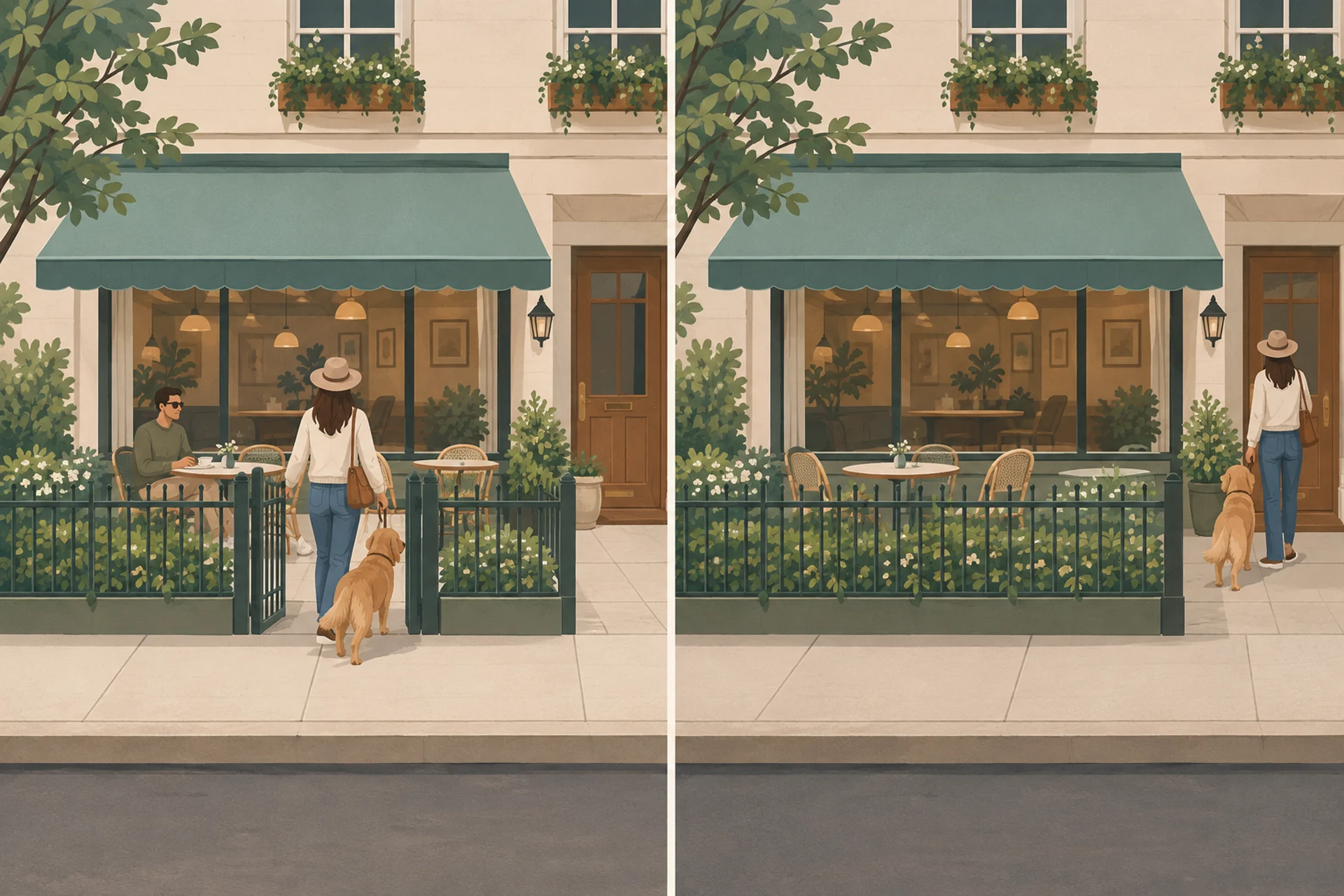
The practical read: if the patio has its own gate from the sidewalk, you are probably fine. If the only way to the patio is through the dining room, the answer is often no even at a dog-friendly restaurant, and the host is not inventing it.
Service dog, emotional support dog, and the two questions
This is where most of the bad information on the internet lives, so it is worth getting exactly right. The Department of Justice’s service animal FAQ defines a service animal as a dog individually trained to do work or perform tasks for a person with a disability. Emotional support, therapy and comfort animals are explicitly not service animals under the ADA, however genuinely they help.
Staff may ask exactly two questions when it is not obvious: is the dog a service animal required because of a disability, and what work or task has it been trained to perform. They may not ask for documentation, may not make the dog demonstrate the task, and may not ask about the disability. There is no federal registry — DOJ says plainly that the certificates and registration documents sold online “do not convey any rights under the ADA.”
Two details people get wrong in stores: a service dog generally must be on the floor or carried, not riding in a shopping cart; and a restaurant is not required to let any dog, service animal included, sit on a chair or be fed at the table.
Do not claim a pet is a service dog to get through a door. Beyond the obvious, several states have made misrepresentation a specific offence, and the practice is the reason handlers with real working dogs get interrogated.
How to get a real answer in one phone call
Chain-level policies get repeated online long after they change, and “corporate says yes” loses to “this location says no” every time. Call the specific store and ask four things:
- Is there any food service or deli counter in the building? If yes, expect the food code answer, not the policy answer.
- Carried or on the floor? Plenty of policy stores that say no to a leashed dog say yes to one that stays in a carrier or a tote, because the concern is usually floor traffic and other customers’ dogs.
- Carts? Many stores that allow dogs still do not allow them in carts, which changes what you need to bring.
- Quiet hours? A manager who says “not on a Saturday” is giving you a yes for Tuesday morning.
Then have a plan for the times the answer is no. The one thing that is never the fallback is leaving them in the car while you run in — the numbers on that are worse than almost everyone assumes, and we went through them in what actually happens inside a parked car. Curbside pickup exists for exactly this.
A common objection: “he’s in a bag, he’s not really in the store”
People say this in good faith and it is half right. In a policy store, the bag genuinely is the difference: a dog who cannot touch the floor, sniff the produce or meet another dog is a much smaller ask, and many managers will say yes on that basis alone. If you carry a dog regularly, the shape you choose changes how long you can stand in a queue — we compared them in sling, backpack or carrier purse, and how to carry a dog properly covers the handling.
Where it is not right is a food establishment. The rule is written about animals on the premises, and a health inspector walking the aisle is not going to relitigate the container. Arguing it at the checkout puts a clerk in a position they cannot win.
Outside the United States
Everything above is US law. In Canada, food premises rules are provincial and enforced by regional health units, and service animal access is set by provincial human rights and accessibility legislation rather than the ADA — different framework, broadly similar outcome in a grocery store. Check your province’s public health unit before assuming an American answer transfers.
Can I bring my dog into a grocery store if I carry them?
No. A grocery store is a food establishment, and the food code prohibits live animals on the premises rather than on the floor. Service animals are the exception; a carrier is not.
Why do some stores let dogs in and others don’t?
Because most stores are not covered by the food code at all. Once no food is involved, nothing federal or state is deciding — it is the chain’s policy, and most chains leave the final call to the individual store.
Can a restaurant let my dog sit on the patio?
If the state adopted the 2022 Food Code exception and the health department approved that venue, yes. States that wrote the detail tend to require a separate outdoor entrance, so patios reachable only through the dining room usually still say no.
What can staff ask me about a service dog?
Two questions only: is the dog required because of a disability, and what task is it trained to perform. Not for paperwork, not for a demonstration, not about your disability.
Does registering my dog as a service animal online help?
No. The Department of Justice states that those certificates and registrations convey no rights under the ADA and are not recognised as proof.
Can my dog ride in the shopping cart?
Usually not, even where dogs are welcome — carts are a food-contact surface in a lot of store policies. ADA guidance says a service dog generally stays on the floor or is carried rather than riding in a cart.
The same split — a hard federal floor under one category, everything else left to whoever owns the space — shows up again the moment you try to get there. See can I take my dog in an Uber or Lyft for how it plays out at the kerb.
Sources
- FDA Food Code 2022 — § 6-501.115 Prohibiting Animals (checked 2026-09-15) — the model text: live animals may not be allowed on the premises of a food establishment, the five exceptions in paragraph (B), and paragraph (D) allowing pet dogs in outdoor dining areas if approved by the regulatory authority.
- FDA — Summary of Changes in the 2022 FDA Food Code (checked 2026-09-15) — confirmation that the outdoor-dining exception is new in the 2022 edition, added as paragraph (D) to § 6-501.115.
- FDA — State Retail and Food Service Codes and Regulations by State (checked 2026-09-15) — the state-by-state index showing that each state adopts its own code, and where to read yours.
- California Health & Safety Code § 114259.5 (checked 2026-09-15) — the adopted state text used as the worked example: the general prohibition, the service-animal exception, and the outdoor dining conditions including the separate outdoor entrance, single-use containers, the staff no-contact rule, and “on a leash or confined in a pet carrier.”
- U.S. Department of Justice — Frequently Asked Questions about Service Animals and the ADA (checked 2026-09-15) — the definition of a service animal, emotional support animals excluded, the two permissible questions, no documentation requirement, online registrations conveying no rights, shopping carts, and seating in restaurants.
Food codes and store policies change, and states adopt different editions of the Food Code at different times. Confirm on your state’s official page and with the specific store before you travel.
Food on the premises is law. Everything else is a phone call.
If the building sells or serves food, the state food code has already answered, and no carrier changes it. If it doesn’t, nobody has answered yet — so ring that store, ask whether carried counts, and pick a quiet hour. The one fallback that is never on the table is the car.