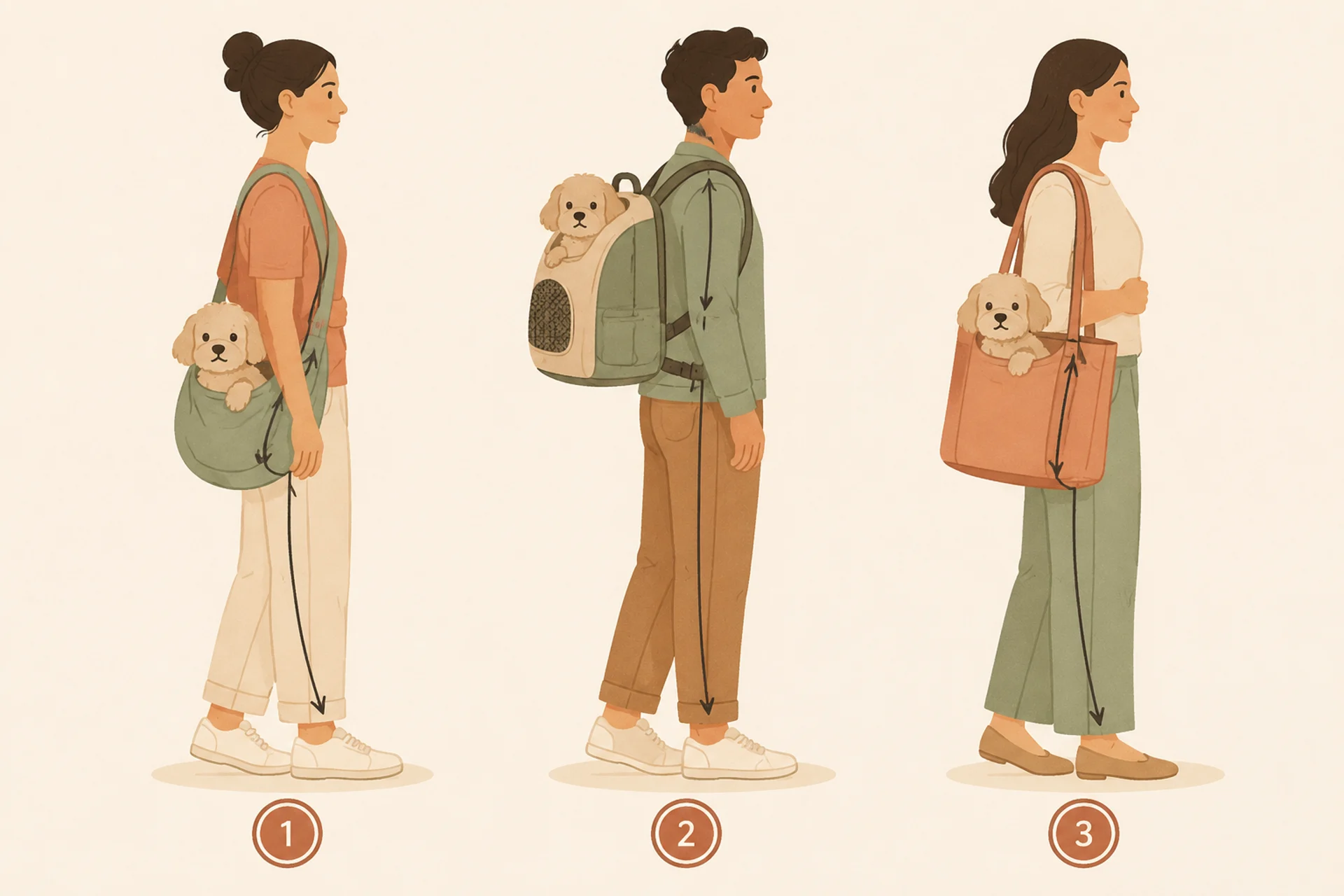
Sling, backpack and carrier purse are three genuinely different tools, and the usual advice — pick by trip length — only gets you halfway. Trip length decides what your shoulder can stand. What your dog’s body can stand is decided by something else: whether the bag gives their spine a flat surface to lie on, and whether they can get out of it.
So the order of questions is: how long is the walk, what shape is your dog, and how good is the tether. A backpack wins on distance because two straps beat one. A sling wins on contact and on getting in and out fast. A tote wins on looking like a bag you already own — and loses on almost everything else.
The three shapes at a glance
| Style | Load path | Dog lies on | Realistic trip length | Hands free? |
|---|---|---|---|---|
| Sling | One shoulder, across the body | A pouch — firm or slack depending on the design | Errands, waiting rooms, the tired last mile | Mostly — one hand steadies at first |
| Backpack | Both shoulders, down the spine | A structured base, usually padded | Hours, with breaks | Fully |
| Purse / tote | One shoulder, hanging free | A flat base, often unpadded | Under an hour | No — one arm stays committed |
Notice what the middle column does to the ranking. On the human side this is a simple ergonomics question and the backpack wins outright. On the dog’s side the answer flips depending on which sling you are holding, because slings are the one category where two products with the same name behave completely differently.
The question the listings skip: what is your dog’s back doing in there?
Look at the breeds that ride in slings. Dachshunds, Shih Tzus, Pekingese, corgis, Lhasa Apsos — short-legged, long-bodied dogs that get tired on a long walk and are light enough to carry. That list is almost exactly the list of breeds the AKC Canine Health Foundation names as most commonly affected by intervertebral disk disease: “Chondrodystrophoid (dwarfed) breeds of dogs whose normal cartilage development has been altered genetically for the purpose of a short, stout appearance.” Corgis, cocker spaniels and poodles are on their list too, and non-dwarfed breeds — German Shepherd, Labrador Retriever, Doberman Pinscher — are commonly affected as well. Obese dogs of predisposed breeds, the foundation notes, are especially likely to suffer from it.
To be clear about what this does and does not mean: IVDD is a degenerative process, not something a bag causes. Nobody has shown that carrying a dog in a sling damages discs. What the foundation does say is that “sudden trauma can cause rupture or herniation of an intervertebral disk in a dog whose disks already are weakened by IVDD” — and the sudden trauma available to a dog in a shoulder bag is the jump. A dog leaping out of an open pouch lands from roughly your hip height onto pavement, front-first.
That reframes the choice usefully. You are not picking a bag that protects a spine; you are picking one that lets the dog lie flat and stay put, which costs nothing and is easy to check in the product photos.
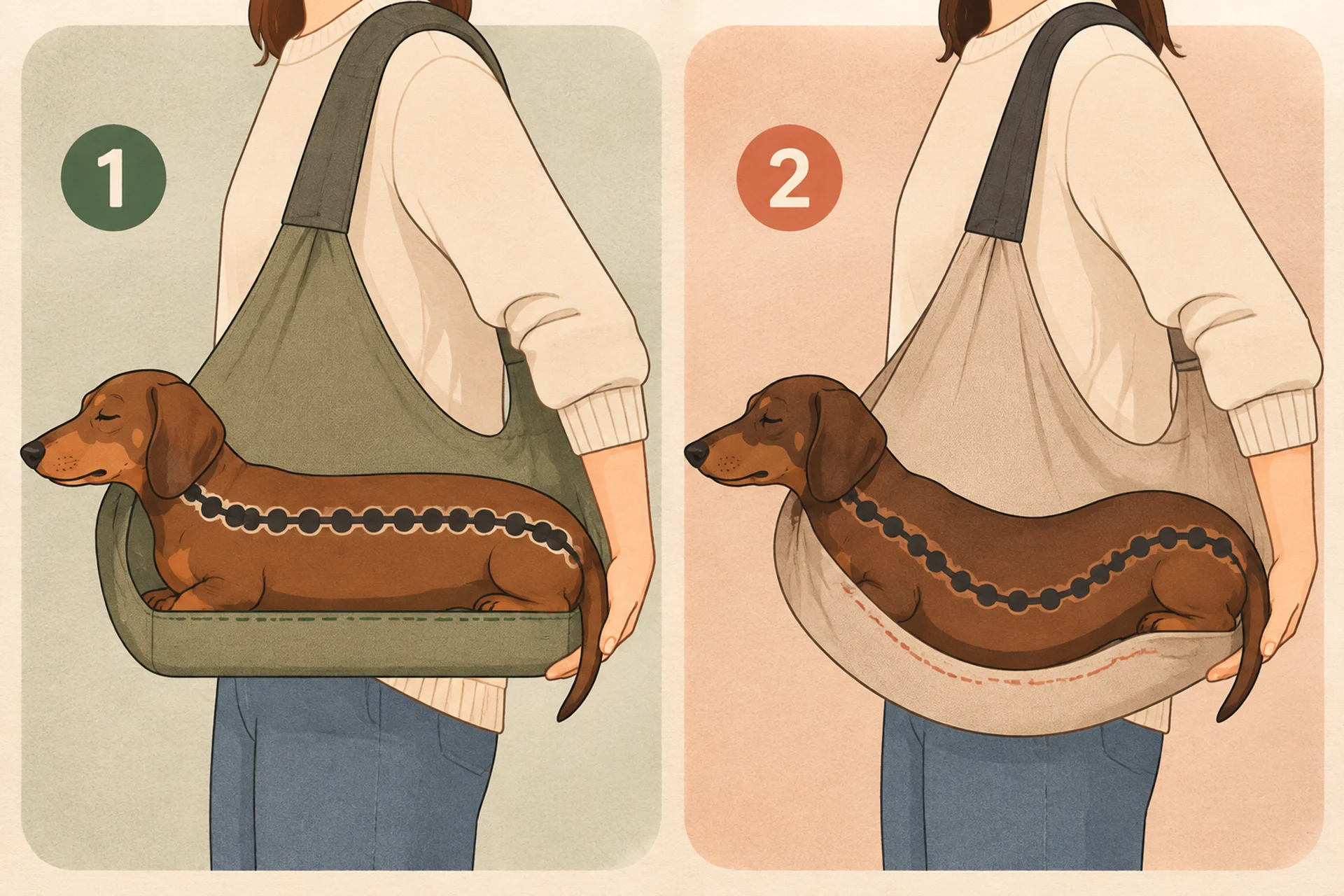
How to tell the two apart before you buy
- Look for a base panel, not just padding. A rigid or semi-rigid insert holds its shape when the bag is empty. A quilted lining does not.
- Check the empty-bag photo. If the sling collapses into a U when nothing is in it, that is the shape your dog will be in.
- Measure body length, not weight. Weight tells you whether the seams hold. Length tells you whether the dog can lie down straight. Measure from the chest to the base of the tail and compare that to the base, not to the opening — our carrier fit guide walks through it.
- Find the tether before you find the color. An interior clip that attaches to a harness — never to a neck collar — is what stops the jump.
Heat is the second limit, and it arrives faster than people expect
Any carrier is a small enclosed space pressed against a warm body. Dogs cannot shed heat the way we do: as Cornell’s Riney Canine Health Center puts it, “Dogs only have sweat glands on their paws so their primary method of dissipating heat to cool themselves is through panting” — and panting only works with air moving past. Cornell flags short-muzzled breeds such as Pugs, Bulldogs, Boston Terriers and Boxers as higher risk because they “cannot pant as efficiently,” along with overweight dogs, elderly dogs, dogs with heart or breathing conditions, and dogs with thick or dark coats.
Practically: an open-top sling is the most ventilated shape of the three, a mesh-panelled sling is close behind, and a closed tote is the worst on a warm day. A backpack sits between them but has one drawback the others do not — the whole back panel is against you, which is why our backpack carrier guide spends so long on airflow. Heavy panting, drooling, whining and a sudden reluctance to settle are the early signs Cornell lists; the answer is to stop, open the bag, and get the dog into cool air and water.
The escape problem, and the cheap insurance
Open-top styles exist because most small dogs want their head out. The trade-off is that a head-out dog is one squirrel away from being a loose dog on a sidewalk. Clip the interior tether to a harness before you step outside, every time — not when you get to the busy street. And make the failure survivable: the ASPCA recommends a microchip plus a collar tag carrying your name and phone number for any trip, which is the difference between a scare and a loss.
TuckTrail picks
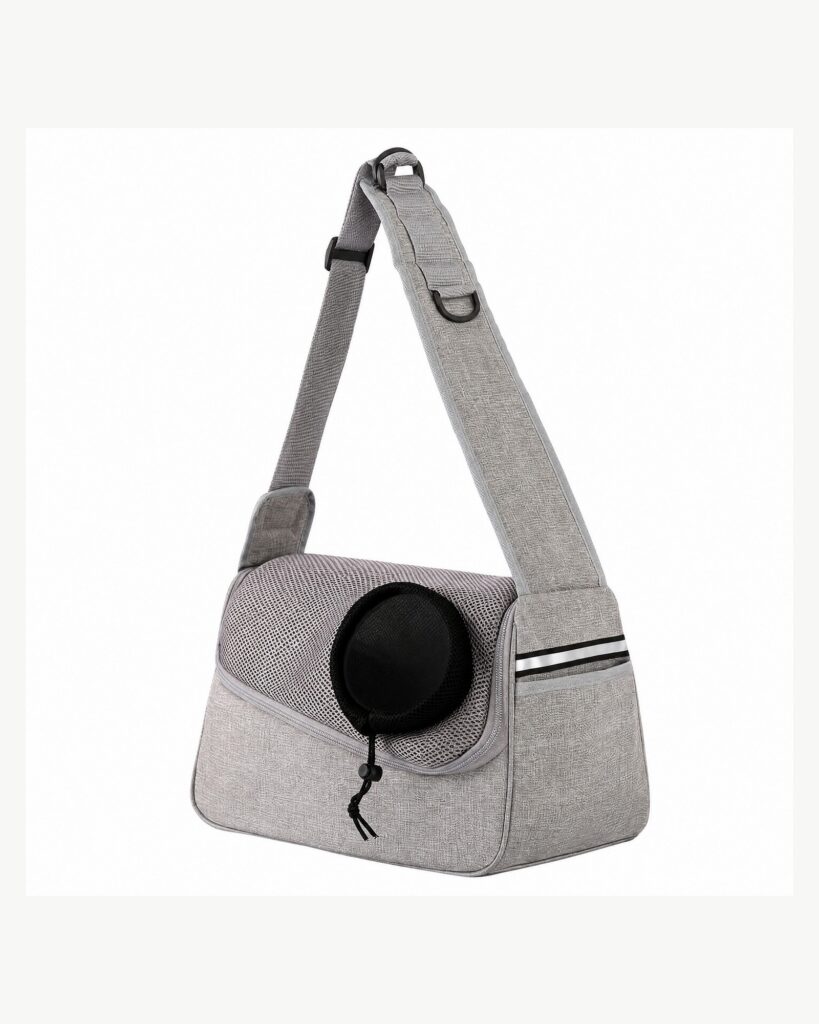
The Everyday Open-Top Sling Pet Carrier is sized for pets up to about 11 lb with body length to 13 in — the head-out shape for short, warm-weather errands. For a longer dog, the Everyday Mesh-Comfort Sling Pet Carrier takes body length to 17 in and pets to about 16.5 lb. Both have an interior tether; clip it to a harness, and check your dog’s real body length against the base before you order. More shapes on the carriers shelf.
Match the style to the dog
- Long-bodied, short-legged, any weight: firm flat base first, style second. This is the one non-negotiable.
- Small, clingy, short trips: sling — the body contact is the point, and the in-and-out is fast.
- Longer outings, transit, both hands needed: backpack, by a wide margin.
- Very small dog, brief calm errands: a tote works, as long as the base is flat and there is a tether. Whether the shop at the end of the errand will let the tote in is a separate question — see can I bring my dog into stores.
- Short-muzzled, overweight, elderly, or thick-coated: maximise mesh area in whatever style you pick, and walk in the cooler hours.
- Reliable escape artist: enclosed styles with a real closure beat open-top anything, whatever your dog’s opinion.
Choosing your first carrier overall? Start with the best dog carrier for small dogs. Driving rather than walking? A carry bag is not a car restraint — see are dog car seats crash-tested for what the safety data actually says.
Frequently asked questions
Are slings safe for dogs?
Within the weight and length rating, with a firm base under the dog and the tether clipped to a harness, a sling is a reasonable way to carry a small dog on a short outing. The two real risks are a slack pouch that folds a long dog in half and an unclipped dog who jumps.
Is a sling bad for a dachshund’s back?
There is no evidence that a well-shaped sling harms a healthy spine. IVDD is degenerative and breed-linked rather than caused by a bag. But dachshund-proportioned dogs are in the highest-risk group, so pick the sling that lets them lie straight and stops them jumping out — and ask your own veterinarian if your dog has a history of back pain.
What size dog fits a carrier purse?
Very small dogs who can sit and turn comfortably inside without touching both ends. If your dog’s body length is close to the base length, move up to a tote with a longer base or to a backpack.
Which style is best for a subway or bus commute?
The backpack. Both hands free for rails and fare gates, the dog above bag-level crowding, and the weight split across both shoulders for the standing stretches.
How long can a dog stay in a sling?
Shorter than your shoulder can stand, which is the honest limit for most people. Let the dog stand and stretch when you stop, and treat panting, restlessness or repeated repositioning as the signal to take a break rather than to push on.
Should the tether clip to a collar or a harness?
A harness, always. A tether on a neck collar puts every jolt and every jump-attempt straight onto the throat.
Sources
- AKC Canine Health Foundation — Overview of Intervertebral Disk Disease (IVDD): chondrodystrophoid breed list, breeds commonly affected, obesity risk, and that sudden trauma can rupture an already-weakened disk (checked 2026-08-26)
- Cornell University College of Veterinary Medicine, Riney Canine Health Center — Summer heat safety tips for dogs (sweat glands on paws only, panting, brachycephalic and thick-coated risk groups, early signs of overheating) (checked 2026-08-26)
- ASPCA — Travel Safety Tips (microchip plus collar and tag with your name and phone number before any trip) (checked 2026-08-26)
Veterinary guidance is updated periodically. Confirm on the official pages, and talk to your own veterinarian about your own dog — nothing here is a diagnosis or a substitute for an exam.