
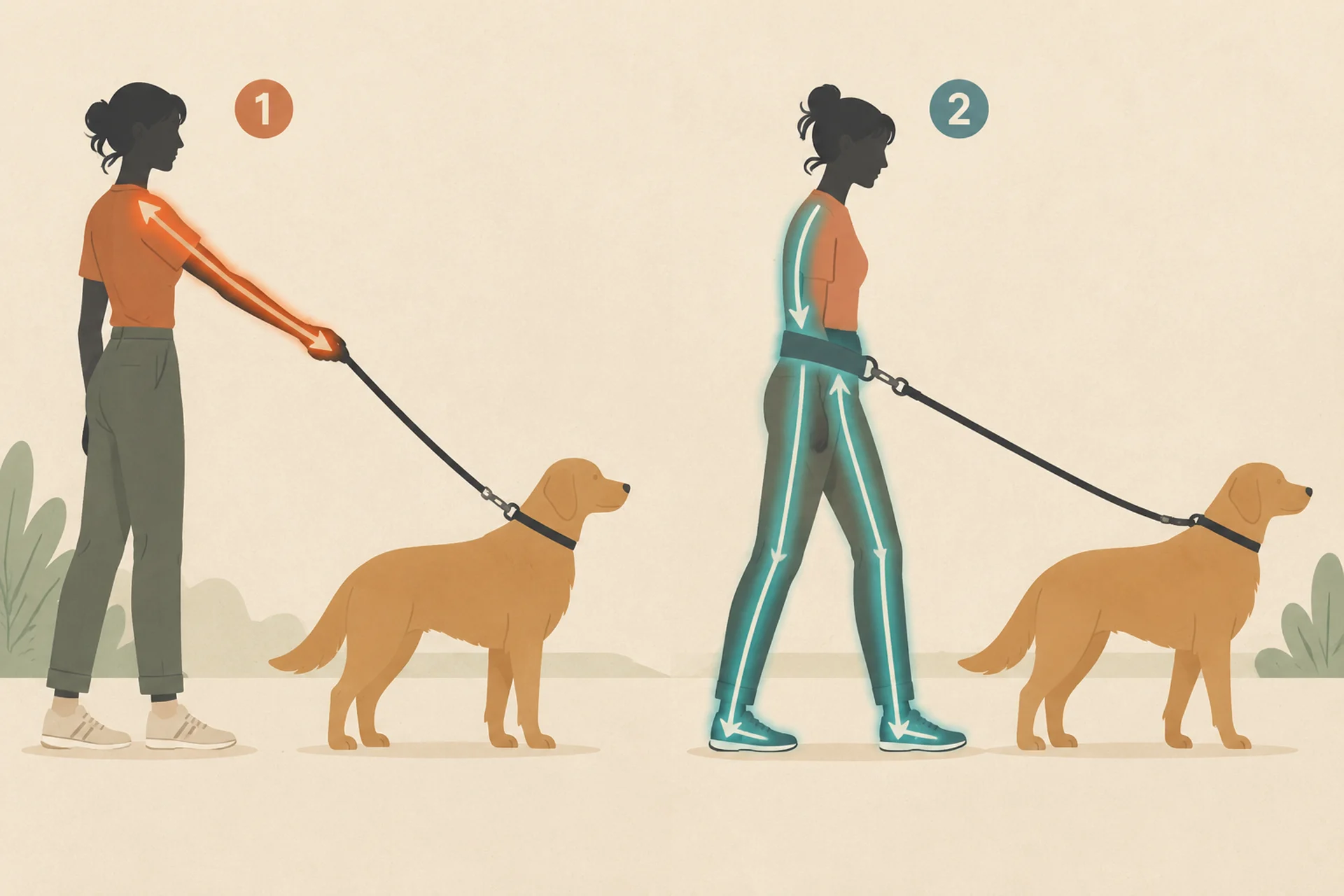
A hands-free leash swaps one injury for another. The most common dog-walking injury treated in US emergency rooms is a broken finger — which happens because the leash is in your hand, and a waist belt removes that failure mode completely. What it adds is leverage: your dog now pulls on your centre of gravity instead of your grip, and the injuries that actually put walkers in hospital beds are falls.
So: good idea for a dog who already walks on a loose leash, on a belt you can pop off one-handed, ideally with a short traffic handle. Bad idea for a dog who lunges at squirrels, for a dog who can out-pull you, and for any walker who cannot afford a fall. Nobody can honestly tell you it is “statistically safer” — the injury data has never been broken down by leash type.
What the emergency-room data actually shows
The numbers are bigger than most owners expect. Johns Hopkins researchers went through twenty years of federal injury surveillance data and found an estimated 422,659 adults treated in US emergency rooms for leash-dependent dog-walking injuries between 2001 and 2020, with the annual count more than quadrupling — roughly 7,200 a year in 2001 to about 32,000 in 2020, average patient age 53.
The mechanism matters more than the total. Most injuries happened when someone fell after being pulled by, tangled in, or tripped by the leash. The three most common were, in order, finger fracture, traumatic brain injury, and shoulder sprain or strain; among adults 65 and over the top two flipped to TBI and hip fracture. Women were 75% of patients and 50% more likely than men to break something, and older walkers were more than three times as likely to fall.
The whole hands-free argument sits inside that list. Finger fractures are a grip injury; head injuries and hip fractures are a balance injury. A waist belt deletes the first category and raises the stakes on the second. The honest caveat: the Johns Hopkins work reports mechanism and demographics, not equipment — it never records what kind of leash was on the other end.
Four setups, and what each one is actually doing
| Setup | Where the force lands | Removes | Adds |
|---|---|---|---|
| Flat leash, held in the palm | Fingers, wrist, shoulder | Nothing — this is the baseline | Grip fatigue on long walks |
| Flat leash looped around the hand or wrist | One or two fingers, at full body-weight leverage | Nothing | The worst single habit on this list |
| Waist belt, hands-free | Hips, low back, feet | Finger and wrist entanglement | Being pulled off balance; slower to release |
| Waist belt with a traffic handle | Hips by default, hand on demand | Entanglement, most of the time | Least of the three — the reason it is worth paying for |
The question that actually decides it
Not your dog’s weight. Not the brand. It is whether your dog already walks without pulling — and the training world is blunt about the order of operations. The American Kennel Club’s guide to running with a dog, where hands-free leashes are the standard recommendation, states the prerequisite first: your dog should master loose-leash walking before you start training them to run beside you. It also adds two things owners skip — a vet check first, and waiting until about 1.5 years old for most breeds, because puppy bones are still growing.
The mechanics are simple. On a hand-held leash a lunge costs you a stumble and maybe a finger; on a belt the same lunge arrives at your pelvis with your whole body above it. If your dog walks on a slack line, that lunge never comes and the belt is pure gain. If they are still learning, a waist leash is not a training tool — it is a way of finding out how strong your dog is.
Where a belt is genuinely the better choice
- Running. Arm swing and a hand-held leash fight each other. A belt, plus the adjustable waist loop AKC describes as the defining feature of a hands-free leash, keeps the line at a constant length while you move naturally.
- When you need both hands. Stroller, second dog, a toddler, a gate, a camera. This is the everyday case, and it is a real one.
- If you already have a hand or wrist problem. Arthritis, a previous fracture, reduced grip strength — the injury a belt prevents is precisely the injury you are most exposed to.
- Trail walking. Two free hands on a rocky descent beat the grip you gave up — though on posted ground the local rules still bind, as our guide to Bay Area dog beaches spells out.
Where a belt is genuinely the worse choice
- A reactive or prey-driven dog. One committed lunge on a belt, and the fall is not optional.
- A dog who outweighs your ability to brace. The honest test is not the scale, it is whether you can hold your ground when they hit the end of the line unexpectedly.
- Ice, wet leaves, or a steep camber. Anything that lowers your traction raises the cost of the trade.
- If you are in the demographic the data flags. Falls, fractures and head injuries concentrate heavily in older walkers. That is not a reason to stop walking your dog — it is a reason to keep the leash in your hand where you can drop it.
Making either setup safer
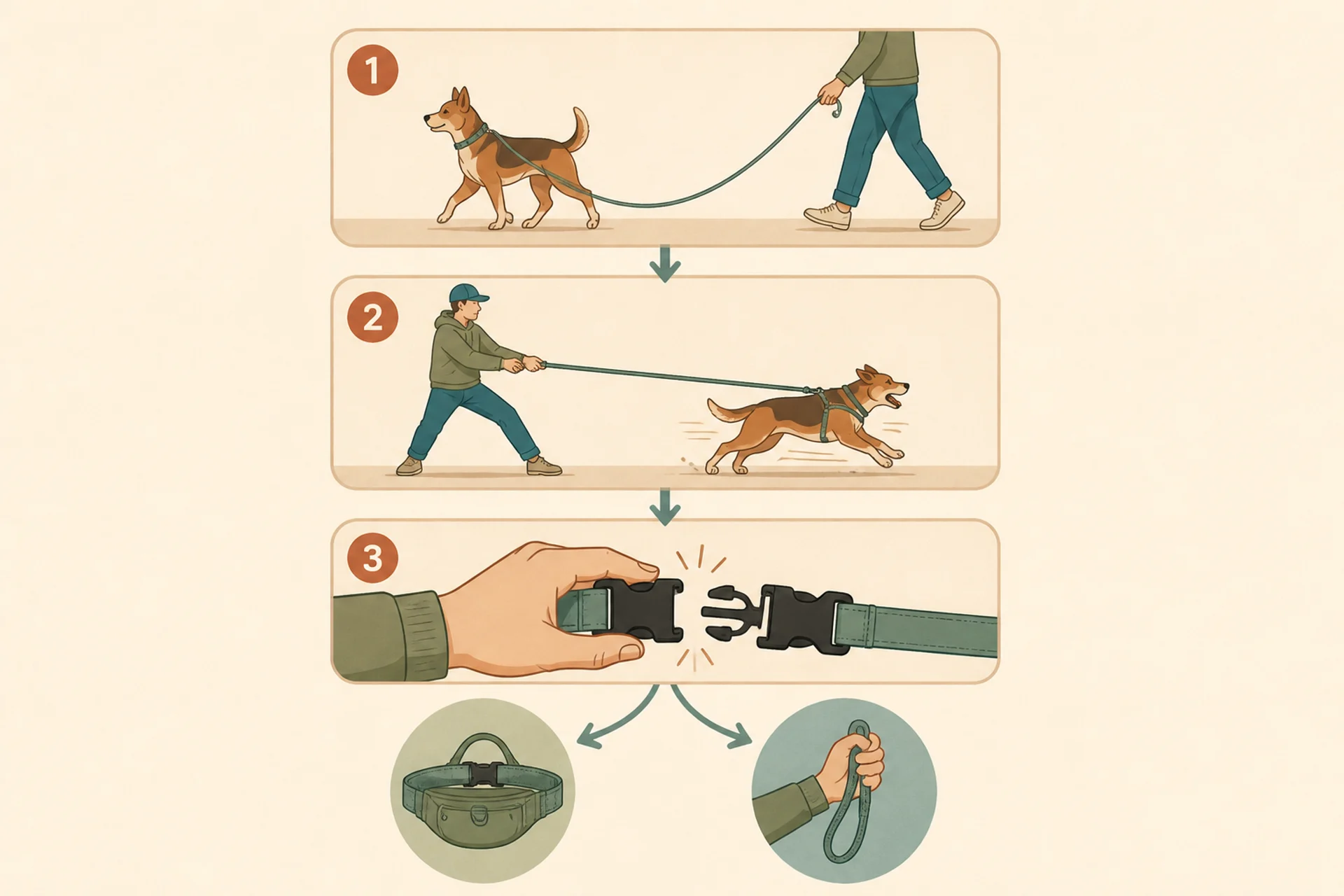
The best technique advice comes from the surgeons who repair the results. Rush University Medical Center’s Dr. Mark Cohen recommends holding a leash “in the palm of your hand — like you would a golf club or baseball bat”, never looped around fingers or wrist: “If the dog takes off, it happens so quickly that you don’t have time to unwrap the leash.” Those injuries often need surgery and months of recovery. Rush’s page says nothing about belts, but the principle transfers — anything you cannot let go of in a hurry is the part that hurts you. Applied to a belt:
- A buckle you can release with one hand, blind, while being pulled. Test it in the shop, not on the street.
- A traffic handle within reach of your hand at rest. Vet parking lots and busy crossings are when you want it.
- The belt on your hips, not your waist. Lower is easier to stay upright over.
- The dog end clipped to a harness rather than a flat collar, so a sudden stop loads the chest instead of the throat.
- One side, always — AKC’s running guide is emphatic that picking left or right and sticking with it is what stops the leash becoming a trip hazard.
- A line short enough that a lunge never builds speed — the same logic behind our take on when a retractable leash actually helps.
One more variable the setup has to survive: the dark. A belt line you cannot see is harder to shorten in a hurry, and after-dark walks are where the traffic risk actually concentrates — walking your dog in the dark covers where reflective material has to sit to do any good.
One clarification, because the two get conflated: hands-free is not off-leash. It satisfies leash laws, but it is not permission to give your dog more line than the local rule allows — six feet is the common maximum in California park systems.
Hands-free dog leash FAQ
Are hands-free dog leashes safe?
For a dog who already walks on a loose leash, yes — and they remove the most common dog-walking injury, a broken finger. For a dog who pulls or lunges, no: the belt converts a hand injury into a fall, and falls are what send walkers to hospital.
Is a waist leash safer than a regular leash?
Nobody knows, and be suspicious of anyone who says otherwise. The large US injury study covering 2001–2020 recorded how people got hurt, not what kind of leash they held. The two setups fail differently — grip versus balance — so the answer changes with the dog and the walker.
Can I use a hands-free leash with a dog that pulls?
Not as a fix for pulling. Train loose-leash walking first — AKC treats it as the prerequisite before you even move to running pace. A belt on a puller mostly teaches you what your lower back can absorb.
Should the leash clip to a collar or a harness?
A harness, for anything involving a sudden stop. A belt takes your arm out of the system, so nothing absorbs the shock before it reaches your dog — you want it landing across the chest, not the neck.
What age can a dog start running on a hands-free leash?
AKC advises that running generally isn’t safe for puppies whose bones are still growing, and suggests waiting until about 1.5 years for most breeds, with a vet check-up first. Growth plate timing varies by size — a question for your own vet, not a blog.
Can I walk two dogs on one hands-free belt?
Mechanically yes, and plenty of belts advertise it — but two dogs pull in two directions and the force lands on one point of your body. A traffic handle per dog and a practised quick-release matter far more here than with one.
Sources
- Johns Hopkins University — 3 injuries: How people get hurt while walking the dog (study published in Medicine & Science in Sports & Exercise; checked 2026-08-28)
- Harvard Health Publishing — Study finds dog walking injuries are increasing (checked 2026-08-28)
- American Kennel Club — How to Train Your Dog to Run With You (checked 2026-08-28)
- American Kennel Club — Dog Leashes 101: Choosing the Right Dog Leash (checked 2026-08-28)
- Rush University Medical Center — Preventing Dog Walking Injuries (checked 2026-08-28)
Injury figures are population estimates from emergency-department surveillance data and describe risk across a group, not your walk. Anything involving your dog’s joints, growth plates or existing injuries is a question for your veterinarian.
Safe for the dog you have trained. Not a substitute for training one.
Hands-free leashes solve a real problem — the leash in your hand is where the most common injury happens — and create a real one, because a dog who lunges now lunges at your balance. Train loose-leash walking first, buy the version with a traffic handle and a buckle you can pop blind, clip it to a harness, and keep it in your hand for the crossings. And, as the Johns Hopkins team closed their own findings: leash your dog wherever it is legally required.