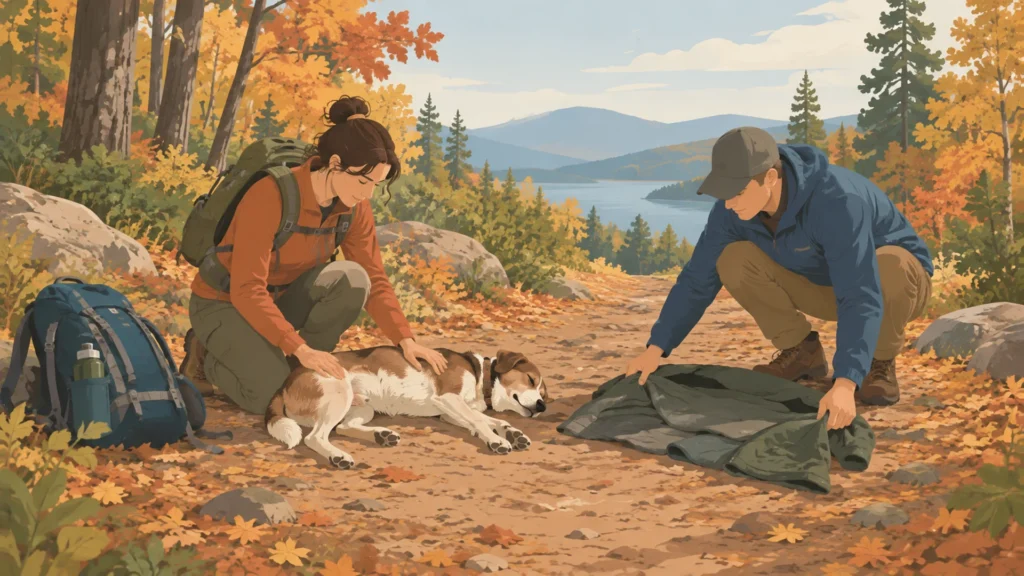
Before you pick your dog up, do two things: make sure they cannot bite you, and decide whether they should be moved at all. The AVMA’s handling guidance is blunt about the first — avoid any attempt to hug an injured pet, keep your face away from their mouth, apply a muzzle if they threaten to bite, and ask other people to help you move them. Pain turns gentle dogs into unpredictable ones, and a bite two miles from the trailhead is now two casualties.
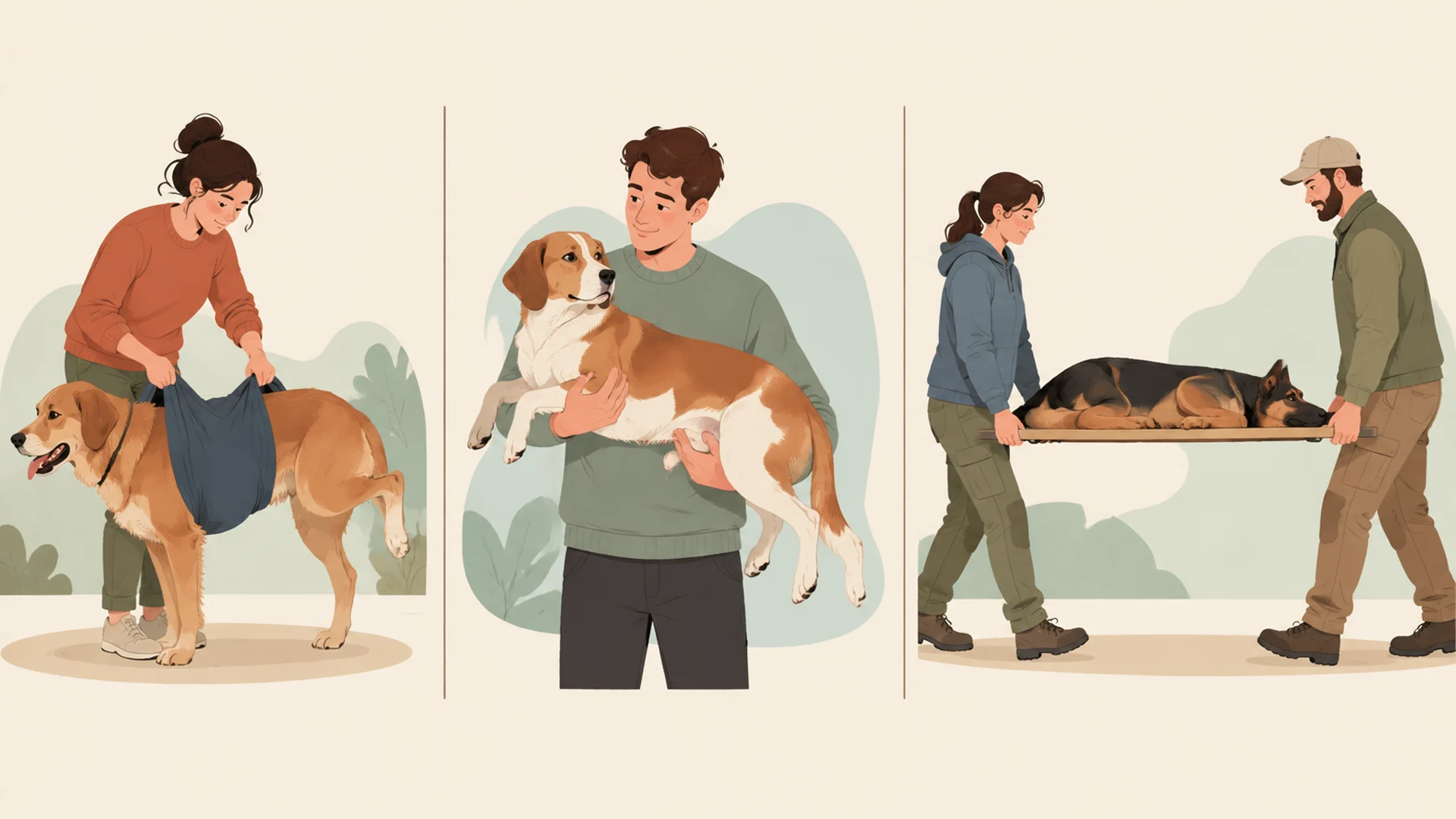
After that, the carry depends on one question: can the dog stand? If they can stand but not weight a leg, a blanket or jacket slung under the belly lets them walk out on three legs with you taking the fourth. If they cannot stand, you are not carrying them — you are moving them on something flat, and the goal stops being speed and becomes keeping the spine still.
This page is about getting your dog off the trail and into a car. It is not a treatment guide, and it is not a substitute for a vet. The AVMA is explicit that first aid is not a substitute for veterinary care — call the clinic while you are still walking out.
First: the safety step everyone skips
The Merck Veterinary Manual’s guidance for clinicians talking owners through a scene puts it in order of priority: the first concern is for the safety of the owner, and restraint comes before anything else you might want to do. Two practical moves from that page are worth knowing before you need them. Placing a light cloth over the dog’s head lowers the flood of stimuli that drives a fearful, defensive reaction. And most dogs can be muzzled with a long strip of fabric — a gauze roll, a sleeve, a bandana.
The caveats matter more than the technique, because this is where improvised advice goes wrong. Merck’s page limits fabric muzzling to dogs with no facial injuries and no respiratory distress, and warns against muzzling a dog with chest injuries or a short-nosed breed at all. The AVMA adds the other hard rule, on its own first-aid kit list: do not muzzle a pet who is vomiting. A muzzle on a vomiting dog is a choking hazard, and the AKC gives the same warning in its guidance on transporting a dog to the hospital.
If your dog already wears a muzzle comfortably for vet visits, this is the day that training pays for itself. If they have never worn one, a scared dog in pain on a trail is a bad place to introduce one — which is an argument for the cloth-over-the-head approach and for keeping your hands away from the head end entirely.
Should you move them at all?
Most trail injuries are boring in the best way: a torn pad, a wrenched shoulder, a stress limp after too many miles on rock. Those dogs want to leave, and helping them leave is right. The cases where moving is the risk are the ones involving a fall, a collision, or a dog who is not fully present — and the tell is not the wound, it is the dog’s state.
Merck lists the parameters an emergency team checks on arrival — temperature, pulse rate, respiratory rate, level of consciousness and level of pain — and notes that an abnormality in any one of them warrants urgent evaluation. You are not diagnosing anything on a trail. But “is my dog responding to me normally?” is a question you can answer, and a dog who is dull, disoriented or not tracking you is a different problem from a dog who is yelping and holding up a paw.
Two specifics from the same page are worth carrying in your head because they are counterintuitive. Motion of the head, neck and spine should be minimised whenever trauma to those areas is known or suspected. And penetrating objects — a stick through a shoulder is the classic trail version — should be left in place during transport, stabilised so they cannot move, rather than pulled out. Both of those instructions override any urge to scoop the dog up and run.
When you are unsure, the AKC’s advice is the one to follow: call the veterinary hospital and ask how to move your dog based on what you are seeing. That call does two jobs at once, because the same page notes that calling ahead lets staff prepare for your arrival and tells you whether they are at capacity before you drive forty minutes to a closed door.
The four ways out, and what each one costs
| Situation | The move | What it costs you |
|---|---|---|
| Can stand, will not weight one leg | Blanket, jacket or pack towel slung under the belly; you lift enough to unload the leg while they walk | Slow, and hard on your back over distance — but the dog does most of the work |
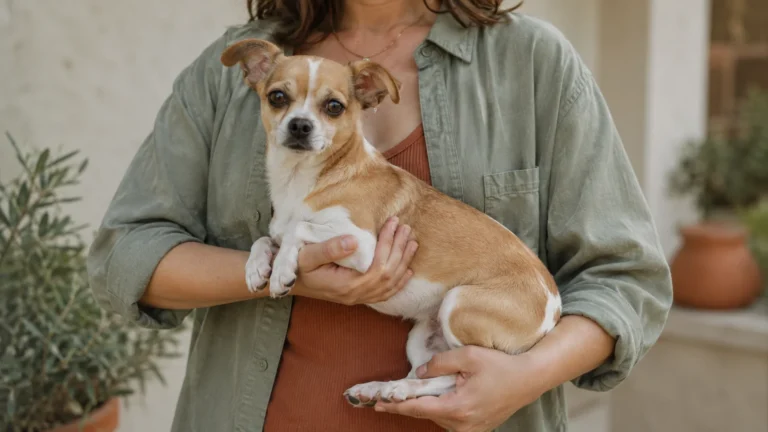
| Small dog, alert, no spinal concern | Lift with one arm under the chest and one under the hindquarters, held against your body | Sustainable for a long way if the dog is genuinely small; your arms, not your legs, set the limit |
| Medium to large dog, alert, no spinal concern | Same two-point support, but as a short relay: carry, set down, rest, repeat | Realistically a few hundred metres at a time, and you will need both hands free in between |
| Cannot stand, or head/neck/back is in question | Slide — do not lift — onto a flat rigid surface and carry that, ideally with a second person | Needs two people and a flat object you probably do not have. This is when you call for help |
The carry the internet recommends, and why it is often wrong
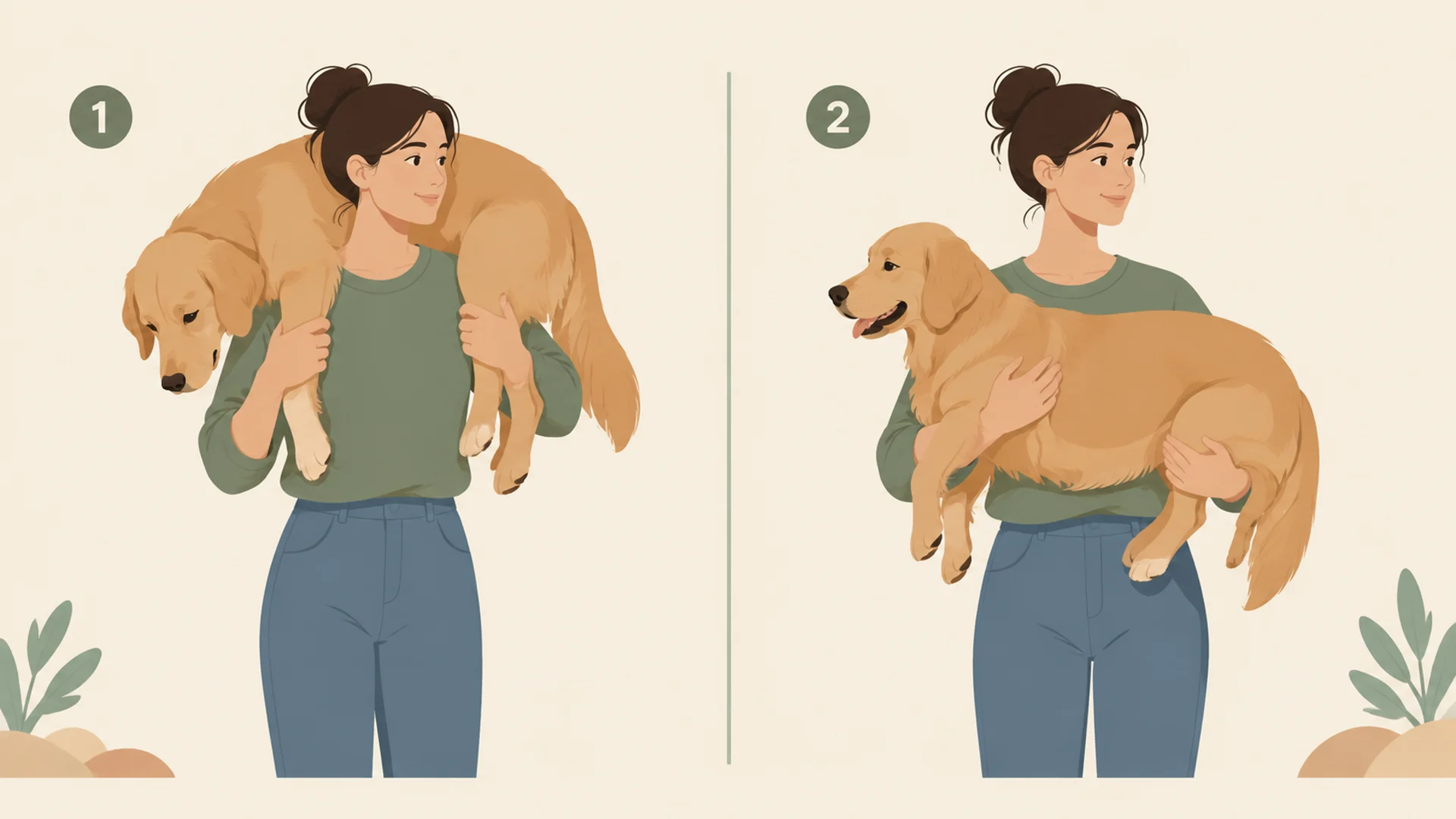
Search this question and you will be told, repeatedly, to put the dog across your shoulders like a fireman’s carry. It is a real technique, it distributes weight well, and for a healthy dog who simply ran out of legs at mile nine it is defensible.
It is a poor default for an injured dog, and Merck’s transport guidance explains why in a line most articles never mention. Animals with altered mentation after trauma should be transported with the head level with the body or elevated about 20 degrees, with no jerking or thrashing motion, avoiding manipulation of the neck or occlusion of the jugular veins. A shoulder carry does close to the opposite: it folds the dog around the back of your neck, hangs the head below the body, and puts pressure exactly where that guidance says not to. Every step you take adds a jolt.
The carry that respects the same constraints is duller and works better. One arm under the chest behind the front legs, one arm under the hindquarters, the dog’s spine kept in a straight line along your forearms and held against your torso so it does not swing. The AKC’s description of what a stretcher is for applies just as well to your arms: the goal is to keep the dog immobilised and prevent twisting of the neck and back.
If the dog cannot stand: the flat-surface rule
A dog who cannot get up is not a carrying problem, it is a stretcher problem. The AKC’s instruction is to use a sturdy flat object such as a board that will hold the dog’s weight, and notes that large dogs may need more than one person to lift safely. Merck’s page names the materials that work — wood, cardboard, or thick fabric — and adds a detail that is genuinely useful and appears nowhere in the usual advice: radiographs can be taken through those materials, so the animal does not have to be moved again on arrival at the hospital.
That is worth knowing for one practical reason. If you get your dog to the clinic on a board or a folded tarp, say so at the desk and leave them on it. Lifting a dog off a stretcher onto a table is another chance to move a spine that should not move, and the imaging can happen without it.
On a trail, the honest version is that you will not have a board. What you might have is a sleeping pad, a folded tent, a jacket stretched between two trekking poles, or a pack emptied and flattened. None is rigid enough to be a real stretcher for a large dog, and improvising one badly can be worse than waiting. If you are far in and the dog cannot stand, stop and get help rather than dragging out a spinal injury over three miles of switchbacks.
Getting help, and the part to sort out before you go
Who responds for an injured dog depends entirely on where you are standing, and there is no national answer. Rules and staffing differ by land manager, so the number worth having is the ranger station or land-manager contact for the specific place you are hiking, saved before you lose signal. The National Park Service makes the same point about pet rules in general: many parks allow pets but different parks have different rules, and you should check the individual park’s website before you travel. That page is also the reminder that federal regulations require pets to be on a leash no longer than six feet — which, on the day something goes wrong, is also the thing that kept your dog within reach.
The AVMA’s travel guidance has the other half of the preparation, and it takes five minutes at home: carry a travel-sized first aid kit, and have the phone numbers of your own vet, a 24-hour emergency veterinary hospital in the area you are visiting, and the animal poison control hotline. The emergency hospital near the trailhead is not the one near your house, and looking it up at the trailhead with one bar is a bad time to find out.
What actually earns its weight in the pack
- A gauze roll or a bandana — doubles as an improvised muzzle, with the caveats above.
- A light cloth or buff to put over the head and take the scene down a notch.
- Something flat and packable: a foam sit pad, an emergency blanket, a folded tarp. Not a stretcher, but better than a jacket.
- A slip lead, so you have a second point of control if the harness is where the injury is.
- Saved offline: your vet, the 24-hour emergency clinic nearest the trailhead, and the ranger station.
- Honest water planning. Dehydration turns a limp into a crisis — see how much water a dog needs on a hike.
The uncomfortable arithmetic
Most owners cannot carry most dogs very far. A 55-pound dog is a 55-pound load that shifts, over uneven ground, with a body that is not designed to be a backpack. The right time to think about this is when you are planning the hike, not when you are standing on the trail doing sums. If your dog is a size you could not carry a mile, then distance from the trailhead is a real constraint on the route, the same way weather is.
The same logic runs in the other direction for small dogs. If yours is genuinely small, a carrier you already own and already brought turns this entire problem into a twenty-minute walk out — which is a fair argument for taking one on longer days even when your dog walks every step. Our guide to carrying a small dog covers the shapes that fit that job, and how much weight a dog can carry is the related question for the pack they wear themselves.
Carrying an injured dog: FAQ
What is the safest way to carry an injured dog?
For an alert dog with no suspected head, neck or back injury: one arm under the chest behind the front legs, one under the hindquarters, spine level, held firmly against your body so they cannot swing or twist. For a dog who cannot stand, do not carry at all — the AKC’s guidance is to slide them onto a sturdy flat surface and move that instead, with a second person if the dog is large.
Should I put a muzzle on my dog before moving them?
The AVMA says to apply a muzzle if your pet threatens to bite, and both the AVMA and the AKC warn never to muzzle a dog who is vomiting. Merck’s guidance adds that fabric muzzling is only appropriate when there are no facial injuries and no breathing difficulty, and not at all for dogs with chest injuries or short-nosed breeds. If any of those apply, keep your hands and face away from the head instead.
My dog has a stick or other object stuck in them. Should I pull it out?
No. Merck’s transport guidance is that penetrating foreign objects should be left in place during transport, with care taken to keep the object from moving. Removing it can turn a contained injury into an uncontrolled one. Stabilise it as best you can and get to a vet.
Can I carry my dog over my shoulders like a firefighter’s carry?
It works for a tired but uninjured dog. It is a poor choice for an injured one, because Merck’s guidance for animals with altered mentation after trauma is to keep the head level with the body or slightly elevated and to avoid manipulating the neck or compressing the jugular veins — which is close to the opposite of what a shoulder carry does.
How do I know whether this is serious enough to stop the hike?
Any limp your dog will not walk off, any injury you cannot see the bottom of, and any change in how present and responsive they seem. Merck lists level of consciousness and level of pain alongside temperature, pulse and respiratory rate as parameters where a single abnormality warrants urgent evaluation. You are not making the diagnosis — you are deciding to turn around and let a vet make it.
What should I do on the drive to the vet?
Call ahead. The AKC notes that telling the hospital you are coming lets them prepare and lets you find out whether they can take your dog at all. Keep the dog confined and still rather than loose on a seat, keep the head level, and if you moved them on a board or a folded tarp, leave them on it and tell the staff — imaging can often be done through it without moving them again.
Sources
- American Veterinary Medical Association — First aid tips for pet owners (checked 2026-09-14) — handling an injured pet, muzzling and the vomiting exception, first aid kit contents, and the instruction to call the clinic before you arrive.
- Merck Veterinary Manual — First Aid and Transport of Small Animals (checked 2026-09-14) — owner safety first, cloth over the head, muzzle limits, minimising head/neck/spine motion, flat-surface transport and imaging through it, penetrating objects left in place, head position with altered mentation, and the five triage parameters. This is the clinician-facing page.
- American Kennel Club — 5 Mistakes Dog Owners Make When Transporting an Injured Pet to the Hospital (checked 2026-09-14) — the belly-sling assist, the makeshift stretcher and its purpose, large dogs needing two people, bite risk, and calling the hospital ahead.
- National Park Service — Pets: Visit Parks (checked 2026-09-14) — pet rules differ by park, check the individual park website, and the six-foot leash regulation.
- American Veterinary Medical Association — Traveling with your dog or cat (checked 2026-09-14) — travel first aid kit, and the emergency numbers to carry for your destination.
Veterinary guidance and park rules change, and nothing here replaces advice from your own veterinarian. Confirm on the official page, and call a vet about your specific dog.
Secure the head, then decide whether to lift at all.
A muzzle or a cloth first, because pain makes bites. Then one question: can they stand? If yes, take the weight off the bad leg and walk out slowly. If no, stop lifting and start thinking flat, still and two people — and call the clinic while you work it out, because they can tell you how to move your dog and be ready when you arrive.