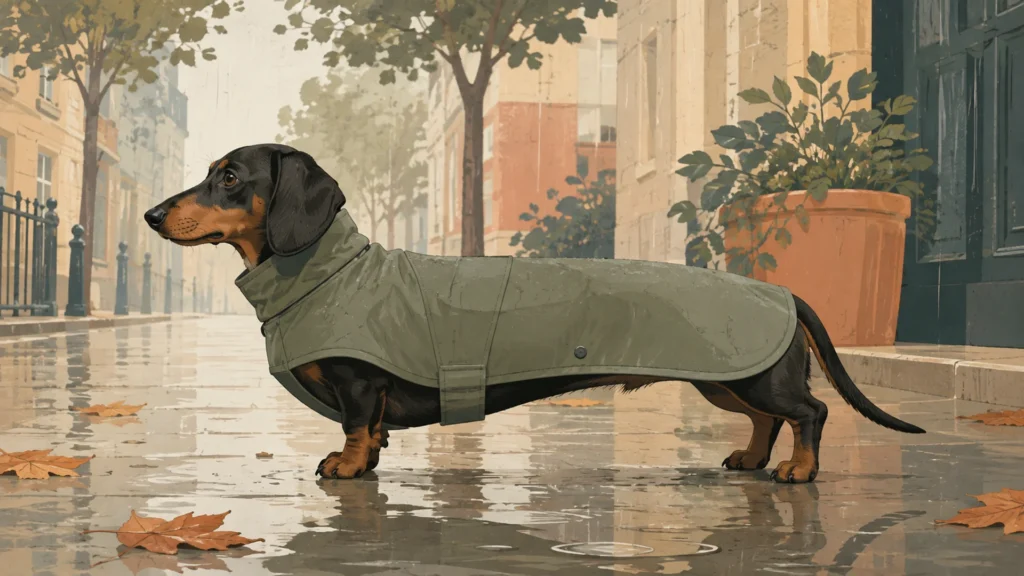
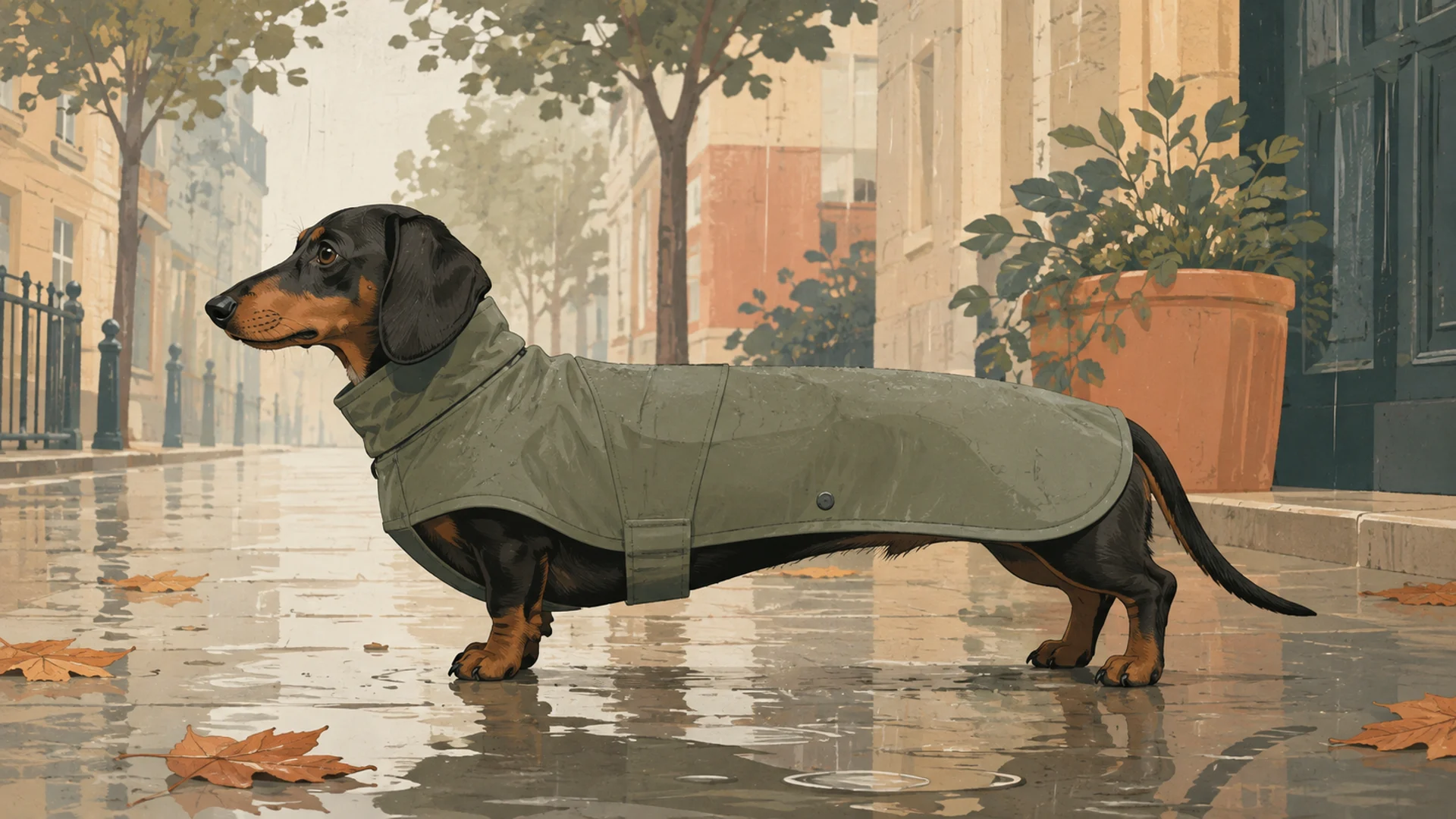
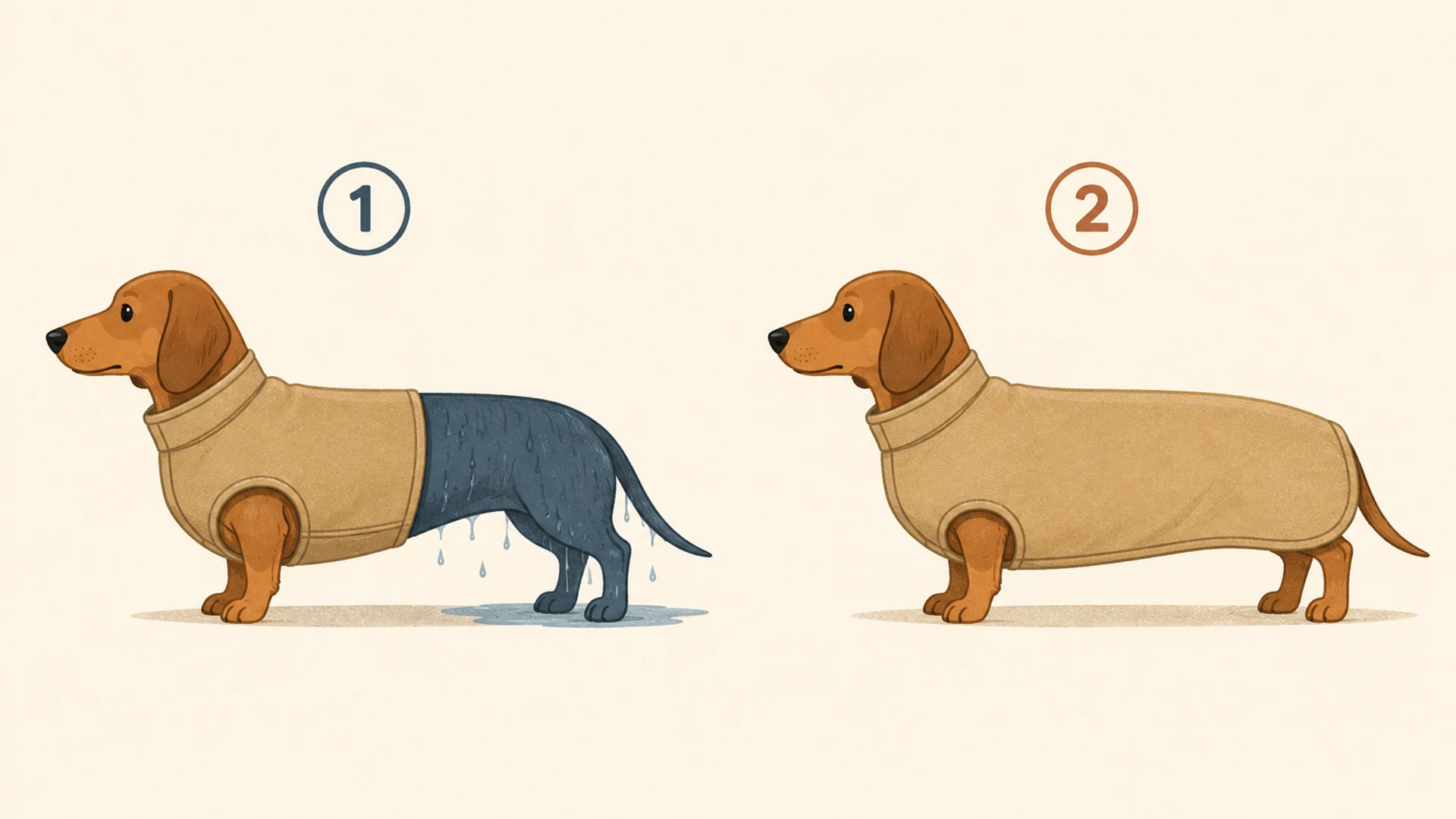
Buy for the back, then adjust the chest. Almost every dog coat on the market is cut on the quiet assumption that a dog’s back is about as long as the dog is tall — and on a Dachshund, a Corgi, a Basset or a long-backed mix, that assumption is simply false. The result is the thing every long-dog owner has seen: a coat that buckles perfectly around the ribs and then stops somewhere over the middle of the back, leaving the hindquarters out in the rain.
So the measurement that decides the purchase is back length, taken along the spine from the base of the neck to the base of the tail. Chest girth decides whether it fastens; back length decides whether it works. If the size chart only lists weight, it was not written for your dog — and if you are unsure how to take either measurement, start with how to measure your dog for clothes.
“Long and low” is a real number, not a vibe
It is worth knowing that the proportion you are shopping around has been measured. In a 2013 study of 700 dogs published in PLoS ONE, researchers recorded each dog’s back length relative to its height at the withers — a ratio they abbreviate BL:HW — and compared dogs with and without thoracolumbar disc extrusion. Dogs in the affected group averaged a BL:HW of 1.28 against 1.03 in the unaffected group, and the association held across breeds rather than being an artefact of any single one.
That study is about spinal risk, not raincoats, and nothing about a coat changes it. But the number is useful for shopping, because it tells you how far off the standard pattern really is. A dog at 1.03 is roughly square: a coat cut to the height of the withers will land near the tail. A dog at 1.28 has a back a quarter longer than the pattern expects, and a dog at 1.5 — the far end of the Miniature Dachshund range in the same study — has a back half again as long. That is not a fit quibble. That is a different garment.
Why the chest fits and the back doesn’t
Sizing charts are built around chest girth because chest girth is the widest part of most dogs and therefore the thing most likely to stop a garment going on. On a conventionally proportioned dog that works, because chest girth and back length rise together. On a long dog they come apart: the ribcage is often modest while the spine keeps going. Size up to reach the back length and the coat now hangs off the shoulders and gapes at the neck; size to the chest and half the dog is uncovered.
The four common cuts handle that split very differently.
| Cut | How it is sized | On a long-bodied dog |
|---|---|---|
| Standard back coat | Chest girth first, one back length per size | Usually the worst case — fits the ribs, ends mid-back |
| Long-cut or “sausage dog” coat | Back length first, adjustable chest and belly straps | The intended answer, if the chart actually lists back length |
| Poncho or cape | One loose panel, minimal fastening | Drapes over the length problem but flaps, and leaves the belly open |
| Four-leg rain suit | Chest girth plus leg placement | Best coverage, hardest fit — leg holes are positioned for a shorter torso |
The four-leg suit is the one people are most often surprised by. Full-body suits solve coverage brilliantly on dogs they were patterned for, but a suit’s rear leg openings sit at a fixed distance from the front ones. Put that on a dog whose torso is 25% longer and the rear legs are pulled forward, which the dog will tell you about immediately. If you are weighing full coverage against a simpler coat, our guide to rain suits with the legs covered works through that trade in general terms — just apply it with the length problem in mind.
Take three measurements, in this order
The American Kennel Club’s guidance on measuring a dog for clothes and gear is the plain version, and it is worth following literally rather than eyeballing it.
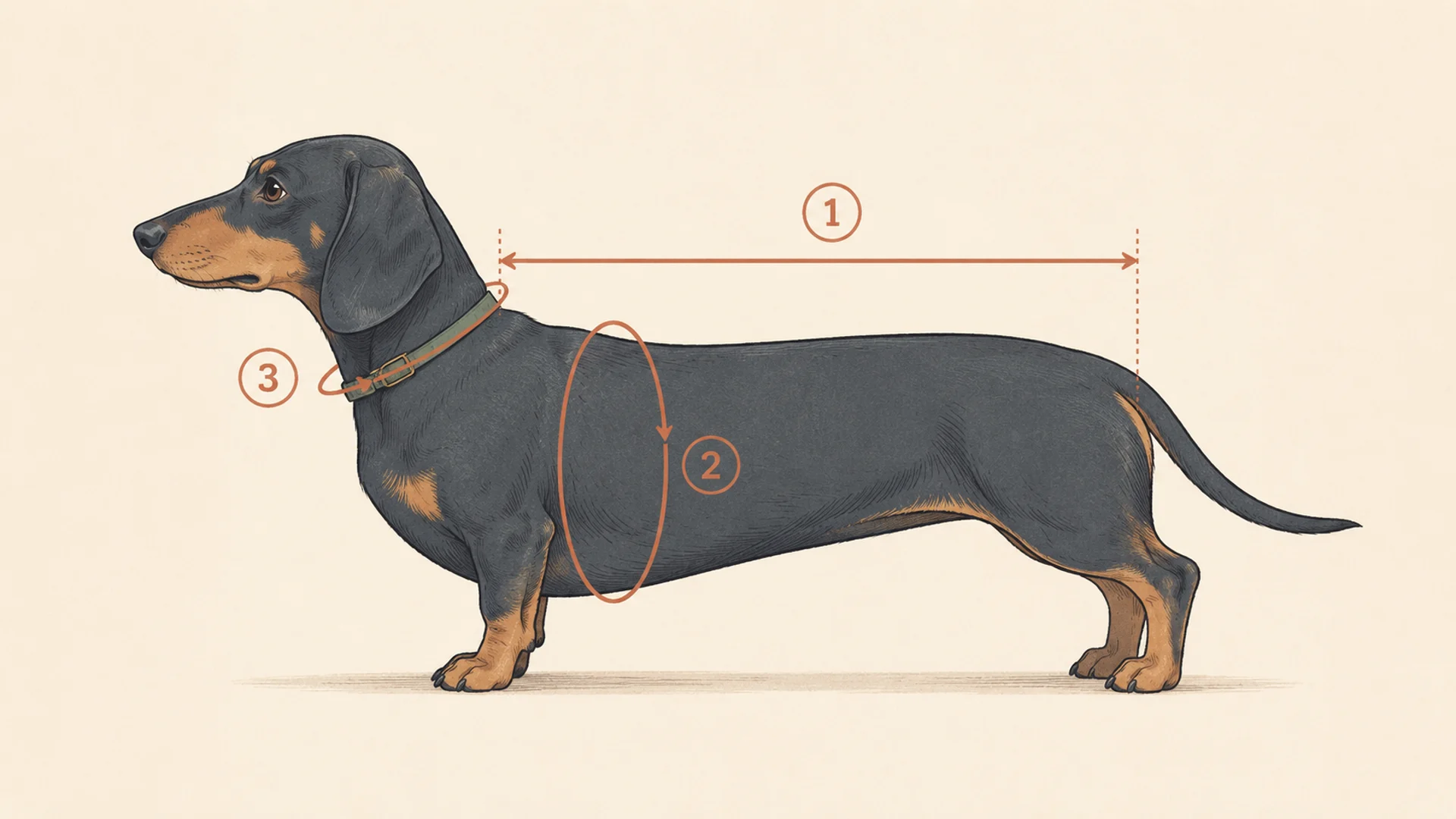
- Measure with the dog standing, not sitting or lying — the AKC is specific that a standing dog has an aligned spine and evenly distributed weight, and a long back sags noticeably when the dog sits.
- Back length runs from the base of the neck, roughly where the collar sits, to the base of the tail. Write it down first; it is your primary number.
- Chest girth is the loop around the largest part of the ribcage, usually just behind the front legs. A string or shoelace laid flat against a ruler is more accurate than a tape you are trying to read upside down over a wriggling dog.
- Neck girth goes low on the neck, between the withers and the collar line, with the two-finger rule for room.
- Between sizes? The AKC’s rule is to go for the larger size, on the reasoning that a slightly loose fit is more comfortable than something too tight. On a long dog that rule is doubly right, because the thing you gain by sizing up is back length.
One caveat the AKC flags that matters more on a low-slung dog: for male dogs, if the garment has no belly cutout, the underside may need to sit shorter to prevent accidents. A long coat with a full belly panel is exactly the design where this bites.
How it goes on matters as much as how it fits
Long-and-low is also the conformation most associated with disc problems. Cornell’s Riney Canine Health Center notes that Dachshunds alone account for 40 to 75% of all cases of intervertebral disc disease, that around 65% of cases involve the thoracolumbar region — the back rather than the neck — and that affected dogs may show signs between three and six years of age. Early signs they list are unglamorous and easy to miss: a reluctance to turn the head one way, difficulty eating from a floor-level bowl, a wobbly gait, weakness at the rear.
That is a matter for your veterinarian, not for a coat. But it does shape a practical preference. Getting a garment onto a dog with a long back should not involve lifting the front end, twisting the spine, or forcing a head through a tight opening. A coat that opens fully along the back or steps on from underneath and then closes is easier on a long dog than one that has to be posted over the head and dragged down the body. The opening styles we compared for harness holes sort the same way here, for the same reason.
If your dog is already reluctant about clothes, the fix is acclimation rather than a bigger coat. Our walkthrough on getting a dog used to wearing a coat covers the short daily sessions that make the difference.
What to check before you buy
- Does the size chart list back length as its own column? If it only lists weight, the pattern is not designed around your dog’s problem.
- Is the chest adjustable independently of the length? Straps and a belly panel let one back length serve several ribcages.
- Does the coverage reach the base of the tail in the photograph — on a dog shaped like yours, not on a Labrador?
- Can the dog squat and toilet without the hem in the way? Longer coats fail here before they fail anywhere else — our guide to rain suit belly coverage works through the three underside cuts and which one suits a male or a female dog.
- Does it go on without a twist? Back-opening and step-in designs beat over-the-head ones on a long spine.
- Does the belly stay covered? On a dog with almost no ground clearance, the spray comes up as much as it comes down.
Worth saying plainly: a coat cut for long bodies is still a thin part of the market, and much of what is sold as a “Dachshund raincoat” is a standard coat photographed on a Dachshund. The size chart is the tell. If the seller cannot give you a back-length range, they have not solved the problem you are shopping for.
What size raincoat does a Dachshund need?
There is no universal answer, because “size 4” means something different on every chart. Measure back length from the base of the neck to the base of the tail, then match that number to the chart’s back-length column. A standard Dachshund and a miniature can differ by several inches of back with a similar chest, which is exactly why weight-based charts mislead.
Why does my dog’s coat only cover half of their back?
Because it was sized to their chest. Most patterns assume back length and height at the withers are close to equal; on a long-bodied dog the back is substantially longer, so a coat that closes correctly around the ribs runs out before the hips. The fix is a cut sized by back length with an adjustable chest, not a bigger size of the same cut.
Should I size up to get more length?
If you are genuinely between sizes, yes — the AKC’s advice is to take the larger, because loose beats tight. But sizing up two or three steps to chase length is a different move, and it gives you a coat that gapes at the neck and slides sideways. At that point you need a different pattern.
Is a full rain suit better than a coat for a long dog?
It covers more, and it is harder to fit. Four-leg suits place the rear leg openings a fixed distance behind the front ones, which is the one dimension a long-bodied dog blows out. If you want a suit, the leg-opening spacing matters more than the chest number — and a dog who is being pulled forward at the hips will refuse to walk in it.
Does a raincoat protect my Dachshund’s back?
No. Keeping a dog dry is about comfort and warmth, not spinal support, and no garment sold as rainwear should be described as protecting a dog’s back. If you have any concern about your dog’s spine — reluctance to turn their head, a hunched stance, weakness at the rear — that is a conversation with your veterinarian, not a purchase.
Do short-legged dogs get wetter than tall ones?
They get wet differently. With only a few inches of clearance, a low dog takes spray from the pavement upward as well as rain from above, so belly coverage does more work than it would on a taller dog, and the legs and undercarriage are what actually come home soaked.
Sources
- Packer RMA, Hendricks A, Volk HA, Shihab NK, Burn CC (2013). “How Long and Low Can You Go? Effect of Conformation on the Risk of Thoracolumbar Intervertebral Disc Extrusion in Domestic Dogs.” PLoS ONE 8(7): e69650 — back-length-to-height ratios of 1.28 in affected versus 1.03 in unaffected dogs, across 700 dogs (checked 2026-08-29)
- American Kennel Club — How to Measure Your Dog for Clothes and Gear (back length, chest girth, neck girth; measure standing; size up when between sizes) (checked 2026-08-29)
- Cornell University College of Veterinary Medicine, Riney Canine Health Center — Intervertebral disc disease (breed predisposition, 40–75% of cases in Dachshunds, ~65% thoracolumbar, early signs) (checked 2026-08-29)
Veterinary guidance is updated periodically. Confirm on the official pages before you rely on them, and talk to your own veterinarian about your own dog — nothing here is a diagnosis or a substitute for an exam.