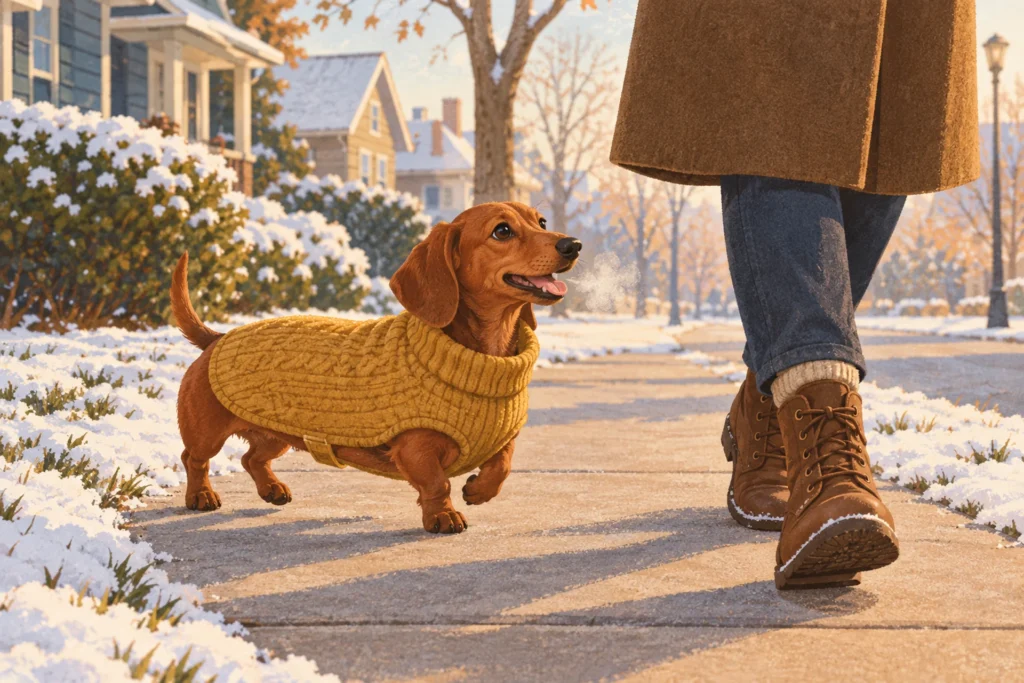
A coat is worth considering for a dachshund in cold weather, especially a smooth-coated one. VCA notes that smooth dachshunds lose body heat rapidly. The AKC also names dachshunds among low dogs whose bellies can become wet against snow and ice. Neither point establishes a universal temperature or a safe number of minutes outside.
Choose for the individual dog, then fit the garment to both chest and back. Miniatures need their own measurements, not simply a smaller version of another dachshund’s coat. If your dog wears a harness, try the two pieces together before the first winter walk.
- Deciding whether to use it? Consider the weather, age, health and how your dog behaves.
- Choosing a miniature’s coat? Check the exact chart, underside clearance and room around the ribs.
- Adding a harness? Confirm that its attachment is accessible without pulling the coat out of position.
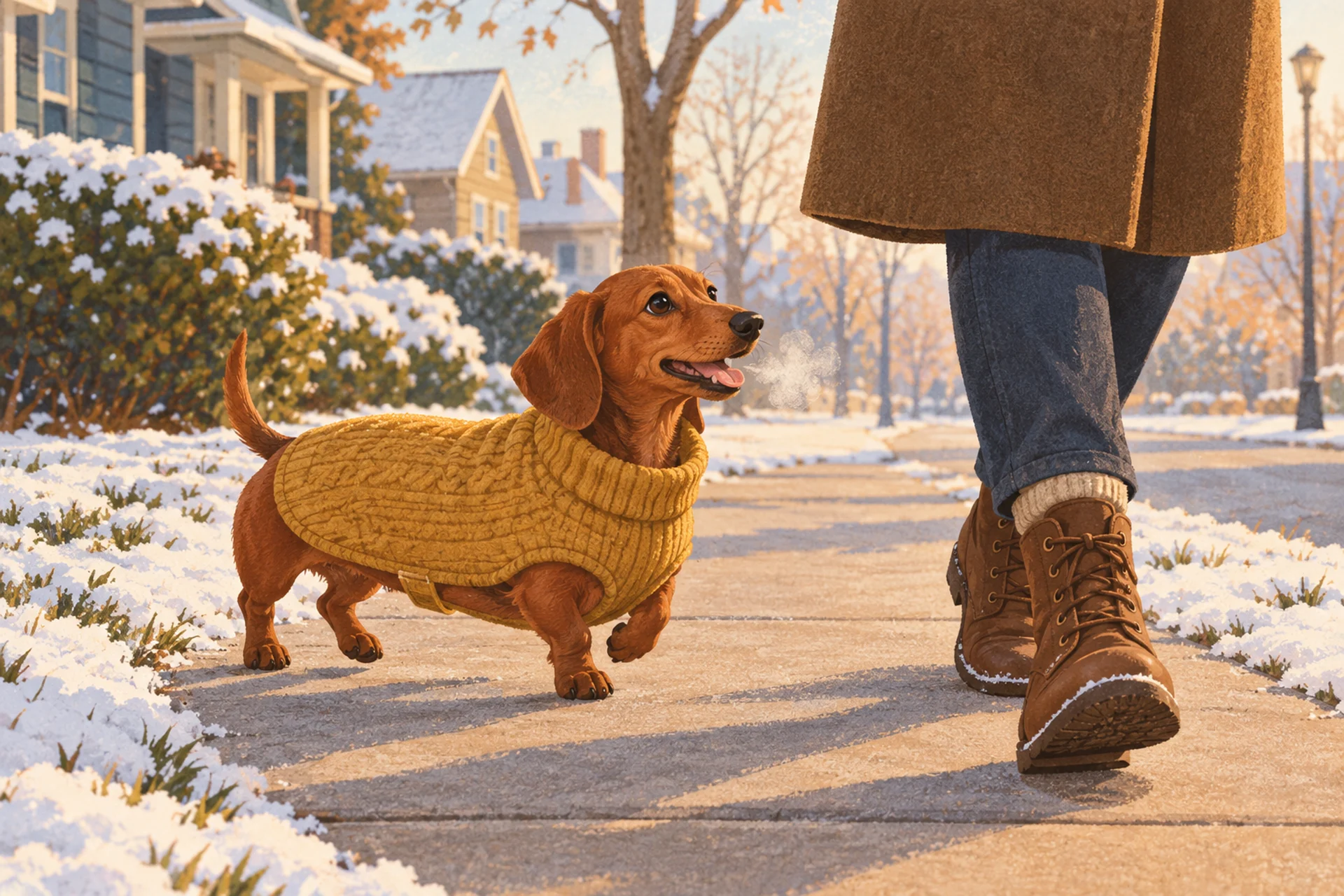
Coat type helps explain the decision, not dictate it
The AKC breed standard describes standard and miniature sizes and three hair types. A wirehaired dachshund has an undercoat; describing every dachshund as single-coated is inaccurate. The standard describes appearance and structure, not measured cold tolerance.
| Hair type | What the standard establishes | What still needs checking |
|---|---|---|
| Smooth | Short, smooth hair that is not excessively thick | VCA identifies rapid heat loss in smooth dachshunds; consider a layer for cold outings |
| Wirehaired | Coarse outer hair with a softer undercoat | An undercoat does not establish an all-weather walking allowance |
| Longhaired | Longer hair on the chest, underside, ears and behind the legs | Check whether that lower hair has become wet; length alone is not proof of warmth |
Merck explains that trapped air between hairs helps conserve heat and that the hairs need to be dry. That supports checking the underside after a wet walk; it does not give us a ranking of the three varieties or a temperature at which all of them must wear clothes.
When to add a layer, shorten the walk or stay inside
Cornell says cold tolerance depends on age, size, nutritional status, health and coat thickness. Puppies, older dogs and animals with health conditions need extra consideration. A familiar brief outing in mild weather is different from standing in cold wind or pushing through slush.
| What you see | Next decision |
|---|---|
| Comfortable adult dog on a mild, dry outing | Do not assume clothing is needed just because the calendar says winter |
| Cold weather, especially with a smooth coat or vulnerable dog | Consider an appropriate layer and plan an outing you can shorten |
| Wet chest or belly | Head somewhere dry and reassess the conditions and garment |
| Shivering, hunched posture, paw lifting or reluctance to walk | Move into a warm, dry area rather than finishing a planned distance |
AAHA advises shorter, more frequent outings in extreme cold. No countdown guarantees that a particular dachshund can safely stay out until it expires. Ask your veterinarian about individual limits, and return earlier when your dog is uncomfortable.
What to look for in a dachshund coat
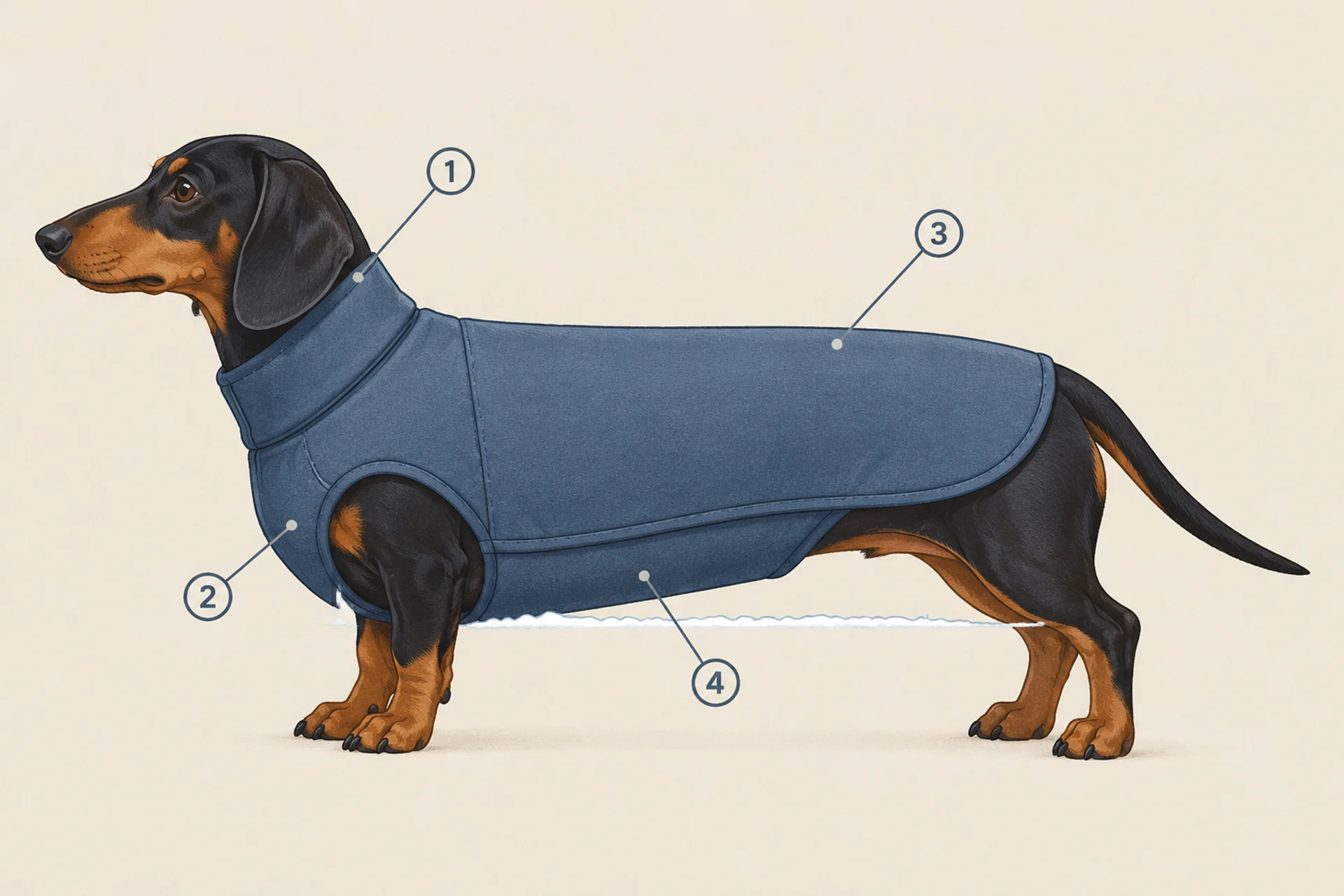
A dachshund combines a long body, deep chest and short legs. Those measurements need to work together: a coat is not finished fitting just because its fastening closes. Compare the actual chart and garment with your own dog.
- Measure, don’t guess from weight. The AKC says you’ll generally need the length of your dog’s body and the widest part of the chest. Neither chest nor back length can be ignored; if the chart cannot accommodate both, ask the maker or choose another cut. Our guide on how to measure your dog for clothes walks through it.
- Coverage underneath. For short-haired dogs, the ASPCA suggests a coat or sweater with a high collar or turtleneck, with coverage from the base of the tail to the belly. Check the coverage underneath as well as the back.
- Length that reaches the tail end. A coat that stops mid-back leaves the rear half of a long body uncovered. Our guide to coats for long-bodied dogs covers the same problem for rain gear.
- Room to move. The AKC says a dog in a jacket should be able to walk, run and play comfortably, and that a jacket shouldn’t be so loose that it becomes an entanglement hazard. Check the front legs as your dog trots. Short legs leave little room for bulky armholes.
- Light or insulated. The AKC suggests a lightweight jacket for dogs that get cold easily as the weather starts to cool, and insulated jackets as the common winter option. Choose for the weather rather than assuming one weight of clothing works year-round.
- Wash it when it’s been in the snow. The AKC says to launder dog coats regularly, especially if they were put away damp after snow.
Miniature dachshund coat with a harness: check the combination
A miniature label is not a fit specification. Use the same measurement process on the smaller dog, including the chart’s body-length and chest instructions. When the chest fits but the lower edge or sleeves trail on the floor, try another shape. Do not keep increasing size to solve one measurement while creating several new problems.
The AKC describes openings that let a back-clip harness attachment pass through a jacket. That does not mean every opening reaches every harness. Try the actual combination: can the leash connect directly to its intended attachment, can your dog walk normally, and does lowering the head pull either garment out of position? Do not treat an unspecified decorative ring as walking equipment.
For another low dog with a different build, our Basset Hound winter coat checklist focuses on the deep chest and short-leg clearance. Its fit observations are useful comparisons, not interchangeable size recommendations.
Dressing a long-backed dog
Dachshunds are prone to back trouble. Cornell’s Riney Canine Health Center cites an American College of Veterinary Surgeons estimate that dachshunds alone account for 40 to 75% of all cases of intervertebral disc disease (IVDD). It advises keeping the dog trim and minimizing stairs and jumping on and off furniture.
A coat doesn’t change that risk. But how you put it on is worth a thought:
- Dress at floor level. Put the coat on while your dog stands on the floor, rather than standing it on a sofa or bed it then jumps down from.
- Pick a coat that’s easy to get on. Wrestling a small dog’s head and legs through a tight pullover takes more handling than a coat that fastens around the body. Our guide to dog coats that don’t go over the head covers the options.
- Notice a change. Cornell says even a sweet dog may snap or growl when it’s in pain. If a dachshund that’s usually fine about being dressed suddenly yelps, flinches or snaps when you touch its back, don’t push on with the coat. Cornell says to contact your veterinarian at the first sign of back discomfort.
Beyond the coat: dry belly, short walks, clean paws
- Start dry. The AKC says to make sure your dog is dry before a walk, because damp fur leaves skin more vulnerable to frostbite.
- Towel the underside when you get in. The ASPCA says to towel dry your pet as soon as it comes inside, and to wash and dry the feet and stomach after each walk to remove ice, salt and chemicals. On a dachshund, the stomach is the part that needs it most.
- Watch the paws. Cornell says road salt and de-icers can irritate paws, and lists ears, paws and tail tips as the places frostbite most often affects. Our guides on ice melt and dog paws and snowballs in paw fur cover those.
- Coats are for supervised time. The AKC says clothing should never be used on an unattended dog or as a substitute for proper care.
- Shorten the outing when conditions demand it. AAHA recommends shorter, more frequent walks in extreme cold; the coat does not override your dog’s response.
When it’s a vet call, not a coat question
Bring a chilly dog somewhere warm and dry, then observe how it is doing. If your dog keeps shivering after it’s warm and dry, doesn’t act like itself, or you’re worried about frostbite on the ears, paws or tail tips, the places Cornell says it most often shows up, call your vet. The AKC’s advice for suspected hypothermia is to bring your dog somewhere warm and contact your vet immediately. For puppies, seniors and dogs with health problems, ask your vet what cold-weather limits make sense for that dog.
Dachshunds and cold weather FAQ
Do dachshunds need coats in winter?
Many benefit from a layer, especially smooths. Cold, wet ground and the individual dog’s age and health matter. Watch the dog rather than treating the breed name as a rule that always requires, or never requires, clothing.
Do dachshunds have double coats?
The AKC standard explicitly describes an undercoat in wirehaired dachshunds. It describes smooth and longhaired varieties separately. Those descriptions do not establish a universal walking temperature or prove that a wirehair can stay out comfortably in any conditions.
Do longhaired dachshunds need coats?
Sometimes. Longer hair does not remove the need to consider wetness, cold and individual comfort. Check the underside after wet outings and choose clothing that leaves the dog free to move.
How long can a dachshund be outside in the cold?
No single time is safe for every dachshund. Weather, health and the dog’s behavior all change the answer. Shorten exposure in extreme cold; shivering, paw lifting, a hunched posture or refusal to continue are reasons to go into warmth sooner.
How do I choose a miniature dachshund coat with a harness?
Measure the dog for the specific coat and try the harness with it. A back opening must line up with the actual harness attachment without pulling the clothing aside. Check leg clearance, normal walking and the ability to lower the head.
Does a dachshund need a coat at night indoors?
Start with a warm, draft-free sleeping place, as the ASPCA advises. Do not put clothing on an unattended dog as a substitute for suitable shelter. If your dog is persistently shivering or seems unwell indoors, contact your veterinarian rather than just adding another layer.
Sources
- American Kennel Club — Official Standard of the Dachshund (checked 2026-11-06)
- VCA Animal Hospitals — Dachshund (checked 2026-11-06)
- American Kennel Club — Does My Dog Need a Winter Coat? (checked 2026-11-06)
- American Kennel Club — Hypothermia in Dogs: How Cold Is Too Cold? (checked 2026-11-06)
- Merck Veterinary Manual — Structure of the Skin in Dogs (checked 2026-11-06)
- Cornell University College of Veterinary Medicine, Riney Canine Health Center — Winter safety tips (checked 2026-11-06)
- Cornell University College of Veterinary Medicine, Riney Canine Health Center — Intervertebral disc disease (checked 2026-11-06)
- ASPCA — Cold Weather Safety Tips (checked 2026-11-06)
- American Animal Hospital Association — Cold Weather Pet Safety Tips (checked 2026-11-06)
Updated and source-checked by Codex (OpenAI), November 6, 2026.
This guide is general information, not veterinary advice. If your dog has a health condition or a history of back problems, ask your veterinarian what cold-weather limits make sense for it.
Check the dog, then the layer.
Measure both chest and back, try the harness with the coat, and check the underside after wet outings. Head into warmth when your dog is uncomfortable. Clothing helps with comfort; it is not permission to ignore weather or illness.