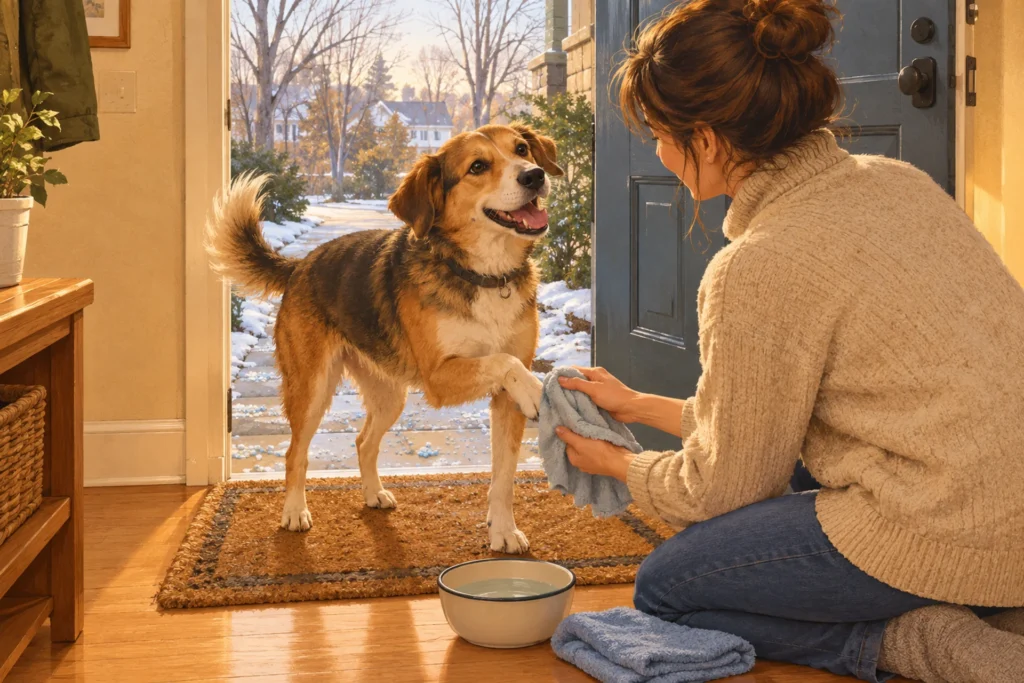
Yes, ice melt can hurt dog paws, but for most dogs the damage is dryness and irritation, and the bigger risk is what gets licked off afterwards. The ASPCA says rock salt, the most common de-icer, can be harsh on paws and cause irritation, and that eating it can push sodium to dangerous levels. VCA Animal Hospitals adds that salt-based de-icers are very drying to the pads and the delicate skin between the toes.
So the practical answer has two halves. Wipe or rinse your dog’s feet, legs and belly as soon as you get home, before any licking starts. And if your dog’s pads are already red or cracked, add a barrier: boots or a paw balm. No ice melt is entirely harmless, including the ones labeled pet-safe, so the routine matters more than the brand.
What ice melt actually does to a paw
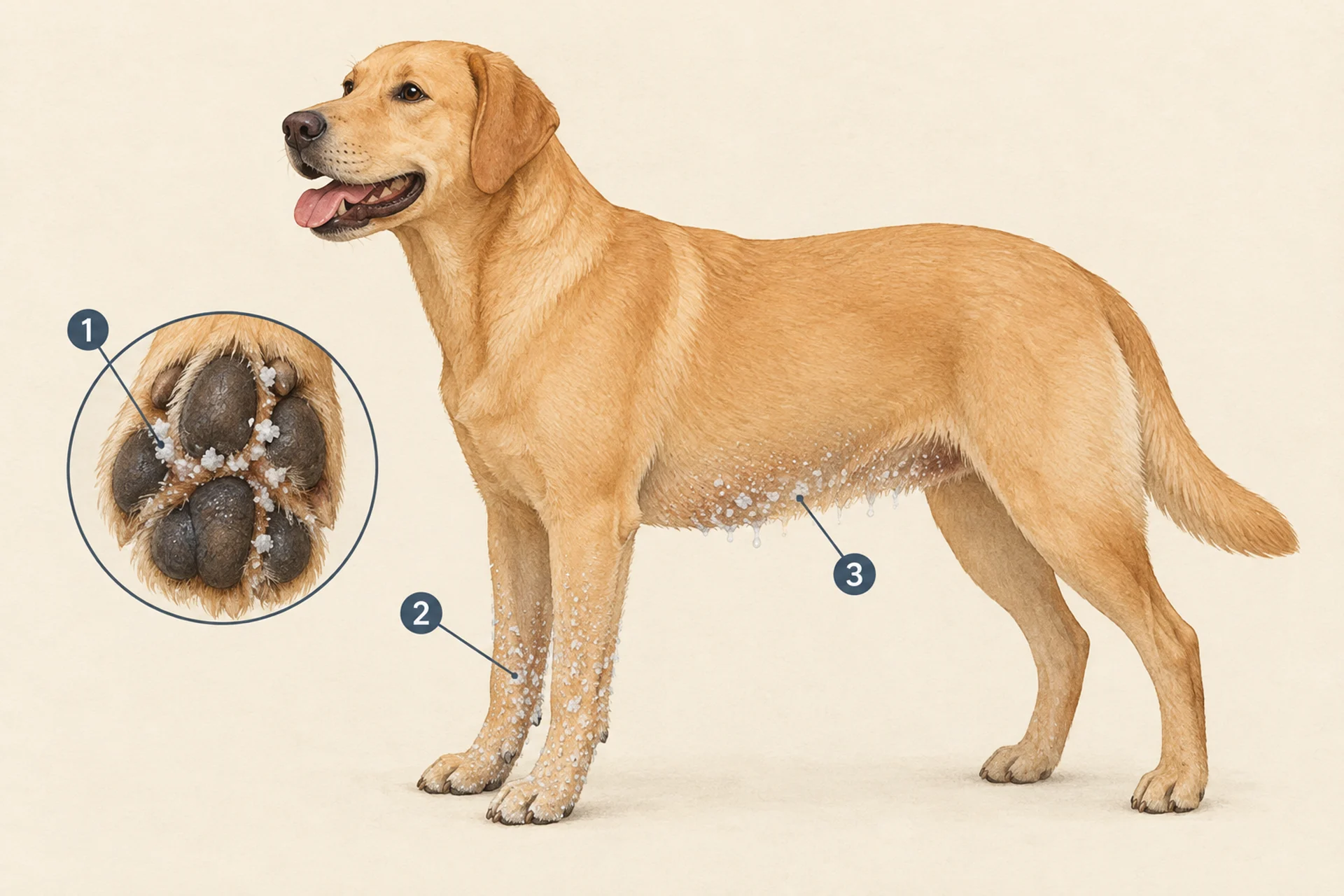
Ice melt works by dissolving into the water on a sidewalk, and it keeps doing that on a dog’s foot. Paw pads are tough, but the skin between the toes is not, and that is where crystals and salty slush collect. VCA describes salt-based de-icers as very drying to both. Repeated walks on treated sidewalks are what cause most trouble, not a single crossing.
The ASPCA’s winter guidance describes what that looks like in a sensitive dog: paw pads that become irritated, cracked or even bleeding. Before it gets that far, you may notice your dog lifting a foot on salted ground, licking the paws hard once indoors, or stopping on the walk to chew at a foot. A dog who limps suddenly on a winter walk may also simply have ice packed between the toes, which the AVMA lists as a common cause, so check before you blame the salt (our guide to snowballs on dog paws covers that one).
The licking is the part that makes dogs sick
Walking through ice melt mostly affects the skin. Swallowing it is what affects the rest of the dog, and a dog grooming its feet on the sofa is swallowing whatever the sidewalk left behind. The ASPCA names exactly this route: pets get exposed when they lick their feet after walking through a treated area, or when they eat snow, especially slushy snow, that has ice melt in it.
Most of the time the result is a stomach upset. The ASPCA says the most common issue is vomiting and diarrhea, and the Pet Poison Helpline says most ice melt exposures are limited to stomach upset and local skin irritation. Larger amounts are a different matter. The ASPCA warns that eating too much ice melt can raise sodium levels enough to cause tremors and seizures, and that products containing calcium chloride can also cause sores in the mouth. The Merck Veterinary Manual describes salt poisoning in dogs as vomiting within several hours, which can progress to weakness, diarrhea, muscle tremors and seizures.
The realistic picture, then: a dog who licks a little residue off clean-ish feet is very unlikely to be in danger. A dog who gets into a bag of ice melt, or eats mouthfuls of treated slush, is a reason to call someone the same day.
Not all ice melt is the same, and “pet-safe” is not a guarantee
The label on the bag tells you less than the ingredient list on the back. Here is what the veterinary sources say about the common ingredients. Where they disagree, we say so.
| Ingredient | What the sources say |
|---|---|
| Sodium chloride (rock salt) | The most commonly used de-icer, per the ASPCA. Harsh on paws, and eating it can cause dangerously high sodium levels. |
| Calcium chloride | The ASPCA notes it can cause mouth ulcers if eaten. The Pet Poison Helpline says calcium salts can irritate skin and paws on contact and cause more severe stomach signs. |
| Potassium chloride | Sources differ. VCA lists it, with magnesium chloride, as a pet-safe option. The Pet Poison Helpline calls it a severe irritant to the stomach and gut. |
| Magnesium chloride | One of the usual ingredients in pet-friendly products, per the ASPCA, and VCA calls it slow but among the safest. It can still upset the stomach. |
| Urea | The ingredient most often labeled safe for pets, according to the Pet Poison Helpline. The ASPCA says it can still cause stomach upset. |
| Calcium magnesium acetate (CMA) | VCA describes it as environmentally and pet friendly, and says less of it is needed to work. |
| Glycols | VCA warns that some de-icers contain ethylene glycol, the main ingredient in antifreeze, which is poisonous to pets, and that propylene glycol products are toxic to cats. |
The Pet Poison Helpline’s bottom line is the one to remember: all types of ice melt have the potential to be hazardous. “Pet-friendly” usually means a gentler ingredient, not a product a dog can lick freely. If you are choosing one for your own steps, which the AVMA encourages, read the ingredients, keep the bag where your dog can’t reach it, and ask your vet if your dog has a health condition. The Pet Poison Helpline notes, for example, that very large amounts of magnesium chloride are mainly a concern for dogs with kidney disease.
You can’t choose what your city or your neighbors put down, which is why the routine below matters more than the bag in your garage.
How to get ice melt off your dog’s paws
This is the same advice from every source we checked, and it takes about a minute.
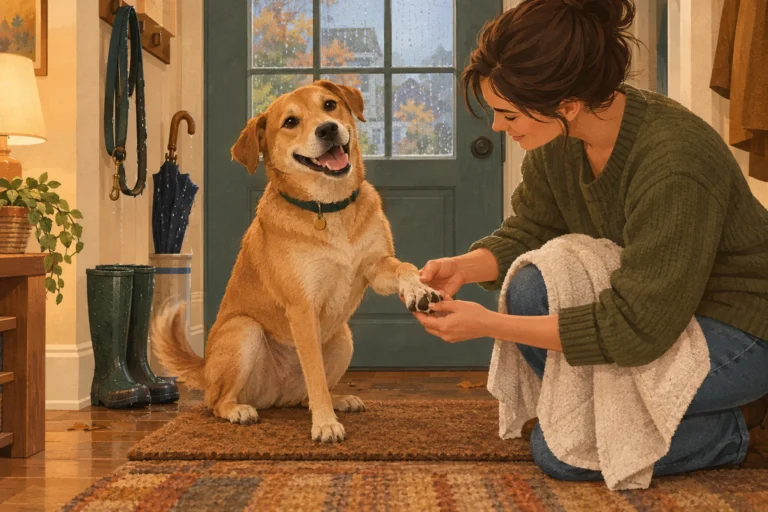
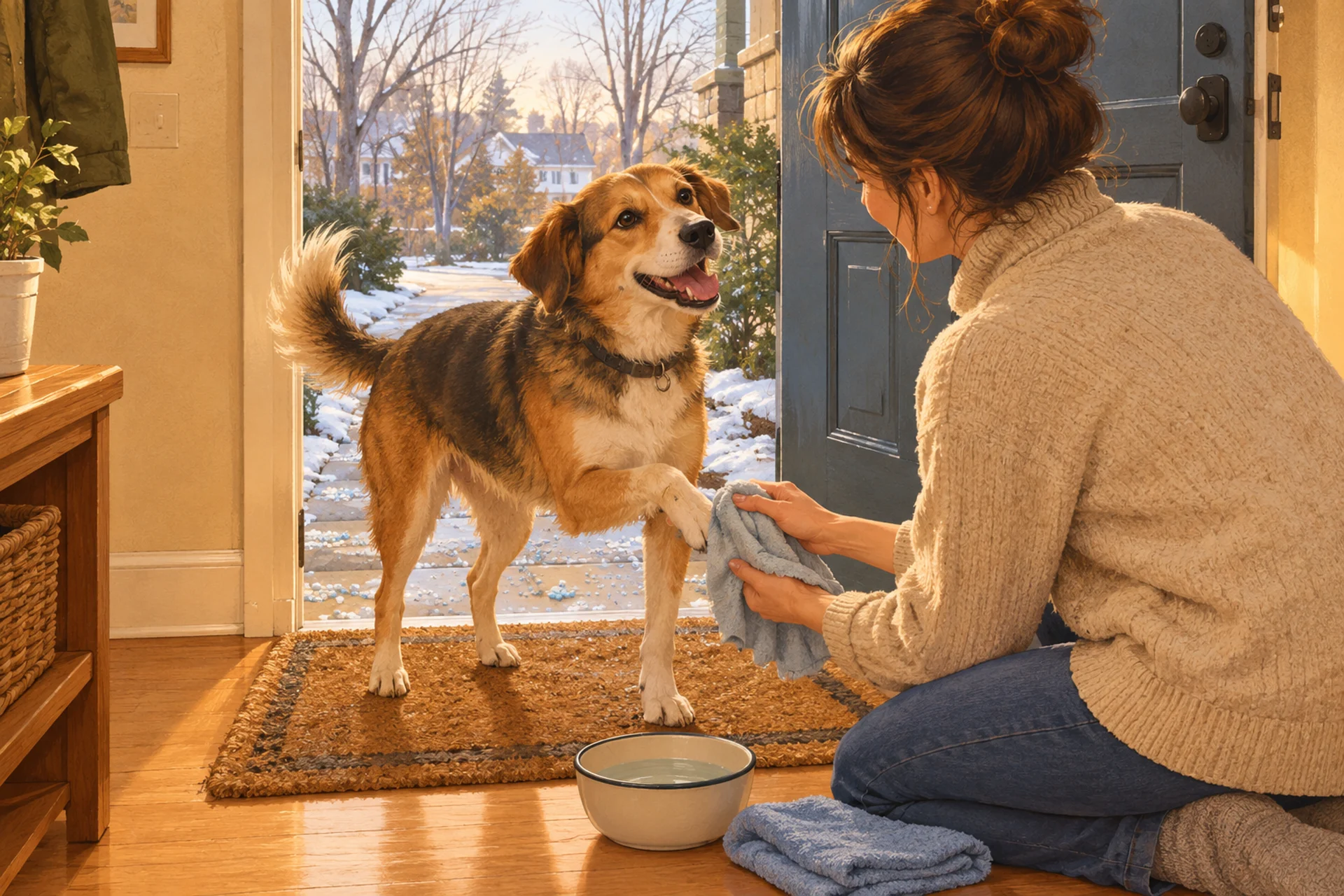
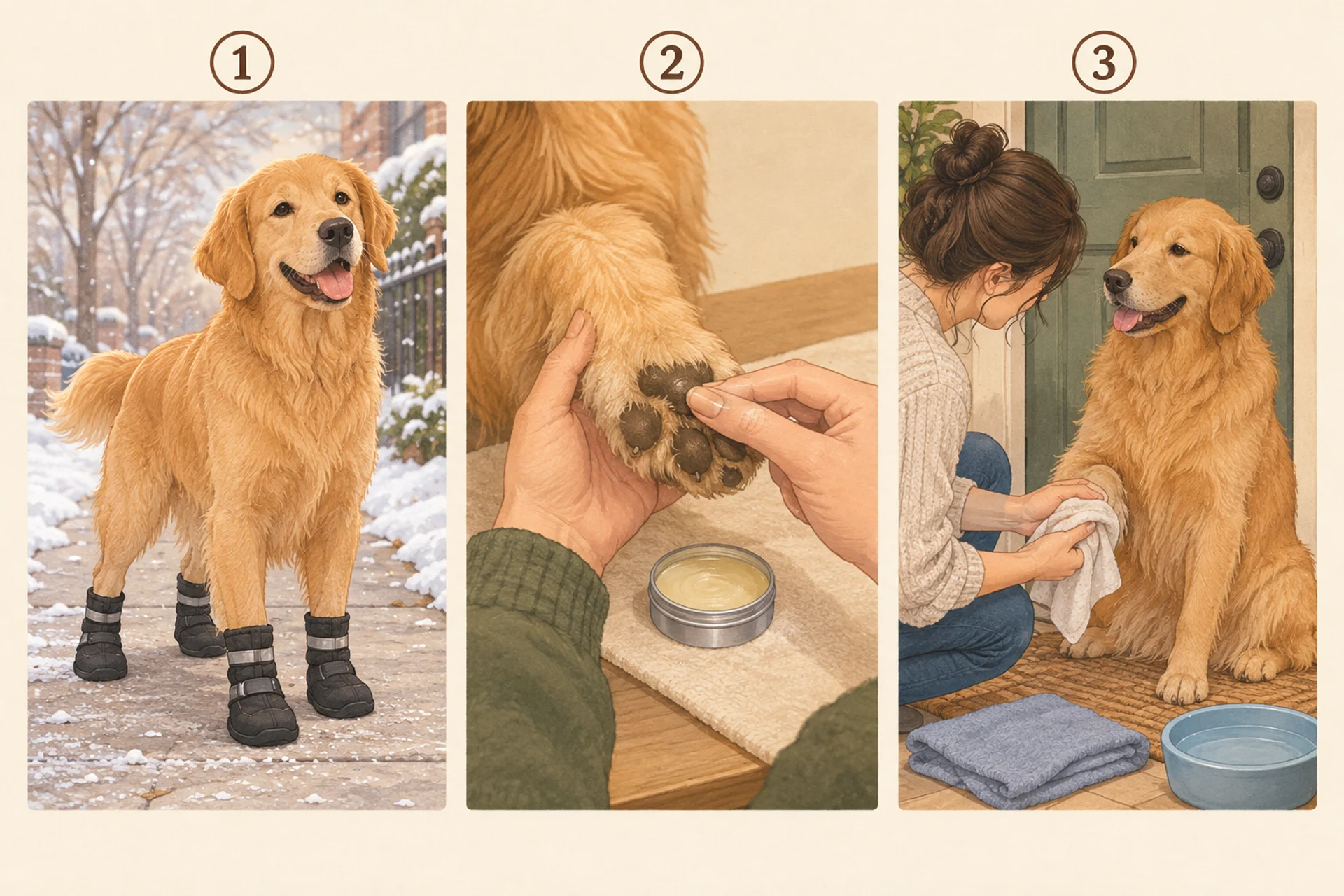
- Do it at the door. The ASPCA says to wipe the paws as soon as your dog comes inside, before the licking starts. Keep a cloth and a towel by the door so it actually happens.
- Use warm water. VCA suggests warm water with a cloth or grooming wipes; the ASPCA mentions a damp cloth or baby wipes.
- Do the legs and belly too. The AVMA points out that feet, legs and belly can all pick up de-icers and antifreeze, and asks owners to wipe or wash all three. Low-slung and long-haired dogs collect the most.
- Get between the toes, then dry there. That is where crystals hide and where moisture lingers. Our guide to cleaning dog paws after a walk goes through the routine and what not to wipe with.
- Look while you’re there. The AVMA recommends checking paws often in winter for cracked or bleeding pads.
Boots, balm, or just the wipe?
Wiping deals with what your dog has already picked up. A barrier stops it reaching the skin in the first place. You don’t need one for every dog, but it makes sense when the pads are already sore, when your walks are mostly on salted city sidewalks, or when your dog is a determined foot-licker.
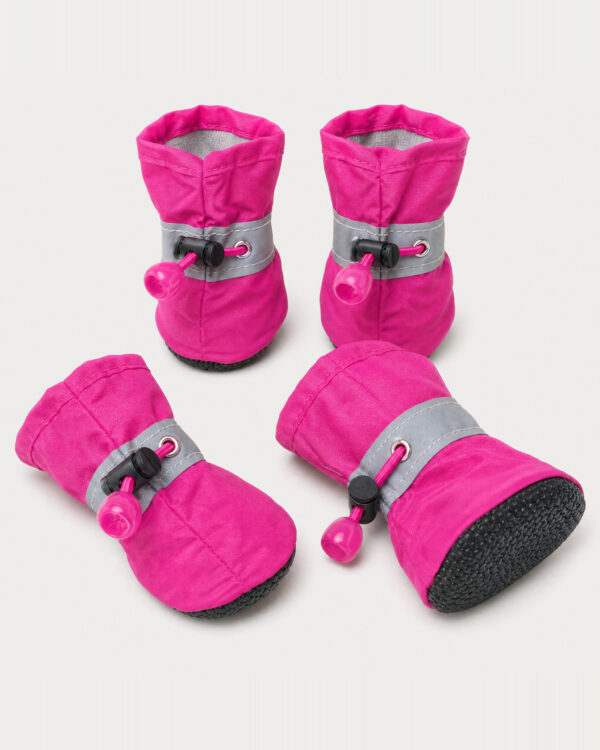
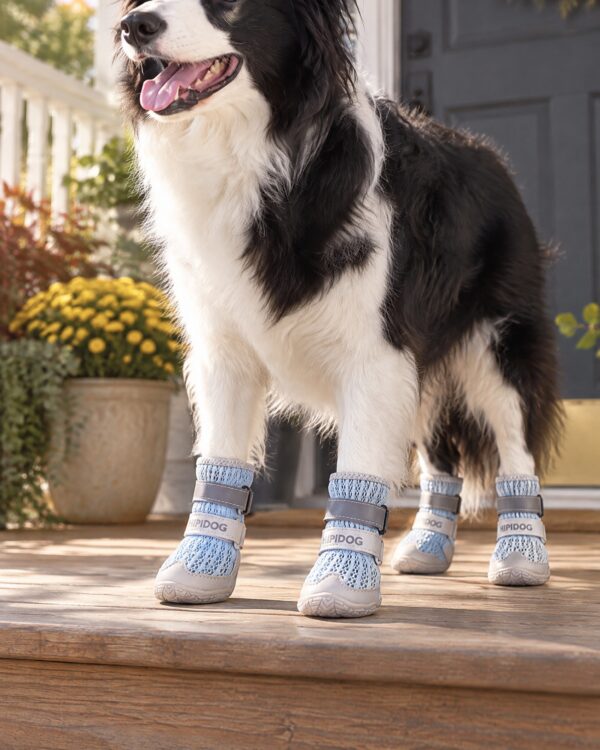
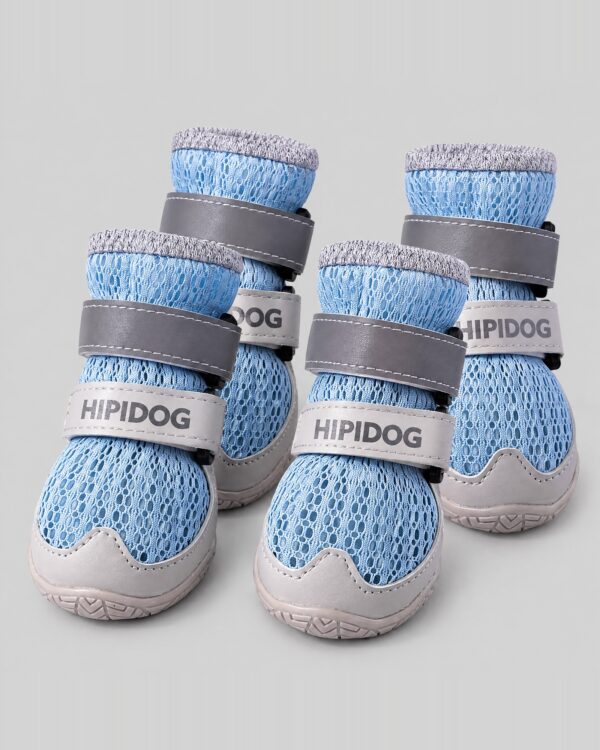
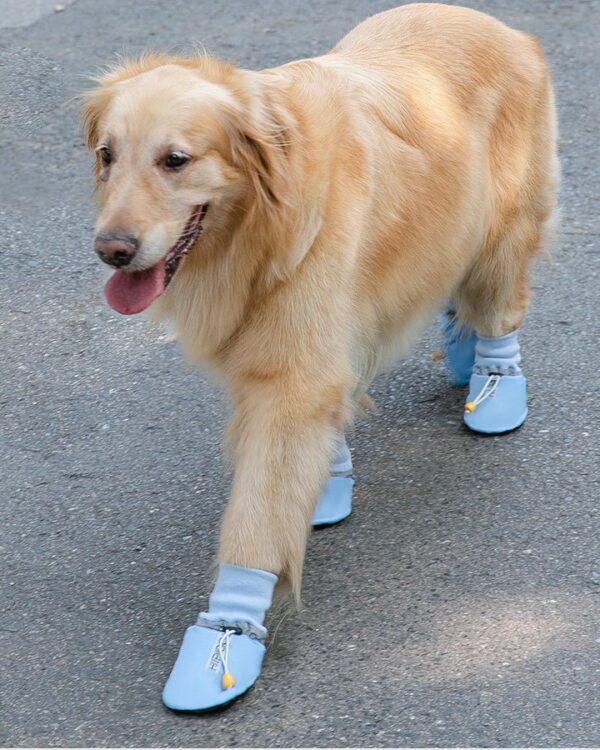
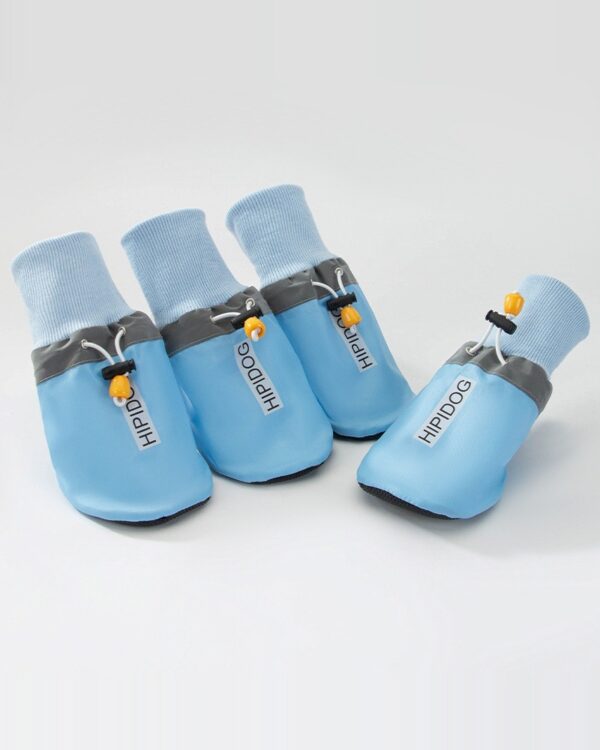
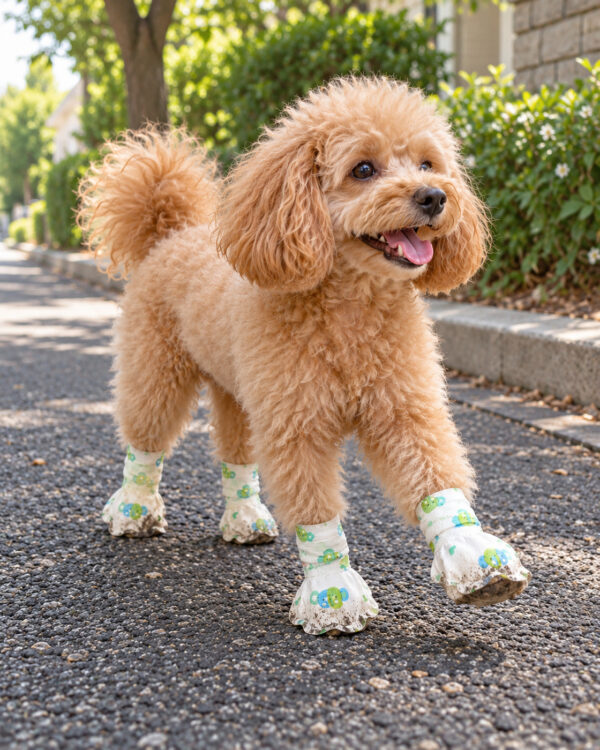
- Boots give the most protection. The AKC lists shielding paws from de-icers and road salt as one of their main jobs, and the ASPCA recommends paw booties too. The catch is fit: VCA says to size them with the manufacturer’s guide, and the AVMA says to make sure they fit properly. If boots keep coming off, see why dog boots keep falling off; if you are still deciding, see do dogs need boots in winter.
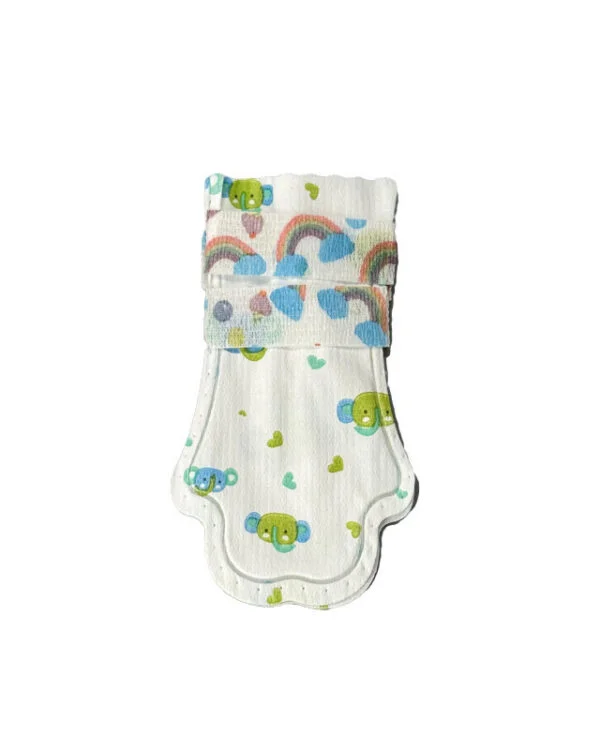
- Paw balm or wax is the lighter option. VCA says these balms create a protective barrier between the pads and salt-covered sidewalks, and the ASPCA lists paw wax alongside boots. It won’t keep crystals out from between the toes the way a boot does, so you still wipe afterwards. The AKC also suggests a paw balm for pads that are already dry or cracked.
- Wiping alone is enough for many dogs on lightly treated routes, as long as it happens every time.
When to call the vet or poison control
Most salty paws need nothing more than a wash. These are the situations where the sources say to get help:
- Your dog ate ice melt from a bag or a pile, or ate a lot of treated slush. Contact your veterinarian, the ASPCA Animal Poison Control Center at (888) 426-4435, or the Pet Poison Helpline at (855) 764-7661. Expect a consultation fee with either line.
- Vomiting, diarrhea, drooling or weakness after a walk on treated ground. Merck notes that salt poisoning usually shows up as vomiting within several hours.
- Tremors or seizures. This is an emergency. Go to a veterinarian now.
- Pads that are cracked, bleeding or swollen, or a limp that doesn’t go away once the foot is clean and free of ice. Have your vet look before you treat it at home.
- Possible antifreeze. The Merck Veterinary Manual warns that antifreeze tastes sweet and has a small lethal dose, and says to call your vet and animal poison control immediately if you suspect it. Puddles in driveways and parking lots are where dogs find it.
This guide is general information, not a diagnosis. If you are unsure, the phone call costs less than waiting.
Ice melt and dog paws: FAQ
Is rock salt bad for dogs’ paws?
It can be. The ASPCA says rock salt can be harsh on paws and cause irritation, and VCA says salt-based de-icers are very drying to pads and the skin between the toes. Wiping the feet after every walk on salted ground prevents most of the trouble.
Is pet-safe ice melt really safe?
Safer, not safe. Pet-friendly products usually use urea or magnesium chloride, which the ASPCA calls typically safer but still able to upset the stomach. The Pet Poison Helpline says all types of ice melt have the potential to be hazardous. Read the ingredients rather than the label.
What happens if my dog licks ice melt off its paws?
A small amount usually means, at most, a mild stomach upset. Larger amounts can raise sodium levels and cause vomiting, weakness, tremors or seizures, according to the ASPCA and Merck. Wiping the paws at the door is how you keep the amount small.
How do I get ice melt off my dog’s paws?
Wipe or rinse with warm water and a cloth or grooming wipe as soon as you get inside, including between the toes, then dry. The AVMA also recommends wiping the legs and belly, which pick up de-icer too.
Is calcium chloride ice melt bad for dogs?
It is one of the harsher options. The ASPCA says calcium chloride can cause mouth ulcers if eaten, and the Pet Poison Helpline says calcium salts can irritate paws on contact. If you are buying ice melt for your own steps, it is one to avoid.
Do dogs need boots for salted sidewalks?
Not every dog, but they are the most complete protection. The AKC and ASPCA both recommend boots against de-icers and road salt. They are most worth it if your dog’s pads are already sore or your walks are mostly on heavily salted pavement. Fit matters more than the brand.
Sources
- ASPCA — Is It Safe to Use De-Icers Around Your Dog? (checked 2026-10-15)
- ASPCA — Keeping Pets Safe During Winter: The Dangers of Ice Melts (checked 2026-10-15)
- Pet Poison Helpline — Is There Really a “Safe” Ice Melt? (checked 2026-10-15)
- VCA Animal Hospitals — How to Keep Your Dog’s Paws Safe in Winter (checked 2026-10-15)
- American Veterinary Medical Association — Cold Weather Animal Safety (checked 2026-10-15)
- Merck Veterinary Manual — Salt Toxicosis in Animals (checked 2026-10-15)
- Merck Veterinary Manual — Keeping Pets Safe During Cold Winter Months (checked 2026-10-15)
- American Kennel Club — Dog Boots (checked 2026-10-15)
This guide is general information, not veterinary advice. Product formulas and guidance change; for a dog that has eaten ice melt or is unwell, call your veterinarian or an animal poison control line.