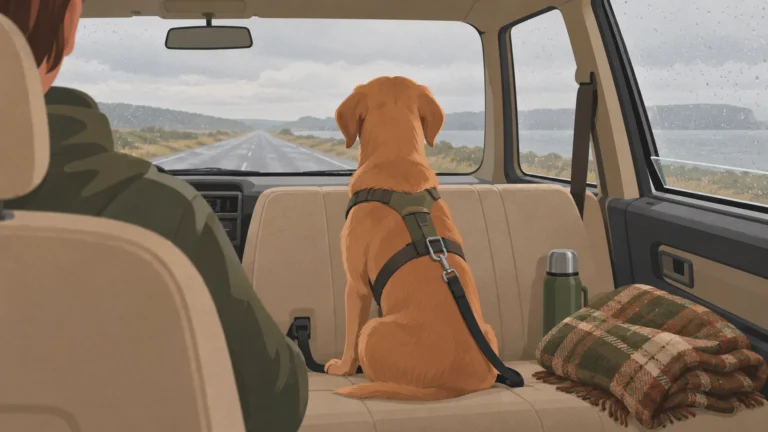
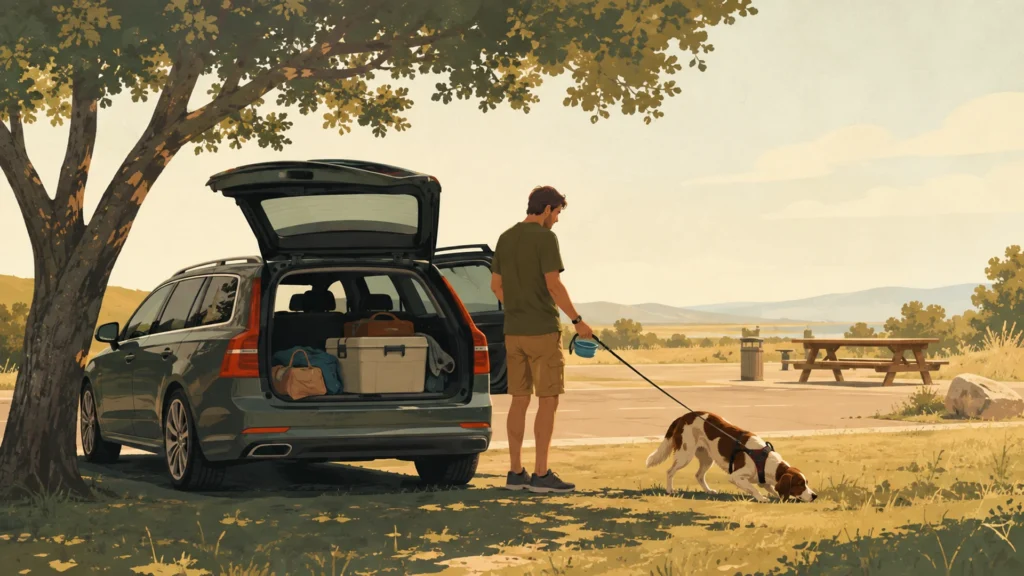
Plan on a stop every two to three hours, then let your dog move the number. That interval is a sensible default — it is roughly a human’s limit too — but it is worth knowing where it comes from, because it does not come from a veterinary body. The AKC’s own road-trip safety guidance and the ASPCA’s travel page both tell you to stop for exercise and relief without naming an interval at all. The number you see quoted everywhere has been copied between blogs, not published by anyone who studied it.
So treat two to three hours as your planning rhythm and let four things override it: bladder, water, heat, and how your dog actually rides. A puppy, a senior, or a dog who drools and whines in the back seat will need more stops than your itinerary allows — and one rule has no flexibility in it at all, which is that the dog does not stay in the car while you go inside.
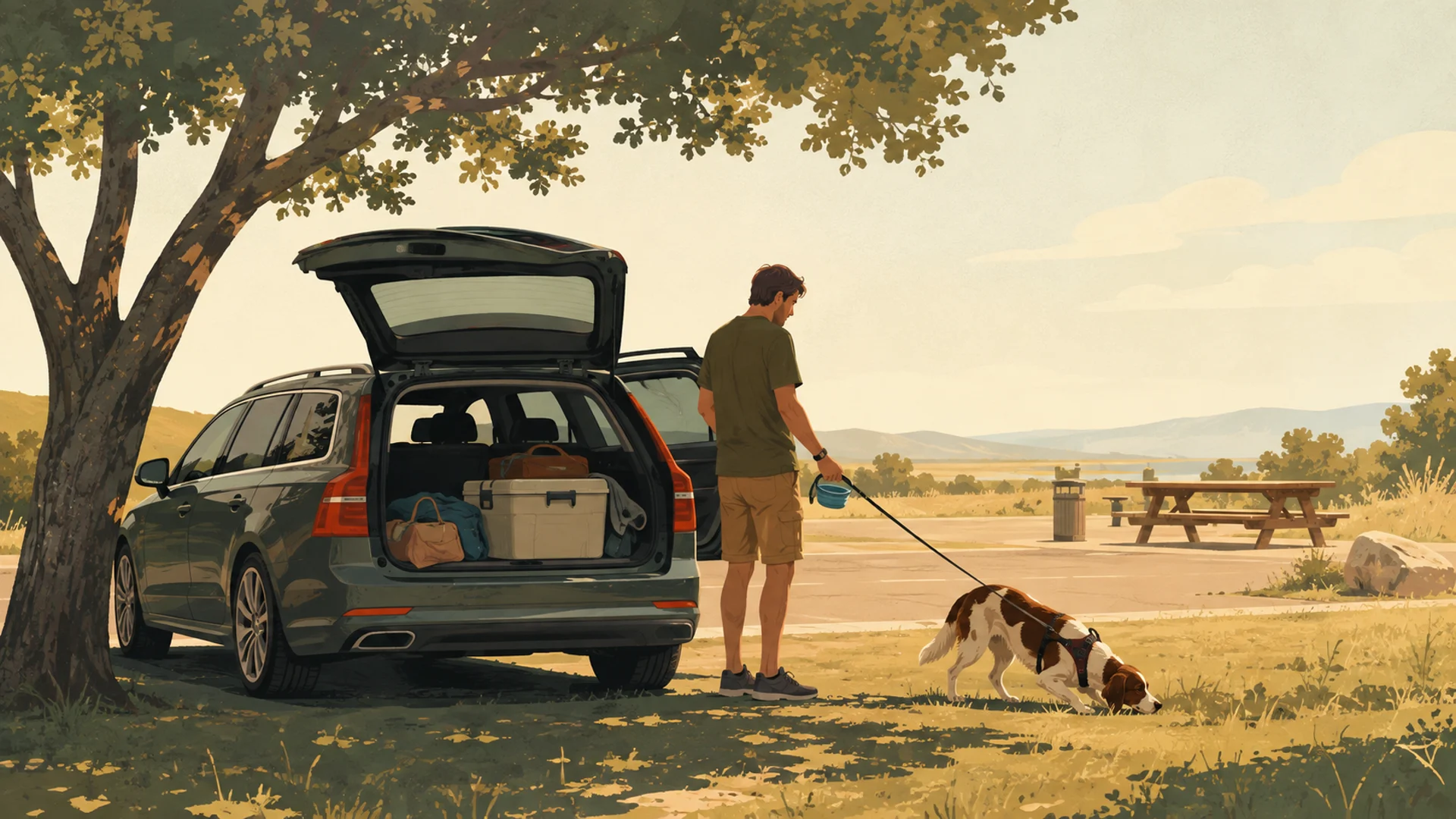
Where the “every two to three hours” number comes from
It is a reasonable rule of thumb with a thin pedigree. Search the question and you will get two to three hours, or fifteen to thirty minutes every two to four hours, or a flat four-hour maximum, each stated with equal confidence and none of them sourced. Go to the organisations that actually review their pet-travel guidance and the number disappears. The AKC’s road-trip safety guidance recommends a carrier or safety harness and says breaks for exercise help prevent boredom and anxiety, but gives no interval. The ASPCA’s travel safety tips cover crating, water, feeding and window rules, and likewise do not name a frequency.
That silence is not an oversight. There is no single correct interval, because the constraint that binds first is different for every dog, and it changes over the course of a drive. Which is genuinely more useful to know than a number would be.
The four things that actually set your cadence
| Constraint | Who it binds first | What it does to your schedule |
|---|---|---|
| Bladder | Puppies, seniors, small dogs, dogs on diuretics | Sets a hard ceiling; a puppy may need a stop every hour or two |
| Hydration | Every dog, more so in summer | Water offered on a stop creates the next stop — that is fine, and better than a dehydrated dog |
| Heat | Short-muzzled and thick-coated dogs | Shortens everything; a car that loses air conditioning at a stop is on a clock |
| Riding style | Anxious riders, car-sick dogs, dogs new to travel | More frequent, shorter stops beat fewer long ones |
Notice that hydration and bladder pull against each other, and the resolution is always in favour of water. The ASPCA is specific about carrying plenty and using bottled water from home rather than whatever is at the rest area, on the reasoning that unfamiliar water can upset a dog’s stomach. Restricting water to buy yourself an extra hour of driving is the wrong trade in every season and a dangerous one in summer.
The one rule with no flexibility in it
Whatever your interval, the dog comes out of the car when you do, or someone stays with them and the engine runs. The National Weather Service’s guidance on children and pets in vehicles documents an interior going from a safe temperature to an unsafe one in just over two minutes in one demonstration, and states plainly that leaving the windows slightly open does not significantly decrease the heating rate. Cracking the windows is not a mitigation. Parking in the shade is not a mitigation either — shade moves, and the interior keeps climbing. We laid the full minute-by-minute numbers out in is it safe to leave my dog in the car.
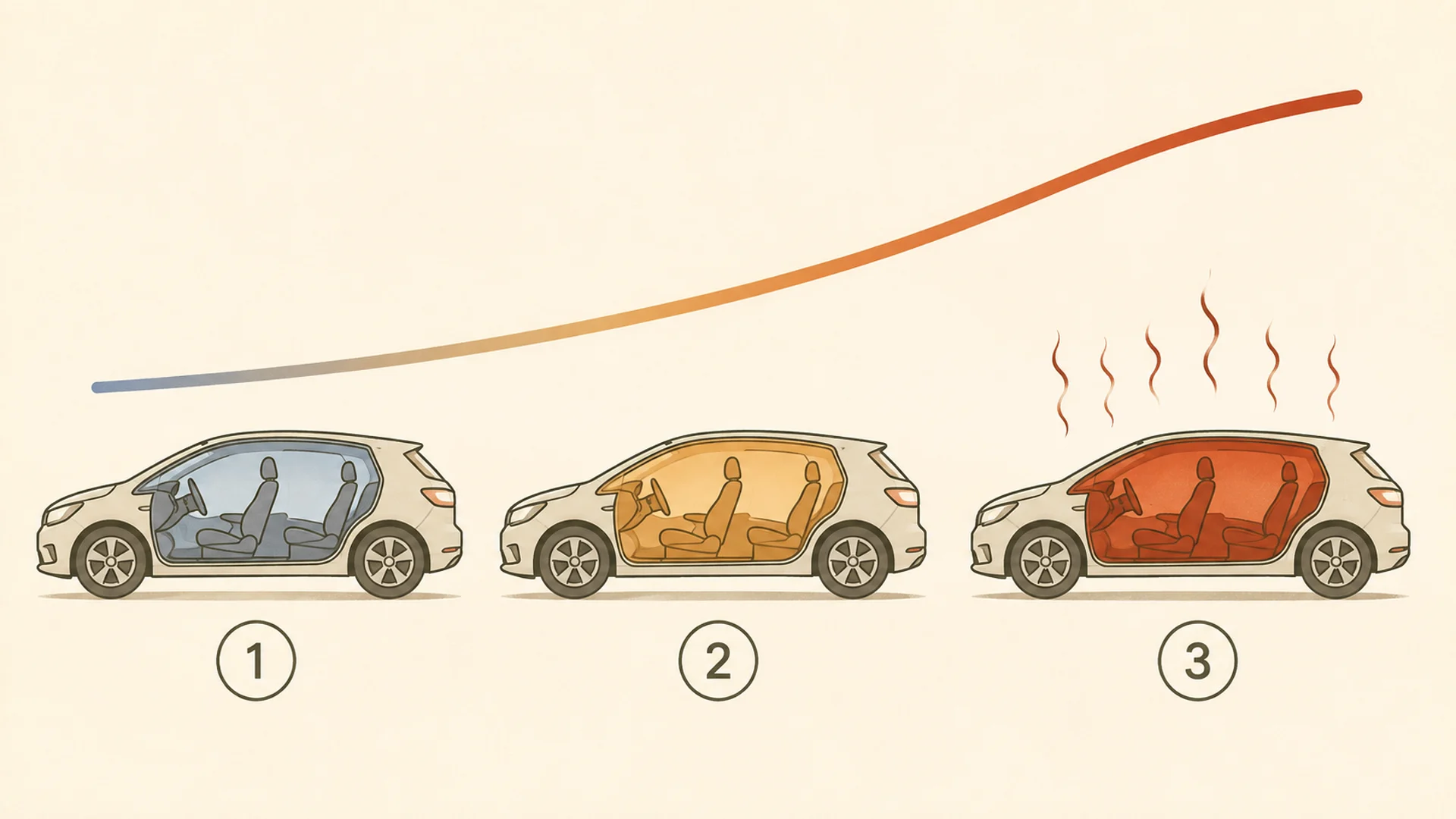
Know what the far end of that curve looks like on the dog, too. The Merck Veterinary Manual lists the signs of heat stroke as hot skin, vomiting, drooling, rapid panting, distress, uncoordinated movement, collapse or unconsciousness, against a normal rectal temperature of about 101.5–102°F. Its first-aid direction is to move the animal out of the heat and cool the head and body with cool water, ice packs or wet towels — particularly the belly — and to get to a veterinarian immediately, while explicitly warning against immersing the dog in cold water. Merck also notes that dogs with short muzzles that do not breathe well in heat, and those with thick or dark coats that trap warm air, are at increased risk. If you are travelling with a Bulldog, a Pug or a heavily coated northern breed, your stop schedule is a summer schedule regardless of what the calendar says.
What a stop should actually consist of
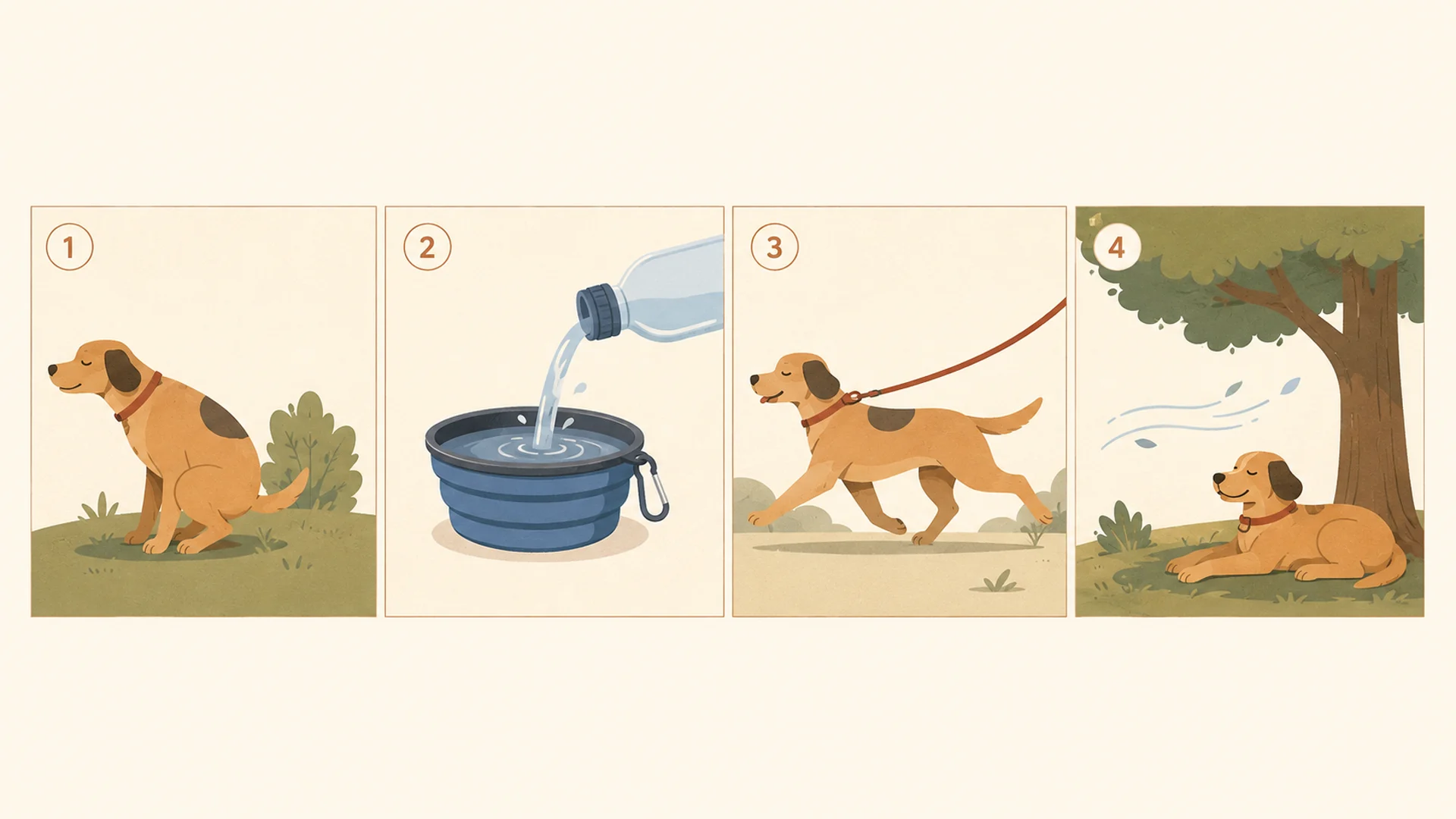
- Leash on before the door opens. A rest area is a car park with fast traffic on two sides, and a dog who has been still for three hours does not exit thoughtfully.
- Relief first, then water, then a short walk. Reversing the order means walking a dog who needs to go.
- Five to ten minutes of actual walking, not a lap of the kerb. The point is circulation and a change of position, not just the toilet.
- Let them cool off before they get back in, especially if the stop involved sun. Loading a panting dog into a car that has been closed for ten minutes stacks two heat sources.
- Check the harness or crate fastening every time you reload. Restraint that loosened over three hours is the one thing you can fix for free.
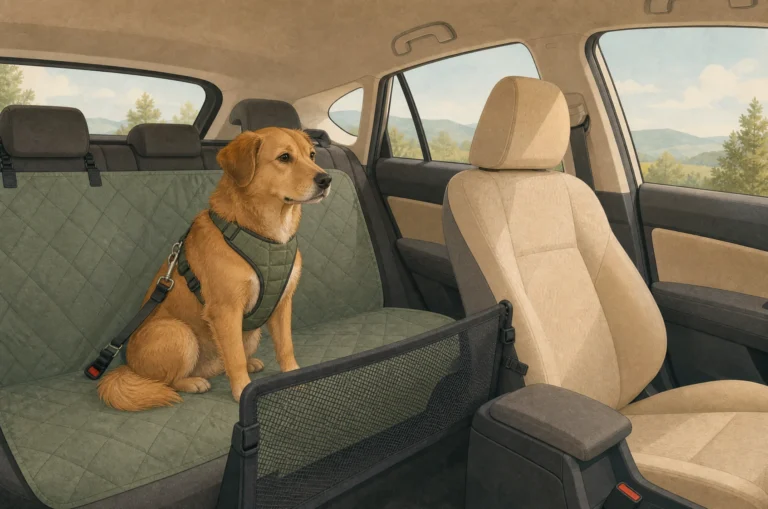
On restraint itself, the ASPCA’s position is a well-ventilated crate secured so it cannot slide or shift in an abrupt stop, or — if you skip the crate — the back seat, in a harness attached to a secured seatbelt, and never with the dog’s head out of the window. Worth knowing what that gear can and cannot claim: we went through what “crash-tested” actually means on a pet product listing, and the short version is that there is no mandatory standard behind the phrase.
If the reason you are stopping is a dog who feels sick rather than a dog who needs a wee, the fix is a different one: does a dog booster seat help with car sickness covers seating position, ventilation and what the evidence behind the elevated-seat claim actually amounts to.
The dogs who need more stops than you planned
Puppies are the obvious case, and not only for the bladder. The AKC notes that puppies get carsick more often because the inner-ear structures used for balance are not fully developed yet, much as with young children. The signs to watch for are whining, drooling, lip-licking and eventually vomiting — and if you catch the drooling stage, a stop is more useful than pressing on.
For a dog who rides badly, the AKC’s non-drug measures are worth trying before your trip rather than during it: position the dog in the middle of the back seat so they face forward, or crate them to limit what they can see; lower the windows a few inches, because equalising internal and external air pressure can reduce nausea; and build tolerance in stages — sitting in a parked car, then with the engine running, then a trip down the driveway, then somewhere the dog likes. Anything involving medication is a conversation with your veterinarian, not a road-trip improvisation.
One place the guidance genuinely conflicts — feeding
You will find two different answers about food, and both are right for different dogs. The ASPCA’s travel-feeding advice is a light meal three to four hours before departure. The AKC’s carsickness guidance says to withhold food for twelve hours before the trip while keeping fresh water available. These are not contradicting each other so much as answering different questions: the first is about a normal dog on a normal drive, the second is about a dog who is likely to be sick. If your dog travels well, feed light and early. If your dog has thrown up in the car before, the empty-stomach approach is the one aimed at your problem. Both agree on not feeding in a moving vehicle, and the AKC adds an hour for the stomach to settle before driving on if you do feed at a stop.
If you are still deciding how the dog will actually ride, our guide to carriers for car travel covers the container side of the same question.
How long can a dog stay in a car without a break?
There is no published veterinary maximum, which is why the figures you see quoted vary so widely. The honest framing is that a healthy adult dog who has emptied out before departure can usually manage a few hours comfortably, and that the first dog to reach their limit — puppy, senior, small bladder, anxious rider — sets the schedule for the whole car. For an older dog the limiting factor is often stiffness rather than bladder, which changes the cadence; see traveling with a senior dog.
Can I leave my dog in the car for five minutes while I run inside?
No. The National Weather Service documents an interior crossing from safe to unsafe in just over two minutes in one demonstration, and notes that cracking the windows does not significantly slow the heating. Five minutes is inside the danger window, not before it.
Should I give my dog water at every stop?
Yes. The ASPCA advises carrying plenty and using water brought from home, since unfamiliar water can cause stomach upset. It will mean more stops. That is the correct trade — do not ration water to stretch your driving legs.
How do I know if my dog is overheating in the car?
Merck lists hot skin, vomiting, drooling, rapid panting, distress, uncoordinated movement, collapse or unconsciousness. If you see them, move the dog out of the heat, cool the head and body with cool water or wet towels — especially the belly — and get to a veterinarian straight away. Do not immerse the dog in cold water.
Where should my dog ride on a long drive?
The ASPCA’s answer is a well-ventilated crate secured against sliding, or the back seat in a harness attached to a secured seatbelt — and never with the head out of the window. The middle of the back seat has a second advantage for a dog prone to motion sickness, because it encourages them to face forward.
Do I need paperwork to drive across state lines with my dog?
Requirements differ by state and do change, so check the destination state’s animal health authority and the USDA’s pet travel pages before you leave rather than relying on a summary. Whatever the paperwork situation, a current rabies vaccination record is worth having in the glovebox — it is the document most likely to be asked for, by a campground or a vet as much as by an official. The same question comes up if you swap the car for a train — see taking a dog on a train or bus for the operator rules and the health-certificate timing.
If the drive ends at an international line rather than a hotel, the paperwork stops being advisory. A dog coming back into the United States needs an import form receipt, a scannable microchip and a minimum age — we set out both directions in crossing the US–Canada border with a dog.
One more thing worth settling before the drive rather than at the desk: whether the hotel at the end of it will let your dog be in the room without you. Usually not — see leaving a dog alone in a hotel room.
Sources
- American Kennel Club — Essential Road-Trip Safety Tips for Traveling With Your Dog (carrier or safety harness; breaks for exercise; no stated interval; one hour for the stomach to settle after feeding) (checked 2026-08-29)
- ASPCA — Travel Safety Tips (secured crate or back-seat harness; water from home; light meal three to four hours before departure; never leave a pet in a parked vehicle) (checked 2026-08-29)
- National Weather Service — Children, Pets and Vehicles (safe to unsafe interior temperature in just over two minutes; cracked windows do not significantly decrease the heating rate) (checked 2026-08-29)
- Merck Veterinary Manual — What to Do in a Dog or Cat Emergency (heat stroke signs; normal rectal temperature 101.5–102°F; cooling first aid; do not immerse in cold water) (checked 2026-08-29)
- American Kennel Club — Carsickness in Dogs (undeveloped inner ear in puppies; signs; forward-facing position, lowered windows, withholding food, staged acclimation) (checked 2026-08-29)
Guidance and state rules are updated periodically. Confirm on the official pages before you travel, and talk to your own veterinarian about your own dog — nothing here is a diagnosis, a medication recommendation, or a substitute for an exam.