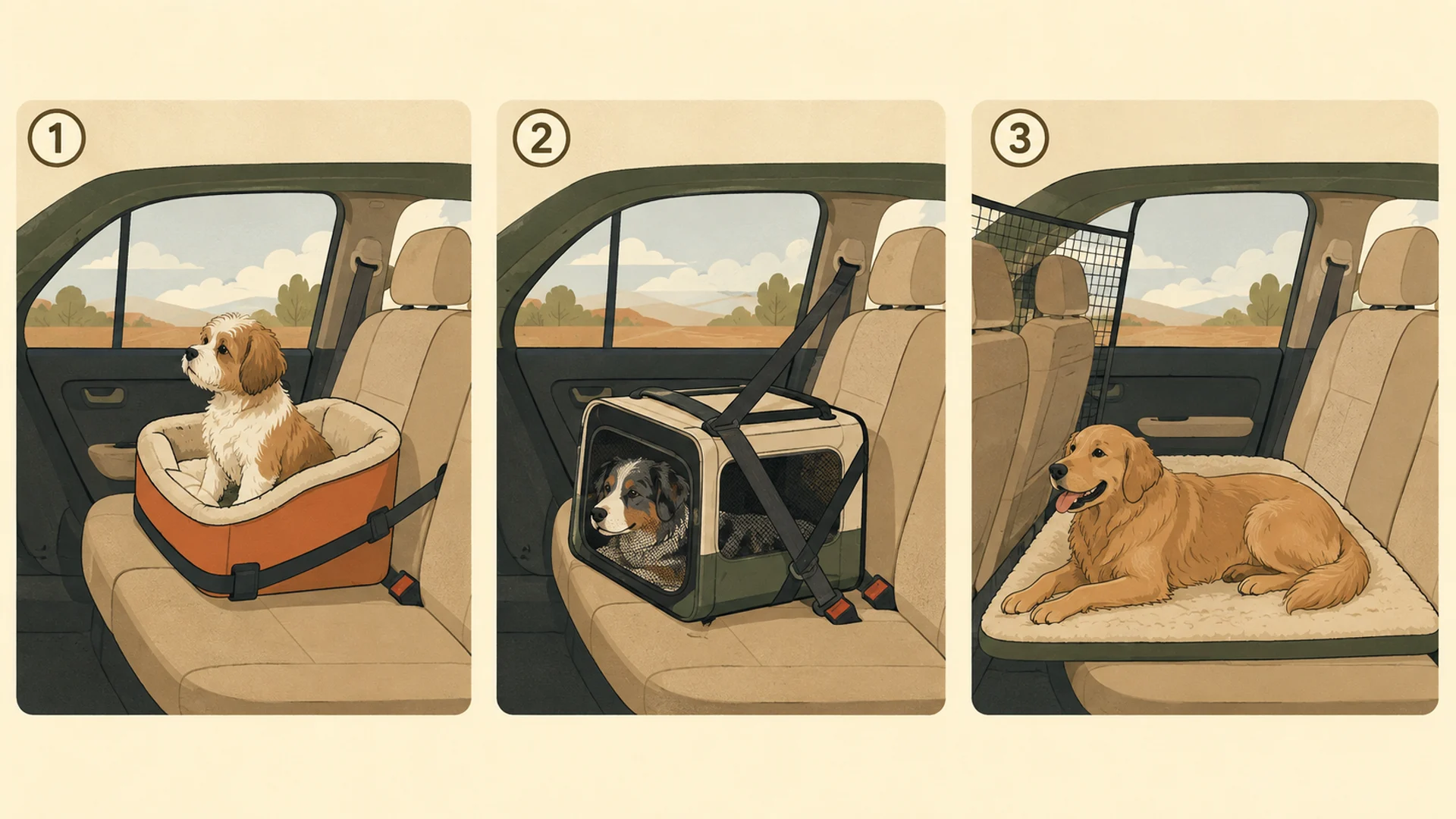
“Dog carrier for car travel” usually means one of three different setups: a booster-style car seat, a secured carrier, or a divider that keeps the back seat contained. They solve different problems, and the right pick depends on your dog’s size, how they ride, and how long your drives run.
What they have in common is the part most people skip. Whichever you choose, it has to be anchored to the car — the ASPCA’s guidance is to “secure the crate so it will not slide or shift in the event of an abrupt stop”. An unanchored carrier on a back seat is luggage, not restraint.
First, what the veterinary bodies actually ask for
This is one of the few gear questions where the mainstream advice is specific and consistent. The American Veterinary Medical Association’s Traveling With Your Pet guidance asks owners to “safely restrain dogs”, to keep dogs out of the passenger seat if the car has airbags, never to let a dog sit on the driver’s lap, and to “confine cats to a cage or carrier” — the reason given for cats being not only safety but that it will “prevent them from crawling under the driver’s feet, and prevent escape from the car while driving or during stops.”
The ASPCA is more explicit about ranking the options: a crate “is the safest option for your pet in case of an accident”, sized “large enough for your pet to stand, sit, lie down and turn around in”. And if you skip the crate, their instruction is to “always keep them in the back seat in a harness attached to a secured seatbelt”.
What none of them can tell you is which product survives a crash, because nothing here is certified against a crash-test standard — no such standard exists for pet restraints. Our guide to whether dog car seats are crash-tested covers what the one independent study found, and it is worth reading before you spend on a product marketed as “crash tested”.
The three car setups compared
| Setup | Best for | How it anchors | Trade-off |
|---|---|---|---|
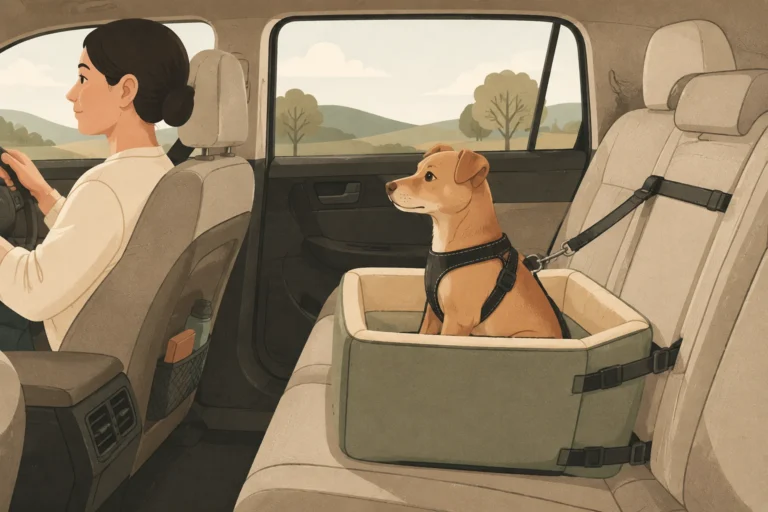
| Open-top car seat | Small dogs who settle but like to see out | Seat belt through the base, plus an interior tether to a harness | Open top means an excited dog can climb out of it |
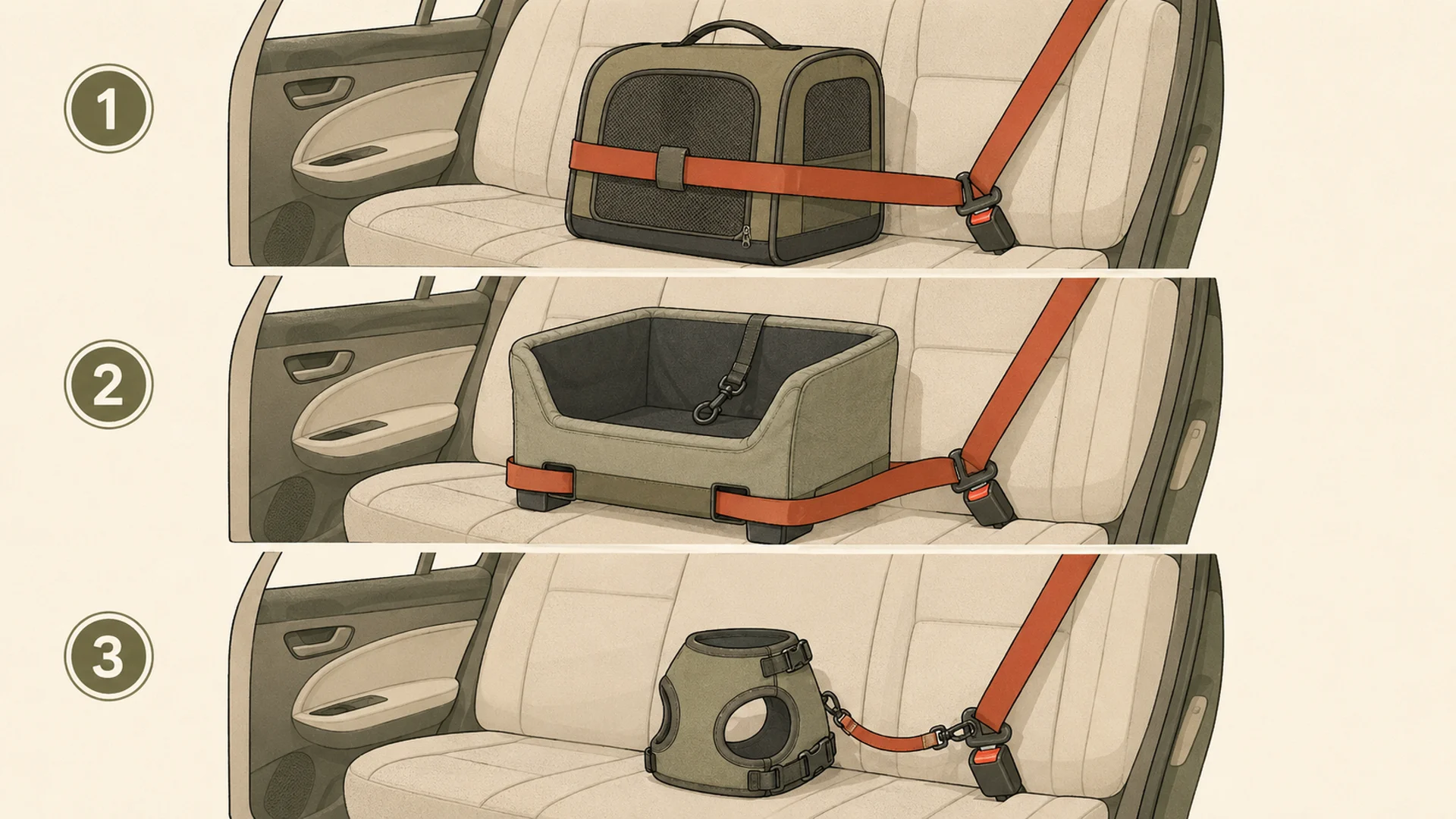
| Secured carrier | Dogs who ride calmer enclosed; doubles as the vet bag | Seat belt routed through a strap or loop on the carrier | Less view; a soft carrier only stays put if the belt actually catches something |
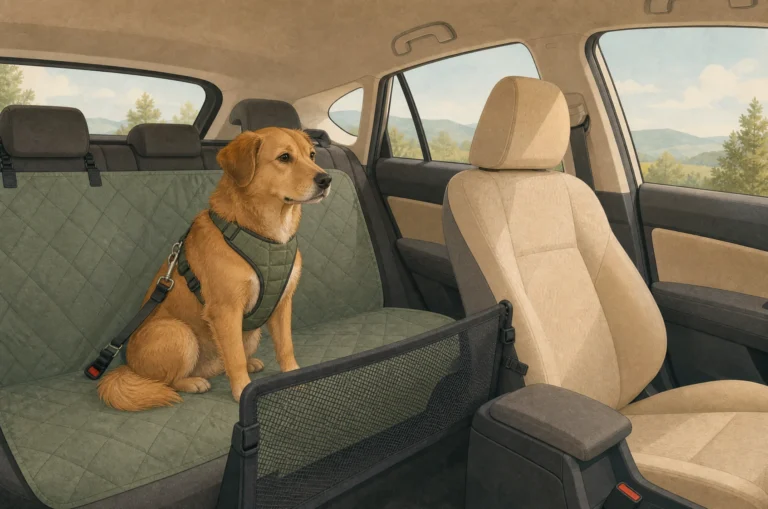
| Seat divider or hammock | Bigger dogs, longer drives, muddy trail days | Tensioned between headrests and seat frame | Contains the space, not the dog — there is no individual restraint |
Read the third row honestly. A divider is a containment tool and a mess-management tool. It keeps a dog out of the footwell and off the driver, which addresses the distraction half of the problem. It does nothing for the dog in a collision, and no amount of marketing changes that.
Open-top car seat: the everyday commuter pick
A booster-style seat raises a small dog to window height, which genuinely calms many dogs who whine when they cannot see out. Look for a stable base, a washable liner, and an interior tether that clips to the harness — never to a collar. The tether is the part doing the safety work; the raised box is doing the comfort work.
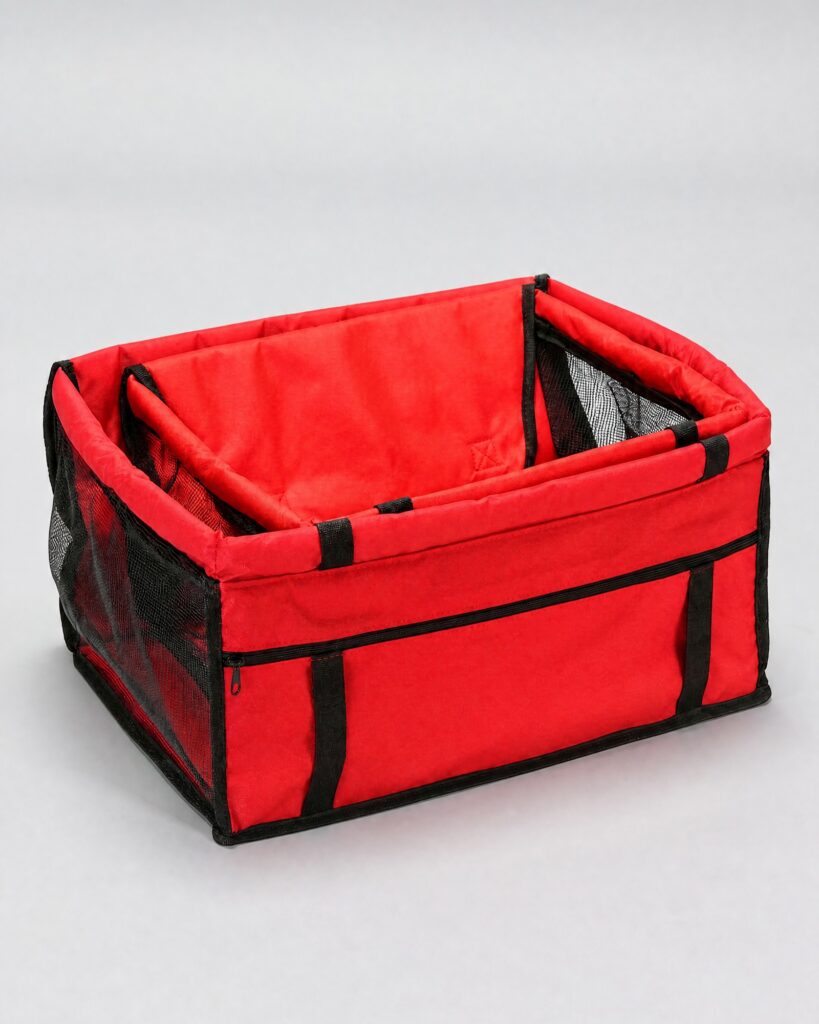
TuckTrail pick
The Road Open-Top Dog Car Seat is rated for dogs up to 23.1 lb, with mesh sides for airflow and an open top that lets your dog settle in their own spot. Secure it with the seat belt and clip the interior tether to a harness before you pull out.
Secured carrier: the den-first option
Some dogs ride better when they cannot see the world rushing past. A soft carrier with the seat belt routed through its strap keeps the den stable on the seat, and the same bag walks into the vet’s office at the other end. If your dog already sleeps in a carrier at home, this is usually the smoothest transition to car travel — our guide to car trips with a cat carrier covers the same logic from the feline side.
The failure mode is specific and common: a strap that the belt passes over rather than through. On an abrupt stop the belt stays put and the carrier keeps going. Before the first real drive, buckle it, then shove the carrier hard toward the footwell with both hands. If it moves more than an inch, the belt is not catching anything.
Divider or hammock: for the bigger co-pilot
Dogs above small-carrier weight need the back seat itself to become the zone. A mesh divider keeps the dog out of the front without blocking airflow or your rear view the way solid barriers can, and a fitted hammock-style bed gives the bench a defined, washable resting spot so the whole car does not become the dog’s territory.
Pair it with a harness and a short tether to the seat-belt buckle if your dog is a mover. The divider stops the dog reaching you; the tether stops the dog launching off the bench at a stop light. They solve different halves.
Anchoring checklist — do this once, before the first drive
- Back seat, not front. The AVMA’s line is to keep dogs out of the passenger seat where the car has airbags, and never on the driver’s lap.
- Route the belt through the carrier strap or the booster’s base slots, then pull the webbing tight and push-test the whole assembly.
- Clip every tether to a body harness, never a collar. A collar concentrates the load on the neck.
- Size the carrier so the dog can stand, sit, lie down and turn around — the ASPCA’s four verbs, and a useful shopping filter.
- Do a short practice loop first. The ASPCA suggests “a series of short drives first, gradually lengthening time spent in the car” — that goes for the gear as much as the dog.
- Keep the head inside. Both the AVMA and the ASPCA call out head-out-the-window riding; airborne debris is the reason.
- Pack water, a familiar blanket and waste bags within reach of the driver’s seat, not in the boot.
That checklist is the compressed version. If the seat still shifts when you push it, or you cannot work out where the bottom straps are meant to go, the step-by-step installation guide takes the anchoring apart properly — including what each piece of hardware in your back seat is actually rated for.
If your dog is at the older end of the range, the setup matters more and the stops matter more — what changes when you travel with a senior dog covers the mobility, sensory and cognitive side of the same trip.
And if your dog’s problem with the car is nausea rather than safety, the seat choice interacts with it — does a dog booster seat help with car sickness pulls the two apart.
The one rule with no exceptions
Never leave your dog alone in a parked car. This is not a cautious-sounding platitude — the National Weather Service measured a parked vehicle going “in just over 2 minutes… from a safe temperature to an unsafe temperature of 94.3°F”, and found that “leaving the windows slightly open does not significantly decrease the heating rate.” The ASPCA adds the winter half of the problem: a cold car “can act as a refrigerator, holding in the cold”.
Which is why the setup you choose should be one you can leave the dog in while you are still in the car. If the plan depends on nipping into a shop, the plan needs a second person.
Dog car travel FAQ
Should the carrier go on the seat or the floor?
The back seat, secured with the seat belt, is the usual choice for small-dog carriers. The floor behind the front seat works for very calm dogs and is hard to dislodge, but it collects road heat and vibration and gives the dog nothing to see. Front seats are a poor spot for any pet because of airbags. For a dog that won’t stay behind the front seats, see how to keep a dog in the back seat.
Is a carrier safer than a harness?
The ASPCA ranks a secured crate as the safest option in a crash and treats the back-seat harness as the alternative if you forgo the crate. Neither is certified to a standard, so treat that as a ranking of principles rather than a tested guarantee — and anchor whichever you pick.
My dog paces the back seat on long drives. Divider or carrier?
Start with the carrier if your dog is within its size rating — pacing often drops when the space shrinks to den size. If your dog is too big for a carrier, a divider plus a defined bed and a short tether teaches a “your spot” habit over a few trips.
Do car seats work for dogs over 25 lb?
Booster-style seats are a small-dog tool; above their rated weight the base gets unstable and the raised centre of gravity works against you. For mid-size and larger dogs, work with the back seat itself: divider, bed, harness and tether.
My dog gets carsick. Does the setup help?
Sometimes — a forward-facing position and a stable, non-sliding base help some dogs. But the AVMA’s advice on carsickness is to tell your veterinarian, because depending on your dog’s health they may be able to prescribe something for longer trips. Do not medicate a dog for a drive on your own initiative.
How often should we stop?
The AVMA’s brochure suggests planning to stop roughly every two hours to let dogs exercise and relieve themselves, with a collar, tags and leash on before anyone opens a door. The real answer depends on the dog — we worked through it in how often to stop on a road trip with a dog.
More drive-day gear and planning lives in our Drive collection.
Sources
- American Veterinary Medical Association — Traveling With Your Pet (safely restrain dogs; keep dogs out of the passenger seat where there are airbags; never on the driver’s lap; confine cats to a cage or carrier; never leave pets unattended in a car; plan to stop every two hours; carsickness is a conversation for your veterinarian) (checked 2026-09-04)
- ASPCA — Travel Safety Tips (a crate is the safest option in an accident; stand, sit, lie down and turn around; secure the crate so it will not slide or shift; back seat and harness attached to a secured seatbelt; a series of short drives first; a parked car as furnace or refrigerator) (checked 2026-09-04)
- National Weather Service — Children, Pets and Vehicles (a parked car going from a safe temperature to an unsafe 94.3°F in just over two minutes; slightly open windows do not significantly decrease the heating rate) (checked 2026-09-04)
Safety guidance and state traffic law both change. Confirm on the official pages before you travel, and talk to your own veterinarian about your own dog — nothing here is a diagnosis, a medication recommendation, or a substitute for an exam.
The anchor matters more than the box.
Match the setup to the dog: an open-top seat for the small dog who wants a view, a secured carrier for the den-seeker, a divider plus bed for the bigger dog who needs the whole bench organised. Then spend two minutes on the part nobody photographs — belt through the strap, tether to a harness, push-test before you pull out. Same spot, same routine, every drive.