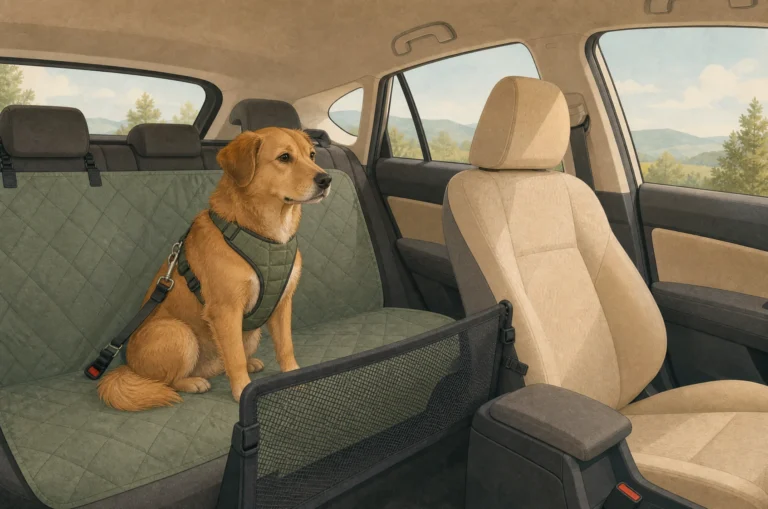
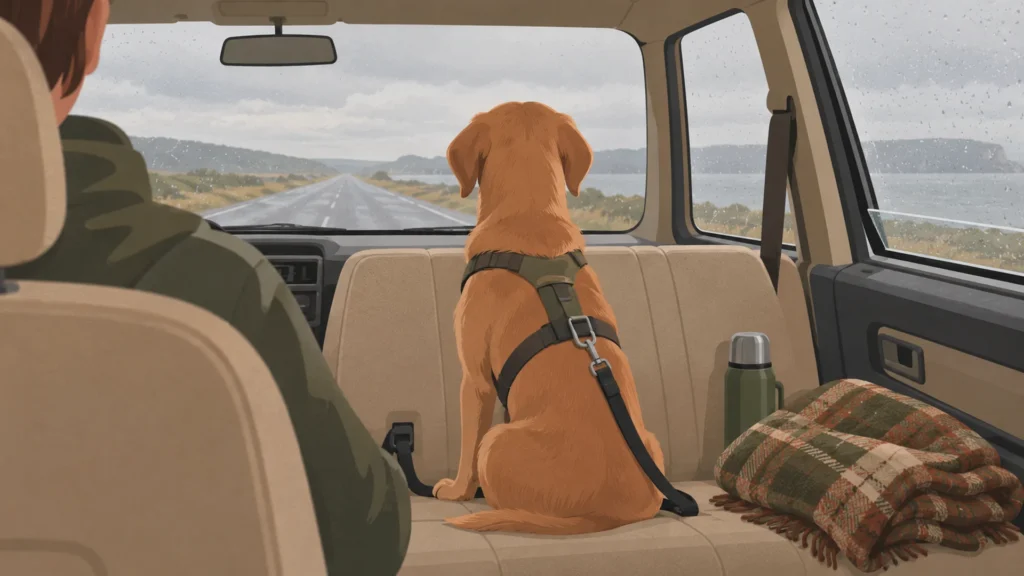
Maybe — but not because it lifts your dog higher. The only part of a booster with a plausible mechanism behind it is what it does to the view. Motion sickness is a disagreement between the inner ear and the eyes, and the American Kennel Club’s version of the fix is to “put your dog in the middle seat in the back so they’re more likely to look forward,” because “watching the world speed by in a blur through a side window can nauseate anyone.” A booster that turns a dog to face forward may help. A booster that just parks them higher against a side window has changed nothing that matters.
No veterinary body recommends a booster as a treatment for car sickness. What they recommend is restraint, gradual conditioning, and a conversation with your vet — and the seat you pick has to survive a stop, not just a curve.
What a booster actually changes, and what it doesn’t
Three separate claims get bundled into one product, and only one of them connects to anything a veterinary source will back.
| What the box implies | What changes | Does it touch nausea? |
|---|---|---|
| “Your dog can see out” | Eye line clears the door sill | Possibly — but only if the view is forward. A raised side-window blur is the thing to avoid |
| “Reduces anxiety” | Enclosed sides, a familiar bed, less sliding on a bench | Indirectly — fear of the car is a separate contributor that can produce the same signs |
| “Keeps them safe” | Depends entirely on how it is anchored and whether the dog is tethered inside it | No — and an unanchored booster is a step backwards. See are dog car seats crash-tested |
Why the view is the part with a mechanism
The Merck Veterinary Manual describes motion sickness as a sensory argument: “the brain receives conflicting input from three main sensory systems that track balance and movement: the vestibular system of the inner ear, the eyes, and the body’s muscles and joints.” Its owner-facing page traces the trouble to “stimulation of the sensory organ in the inner ear, which has connections to the vomiting center in the brain stem.”
That is the whole logic of the forward view. A dog staring sideways gets a window streaming past at ninety degrees to the direction of travel; a dog looking through the windscreen gets a picture that agrees with what the inner ear is reporting. Raising the dog is useful only insofar as it makes that forward picture available.
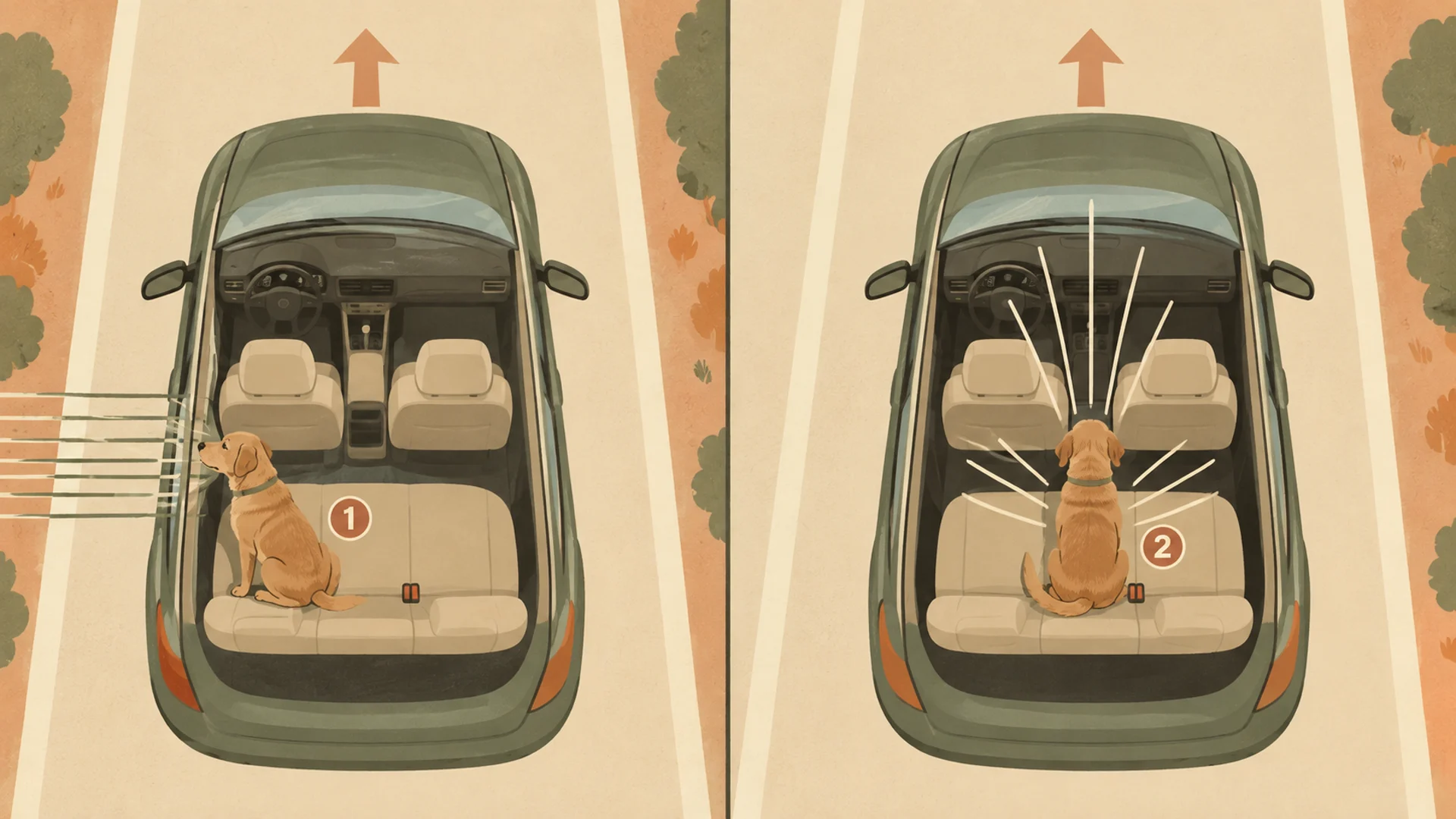
The trade-off nobody prints on the box
Here the honest answer gets uncomfortable: the position veterinary sources actually recommend is low and anchored, not high and loose. Cornell’s Riney Canine Health Center says “the safest way for your dog to travel is in a crash-tested harness, seat belt, or travel crate,” and for a crate it is specific about where: “secure your dog’s carrier on the floor behind either front seat.” The ASPCA’s travel guidance is in the same key — “always keep them in the back seat in a harness attached to a secured seatbelt” — with a line that reads like it was written about boosters specifically: “secure the crate so it will not slide or shift in the event of an abrupt stop.”
A booster moves a dog in the opposite direction from all of that: off the floor, higher above the seat back, often held on by two straps looped round a headrest. Fine place to watch a windscreen; poor place to be during a hard brake. The way through is not to abandon the booster but to insist it does both jobs — anchored so it cannot slide, tethered to a body harness inside it, and never used to move the dog into the front seat.
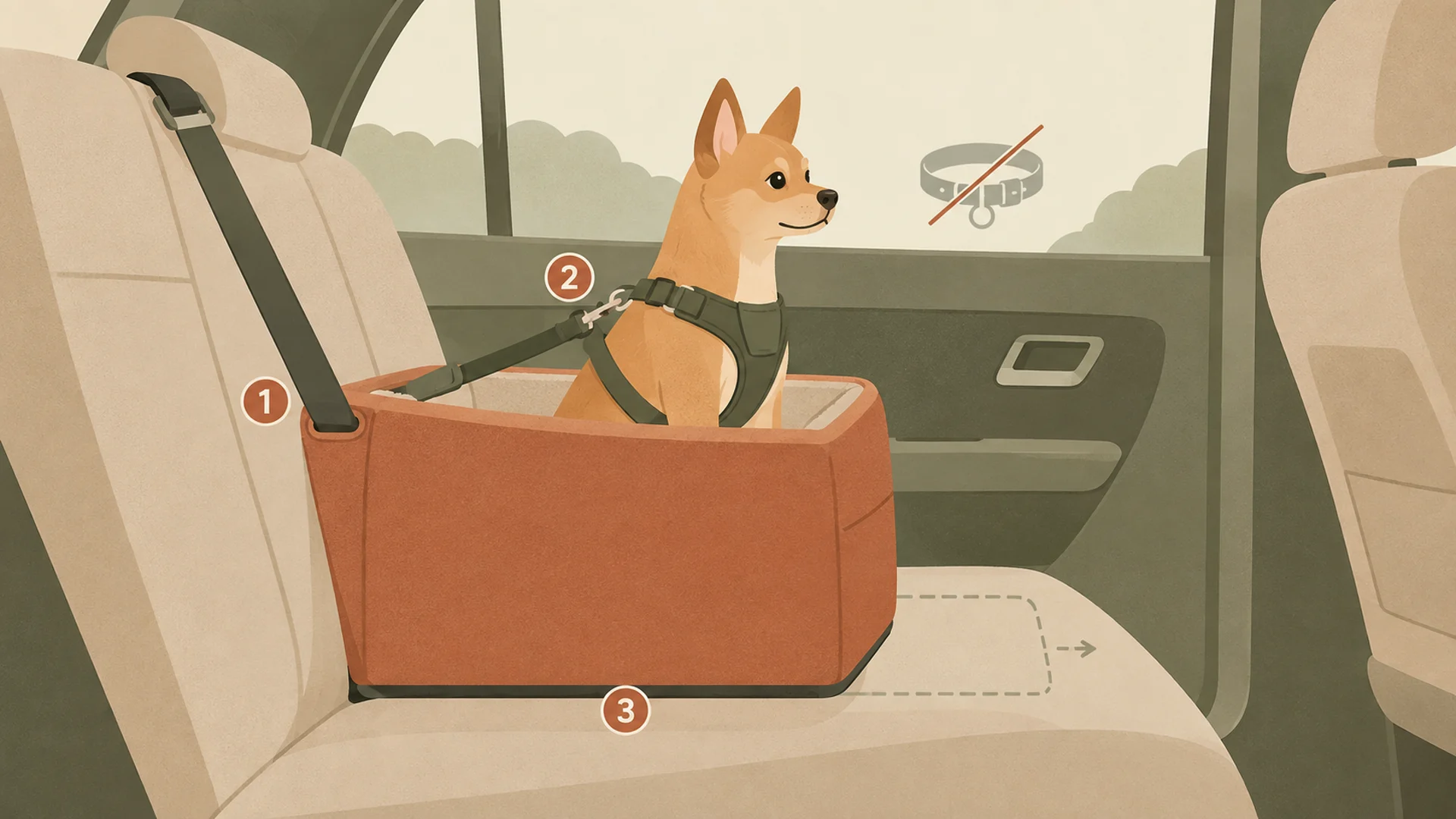
The measures that do have veterinary backing
- Face forward, centre of the back seat. The AKC’s positioning advice, and the only seating change with a stated reason behind it.
- Crack the windows. Per the AKC, “even a few inches of fresh air will equalize internal and external air pressure, which can help reduce nausea,” and a cool, well-ventilated car helps too. Cracked, not open — Cornell warns against letting a dog put its head out, which “puts them at risk for eye injuries from flying debris.”
- Rebuild the association in short sessions. Merck states plainly that “motion sickness can be overcome by conditioning the animal to travel.” The AKC’s ladder: parked car, engine running, one trip up and down the driveway, then slowly more. Cornell keeps sessions “short and fun for your dog (eg, 5–10 minutes at a time)” and is honest that “some dogs acclimate to car rides within a week, others may take a few months.”
- Break long drives up. Nausea and a full bladder compound each other; our guide on how often to stop on a road trip with a dog covers the spacing.
- Ask about medication rather than improvising. Merck names maropitant, an NK-1 receptor antagonist, as the FDA-approved and “preferred drug to treat motion sickness in dogs,” with an age floor of 8 weeks for dogs. Which drug, at what dose, for your dog, is a prescription decision. Nothing here is one.
Three authorities, three answers on food
The question owners ask most — and the mainstream advice genuinely does not agree with itself.
| Source | What it says |
|---|---|
| American Kennel Club | “If possible, withhold food for 12 hours before the car trip. But don’t restrict access to fresh water.” |
| Cornell Riney Canine Health Center | “Avoid feeding your pet 4–6 hours before travel to reduce the risk of nausea.” |
| ASPCA | “Your pet’s travel-feeding schedule should start with a light meal three to four hours prior to departure.” |
The shared idea is narrow: do not set off on a full stomach. Twelve hours and “a light meal three hours before” are different enough that treating any of them as a rule would be overreading. A long fast is also not neutral for every dog — puppies, very small dogs and dogs on metabolic medication are exactly the animals for whom it is its own decision. Ask your vet which end of that range your dog belongs at.
When it is not motion sickness at all
Both Merck pages flag the same complication: the car itself can become the trigger. “Fear of the vehicle may be a contributing factor in dogs and cats, and signs may occur even in a vehicle that is not moving,” which happens once a dog has, in Merck’s words, been preconditioned to illness associated with travel. The tell is drooling or whining before the engine turns over. No seat fixes that; conditioning and, if needed, the calming aids Cornell says to “talk to your veterinarian about” are the route.
Age cuts the other way. The AKC attributes puppy car sickness to inner ears where “the structures in the inner ear used for balance aren’t fully developed yet,” while also noting that “like humans, some dogs never outgrow the nausea and vomiting caused by motion sickness.” So “he’ll grow out of it” is a reasonable hope and a poor plan. And an adult dog that travelled happily for years and suddenly starts being sick in the car is not a seating problem — that is a vet appointment.
Dog booster seats and car sickness FAQ
Do dog booster seats help with car sickness?
Only through the view. If it gets your dog facing forward instead of staring at a side window, it is doing the thing the AKC describes as helpful. If it just raises them at the same sideways angle, there is no mechanism for it to help. No veterinary body lists a booster as a treatment.
Where should a carsick dog ride in the car?
The AKC suggests the middle of the back seat so the dog is more likely to look forward. Cornell’s safest-position advice for a crated dog is the floor behind a front seat. Those two can conflict; whichever you pick, the ASPCA’s rule still applies — back seat, restrained, and secured so nothing slides in a sudden stop.
Should I stop feeding my dog before a car trip?
Not necessarily for twelve hours. The AKC says withhold food for 12 hours if possible, Cornell says avoid feeding within 4–6 hours, and the ASPCA suggests a light meal three to four hours before departure. The common thread is simply not travelling on a full stomach. Never restrict water, and ask your vet before fasting a puppy or a dog on medication.
Do puppies grow out of car sickness?
Many do, because the balance structures of the inner ear are still developing. But the AKC is explicit that some dogs never outgrow it. Treat growing out of it as a possibility, not a plan, and start the short conditioning trips now either way.
Is it motion sickness or anxiety?
Watch the timing. Merck notes signs can appear in a vehicle that is not even moving, once a dog has learned to associate the car with feeling ill. Drooling before the engine starts points at the association; symptoms that begin after a few miles of winding road point at the inner ear. Many dogs have both.
Can I give my dog a human motion-sickness tablet?
Not on your own initiative. Merck names maropitant as the FDA-approved and preferred drug for motion sickness in dogs, and lists other classes including antihistamines and sedatives. Which one, whether, and how much is a prescribing decision for your vet, who also needs to know everything else your dog takes.
Buy the view, not the height — and never at the cost of the restraint.
A booster is a seating-position accessory that sometimes produces a helpful side effect. The forward-facing view is the part with a reason behind it; the elevation is incidental. Try the free changes first — centre rear seat facing forward, windows cracked, cooler cabin, food timed sensibly, short trips that do not end at the vet. Everything with real veterinary weight behind it is available to you whether or not you buy anything at all.
Sources
- American Kennel Club — Carsickness in Dogs (middle rear seat and looking forward; side-window blur; cracking windows to equalise air pressure; 12-hour food guidance; the desensitisation ladder; puppy inner-ear development and dogs who never outgrow it) (checked 2026-09-13)
- Merck Veterinary Manual — Motion Sickness in Animals (conflicting input from the vestibular system, the eyes and the muscles and joints; conditioning; maropitant as the FDA-approved preferred drug and its 8-week age floor for dogs) (checked 2026-09-13)
- Merck Veterinary Manual — Motion Sickness in Dogs (inner-ear stimulation and the vomiting centre; signs in a stationary vehicle; preconditioning to illness associated with travel) (checked 2026-09-13)
- Cornell University College of Veterinary Medicine, Riney Canine Health Center — Traveling safely with your dog (crash-tested harness, seat belt or travel crate; carrier on the floor behind a front seat; 4–6 hours without food; 5–10 minute training sessions and acclimation timelines; heads out of windows and eye injuries) (checked 2026-09-13)
- ASPCA — Travel Safety Tips (back seat, harness attached to a secured seatbelt; securing a crate so it cannot slide or shift in an abrupt stop; a light meal three to four hours before departure) (checked 2026-09-13)
Veterinary guidance is updated periodically, and the sources above do not agree with each other on every point. Confirm on the official pages, and talk to your own veterinarian about your own dog — nothing here is a diagnosis, a prescription, or a substitute for an exam.