There is no age at which a dog stops being allowed to go places. Plenty of thirteen-year-olds do a weekend at the coast better than a two-year-old does. What changes with age is not permission — it is that three specific things get harder, and all three get harder specifically in unfamiliar places, which is the one thing every trip guarantees.
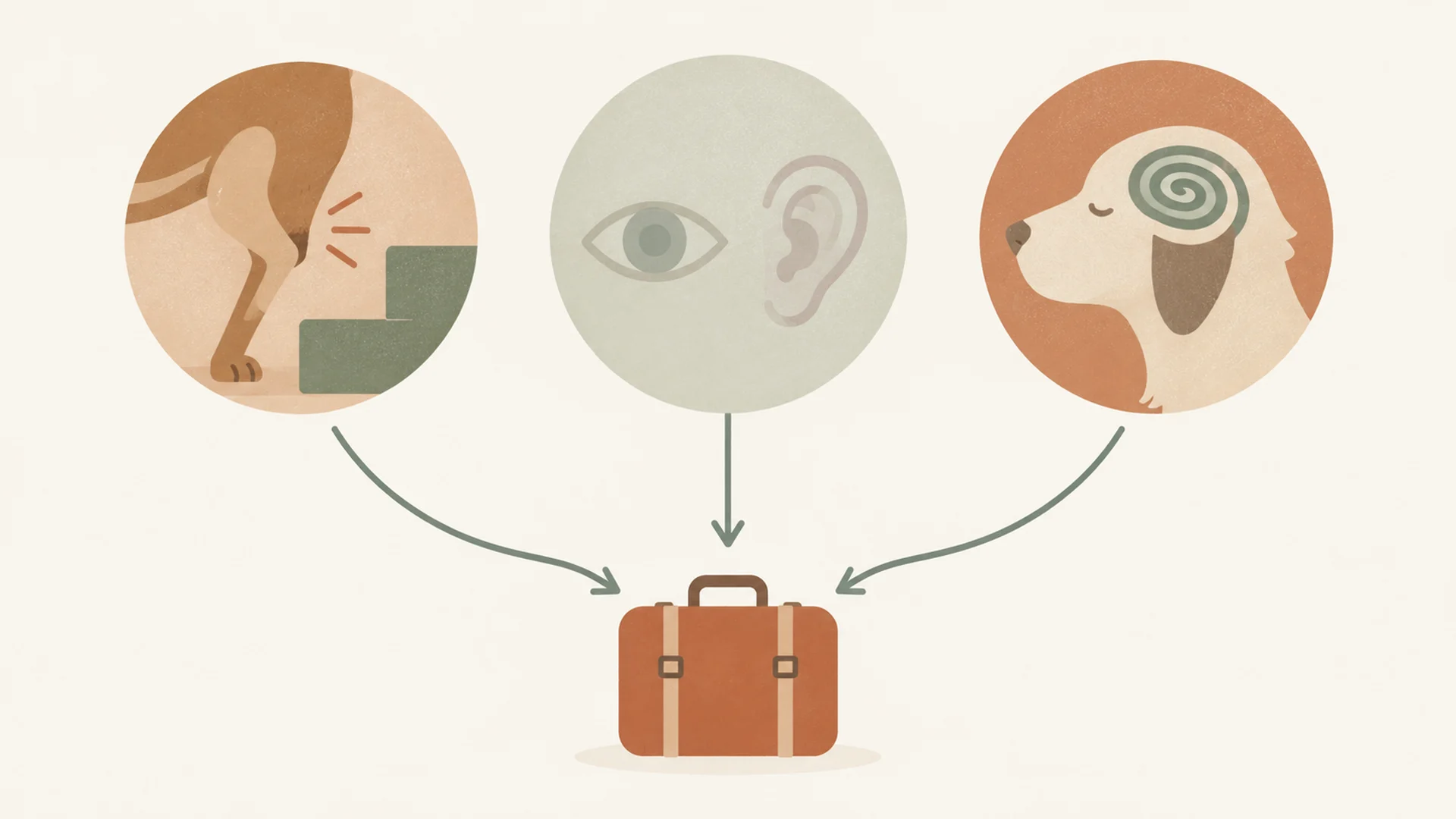
Those three are pain and mobility, sensory decline, and cognitive change. A senior dog at home is running on a memorised map and a fixed routine. Travel removes both at once. Almost everything that goes wrong on a trip with an old dog traces back to that swap rather than to the distance covered.
So the useful question is not “is my dog too old for this?” It is “which of those three is my dog already managing, and does this particular trip make it worse?” This guide walks through how to answer that, what to raise with your vet beforehand, and the honest signs that the answer is to leave them home with someone they know.
First, what “senior” actually means
It is later and vaguer than most people assume. The American Animal Hospital Association is explicit that no specific chronological age defines a pet as senior; the term applies to pets in “the last 25% of their estimated life span.” In practice that means a large dog can reach senior status “as early as 7 to 8 years old,” while smaller breeds “may not be considered seniors until around 12.” For cats, AAHA puts it at over 10 years.
Two things follow from that. A seven-year-old Great Dane and a seven-year-old terrier are not at the same life stage, so breed-generic travel advice is worth very little. And a dog with chronic health issues, AAHA notes, “may age earlier than their peers” — the calendar is a weak proxy for what your particular dog can handle this month.
The three things travel makes harder
1. Pain and mobility
AAHA calls arthritis “one of the most common senior pet ailments,” and its own advice for living with it is telling: pet ramps or stairs, non-slip rugs, orthopedic beds — home modifications. Every one of those is a thing you leave behind when you travel.
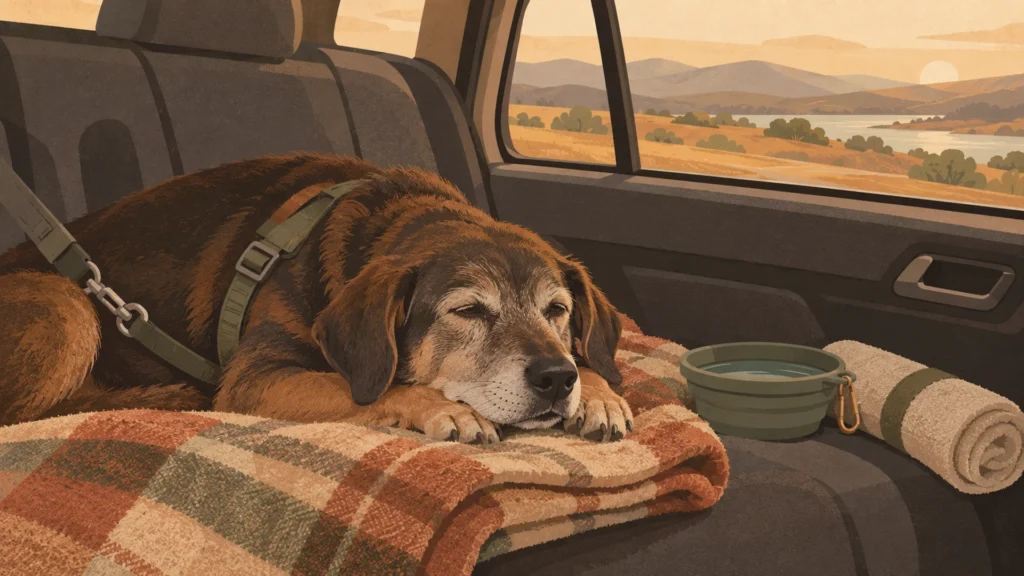
What that means practically is that the hard parts of a trip are the transitions, not the trip. Getting into a car. Getting out of it after two hours of holding one position. Polished hotel lobby floors. A single deep step down from a rental porch at night. If your dog needs help with any of those at home, they will need more help away, on worse surfaces, when they are already tired.
AAHA also makes a point worth repeating: chronic pain in older pets often shows “only subtle pain signs, such as personality changes or unusual habits.” A dog who is grumpy or withdrawn on the second day of a trip may not be sulking.
2. Sensory decline
Vision, hearing and smell all fade with age. AAHA’s guidance for a pet losing them is to “adjust your home environment to help your pet feel safe” — scent markers, more light, “removing obstructions from their normal path,” gates at the top of stairs.
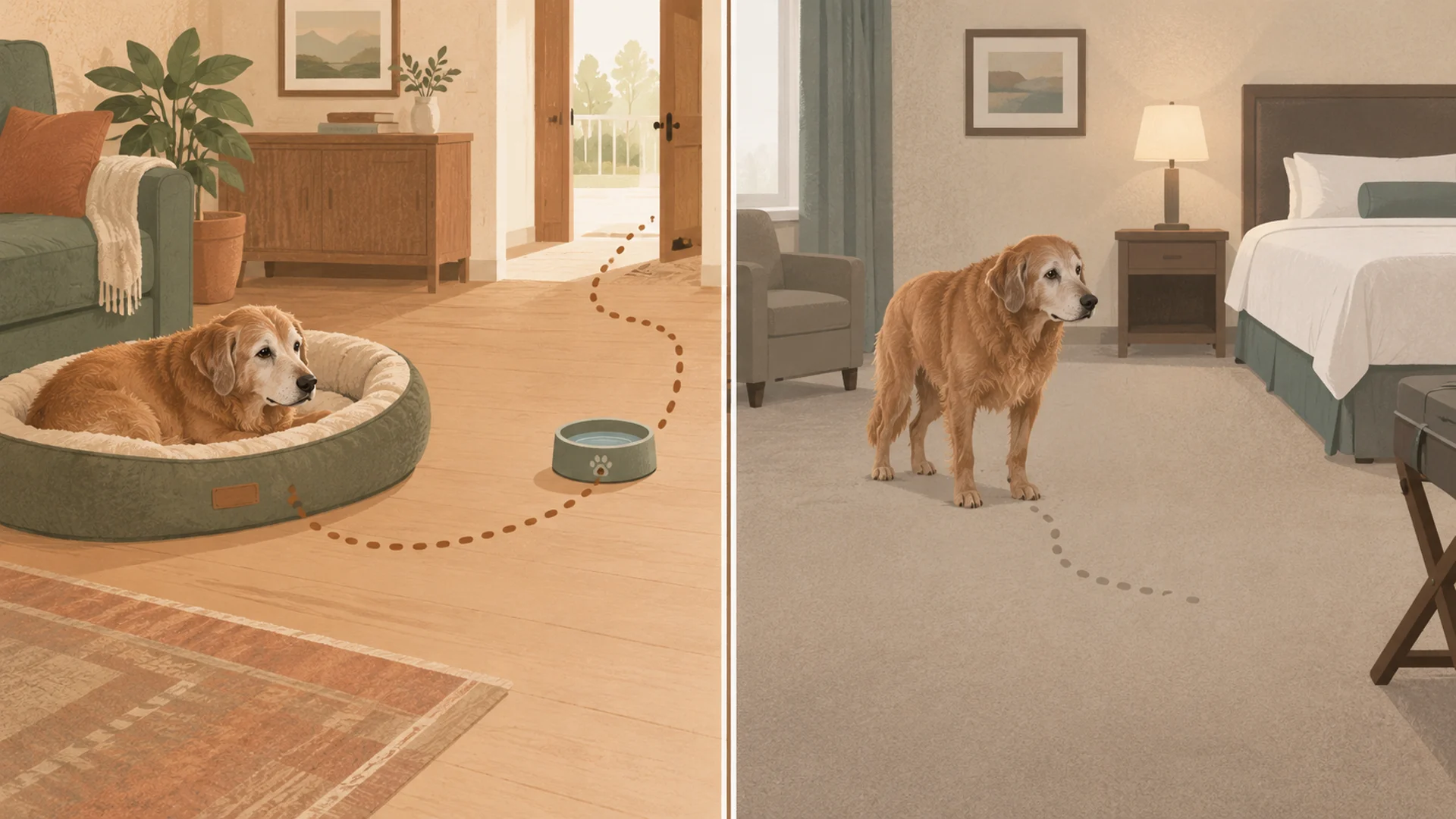
Read that as a travel warning, because it is one. A dog whose sight is going has usually compensated by memorising the house. An unfamiliar room hands them none of that, plus furniture in the wrong places, plus a staircase nobody has gated. This is why a dog who seems entirely fine at home can look lost in a rented cottage — you did not see the decline before because the environment was hiding it.
3. Cognitive change
This is the one people underestimate, and it has the sharpest numbers behind it. The Merck Veterinary Manual describes canine cognitive dysfunction syndrome under the acronym DISHAA — “disorientation, interactions, sleep-wake cycles, house soiling, anxiety, and activity changes.” In one study it cites, “28% of dogs 11–12 years old and 68% of dogs 15–16 years old showed signs consistent with CDS.” Another survey estimated it in 14.2% of dogs over 10, and found that “> 85% of these CDS cases had not been diagnosed.”
Look at that list of signs again next to a hotel room. Disorientation, disrupted sleep, house soiling and anxiety are also, precisely, the things that go wrong overnight in a strange place. That overlap is not a coincidence, and it is why “he was fine until we went away” is such a common sentence in a vet’s exam room.
Merck adds one line that explains the whole pattern: “Aging dogs cope less efficiently with distress and display increased dependence on human family members.” An old dog is not less tolerant of travel because travel is harder. They are less tolerant because their buffer is thinner and their need for you is greater — which is also, honestly, an argument for bringing them rather than boarding them, if the trip is manageable.
Matching the signs to the trip
| What you are already seeing at home | What it usually means on a trip | The adjustment that helps most |
|---|---|---|
| Hesitates before jumping into the car; slower on stairs | The transitions cost more than the distance | Ramp or a lift with two hands; short legs between stops; avoid lodging with steps |
| Bumps into things in dim light; does not hear you come in | Loses the memorised layout the moment you arrive | Keep a light on overnight; block stairs; put the bed, water and door on one straight line |
| Pacing at night, waking at odd hours, standing in corners | Disruption compounds — the second and third nights are often worse, not better | Bring the actual bed and bedding from home; keep meal and walk times unchanged; discuss with your vet first |
| Occasional accidents indoors despite being house-trained | Reliably worse away from home, and worse again overnight | More frequent, shorter potty breaks on a schedule rather than on request; waterproof bedding layer |
| Clingier than they used to be; unsettled when you leave the room | Being left alone in the room is the hard part, not the travelling | Plan the trip so someone stays with them; rule out lodging you cannot bring them out from |
The conversation to have before you book
AAHA’s recommendation for senior pets is more frequent veterinary exams, including “comprehensive health assessments, screenings for common age-related conditions, pain evaluations, appropriate laboratory testing, and discussions about changes in your pet’s health, daily routine, or behavior.” A trip is exactly the sort of change that belongs in that last category, so raise it as a plan rather than as a question about fitness.
Useful things to bring to that appointment: how far you are going and for how long, what the sleeping arrangement is, how many hours in the car at a stretch, whether there are stairs, and an honest list of anything you have noticed at home over the last few months — including the small behavioural things that feel too minor to mention. Given that most cognitive dysfunction goes undiagnosed, the night pacing you were going to leave out is often the most useful thing you can say.
What we are not going to do here is tell you what your dog needs. Medication, supplements, whether a specific condition rules out a specific trip — those are decisions for the vet who can actually examine your dog. Ask them; do not calibrate off an article.
In the car
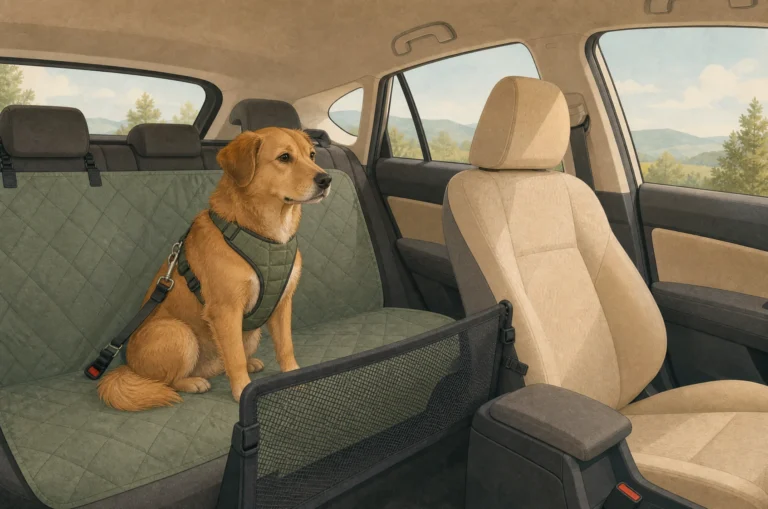
The restraint rules do not soften with age. The AVMA’s position is that “it is unsafe for pets to be loose inside motor vehicles”, and that the preferred approach is “securing them in a species-appropriate enclosure of appropriate size, or fitting them with a properly designed, species-appropriate safety harness.”
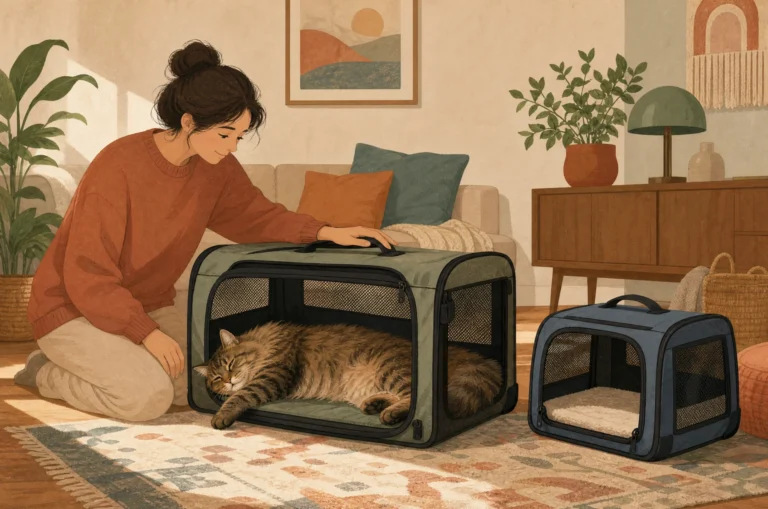
Two details in the AVMA’s pet safety in vehicles guidance matter more for an older dog than a younger one. A crate or carrier should be “big enough to allow your pet to stand up, turn around, and lie down comfortably” and positioned “as near to the center of the vehicle as possible,” secured “in place to prevent movement” — a stiff dog braced against a sliding crate is spending the whole drive working. And the rule about never leaving a pet alone in a parked car has no exceptions at any age; the AVMA’s own figures put the interior temperature rise at about 19°F in ten minutes and 43°F in an hour, regardless of whether it is 70 or 110 outside; the full table, and what a mild day does to the cabin, is in is it safe to leave my dog in the car.
Our guide to road-trip stops covers the cadence question; for a senior dog, err toward stopping for stiffness rather than for bladder, which usually means more often and for longer than the internet’s two-hour rule of thumb.
When the answer is to leave them home
This is the part most articles skip. Some honest cases where the trip is the wrong call:
- The itinerary has long unavoidable stretches where the dog would be alone in an unfamiliar room.
- Your dog is already disoriented at home in the evenings — a new environment reliably makes that worse, not better.
- You are going somewhere without a reachable veterinary practice, and your dog has a condition that has needed attention this year.
- Getting in and out of the car is already a two-person job and you are travelling alone.
- The trip’s whole point is activity your dog cannot join, so they would spend it waiting.
The alternative is not automatically a boarding kennel. For a dog who has grown more dependent on their people, a familiar person coming to the house usually beats a strange building with a strange routine — the same reasoning that makes travel hard makes at-home care easier.
Traveling with a senior dog: FAQ
Is my dog too old to travel?
Age alone does not answer it. AAHA notes that no specific chronological age defines a pet as senior, and that health history matters more than the calendar. The better test is whether your dog is currently managing mobility, sensory or cognitive changes at home, and whether this particular trip removes the supports that are helping. Your veterinarian is the right person to weigh that for your dog.
At what age is a dog considered senior?
Per AAHA, roughly the last 25% of estimated lifespan — which works out to as early as 7 to 8 years for a large dog and around 12 for a small breed. Cats are considered senior after 10.
How long can an old dog be in the car?
There is no published number, and be sceptical of anyone who gives you one. For a stiff or arthritic dog the limiting factor is time held in one position rather than total hours, so plan shorter legs with real stretching breaks rather than a fixed maximum. Ask your vet for a cadence that suits your dog’s specific condition.
My senior dog gets confused in new places. Is that normal aging?
Disorientation is one of the DISHAA signs the Merck Veterinary Manual associates with canine cognitive dysfunction, and the manual notes most cases go undiagnosed. It is common with age but it is not something to simply accept — describe what you are seeing to your veterinarian, since early recognition is what gives the best chance of slowing the decline.
Should I sedate my dog for a trip?
Not on your own initiative, and never with anything you have not been prescribed for that dog. This is a veterinary decision, and there are contexts — air travel in particular — where sedation is specifically discouraged. Raise it at the pre-trip appointment.
What should I pack that I would not pack for a younger dog?
Their actual bed rather than a travel substitute, a non-slip mat or towel for smooth floors, a night light, any mobility aid you use at home, a waterproof bedding layer, your vet’s contact details and the address of a practice near your destination, and enough of their normal food to avoid a diet change on top of everything else.
Bottom line
Old dogs travel well when the trip is built around what they have already lost rather than around what they used to manage. Keep the routine, bring the bed, light the room, shorten the legs, and be honest about the stretches where they would be alone. Do that and the age on the paperwork stops being the interesting number — which is roughly what every veterinary body says when asked where the cutoff is, because there is not one.
The overnight stop deserves its own thought at this age, because an older dog left alone in an unfamiliar room has less tolerance for it. Our guide to leaving a dog alone in a hotel room covers both the policy and the behaviour side.
Sources
- American Animal Hospital Association — Senior Status? Understanding Your Senior Pet’s Life Stage (checked 2026-09-09)
- Merck Veterinary Manual — Behavior Problems of Dogs (Aging and Cognitive Dysfunction) (checked 2026-09-09)
- American Veterinary Medical Association — Safe non-commercial transport of pets in motor vehicles (checked 2026-09-09)
- American Veterinary Medical Association — Pet safety in vehicles (checked 2026-09-09)
This guide is general information, not veterinary advice. Every decision about a specific older dog — whether to travel, how far, and what to do about pain, anxiety or cognitive change — belongs to the veterinarian who can examine them.