
Train: usually yes, if the dog is small. Amtrak takes dogs and cats in Coach on most routes when the pet and its carrier together weigh 20 pounds or less and the whole trip is seven hours or less — but not in sleeper rooms, not on the Auto Train, and not on Amtrak’s connecting buses. Long-distance bus: no. Greyhound takes no pets at all, only service animals. City bus: often yes, on the city’s terms. In Seattle King County Metro lets dogs ride without a carrier (lap dogs free, other dogs pay a fare); in San Francisco Muni wants the dog leashed, muzzled and off the bus at rush hour.
Behind those three answers there is no national rule. Every railway, bus line and transit agency writes its own, and they disagree with each other — sometimes inside the same agency. In the United States, Amtrak takes dogs and cats on most routes if the pet and its carrier together weigh 20 pounds or less; Greyhound takes no pets at all, only service animals; and local buses and subways range from “in a bag, any time” to “not during rush hour.” Newer intercity operators write their own rules again: Brightline takes dogs and cats but caps the carrier at 17 × 10 × 10 inches and wants the pet on the booking ten minutes before departure.
So the useful skill is not memorising a policy. It is knowing which page to open, and which four numbers to look for before you buy the ticket: the weight cap, the carrier dimensions, the trip-length cap, and whether you have to book the pet separately.
Intercity trains: Amtrak has the most generous rule, and the most specific one
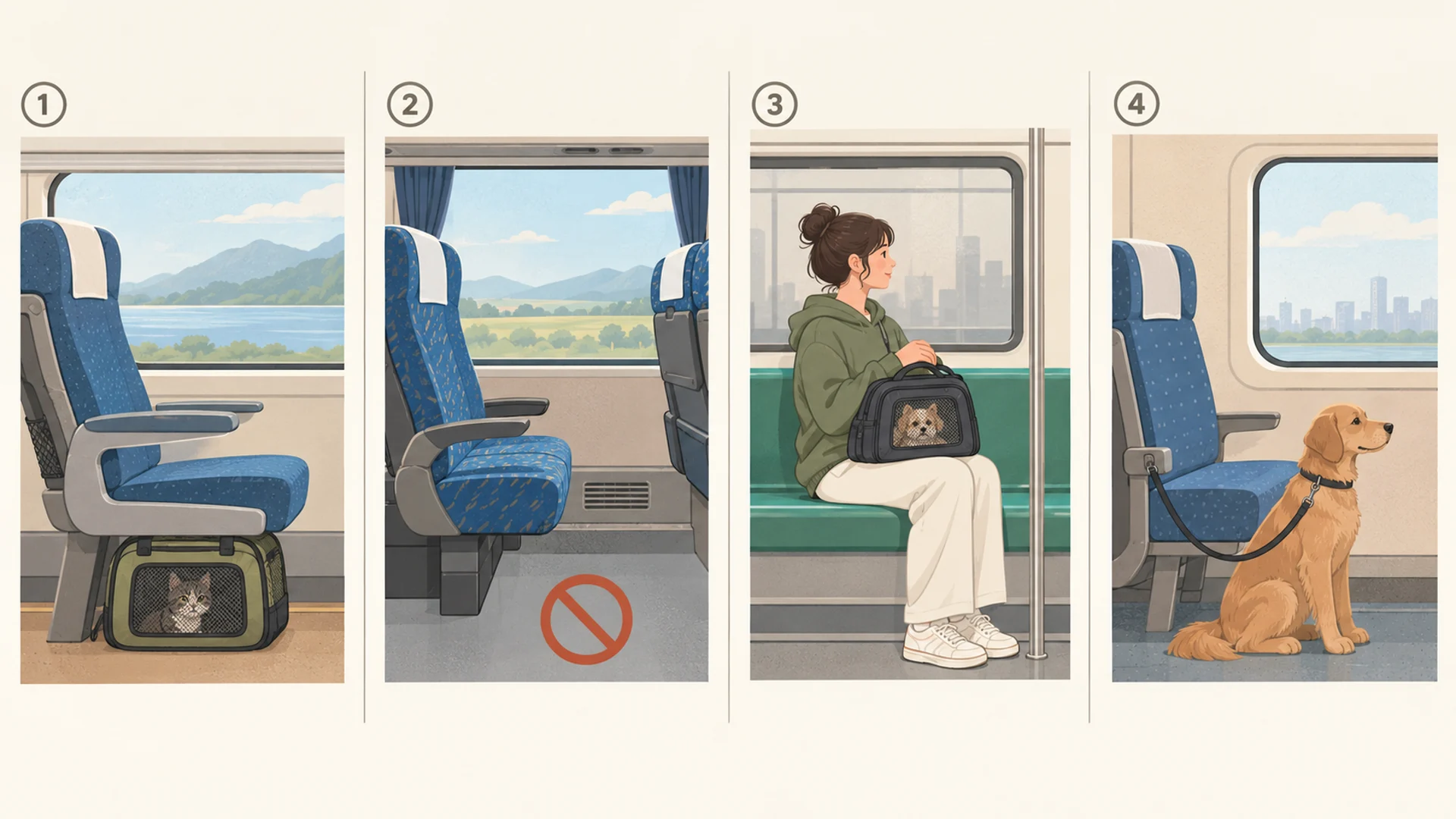
Amtrak is the one long-distance option in the US where a pet can ride in the passenger cabin as a passenger’s own carry-on rather than as freight. Its published pet policy is unusually precise, and every number in it is a hard gate:
- 20 pounds — the combined weight of pet and carrier, not the pet alone.
- 19″ long × 14″ wide × 10.5″ high — the maximum carrier size.
- Seven hours — reservations with pets are limited to seven hours of total travel time, which quietly rules out most of the long-haul network.
- Eight weeks — the minimum age, with vaccinations current.
- One pet per customer, dogs and cats only, and the pet must stay in the carrier.
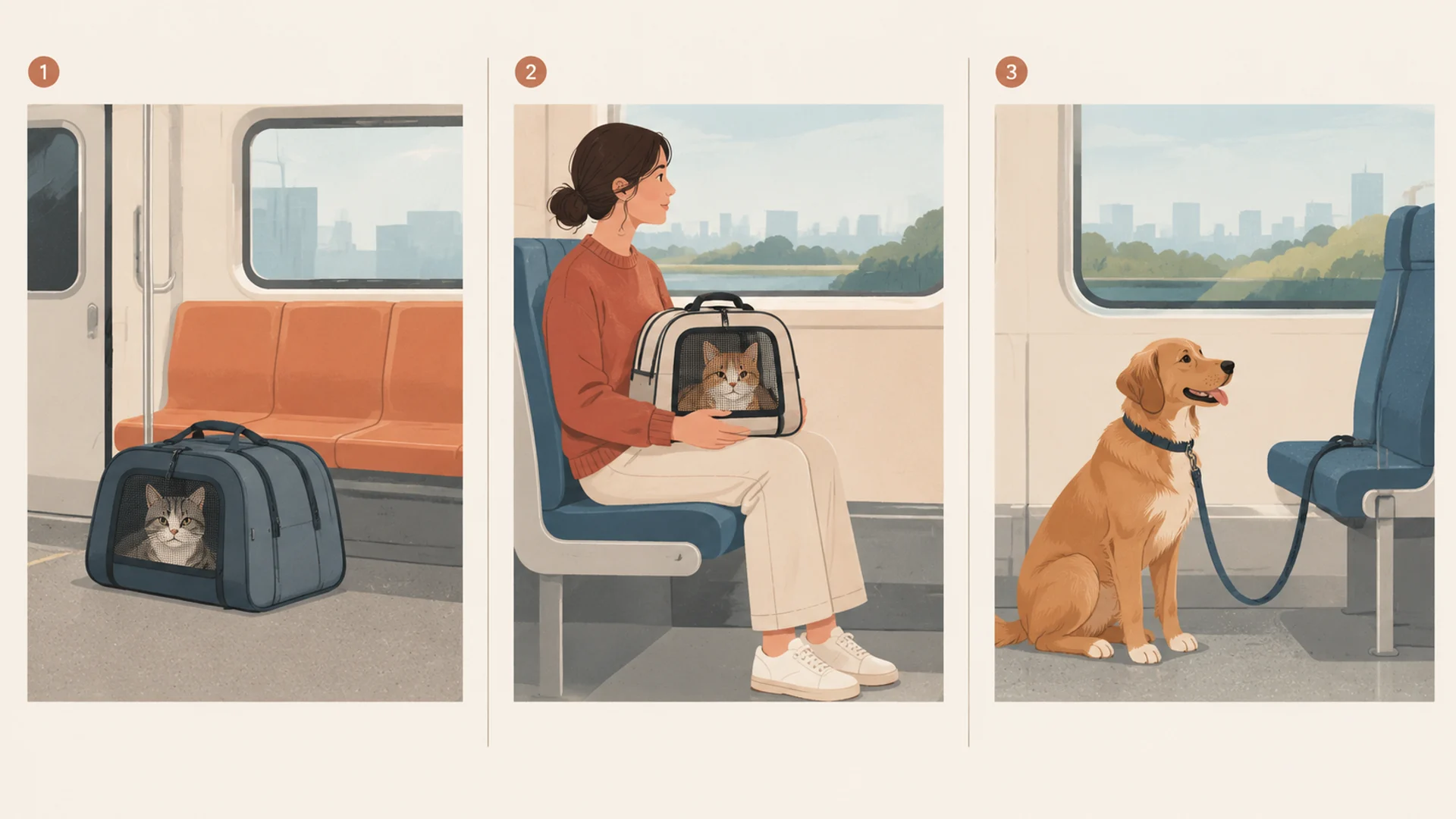
Two details catch people out. The carrier goes under your own seat rather than under the seat in front of you, which is the opposite of the aeroplane habit — the Cascades service is the exception. And pets are not accepted on every service: Amtrak excludes the Auto Train and certain cross-border routes, and bars pets from the Quiet Car on Keystone and Pennsylvanian trains. Fares for the pet vary by route and appear at checkout, so the fee is not something you can look up in advance and trust.
The seven-hour cap is the one that changes plans: it is measured on total travel time for the reservation, so a trip that would be a single comfortable day for you can be off-limits for your dog. Check it before you check the price.
Amtrak sleeper cars, the Auto Train, Thruway buses and puppies
Most of the Amtrak questions people actually type are not about the 20-pound rule. They are about a specific train, a specific car, or a specific dog. Amtrak’s pet page answers each of them, but you have to read to the bottom:
- Sleeper cars: no. Pets are allowed in Coach and in Acela Business Class only. The page explicitly excludes “First Class private rooms” — which is what the roomettes and bedrooms on overnight trains are — along with Acela First Class, non-Acela Business Class and food service cars. In practice the seven-hour cap would rule most overnight trips out anyway.
- Auto Train: no. It is on the list of services where pets are not available, alongside the Gold Runner.
- Amtrak buses: no. The connecting services Amtrak sells under the “Amtrak Connection” name — most of them buses that fill gaps in the rail network — are excluded, and pets cannot be booked on them. A trip that looks like one Amtrak ticket but includes a bus leg cannot take your dog.
- Crossing into Canada: not on three routes. Pet travel in Canada is not available on the Adirondack, the Maple Leaf or Amtrak Cascades, even though the US portions of those routes take pets.
- Puppies: from eight weeks. The pet must be at least eight weeks old, vaccinated, and “odorless, harmless, not disruptive” — Amtrak reserves the right to remove a pet that is not.
- Everyday corridor trains (Pacific Surfliner, Northeast Regional, Midwest routes): usually yes, within the 20-pound and seven-hour limits. Some routes, including Cascades, Hiawatha, Lincoln Service and Wolverine, put pets in one designated Coach car; on the rest you can sit in any Coach car.
The paperwork is small but real. You sign an online Pet Release and Indemnification Agreement for each segment after booking, and at a staffed station you check in at the ticket office 45 minutes before departure so an agent can confirm the pet is eligible. At unstaffed stations the conductor does it on board. Amtrak does not ship pets on their own or carry them as checked baggage; a pet always travels with a person.
Brightline: the other intercity train, with a smaller box
Amtrak is not the only intercity railway in the US that takes pets any more, and the second one has different numbers. Brightline’s terms of service allow carry-on pets on these conditions: “Dogs and cats are the only pets that are permitted to travel on our trains,” “Adults (13+) may bring one (1) pet per passenger,” “Carry-on pets must be at least eight weeks old,” and, for a carrier under the seat or on your lap, “the size of the carrier may not exceed 17″ x 10″ x 10″.”
Two of those are worth putting next to Amtrak’s. The carrier ceiling is meaningfully smaller — 17 × 10 × 10 against Amtrak’s 19 × 14 × 10.5 — so a bag bought to Amtrak’s limit does not automatically clear Brightline. And there is a deadline rather than a weight cap: Brightline warns that “failure to add your dog and cat to your reservation at least 10 minutes prior to departure may result in refusal to allow your pet on the train.” A pet you forgot to add is a pet that does not board, even with a ticket in hand.
Intercity buses: the answer is no
This is the shortest section on the page because the policy is short. Greyhound’s rules for riders state it plainly: “We don’t let animals on board (not even Greyhound puppies). The only exception is legitimate service animals riding together with a disabled person.”
The more useful thing to know is that the biggest US coach network is one company with two front doors. Greyhound is now part of the Flix group, and the FlixBus-branded services run to the same answer. FlixBus’s US help page says it as tersely as it can: “For safety reasons, we cannot transport any pets on our buses. The only exception to this are service animals.”
So checking “the Greyhound policy” and booking a FlixBus does not buy you a loophole, and nor does the reverse. There is also no cargo-hold option on either brand — this is not a case where a crate in the baggage compartment is the workaround. Other coach operators write their own rules, and several take the same line. If a coach is your only route, plan around it rather than planning to talk your way on at the door.
When the coach is out, the fallback most people reach for is a car for hire — which has its own rulebook, and it is not the one you would guess. We covered it separately in can I take my dog in an Uber or Lyft: the driver is allowed to refuse a pet, and the driverless option is a flat no.
Local transit: the rules change by city, and sometimes by line
Commuter systems are where people get caught, because the answer feels like it should be uniform within one metro area. It is not. New York is the clearest example: the MTA runs the subway, the Long Island Rail Road and Metro-North, and its own pet guide gives all three different rules.
| Service | Pets allowed? | Carrier required? | The catch |
|---|---|---|---|
| Amtrak (US intercity rail) | Dogs and cats | Yes — max 19 × 14 × 10.5 in | 20 lb pet + carrier; 7-hour trip cap; route exclusions |
| Brightline (Florida intercity rail) | Dogs and cats | Yes — max 17 × 10 × 10 in | One pet per adult; add to the booking 10 min before departure |
| Greyhound / FlixBus (US intercity coach) | No | — | Service animals only; same answer under both brands |
| MTA subway and bus (NYC) | Yes | Yes — “a bag or other container” | No published size limit; must not annoy other riders |
| Long Island Rail Road | Yes | Yes — must fit on your lap | Stricter than the subway in the same agency |
| Metro-North | Yes | Kennel or a secure leash | Looser than the subway in the same agency |
| BART (San Francisco Bay Area) | Yes | Yes — a carrier “specifically manufactured for transporting pets” | No leash option for pets; ESAs counted as pets |
| CTA (Chicago) | Yes | Yes — closed container that fits under a seat | Must be carried by one person; size is defined by the seat, not a number |
| King County Metro bus (Seattle) | Yes | Not for dogs; other pets in a carrier | Lap dogs free; any other dog pays a fare; driver can refuse |
| Muni (San Francisco) | Yes, off-peak only | Dogs leashed and muzzled on lap or under seat; other pets in a closed container | No pets weekdays 5–9 AM and 3–7 PM; one pet per vehicle |
| MBTA (Boston) | Yes | Carrier for small pets; leash for large dogs | Large dogs barred weekdays 7–9 AM and 4–7 PM |
| VIA Rail (Canada) | Small dogs and cats | Yes — max 55 × 40 × 27 cm | 10 kg (22 lb) combined; book 2 days ahead by phone |
City buses: Seattle, San Francisco, New York and Chicago side by side
“Can dogs ride the bus” gets a different answer in every city, and the differences are not small. Four large systems show the full range:
- Seattle (King County Metro): the most open rule of the four. Metro’s own page says small dogs that stay on their owner’s lap ride free, and “fare for all other dogs must be paid” — there is no carrier requirement for dogs at all. Other pets must be in a carrier. The driver can refuse boarding, or ask you to leave, if the animal’s behaviour threatens anyone’s safety or comfort.
- San Francisco (Muni): the strictest. SFMTA’s pet policy bars pets on weekdays from 5–9 AM and 3–7 PM, allows only one pet per vehicle the rest of the time, and requires dogs to be “leashed and muzzled” and to ride on your lap or under your seat. The dog pays a fare equal to yours. BART, across the bay, is a different agency with a different rule — carrier only.
- New York (MTA buses and subway): a pet rides only in “a bag or other container,” with no published size limit. A dog that cannot be carried in a container cannot ride.
- Chicago (CTA): a closed container that one person carries and that fits under a seat. Same practical answer as New York: small dogs yes, large dogs no.
If your dog is too big to carry, Seattle is the unusual case where the bus still works. In most other large US systems a big dog is limited to commuter rail lines with a leash clause — Metro-North in New York, the MBTA off-peak in Boston — or to a car. When the bus is out, most people’s next move is a rideshare; our Uber and Lyft guide covers how that works.
Three phrasings that mean three different things
Once you have read a dozen of these pages, the wording sorts itself into three families, and knowing which family you are looking at tells you what to buy before it tells you what to do.
- “A bag or other container.” The loosest version. New York’s subway rule is this shape — a container is required, but no dimensions are published, and the enforceable half of the sentence is about not bothering other riders.
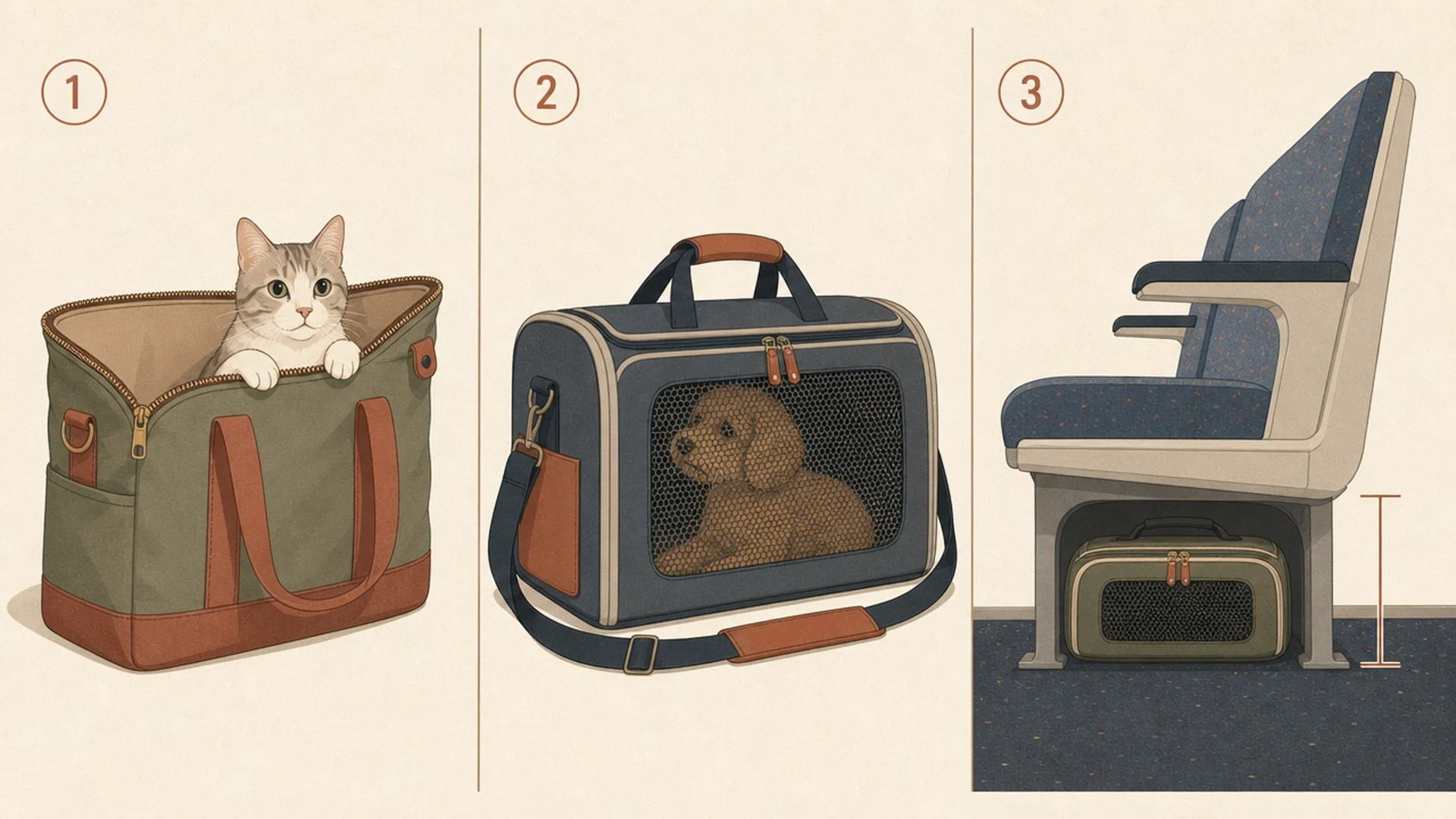
- “A carrier, defined by what it is.” BART’s rule is the clearest example: “All non-service pets, including dogs whose sole function is to provide comfort or emotional support, must travel in a secure, enclosed carrier specifically manufactured for transporting pets.” A tote bag with a dog in it is not compliant even if the dog fits, and BART spells out that emotional support dogs sit on the pet side of the line.
- “A container, defined by where it goes.” Chicago’s CTA rules of conduct permit animals only “in a closed and secure small container designed for travel that is carried by one person and which can fit under seat.” There is no published inch measurement; the seat is the measurement. The Long Island Rail Road does the same thing with a lap instead of a seat.
The practical consequence is that a soft carrier sized to an airline’s under-seat template clears almost every one of these rules, and an open-top tote clears almost none of them — whatever the dog weighs.
Boston shows the other common pattern — a size-based split rather than a container rule. The MBTA’s rider rules allow small domestic animals at any hour if they are in a secure carrier, and allow larger dogs on a leash only outside weekday peak hours of 7–9 AM and 4–7 PM. The same page reserves the right for staff to refuse an animal based on crowding or the animal’s behaviour, which is the clause that exists on almost every transit system and is the reason a carrier is worth having even where a leash is technically allowed.
Crossing into Canada, and the paperwork nobody mentions
VIA Rail carries small dogs and cats in the cabin on the Québec City–Windsor Corridor. Its published conditions are tighter than Amtrak’s in several ways at once: the carrier and animal together must not exceed 10 kilograms (22 lb), the pet must be at least 12 weeks old and fully weaned, only one carrier is allowed per passenger aged 12 or over, and space is capped at two pets in Economy and one in Business per departure. Booking is not something you can do online — VIA requires you to phone at least two days before departure, and you sign a pet transportation agreement at the station. VIA also declines pit bulls system-wide, because some provinces and regions refuse the breed.
The paperwork point applies on the US side too, and it is genuinely easy to miss because ground travel feels informal. The American Veterinary Medical Association’s travel guidance notes that a Certificate of Veterinary Inspection is generally needed within 30 days for non-air travel across state or international borders — against 10 days for flying — and that it must be signed by a federally accredited veterinarian, which not every practice has on staff. If you are crossing a state line by train, ask your vet whether they are accredited before you assume it.
Crossing the international line is a separate rulebook again, and it attaches to the dog rather than to the train — a CDC import form, a readable microchip and a six-month minimum age on the way back into the United States, whatever you are riding in. We set both directions out side by side in crossing the US–Canada border with a dog.
Service animals are a separate legal category — and not a workaround
Every one of the policies above has a service-animal exception, and it is worth understanding what that exception actually covers. Under the Americans with Disabilities Act, a service animal is a dog that is trained to perform a task directly related to a person’s disability. Size and breed do not matter. What does matter is the training: the ADA guidance is explicit that emotional support and comfort dogs do not qualify, because providing comfort is not a task. If a dog’s presence alone is the benefit, it is not a service animal under the ADA.
Staff may ask only two questions when it is not obvious: whether the dog is a service animal required because of a disability, and what work or task it has been trained to perform. That short list is sometimes read as an invitation to bluff. It is not one — misrepresenting a pet as a service animal is a state offence in much of the country, and on a train or coach it puts you in front of a conductor who has the authority to remove you both mid-route.
Before you book: the five-minute check
- Open the operator’s own page, not a listicle. Pet policies change without notice and aggregator posts go stale fast.
- Find the weight number and read whether it includes the carrier. Amtrak’s 20 lb and VIA’s 10 kg both do. That difference decides a lot of dogs.
- Find the carrier dimensions and measure your bag zipped shut. Expandable bags get measured closed; see our expandable carrier guide for why that matters.
- Check the trip-length cap. Amtrak’s seven hours is a real limit, not a suggestion.
- Check whether the pet needs its own reservation, and how far ahead. VIA needs two days and a phone call; several transit systems need nothing at all.
- Check the peak-hour clause. On local transit this is the rule most likely to catch a large dog.
- Work out which of the three phrasings you are reading. “A bag,” “a carrier made for pets,” and “a container that fits under a seat” are three different purchases.
- Plan the toilet stops. A seven-hour train has no grass. The same thinking as planning stops on a road trip applies, minus the ability to pull over.
Taking a dog on public transport: FAQ
Can I take my dog on Amtrak?
On most routes, yes — if your dog and its carrier together weigh 20 pounds or less, the carrier is no larger than 19 × 14 × 10.5 inches, and the whole reservation is seven hours or less of travel time. Your dog must be at least eight weeks old, stay in the carrier, and ride under your own seat. Amtrak excludes some services entirely, including the Auto Train, so check your specific train.
Can my dog ride in an Amtrak sleeper car?
No. Amtrak allows pets in Coach and Acela Business Class only, and its pet policy specifically excludes First Class private rooms — the roomettes and bedrooms on overnight trains. Pets are also not available on the Auto Train or on Amtrak Connection buses.
Can dogs ride the city bus?
It depends entirely on the city. King County Metro in Seattle lets dogs ride without a carrier (lap dogs free, other dogs pay a fare); Muni in San Francisco requires dogs to be leashed and muzzled, on your lap or under your seat, and bans pets at weekday rush hours; New York’s MTA and Chicago’s CTA require a carrier or container, which rules out large dogs. Check your transit agency’s own rules page before you ride.
Can I take my dog on a Greyhound bus?
No. Greyhound’s rules state that animals are not allowed on board, with the sole exception of legitimate service animals travelling with a person with a disability. There is no pet fee option and no carrier size that changes the answer.
Can I take my dog on Brightline?
Yes, within limits. Brightline’s terms allow dogs and cats only, one pet per adult passenger aged 13 or over, a minimum age of eight weeks, and a carrier no larger than 17 × 10 × 10 inches. The pet has to be added to the reservation at least ten minutes before departure or it can be refused at the door.
Is FlixBus any different from Greyhound for pets?
No. FlixBus’s US help page states that it cannot transport any pets on its buses and that service animals are the only exception — the same answer Greyhound publishes. The two brands are part of the same group, and neither offers a baggage-compartment option for a crated pet.
Is there a national rule for dogs on public transit in the US?
No. Local transit is governed by each agency’s own rules of conduct, which is why New York, Boston and every other metro area differ. The only rule that is consistent across systems is the service-animal exception, which comes from federal disability law rather than from transit policy.
My dog is too big for a carrier. Can we still take the subway?
It depends entirely on the city. In New York the MTA’s guidance requires pets to be in a bag or container on the subway and buses, with no leash alternative. In Boston, the MBTA allows leashed larger dogs outside weekday peak hours. Metro-North, also run by the MTA, allows a secure leash as an alternative to a kennel. Read the specific service, not the city.
Do I need paperwork to take a dog across a state line by train?
Often, yes. AVMA guidance describes a Certificate of Veterinary Inspection as generally required within 30 days for interstate travel other than by air, signed by a federally accredited veterinarian. Requirements are set by the destination state and change, so confirm with your veterinarian and the state’s animal health office rather than relying on the operator’s page.
Can I bring my emotional support dog instead?
Not as a service animal. The ADA’s guidance is direct on this: comfort is not a trained task, so emotional support dogs are not service animals under the ADA. Individual operators may have their own policies, but none of them treat an ESA letter as a substitute for the pet rules above.
Bottom line
The ground network is more open to pets than most people assume and far less consistent than anyone would like. Intercity rail will take a small dog with real limits attached; intercity coach will not take one at all; local transit ranges from permissive to peak-hour-restricted within a single agency. Four numbers — combined weight, carrier size, trip length, booking lead time — settle almost every trip, and all four live on the operator’s own page. A fifth question settles the rest: does this system define the carrier by its dimensions, by what it was built for, or by where it has to fit? Read that page the week before you travel, not the year before.
Sources
- Brightline — Terms of Service, carry-on pets (dogs and cats only; one pet per adult aged 13+; minimum age eight weeks; carrier no larger than 17 × 10 × 10 in; add the pet to the reservation at least 10 minutes before departure) (checked 2026-09-17)
- FlixBus US — Pets and special items (“we cannot transport any pets on our buses”; service animals the only exception) (checked 2026-09-17)
- BART — Pets and service animals (non-service pets, including emotional support dogs, must travel in a secure enclosed carrier specifically manufactured for transporting pets) (checked 2026-09-17)
- Chicago Transit Authority — Rules of Conduct (animals only in a closed and secure small travel container carried by one person that fits under a seat, or a service animal under 49 CFR § 37.3) (checked 2026-09-17)
- Amtrak — Traveling with Pets (20 lb combined pet and carrier; 19 × 14 × 10.5 in maximum carrier; seven-hour total travel time limit; minimum age eight weeks; one pet per customer; carrier under your own seat; not in First Class private rooms; not on Auto Train, Gold Runner or Amtrak Connection services; no Canada segments on Adirondack, Maple Leaf or Cascades; 45-minute check-in at staffed stations) (checked 2026-09-24)
- King County Metro — Accessibility on buses: service animals and pets (small lap dogs ride free; fare for all other dogs; pets other than dogs in a carrier; driver may deny boarding) (checked 2026-09-24)
- SFMTA — Animals on Muni (no pets weekdays 5–9 AM and 3–7 PM; one pet per vehicle off-peak; dogs leashed and muzzled on lap or under seat; pet pays a fare equal to the rider’s) (checked 2026-09-24)
- Greyhound — Your Rights and Rules on Board (“We don’t let animals on board… The only exception is legitimate service animals riding together with a disabled person.”) (checked 2026-09-17)
- Metropolitan Transportation Authority — Taking your pet on MTA subways, buses, and railroads (subway and bus: bag or other container; LIRR: container that fits on your lap; Metro-North: kennel or secure leash) (checked 2026-09-17)
- MBTA — Rider Rules and Regulations (small domestic animals in a secure carrier at all times; larger dogs barred weekdays 7–9 AM and 4–7 PM, leashed off-peak; staff discretion to restrict) (checked 2026-09-17)
- VIA Rail Canada — Travelling with pets on board, Québec City–Windsor Corridor (10 kg combined carrier and animal; minimum 12 weeks and fully weaned; one carrier per passenger 12+; two pets in Economy, one in Business; reserve at least two days ahead by phone; pit bulls not accepted system-wide) (checked 2026-09-17)
- U.S. Department of Justice — ADA Requirements: Service Animals (service animal defined as a dog trained to perform a task; emotional support and comfort dogs excluded; the two questions staff may ask) (checked 2026-09-17)
- American Veterinary Medical Association — Traveling With Your Pet (Certificate of Veterinary Inspection within 10 days for air travel, generally 30 days for other travel; must be signed by a federally accredited veterinarian) (checked 2026-09-17)
Operator pet policies, transit rules of conduct and interstate health-certificate requirements all change without notice. Confirm on the official page before you book, and talk to your own veterinarian about whether the trip suits your own animal — nothing here is veterinary advice.