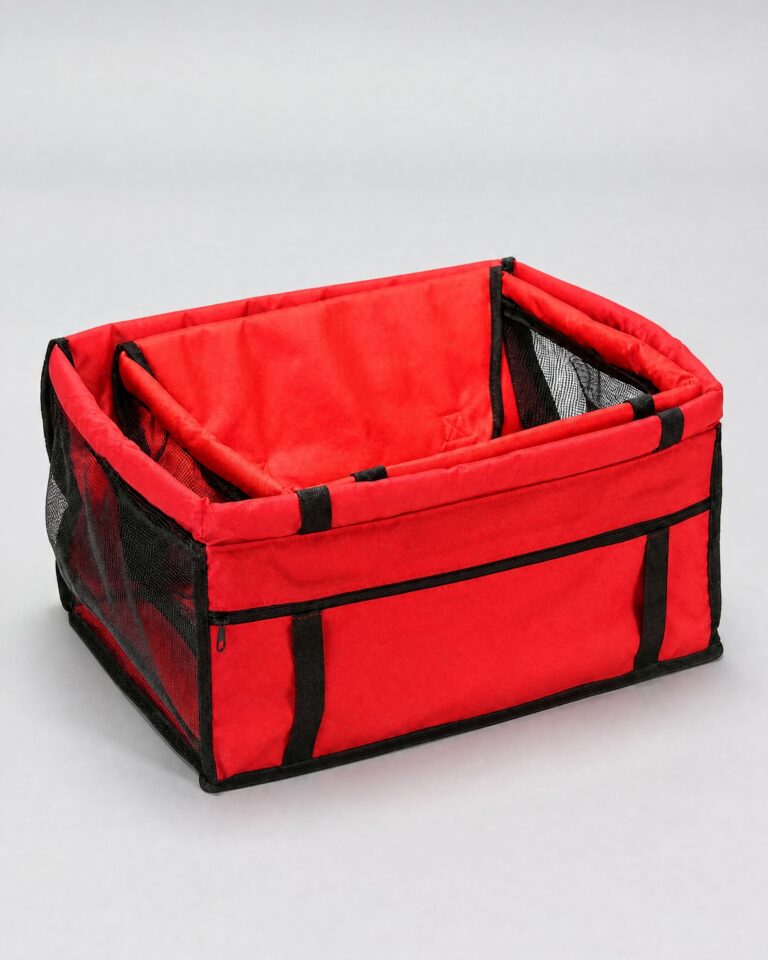
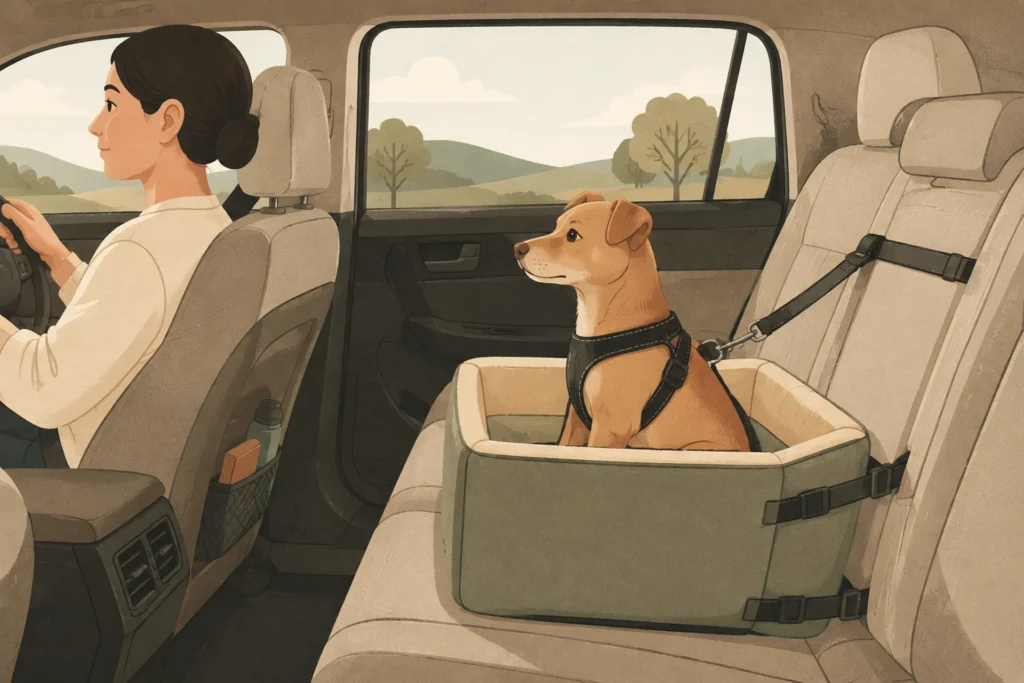
Almost certainly not — and no government agency requires it. There is no federal safety standard for pet travel products in the United States, no test every seat has to pass, and no agency that checks the claim on the box. “Crash-tested” on a pet product means whatever the company selling it decided it means.
The one independent study that put popular pet booster seats on a crash bench is the Center for Pet Safety’s 2015 pet travel seat pilot study. Every product it tested failed. None earned the group’s Top Performer rating. That is the honest starting point, and the rest of this guide is about what to do with it.
Why there is nothing to certify against
Child car seats are regulated: a seat sold in the US has to meet a federal motor vehicle safety standard, and there is a defined test it must survive. Nothing equivalent exists for dogs. Dr. Flaura Winston, a physician-researcher at the Center for Injury Research and Prevention at Children’s Hospital of Philadelphia, put it plainly when she wrote her own guidance for driving with dogs: there is “almost no scientific foundation for pet safety in cars in the peer-reviewed literature.”
So when a listing says crash-tested, ask three things: tested by whom, against what standard, with what result published. A company can crash a product, watch it fail, and still say it was tested. Without an independent lab and a readable result, the phrase carries no information.
What happened when someone actually ran the test
The Center for Pet Safety is a non-profit research organization that has run crash tests on pet harnesses, carriers, crates and travel seats. Its 2015 pilot study, funded by Subaru of America, took four small-dog travel seats chosen for high sales volume or for advertising that they had been crash-tested, secured each one according to the manufacturer’s own instructions, and crashed them with weighted test dogs.
| Product tested | Test dog | What the study reported |
|---|---|---|
| PupSaver | 30 lb | Rotated on impact and rolled onto its side; an anchor strap released after a plastic buckle failure; some tearing |
| Snoozer Lookout I (medium) | 25 lb | Anchor strap failed; the test dog was fully unrestrained |
| PetSmart Top Paw Booster Seat | 30 lb | Wire connection hardware significantly deformed; the test dog was fully unrestrained |
| Kurgo Skybox Booster Seat | 30 lb | Seat connections failed; the test dog became a fully unrestrained projectile |
Two things are worth holding onto. The failures were not exotic — a plastic buckle, a strap, a wire clip — and every one of them was in the part that connects the seat to the car. And this was a pilot study on four products a decade ago, not a survey of what is on sale today. It does not prove that every pet seat sold in 2026 fails. It proves the category was untested, that the first serious test found nothing that passed, and that nothing since has made passing a requirement.
One note on honesty. You will find a widely repeated pair of numbers about the force an unrestrained dog exerts in a crash — one figure for a ten-pound dog at 50 mph, another for an eighty-pound dog at 30 mph. They appear on hundreds of pages, almost always uncited, and we could not trace them to a published study or an agency. So we are not repeating them as fact. The physics is real; the specific figures are folklore until someone shows their work.
The risk that shows up far more often than a crash
Crash performance is the dramatic question. Distraction is the common one, and it is the part with real data behind it.
The National Highway Traffic Safety Administration defines distracted driving as “any activity that diverts attention from driving” and names talking to people in your vehicle as one of them. NHTSA reports that distracted driving claimed 3,208 lives in 2024 and injured 315,167 people that year. Its go-to illustration — five seconds with your eyes off the road is a football field at 55 mph — applies just as well to five seconds spent reaching back to push a dog off the console.
How often does that happen? In an AAA and Kurgo survey of 1,000 dog owners who had driven with their dog that year, 31 percent admitted being distracted by their dog while driving, 21 percent had let the dog sit in their lap, and only 17 percent used any restraint at all. The survey dates from 2010 and was co-run by a company that sells restraints, so treat the exact figures as a snapshot rather than a law of nature — but the shape of it matches what most drivers will recognize.
Winston’s framing is the useful one: a restraint does three separate jobs. Before a crash it keeps the dog from causing one. During a crash it keeps the dog attached to the car instead of loose inside it. After a crash it keeps a frightened dog from bolting out of a broken window into traffic, which is the failure mode most owners never think about.
What to do, in order of how much it actually helps
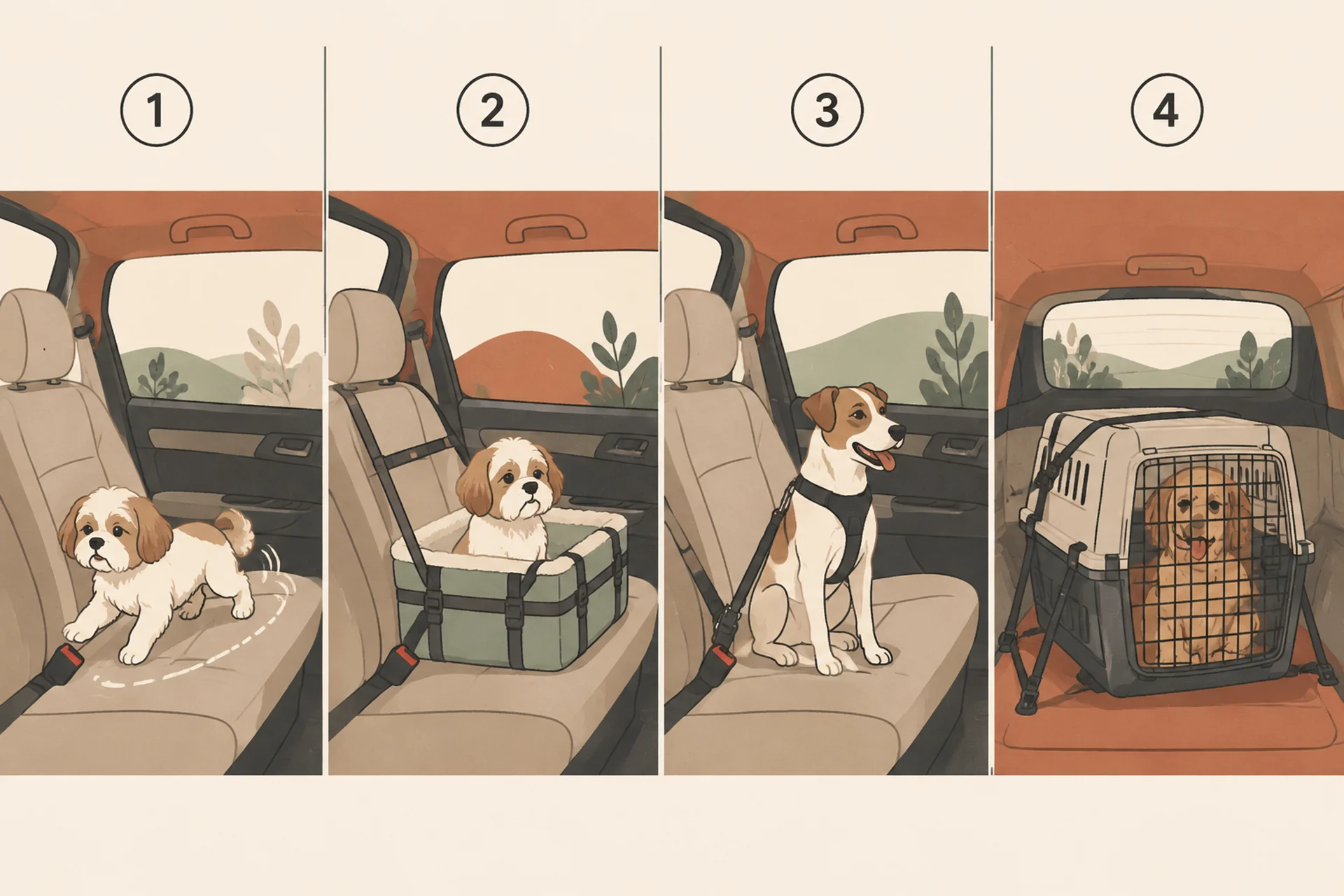
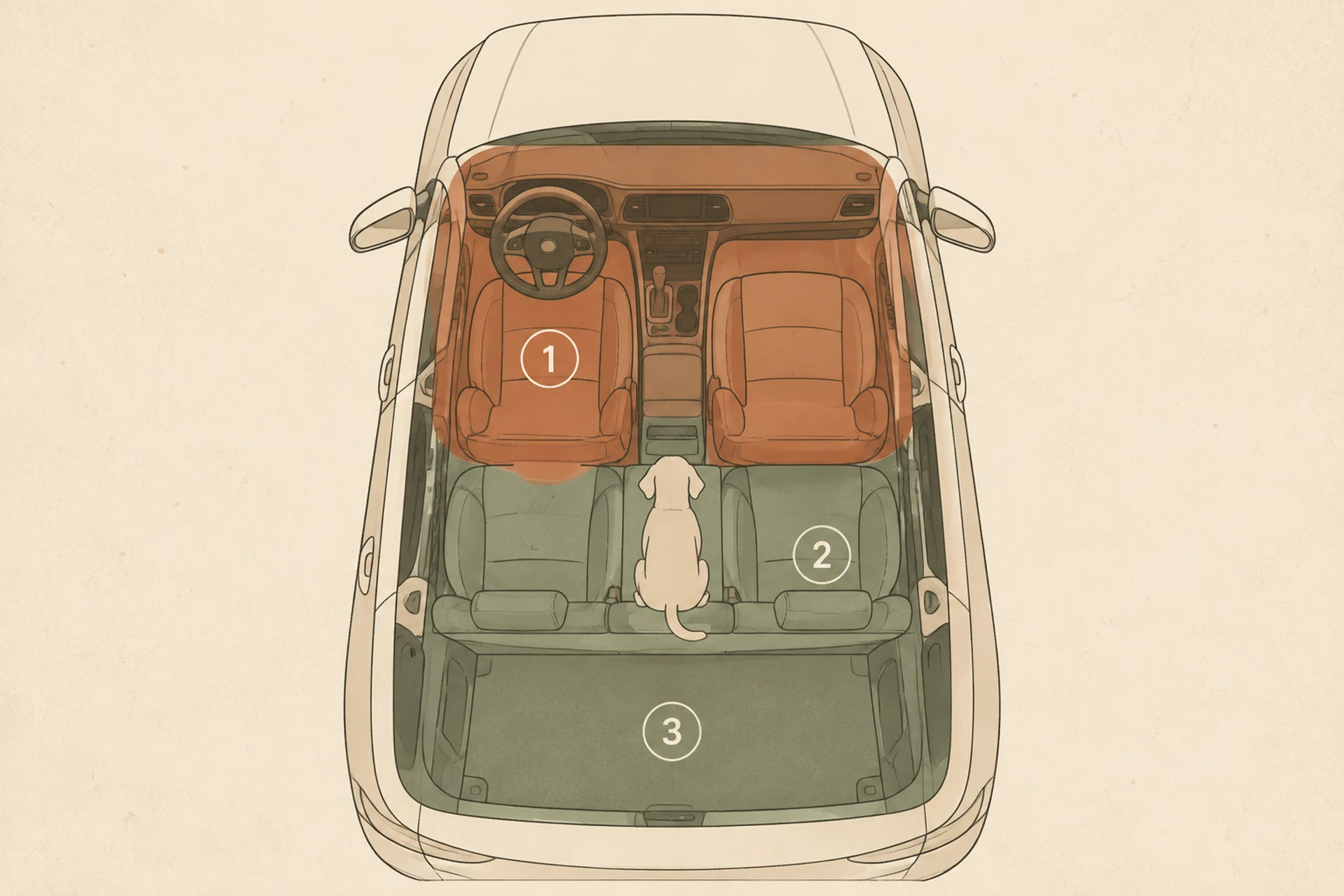
- Put the dog in the back. The ASPCA’s travel safety guidance is direct: if you skip the crate, “always keep them in the back seat in a harness attached to a secured seatbelt.” A dog in the front is in the path of an airbag designed for an adult human.
- Use a well-ventilated crate or carrier if the dog tolerates one. The ASPCA calls a crate “the safest option for your pet in case of an accident,” sized so the dog can stand, sit, lie down and turn around — and secured “so it will not slide or shift in the event of an abrupt stop.” An unsecured crate is cargo, not a restraint.
- Attach a harness, never a collar. Whatever the restraint, the load should go across the chest. A tether clipped to a neck collar concentrates force exactly where you least want it.
- Check the anchor, not the padding. Every CPS failure was in the connection. Look at how the product attaches to the car and ask whether that buckle is what you want between your dog and the windshield.
- Treat a booster seat as containment, not protection. A raised, strapped-in seat that keeps a small dog off your lap and out of the footwell does real work against distraction. That is a good reason to use one — and it is not the same claim as crash protection.
- Microchip and tag before the trip. The ASPCA recommends a microchip plus a collar tag with your phone number and a temporary travel tag with your destination number — cheap insurance against the post-crash bolt.
Is any of this the law?
There is no federal rule requiring you to restrain a dog in a car. Some states reach the same behavior indirectly — through distracted-driving statutes, obstruction-of-the-driver rules, or cruelty law covering dogs in open truck beds — and the details differ enough that any summary here would be wrong somewhere. NHTSA points drivers to their own state: “Your state legislature and governor make the laws regarding distracted driving.” Check your state’s DMV or highway safety office before a long drive, and check again for any state you drive through.
Choosing gear for the trip more broadly? Our guide to dog carriers for car travel covers shape and fit, and cat carriers for car trips does the same for cats, who mostly want a den rather than a view.
Frequently asked questions
Is a dog booster seat safer than nothing?
Against distraction, yes — it keeps a small dog off your lap, out of the footwell and away from the gearshift, and that is the risk you face on every single drive. Against crash forces, the only independent test we could find says do not count on it. Both of those things are true at once.
What does “crash-tested” mean on a pet product listing?
Legally, very little. There is no federal standard for pet travel products and no agency verifying the claim, so the phrase can describe an internal test with no published result. Look for an independent testing organization named by name and a result you can read.
Can my dog ride in the front seat?
Every source we checked advises against it. The front passenger airbag deploys with force calibrated for an adult human, and the front seat also puts the dog inside your sightline and within reach — the two ingredients of the distraction problem.
Crate or harness — which one?
The ASPCA names a secured, well-ventilated crate as the safest option in an accident, with a back-seat harness tethered to the seat belt as the alternative if a crate is not workable. In practice the better choice is often the one your dog will actually settle in, because a panicking dog in the right equipment is still a distracted driver.
Are dogs injured in crashes very often?
There is remarkably little data. When Winston followed up on a case report of a dog injured by a harness, the University of Pennsylvania veterinary school told her they had not seen severe injuries of that kind in car crashes, though they do “on occasion, see fractured bones.” The absence of data is not evidence of safety — it is the same gap that leaves the products untested.
Sources
- Center for Pet Safety — Pet Travel Seat Pilot Study (2015, funded by Subaru of America): products tested, test-dog weights, and per-product failure findings (checked 2026-08-26)
- Center for Injury Research and Prevention, Children’s Hospital of Philadelphia — Dogs and Driving: Reasons to Restrain Pets in Cars, by Flaura Winston (the missing literature, the three phases of crash protection, the University of Pennsylvania follow-up) (checked 2026-08-26)
- National Highway Traffic Safety Administration — Distracted Driving (definition, 3,208 deaths and 315,167 injuries in 2024, and that states make the laws) (checked 2026-08-26)
- AAA — survey of 1,000 dog owners conducted with Kurgo (31% distracted by their dog, 21% drove with the dog in their lap, 17% used any restraint) (checked 2026-08-26)
- ASPCA — Travel Safety Tips (crate as safest option, securing the crate, back seat and harness, microchip and travel tag) (checked 2026-08-26)
Safety guidance and state traffic law both change. Confirm on the official pages before you travel, and talk to your own veterinarian about your own dog — nothing here is a diagnosis or a substitute for an exam.