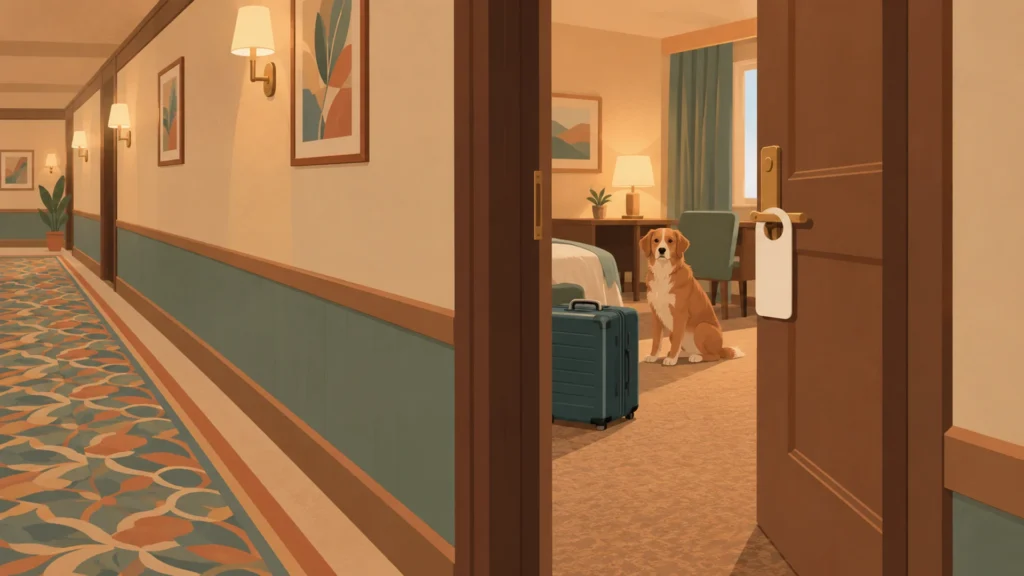
Usually no — and not as a matter of etiquette. It is written into the pet policy you agreed to at check-in. Red Roof is about as pet-welcoming as American hotels get; the first pet stays free. Its published policy still says plainly that guests may not leave a pet unattended in a guestroom, with a narrow exception for emergencies that requires you to phone the front desk first.
“Pet friendly” answers a different question than the one you are asking. It means the hotel will rent you a room with a dog in it. It does not mean the dog can be in that room without you while you go to dinner.
If your dog is a trained service dog, the answer is a flat no, and it comes from federal guidance rather than the hotel. The Department of Justice’s ADA guidance answers this exact question: hotel guests may not leave their service animals in the room when they leave the hotel, because the dog must be under the handler’s control at all times.
The second answer is about your dog rather than the hotel, and it is the one that decides how the evening actually goes. A strange room is not your living room, and the window that matters is short: Merck’s veterinary reference notes that signs of separation distress in dogs typically appear within the first 15 to 30 minutes after you leave. Whatever is going to happen has usually happened before your appetisers arrive.
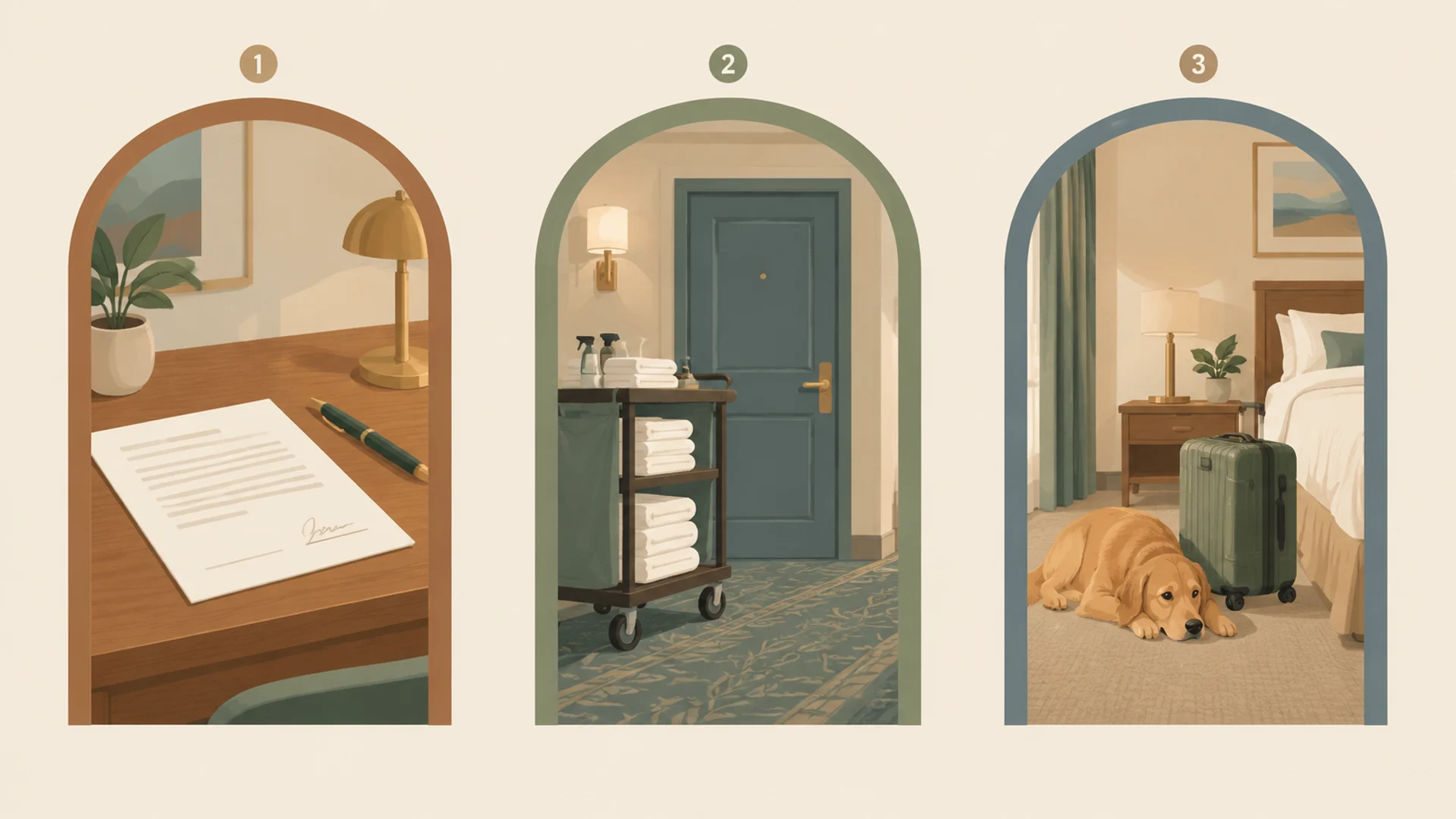
Gate one: what the policy actually says
Pet policies are not decoration. They are the terms you accept, and most of them contain a clause about unattended animals that guests never read because they skimmed to the fee. Red Roof’s is worth quoting because it comes from the permissive end of the market rather than the strict end. Alongside the no-unattended-pets rule, the same policy reserves the right for management to ask a guest to remove a disruptive pet or to find other accommodation, and notes that staff may contact animal control. It also caps pets at 80 pounds each, two per guestroom.
Two things follow from reading a real policy rather than a summary of one. First, the rule is usually conditional rather than absolute — Red Roof’s emergency carve-out requires you to contact the front desk, tell them the pet will be alone, and leave current contact information. That is a very different instruction from “sneak out quietly.” Second, even within a single brand the answer moves: Red Roof’s own page notes that policies vary by location at its HomeTowne Studios and Red Collection properties. Chain-level pages tell you the default. The property tells you the rule.
The AVMA’s travel guidance puts the homework in the right place — before booking, not at check-in. Its advice for anyone planning to stay in a hotel, motel, park or campground is to find out whether pets are welcome, whether there are breed or size restrictions, whether any paperwork is required, and what the property offers for your pet’s needs.
Gate two: the door opens whether you are there or not
This is the part almost nobody plans for, and it is the most common way a quiet dog becomes an incident. Housekeeping has a key. So does maintenance, and so does anyone responding to a fire panel at two in the afternoon.
Red Roof’s policy handles it by forbidding the situation outright: property staff cannot clean a guestroom while a pet is present, and guests are told to arrange cleaning for a time when the pet is not in the room. Read that carefully and you will notice it quietly constrains your whole day. If the dog is in the room, the room does not get serviced. If you want the room serviced, you and the dog both have to be out of it.
The AVMA’s own instruction for the unavoidable case is specific and takes ten seconds: if your pet must be left alone in a hotel room, put a “do not disturb” sign on the door and tell housekeeping and the front desk. The sign is for the door; the conversation is for the people who might open it anyway. Note the word the AVMA chose — must. It is framed as a contingency, not a plan.
Service dogs: the one case where the answer is fixed
People searching this question often have a service dog, and the rules for them are different in both directions. A hotel has to give a service dog more access than a pet, and it expects more of the handler in return.
On access, the ADA guidance is generous. A hotel cannot restrict a guest with a service animal to its “pet-friendly” rooms, and it cannot charge a cleaning fee for hair or dander, although it can charge for real damage the same way it would charge any guest. Staff may ask only two questions when it is not obvious: whether the dog is required because of a disability, and what task it has been trained to perform. They cannot ask for paperwork, and the online “registration” certificates carry no weight under the ADA.
On supervision, the same guidance is strict. The handler is responsible for the dog’s care and supervision, the dog must be under control at all times, and the Department of Justice answers the hotel-room question directly: no, you may not leave a service animal in the room when you leave the hotel. “Under control” also covers noise. A dog that barks repeatedly in a quiet place is not under control, though a single bark, or barking because someone provoked it, does not count. If a service animal is out of control and the handler does not take effective action, staff can ask for it to be removed.
Two edge cases catch people out. Emotional support animals are not service animals under the ADA, because they have not been trained to perform a specific task, so a hotel’s ordinary pet policy (fees, size caps and the unattended-pet clause) applies to them. And a dog still in training is not covered by the federal rule either, although some state or local laws cover animals in training. If either applies to you, ask the property, and check your state’s rules, before you book.
What to settle before you book
| Ask this | Why it decides your evening | Who has the answer |
|---|---|---|
| Can the dog be alone in the room at all? | If no, dinner out is a pet-sitter problem, not a hotel problem | The individual property — brand pages give the default only |
| If yes, is a crate required? | A crate-required rule is a hard stop for a dog who is not crate-trained | The property, in writing, ideally on your reservation |
| How and when does housekeeping enter? | Determines whether a stranger opens the door while you are gone | Front desk at check-in — and put it on the record |
| Weight, breed or number limits | Caps are common and are enforced at the desk, not at booking | Property page or a phone call; the AVMA advises checking before you book |
| Who do they call if the dog is barking? | You would rather get the call than have the decision made without you | Front desk — leave a mobile number that will be answered |
| Nearest 24-hour emergency vet | Not the one near your house; look it up while you have signal | Search it at home and save it offline |
Gate three: the first half hour is the whole test
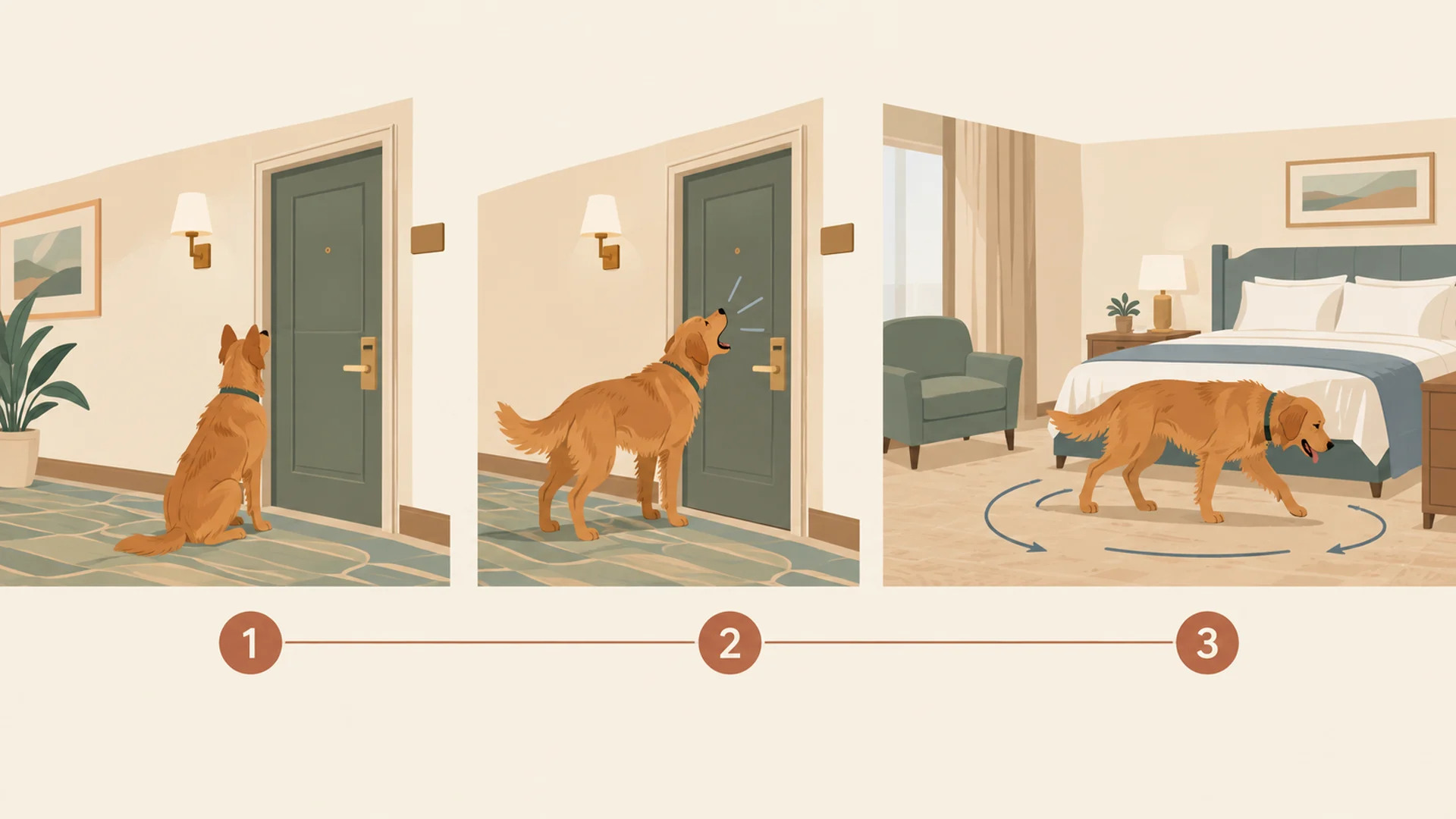
A dog who is reliably fine alone at home is not automatically fine alone here, and the reason is that almost every cue has changed at once. Merck’s reference on canine behaviour problems describes what separation distress looks like: destructive behaviour, especially at exits or directed at the owner’s possessions, distress vocalisation, house soiling, salivation, pacing, restlessness, an inability to settle. In a hotel, that list reads as a damage charge and a complaint from the room next door.
Three details from that page are more useful than any amount of general reassurance.
The timing. Signs typically start within 15 to 30 minutes of departure, and many dogs begin showing them while the owner is still preparing to leave — putting on shoes, picking up keys, moving toward the door. If you want to know how your dog will do, you do not need a three-hour absence. You need the first half hour.
The order. Distress changes shape over time: vocalisation peaks early, while pacing and orienting become more prominent later. That is precisely backwards from what a hotel guest hopes for. The barking is not the thing that builds after an hour — it is the thing that happens immediately, in a corridor of people who did not bring a dog.
The thing that does not predict it. Merck notes that dogs who show close-attachment behaviours, like following family members from room to room, are at no greater risk of separation anxiety than dogs who do not. The velcro dog may be fine; the independent one may not be. You cannot read this off your dog’s personality, which is exactly why you test it.
There is also a mechanism for how a dog who has never had a problem acquires one on holiday. Merck notes that separation distress sometimes develops after a frightening experience while alone — thunder is the example given. An unfamiliar room with corridor noise, a door slamming, and a fire alarm test is a reasonable candidate for the same thing.
“Just crate them” is a different question, not a solution
Crating is the standard workaround, and several hotels that permit unattended pets permit them only crated. It genuinely solves the damage problem. It does not automatically solve the distress problem, and treating the two as one is where this advice goes wrong.
Merck’s page lists confinement anxiety among the conditions that have to be excluded before separation distress is diagnosed at all — meaning they are recognised as distinct problems with distinct triggers. A dog who is content alone but loose can be a dog who panics behind a door, and a crate that has always been a bedroom at home can read differently in a room that smells of strangers. If the hotel requires a crate and your dog has not been comfortably crated recently, that is a reason to change the plan rather than to buy a crate on the way.
The broader point from the same reference is worth sitting with before booking a trip built around leaving the dog behind in the room: dogs with separation anxiety should be left alone as rarely as possible, because each episode sensitises them further. Pushing through a bad night does not build tolerance. It makes the next one worse.
Keeping a dog quiet in a hotel room, even when you are there
Much of the barking in hotels happens with the owner in the room. It starts with a door closing down the corridor, a cart going past or voices outside. The AKC’s travel advice for hotel stays is short and blunt: keep your dog as quiet as possible, and beware of leaving it unattended, because many dogs bark or destroy property in a strange place. Corridor barking is mostly the territorial kind, and the AKC’s guide to nuisance barking explains why it is hard to shift: it is self-rewarding, because from the dog’s point of view the barking appears to make the passer-by go away.
What that guide recommends translates to a hotel room with very little change:
- Give the dog a place away from the door. The AKC suggests teaching a “go to your place” cue on a bed, mat or crate, and choosing something portable. Bring that mat from home and put it at the far end of the room, not by the entrance where every footstep in the corridor lands.
- Cut off what sets it off. The AKC’s fix for territorial barking is to block the dog’s view of passers-by. In a hotel, that means keeping the curtains closed on a ground-floor or street-facing room and keeping the dog away from the gap under the door.
- Do not shout back. The same guide warns that yelling is still attention and, from the dog’s point of view, sounds like you are barking too. Wait for a moment of silence and reward that instead. A “quiet” cue works best if you have practised it at home before the trip.
- Keep the routine the dog already knows. The AVMA advises keeping your usual feeding times and toilet opportunities while away from home. A dog that has had its walk and dinner at the normal time has fewer reasons to be restless.
- Leave anti-bark collars at home unless a professional has advised one. The AKC notes that spray, ultrasonic and shock devices all work by punishment, that they are no more effective than positive methods, and that you should see a certified trainer or behaviourist before using one.
If the barking is the frantic, can’t-settle kind that starts as soon as you pick up your keys, that is not a manners problem. That is the separation distress described above, and it is a conversation for your vet or a behaviourist, not something to fix with a better mat.
If you are going to do it anyway
Sometimes there is no alternative — a hospital visit, a funeral, a restaurant that will not seat a dog on a night you cannot skip. The honest version is to lower the stakes rather than pretend they are not there.
- Tell the front desk before you leave, not after. Red Roof’s emergency exception requires exactly this: notify staff and leave contact information that will be answered.
- Hang the “do not disturb” sign and tell housekeeping directly, as the AVMA advises. The sign alone assumes everyone reads it.
- Run a fifteen-minute rehearsal first — down the corridor, not out of the building. That is inside the window where distress signs usually appear.
- Point a phone at the room and watch. Merck calls video recording an invaluable tool for seeing what a dog actually does when alone, and it is the only way you will know.
- Keep the routine intact. The AVMA advises maintaining your usual feeding times and toilet opportunities while away from home — a dog left alone on a disrupted schedule has two problems.
- Do a daily health check. The AVMA notes that in unfamiliar surroundings a pet’s appetite, energy and behaviour may change, and that changes are worth a local vet’s opinion.
- Have the number for a 24-hour emergency clinic near the hotel saved offline before you need it.
And consider the alternative honestly. A local day-care or a sitter for three hours is often cheaper than a damage charge and considerably cheaper than being asked to leave at nine at night with a dog and a suitcase. If the trip is long enough that this comes up repeatedly, our guide to how often to stop on a road trip with a dog is the companion piece on structuring the days, and traveling with a senior dog covers the case where the dog’s tolerance for all of this is lower than it used to be.
Leaving a dog alone in a hotel room: FAQ
Can I leave my dog alone in a hotel room?
At most hotels, no. Even brands at the permissive end say so explicitly — Red Roof’s published policy states that guests may not leave a pet unattended in a guestroom, with an emergency exception that requires contacting the front desk first. Policies vary by property even inside one brand, so confirm with the specific hotel rather than relying on the chain page.
What happens if I leave my dog and they bark?
Expect a call, and expect the hotel to act if it continues. Policies commonly give management discretion to require that a disruptive pet be removed or that the guest find other accommodation. Red Roof’s policy says a pet disturbing other guests or staff cannot be left alone and must remain under the guest’s control.
Can I leave my service dog alone in a hotel room?
No. The Department of Justice’s ADA guidance addresses this directly: hotel guests are not allowed to leave their service animals in their hotel room when they leave the hotel, because the dog must be under the handler’s control at all times. Emotional support animals are not service animals under the ADA, so for them the hotel’s ordinary pet policy applies instead.
How do I keep my dog quiet in a hotel room?
Give the dog a familiar mat or bed at the far end of the room from the door, keep the curtains closed, stick to its usual feeding and walk times, and reward quiet instead of shouting over barking. These are the AKC’s barking-management basics adapted to a hotel room. Barking that starts the moment you get ready to leave is separation distress, which needs your vet or a behaviourist, not a quieter room.
Does a crate make it allowed?
Sometimes — a number of properties permit unattended pets only when crated, so it is worth asking specifically. But it answers the hotel’s question, not your dog’s. Merck’s behaviour reference treats confinement anxiety as a separate condition from separation distress, so a dog who is calm alone and loose is not guaranteed to be calm alone and crated.
Will housekeeping come in while my dog is in the room?
They may, unless it has been agreed otherwise. Red Roof’s policy goes the other way and forbids staff from cleaning a room while a pet is present, telling guests to schedule cleaning for when the pet is out. Either way, settle it at check-in and hang the “do not disturb” sign the AVMA recommends.
How long can a dog be left alone in a hotel room?
The wrong frame. Merck notes that separation distress signs typically appear within the first 15 to 30 minutes, with vocalising peaking early — so the risk is concentrated at the start rather than accumulating over hours. A dog who is going to struggle will usually do it before you have parked the car.
My dog is fine alone at home. Isn’t a hotel the same?
Not reliably. Merck notes that separation distress can be triggered by a frightening experience while alone, and an unfamiliar room with corridor noise supplies plenty of candidates. The same reference also points out that you cannot predict this from temperament — dogs who follow you everywhere at home are at no greater risk than dogs who do not. Test it for fifteen minutes before you rely on it.
Sources
- Red Roof — Pet Policy (checked 2026-09-14) — pets may not be left unattended in a guestroom and the emergency exception; staff cannot clean a room while a pet is present; disruptive pets must remain under the guest’s control; management discretion to require removal; 80 lb and two-pet limits; policies vary at HomeTowne Studios and The Red Collection.
- American Veterinary Medical Association — Traveling with your dog or cat (checked 2026-09-14) — check pet acceptance, breed and size restrictions and paperwork before booking; the “do not disturb” sign and informing housekeeping and the front desk; daily health checks away from home; maintaining feeding and toilet routines; emergency numbers for your destination.
- Merck Veterinary Manual — Behavior Problems of Dogs (checked 2026-09-14) — separation distress signs and their timing in the first 15–30 minutes, vocalisation peaking early with pacing later, close-attachment behaviour not predicting risk, confinement anxiety as a separate condition, sensitisation with repeated episodes, and video recording as an assessment tool. This is the clinician-facing page.
- U.S. Department of Justice — Frequently Asked Questions about Service Animals and the ADA (checked 2026-09-29) — Q29: service animals may not be left in a hotel room when the guest leaves the hotel; handler control at all times, including repeated barking (Q27); removal if out of control (Q28); emotional support animals are not service animals (Q3); animals in training not covered federally (Q6); no restriction to pet-friendly rooms and no cleaning fee (Q11, Q12); the two permitted questions (Q7); online certificates carry no rights (Q17).
- American Kennel Club — Dog Travel Tips (checked 2026-09-29) — keep your dog as quiet as possible at a hotel; beware of leaving your dog unattended, because many dogs bark or destroy property in a strange place.
- American Kennel Club — Expert Tips to Help Curb Excessive Dog Barking (checked 2026-09-29) — territorial barking is self-rewarding; block the view; teach “go to your place” on a portable mat; do not yell; reward silence; bark-deterrent devices rely on punishment and call for a professional first.
Hotel pet policies change and differ property by property, including within a single brand. Confirm the rule with the hotel before you book. Service-animal guidance can be revised, so check ADA.gov for the current version. Behaviour concerns are a conversation for your own veterinarian.
“Pet friendly” rents you the room, not the evening.
Assume the answer is no until the property tells you otherwise in writing, and settle the housekeeping question at the desk rather than hoping. Then ask the separate question the policy cannot answer: give your dog fifteen minutes alone in that room with a camera running, because if it is going to go wrong, that is when you will see it.