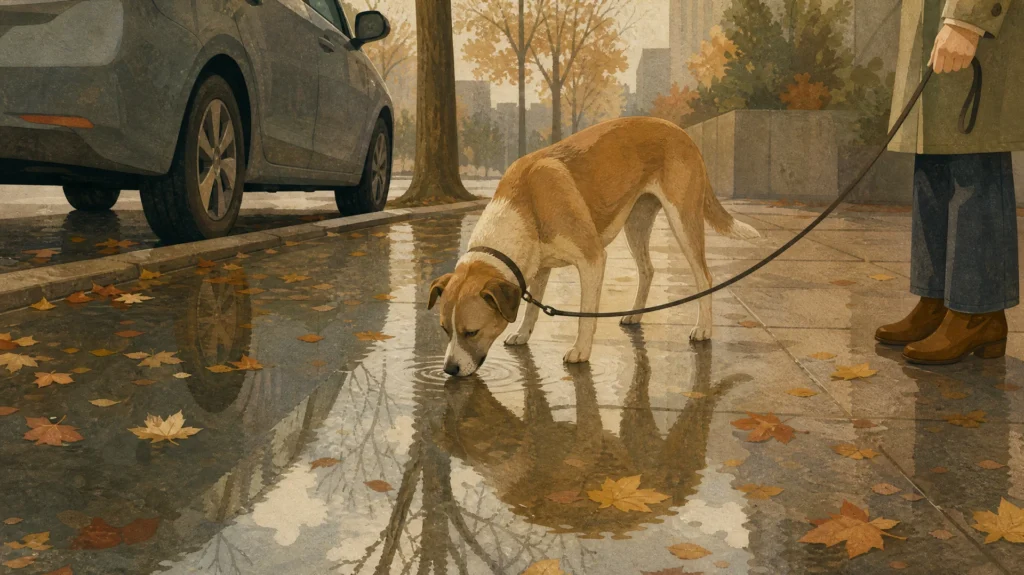
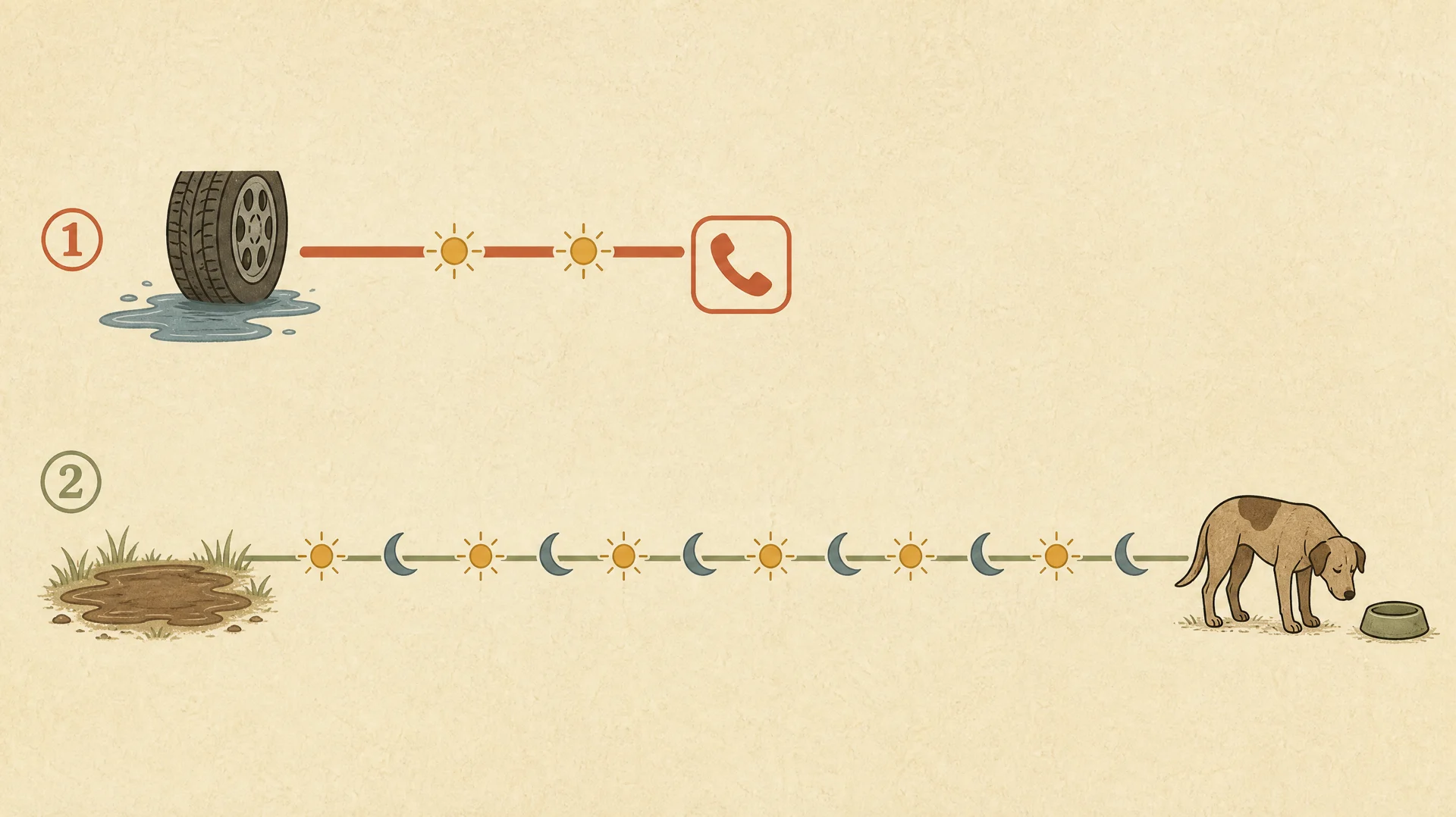
Most puddle sips end in nothing at all. But “wait and see” is the wrong default for two of them, and the reason almost every page you will read about this is unhelpful is that it gives you one watching window when the hazards actually run on three completely different clocks — minutes, a day, and a full week.
Two situations do not wait. If the puddle was on asphalt beside a parked car, you are calling someone now, because the Merck Veterinary Manual gives ethylene glycol a minimum lethal dose of just “4.4–6.6 mL/kg” in dogs and notes that “prognosis varies inversely with the amount of time that elapses between ingestion and initiation of treatment.” And if the water carried foam, scum or a paint-like film, the CDC’s line is that animals “can get very sick and die within hours to days after swallowing cyanobacterial toxins.”
Everything else is genuinely a watch-and-wait — but watch for about a week, not for an afternoon. Cornell’s Riney Canine Health Center puts the incubation period for leptospirosis, the disease most associated with puddles, at “about one week.” A dog who is bright at bedtime has told you nothing about that one.
Not all puddles are the same puddle
The single most useful thing you can do is remember where the water was. Sites that answer this question tend to blend every puddle into one undifferentiated hazard and then tell you to monitor your dog, which is advice you could have generated yourself. The location tells you which of three unrelated problems you might have, and each one has its own clock and its own response.
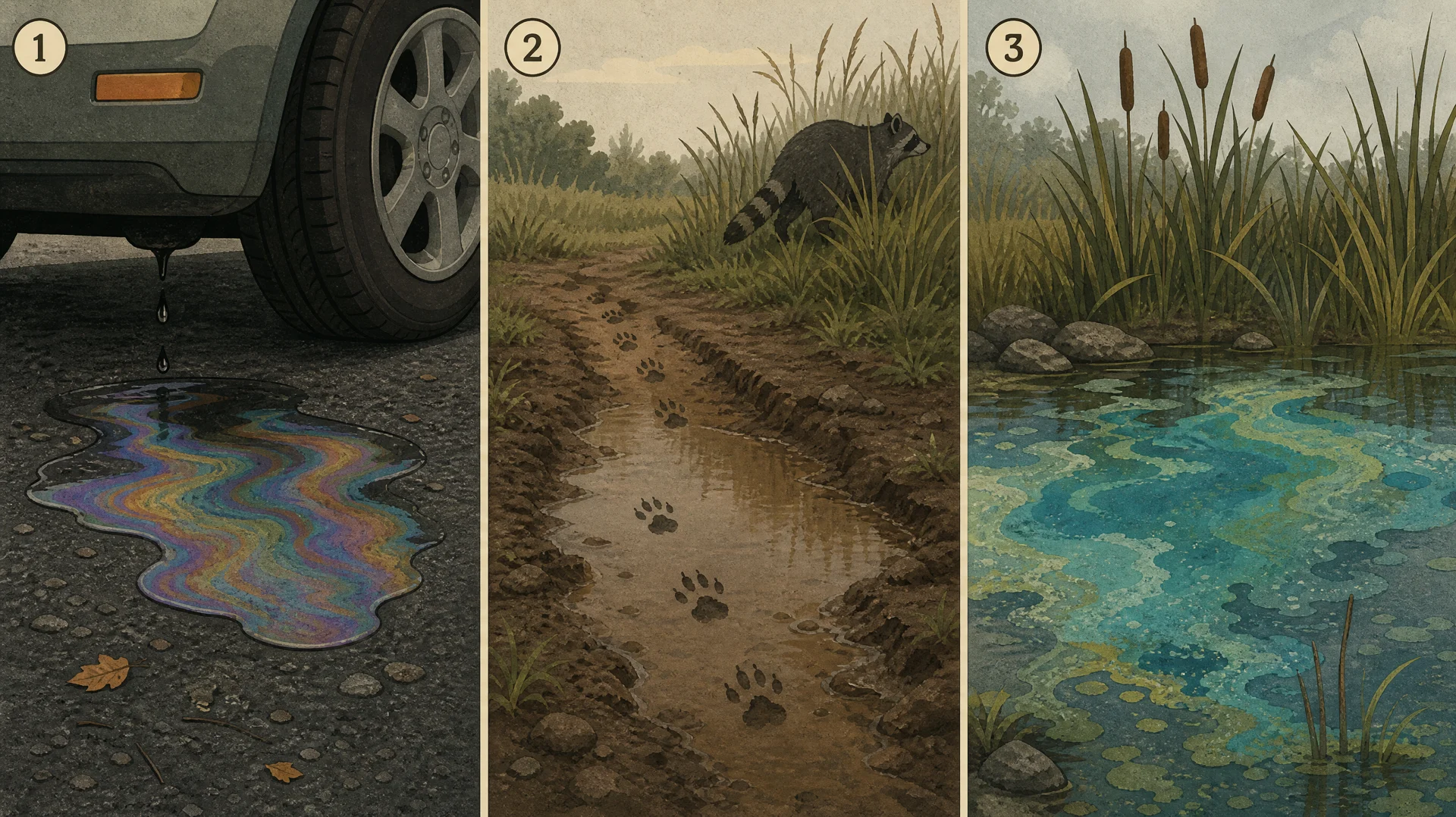
| Where the water was | What you are actually worried about | The clock | What to do |
|---|---|---|---|
| Asphalt, driveway, parking structure, kerb beside a parked car | Ethylene glycol from a coolant leak — sweet-tasting, and dogs drink it readily | Signs from 30 minutes; decontamination is most useful inside 1–2 hours | Call a vet or a poison line now, before symptoms |
| Trail, park, grass verge, farmyard, anywhere with rodents or wildlife | Leptospirosis from urine-contaminated standing water | Incubation about one week | Note the date, watch for roughly ten days, call at the first sign |
| Anywhere a dog has toileted — dog parks especially | Giardia cysts from faecal contamination | Diarrhoea, often days later, and often nothing at all | Watch the stool; a faecal sample if it persists |
| Still pond, lake edge, slow creek with surface scum or foam | Cyanobacterial toxins | Hours to days | Rinse the dog immediately with clean water, then call |
Leptospirosis: the one with a one-week fuse
This is the disease behind the advice, and it is worth knowing properly because it is the one that punishes a short watching window. Cornell’s Riney Canine Health Center is unusually direct about the route: “The most common way dogs get leptospirosis is through water contaminated with urine, particularly stagnant or slow-moving water like puddles, ponds or lakes.” Puddles are named first, not as an afterthought.
The CDC’s page on leptospirosis in animals describes the same exposure as “direct contact with infected urine (pee) or contaminated water sources, especially drinking from slow-moving or stagnant water sources, like ponds, rivers, lakes, or streams.” The urine usually is not another dog’s. Cornell: “Many different animals can spread leptospirosis through their urine, primarily rodents and small mammals like rats and raccoons, and even some livestock.” Which is why a tidy suburban puddle behind a bin store is not automatically safer than a farm one.
Then the number that changes how you handle the next few days: “The incubation period, or the time between exposure to the organism and the appearance of symptoms, is about one week.” Not twenty-four hours. Not forty-eight. If you are going to watch for anything, the date in your calendar is seven days out, and the early signs are deliberately unremarkable — Cornell lists fever, decreased appetite, vomiting, diarrhoea, increased thirst and urination, and lethargy or weakness. The CDC’s list starts in the same dull place: fever, depression, lethargy, loss of appetite, joint or muscle pain.
Two more things worth having straight. It is treatable, and treated early it is treatable well — Cornell describes antibiotics, “most commonly doxycycline, for at least two weeks,” with hospitalisation and IV fluids often needed at the start. And it is a disease you can catch too: the CDC notes that an incompletely treated animal “may continue to shed the bacteria in its urine for up to 3 months, potentially spreading the disease to people and other animals.” That is a reason to be scrupulous about gloves and handwashing around a sick dog’s urine, not a reason to panic about a healthy one.
There is also a vaccine, and it is the part of this article that is genuinely actionable before anything happens. Cornell’s schedule: “After the first vaccine, your dog will need a booster in 3-4 weeks. Your dog should then receive a booster once a year.” Whether your own dog’s lifestyle warrants it is a conversation with your vet, not something a website should decide — but it is a conversation worth having at the next appointment rather than after a puddle.
The parking-lot puddle is a chemistry problem, not an infection one
Everything above is about bacteria and takes days. A puddle on tarmac next to a car is a different category and runs on minutes, because of what can be in it. The ASPCA’s explanation of why is one sentence long: “ethylene glycol has a sweet taste, so pets can easily be drawn to and ingest it” — and they add, plainly, that “it takes only a small amount of ethylene glycol to be potentially fatal.”
The Merck Veterinary Manual gives the amount: a minimum lethal dose of “4.4–6.6 mL/kg” in dogs, and “1.4 mL/kg” in cats. Signs appear “30 minutes to 12 hours after ingestion” and look, at first, like drunkenness — gastrointestinal upset, dullness, an unsteady gait.
The cruel part is the middle. Merck describes “a brief recovery” that “may occur approximately 12 hours after ingestion,” before kidney damage arrives at 36–72 hours in dogs. A dog who seemed wobbly at lunchtime and is bouncing around by bedtime has not necessarily recovered. That interval is exactly when a worried owner decides they were overreacting, and it is the interval in which treatment is still worth a great deal — Merck notes that decontamination is aimed at the first one to two hours and that the antidote works best given early.
So the rule for that puddle inverts the usual one. You do not wait for a symptom. If your dog drank from standing water next to a vehicle and you cannot rule out a coolant leak, the phone call happens while the dog still looks completely fine. The ASPCA Animal Poison Control Center takes calls on (888) 426-4435, and Pet Poison Helpline is available 24/7 on (855) 764-7661; Save one of them in your phone now rather than looking it up in a car park.
Giardia: common, milder, and probably not from the puddle you are picturing
This is the organism people name most often and worry about second-most, and the honest version is less dramatic than the search results suggest. The Companion Animal Parasite Council describes transmission as ingestion of cysts, which are “acquired from fecal-contaminated water, food, or fomites or through self-grooming.” The operative word is faecal. Rainwater on a pavement is not intrinsically full of Giardia; a churned-up wet patch in a well-used dog park is a far better candidate.
CAPC’s description of what it does is also calmer than most: “Diarrhea, which may be acute, intermittent, or chronic, and can be accompanied by flatulence, vomiting or mucous in the stool. In severe cases lethargy, inappetence, and weight loss may also occur.” And then the line that reframes the whole thing — “most infections are subclinical.” Plenty of dogs carry it and are fine.
The zoonotic question deserves a straight answer too, because this is where content farms tend to raise an alarm and leave it there. CAPC: “Human infection from a dog or cat source has not been conclusively demonstrated in North America,” and “human infections are primarily acquired from other humans; transmission from dogs to humans appears to be rare.” They do add a real caveat — people with increased susceptibility to infection because of underlying disease “should consider limiting their exposure to Giardia-infected pets.” That is a meaningful exception, not a general warning.
Practically: if loose stool shows up in the days after a muddy walk and does not settle, the useful move is a faecal sample rather than a guess. It is diagnosable and treatable, and it is not an emergency.
Scum, foam and paint-like films: the one that does not get a watching window
If the standing water had colour on its surface, stop reading and rinse the dog. The CDC’s description of what a cyanobacterial bloom looks like is the most practical identification guide available, because it is entirely visual: cyanobacteria “can change the color of the water or look like foam, scum, mats, or paint on the surface of water.”
The CDC’s prevention guidance for pets tells you not to let animals “drink the water, swim or play in the water, eat near the water, eat dead animals (like fish) washed up on the shore, eat algae, or lick their fur afterward.” And it gives one instruction to carry out immediately: “If your pets or livestock go in water with a possible cyanobacterial bloom, immediately wash them off with clean water to keep them from licking cyanobacteria off their fur.”
The urgency is in the timeline — animals “can get very sick and die within hours to days after swallowing cyanobacterial toxins.” This is not a puddle-on-the-pavement hazard; it belongs to still, warm, slow water at pond and lake edges. But dogs wade there, and the coat is a delivery mechanism even when the dog never drank. Rinse first, call second, and check whether your state or county posts bloom advisories for the water you use.
What to actually do tonight
- Write down where the puddle was and what day it is. Sounds fussy; it is the single piece of information a vet will want in a week’s time, and it is the piece you will have lost by then.
- Kerbside or car park → call before symptoms. This is the one hazard where waiting for a sign is the mistake. Merck’s window for decontamination is the first one to two hours.
- Any surface scum → rinse with clean water now. The CDC’s instruction is about the coat, not the stomach — dogs dose themselves again by grooming.
- Otherwise, watch for about ten days, not one evening. Cornell’s incubation period for leptospirosis is about a week. Fever, appetite, energy, thirst and urination are the things to notice.
- Call at the first dull sign rather than waiting for a dramatic one. The early signs are boring on purpose — off food, flat, drinking more. That is the list.
- Treat loose stool as a faecal-sample question, not a puddle question. If it persists, Giardia is diagnosable and treatable, and guessing helps nobody.
- Ask about the leptospirosis vaccine at your next appointment. Cornell’s schedule is a first dose, a booster at 3–4 weeks, then annually. Whether your dog needs it is a vet conversation about where you actually walk.
- Save the poison line before you need it. ASPCA APCC on (888) 426-4435, or Pet Poison Helpline on (855) 764-7661.
Why your dog does this, and what actually stops it
Dogs drink from puddles because the water is there, at nose height, and moving slightly. Interesting beats clean every time, and a dog who has been panting for twenty minutes is not conducting a risk assessment. Which means the interventions that work are the boring physical ones rather than training the behaviour out.
Carrying water is most of it. A dog who has been offered a bowl in the last ten minutes is far less interested in the puddle, and this is the same principle that governs the saltwater version of the problem — our guide to what to do when a dog drinks ocean water gets into why fresh water being available is the whole prevention strategy there, and how much water a dog needs on a hike covers what carrying enough actually looks like. The rest is route choice: the verge instead of the gutter, and a wide berth around the pond edge in warm weather. On a dark evening walk you often cannot see what is in the water at all, which is its own argument for keeping the lead short near kerbs — something we get into in walking your dog in the dark. Autumn adds a second thing your dog will pick up off the same pavement without asking, and what to do when a dog eats acorns sorts that one the same way — by working out which hazard you actually have before deciding how long to watch. And if the wider worry is whether the rainy walk itself can make your dog ill, can dogs get sick from rain? separates the weather from the water.
What does not work is expecting to catch it every time. You will not. The goal is to make the interesting puddle less interesting, and to know which one deserves a phone call when you miss.
Dogs and puddle water FAQ
My dog drank puddle water and seems fine. Should I worry?
Probably not, but “seems fine tonight” is weaker evidence than it feels. The main puddle-borne disease, leptospirosis, has an incubation period Cornell puts at “about one week,” so a bright dog at bedtime tells you nothing about it. Note the date and the location, watch for fever, appetite loss, lethargy, vomiting or increased thirst over the following ten days, and call at the first one. The exception is a puddle near a parked car — that one is a call now, not a watch.
Can dogs get sick from drinking puddle water?
Yes, though most sips result in nothing. The realistic hazards are leptospirosis from water contaminated by wildlife or rodent urine, Giardia from faecally contaminated water, ethylene glycol from vehicle coolant on hard standing, and cyanobacterial toxins at the edge of still ponds. They are unrelated problems with unrelated timelines, which is why the location of the puddle matters more than the fact that it was a puddle.
How long after drinking puddle water would a dog get sick?
It depends entirely which hazard. Ethylene glycol produces signs “30 minutes to 12 hours after ingestion,” per Merck, with a deceptive brief recovery around twelve hours. Cyanobacterial toxins act within hours to days. Leptospirosis takes about a week. Giardia commonly produces nothing at all. A single 24-hour watching window covers only one of the four.
Is city puddle water safer than a puddle on a trail?
Not in the way people assume. Cornell names rats and raccoons among the main shedders of leptospira, and those animals live in cities in large numbers — so the urban puddle is not exempt. It also adds a hazard the trail puddle does not have, which is vehicle fluid on hard standing. The genuinely lower-risk water is the bowl you brought.
Can I catch anything from my dog after this?
For leptospirosis, the risk is real but specific: the CDC notes an untreated animal may shed bacteria in its urine for up to three months, “potentially spreading the disease to people and other animals.” Gloves and handwashing around a sick dog’s urine are sensible. For Giardia, CAPC is reassuring — transmission from dogs to people “appears to be rare” and has not been conclusively demonstrated in North America, though people with weakened immune systems should limit exposure to an infected pet.
My dog only wants to drink from puddles and ignores their bowl. Why?
Novelty and temperature, mostly — outdoor water is cool, it moves, and it smells of everything the dog is interested in. It is a preference, not a symptom. What is worth mentioning to a vet is a genuine change in how much your dog is drinking overall, because increased thirst appears on both Cornell’s and the CDC’s early sign lists for leptospirosis. A dog who has always liked puddles is different from a dog who suddenly cannot stop drinking.
Remember the puddle, not just the drink.
Where the water was decides everything: tarmac by a car means a phone call before any symptom appears, surface scum means rinse the dog now, and a trail or park puddle means a date in the calendar and about ten days of paying attention to dull things — appetite, energy, thirst. Most of the time the answer is nothing happened. The reason to know the difference is that the two hazards that do not wait are the two that are cheapest to act on early.
Sources
- Cornell University College of Veterinary Medicine, Riney Canine Health Center — Canine Leptospirosis (stagnant or slow-moving water like puddles, ponds or lakes as the most common exposure route; urine-contaminated soil, bedding and food; rodents, raccoons and livestock as shedders; incubation period of about one week; early signs; doxycycline for at least two weeks with IV fluids often needed; booster at 3–4 weeks then annually) (checked 2026-09-21)
- Centers for Disease Control and Prevention — Leptospirosis in Animals (infection by direct contact with infected urine or contaminated water, especially drinking from slow-moving or stagnant water; initial signs of fever, depression, lethargy, loss of appetite and joint or muscle pain; shedding in urine for up to 3 months in an incompletely treated animal; vaccine availability; handwashing and protective clothing) (checked 2026-09-21)
- Merck Veterinary Manual — Ethylene Glycol Toxicosis in Animals (minimum lethal dose 4.4–6.6 mL/kg in dogs and 1.4 mL/kg in cats; sweet taste; signs 30 minutes to 12 hours after ingestion; brief apparent recovery around 12 hours; kidney damage at 36–72 hours in dogs; prognosis varying inversely with time to treatment; decontamination aimed at the first 1–2 hours) (checked 2026-09-21)
- ASPCA — Digging Deeper: Getting the Facts on the Dangers of Antifreeze and Your Pets (ethylene glycol’s sweet taste drawing pets to ingest it; only a small amount potentially fatal; problems starting within a couple of hours and animals markedly ill in six to twelve hours; propylene glycol alternatives; Animal Poison Control Center on 888-426-4435) (checked 2026-09-21)
- Companion Animal Parasite Council — Giardia (cysts acquired from faecally contaminated water, food or fomites, or through self-grooming; clinical signs including acute, intermittent or chronic diarrhoea; most infections subclinical; human infection from a dog or cat source not conclusively demonstrated in North America and dog-to-human transmission appearing rare; caveat for people with increased susceptibility) (checked 2026-09-21)
- Centers for Disease Control and Prevention — Preventing Pet and Livestock Illnesses Caused by Harmful Algal Blooms (blooms changing water colour or looking like foam, scum, mats or paint on the surface; animals getting very sick and dying within hours to days after swallowing cyanobacterial toxins; the list of things not to let pets do; washing animals off immediately with clean water so they do not lick cyanobacteria from their fur) (checked 2026-09-21)
- Pet Poison Helpline — Antifreeze Is Toxic To Dogs (small volumes of ethylene glycol leading to death if treatment is delayed; signs depending on the specific chemical and volume; 24/7 line on (855) 764-7661) (checked 2026-09-21)
Veterinary guidance and local water advisories change, and nothing here replaces a conversation with your own vet. If you think your dog has swallowed something toxic, call a vet or a poison control line rather than waiting to see what happens.