
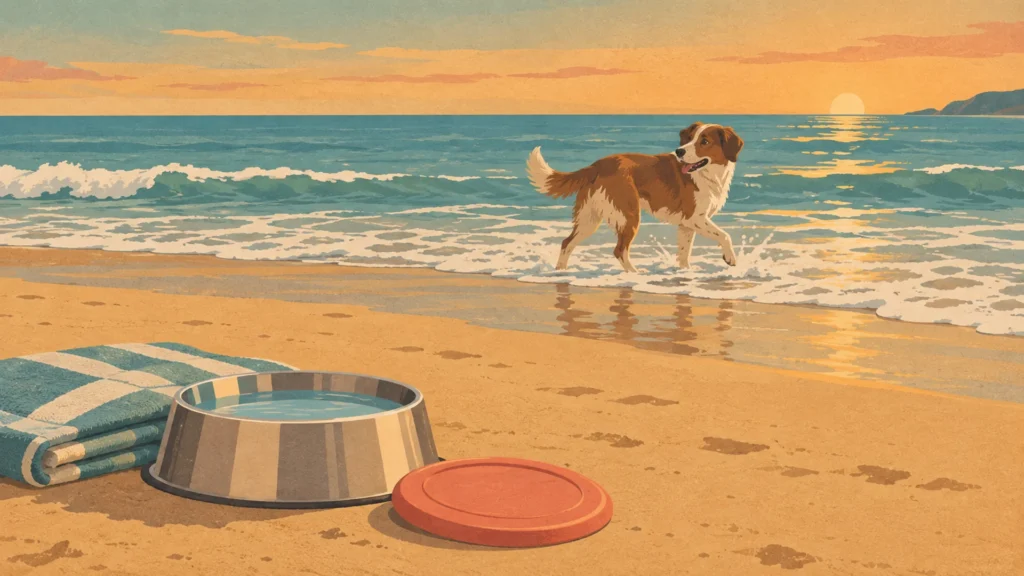
A few mouthfuls of seawater usually buys you a messy evening, not an emergency. The American Kennel Club puts it plainly: “In most cases, a few mouthfuls of salt water may only cause diarrhea. Consuming large amounts of salt water, however, can be fatal.” The variable that decides which one you get is not the ocean. It is whether your dog had fresh water in front of them all afternoon.
That is the whole mechanism, and the Merck Veterinary Manual states it directly: “Salt toxicosis is unlikely to occur as long as sodium-regulating mechanisms are intact and fresh drinking water is available.” The same page notes that dogs “have been reported to develop hypernatremia after swimming or playing in the ocean (which contains ~3.5% sodium) without having access to fresh water.”
What the water is actually doing
Seawater is roughly ten times saltier than the fluid inside your dog’s body. Swallowed in quantity, it raises the sodium concentration in the blood faster than the kidneys can dump it, and water gets pulled out of cells — including brain cells — to even out the gradient. That is why the symptom list starts in the gut and ends in the nervous system.
Merck describes the progression: “Excess salt intake in dogs results in vomiting within several hours after ingestion. Clinical signs can progress to weakness, diarrhea, muscle tremors, and seizures.” AKC’s list is the same shape — vomiting within a few hours, then “weakness, diarrhea, muscle tremors, or seizures,” plus “odd behavior” such as confusion or lethargy.
One figure from Merck deserves to be quoted carefully, because it gets passed around out of context: “The mortality rate may be >50% in affected animals regardless of treatment.” That is the outcome for animals who have actually developed salt toxicosis — not the outcome for a retriever who took a few gulps between fetches. Most dogs at most beaches on most days never get near it. But it explains why vets treat a wobbly, disoriented dog coming off a beach as urgent rather than as something to sleep off.
The part most beach advice gets backwards
Search this question and you will be told, over and over, to get your dog to drink plenty of fresh water. As prevention, that advice is exactly right — it is the single thing that keeps this from happening at all. As first aid for a dog who is already showing signs, it is the part worth slowing down on.
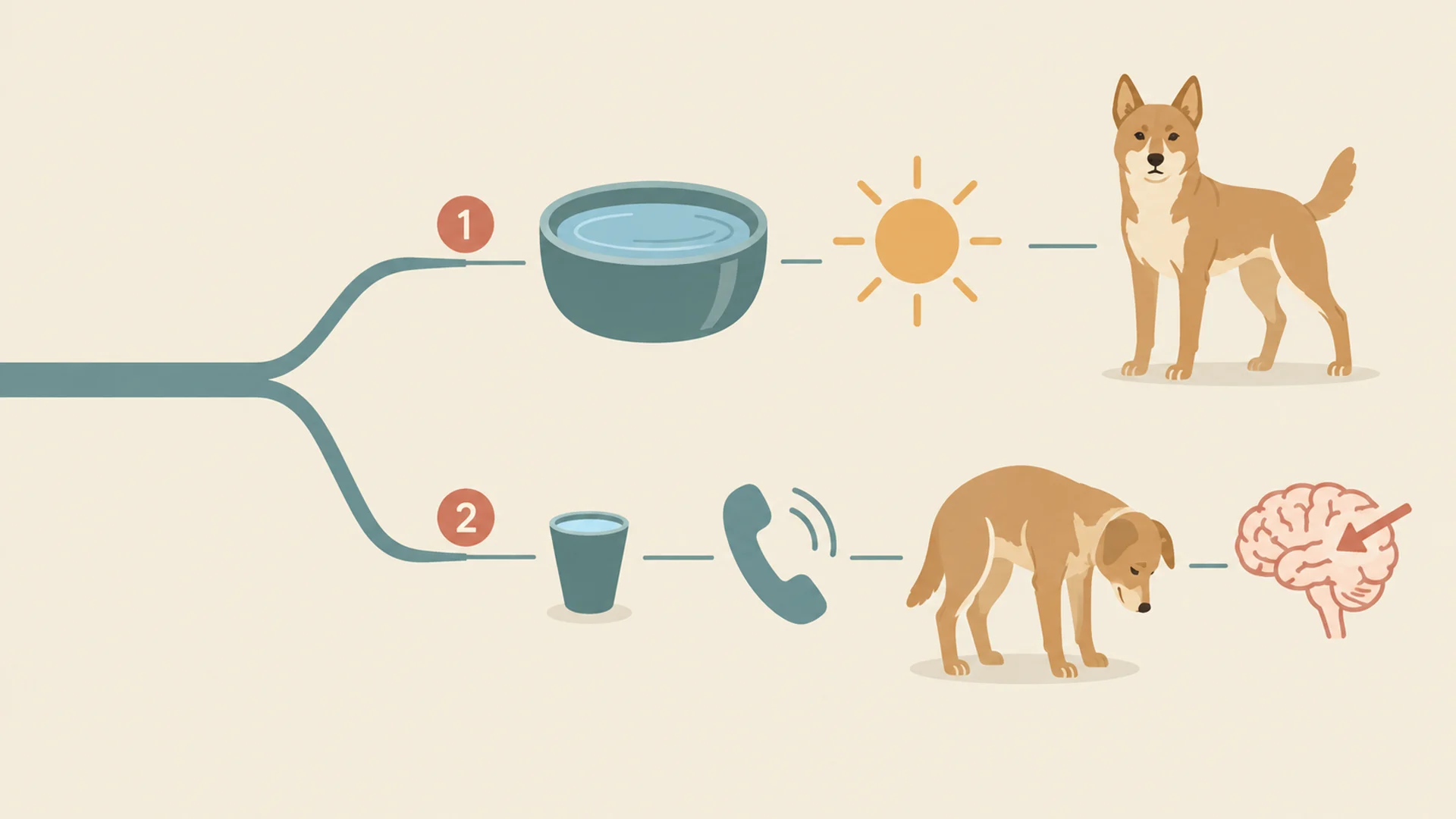
Merck’s treatment guidance is specific about the order of operations: “Fresh water must be provided to all animals, initially in small amounts at frequent intervals to avoid exacerbation of clinical signs.” The reason follows immediately: “Quickly lowering the serum sodium concentration will increase the osmotic gradient between the serum and the brain, with water following the gradient into the brain and increasing the likelihood of severe cerebral edema.”
In plain terms: the correction can hurt as much as the problem if it happens too fast. So the honest version of the advice splits in two. Before anything goes wrong, offer fresh water constantly and generously. After something has gone wrong, small amounts, and get a professional on the phone. AKC quotes Dr. Heather Loenser on where that line sits: “If your dog’s behavior changes after swimming in either fresh or saltwater, take them to the vet immediately for bloodwork.” AKC’s own threshold is lower still — “If your dog shows any of these signs, even diarrhea, call your veterinarian or local veterinary emergency hospital for advice.”
“How much is too much?” has no clean answer
This is the question everybody types, and the reason the results feel evasive is that there genuinely is no published mouthful count. The threshold moves with body weight, how much fresh water the dog has taken on, how salty that particular stretch of water is, and whether the dog is already dehydrated from running in the sun. A 9 lb terrier and a 90 lb Lab are not in the same conversation.
What you can actually observe is behaviour, and that turns out to be the more useful signal. A dog who drinks from the ocean once, gets offered a bowl, and moves on is in a different situation from a dog who is repeatedly biting at waves, who has been out for three hours, and whose water bowl is still in the car. The second dog is the one to interrupt. If you are already thinking about how much your dog has swallowed, the useful next step is a phone call rather than a search — Pet Poison Helpline lists salt as a toxin and takes calls at (855) 764-7661, and your own vet or the nearest emergency hospital is the other number worth having saved before you leave.
| What you see | Roughly when | What it usually means | What to do |
|---|---|---|---|
| Loose stool that evening, dog otherwise bright | Same day | The common outcome from a few gulps | Fresh water available, keep an eye on them, call if it repeats |
| Vomiting | Within several hours of ingestion | Merck lists this as the first sign of excess salt intake | Call the vet — AKC’s threshold for a call is “any of these signs, even diarrhea” |
| Weakness, wobbliness, unusual lethargy | Hours | Moving past the gut into the nervous system | Emergency vet, and bloodwork — this is the behaviour change Dr. Loenser flags |
| Confusion, muscle tremors, seizures | Hours | The severe end of the Merck progression | Emergency vet now; do not try to correct it with water yourself |
Note what is missing from that table: a home treatment column. There isn’t one, and that is not us being cautious — Merck’s own line is that for salt toxicosis “there is no specific treatment,” and the management that does exist is fluid and electrolyte work that has to be done with bloodwork in front of you.
The hazard that arrives in the same mouthful
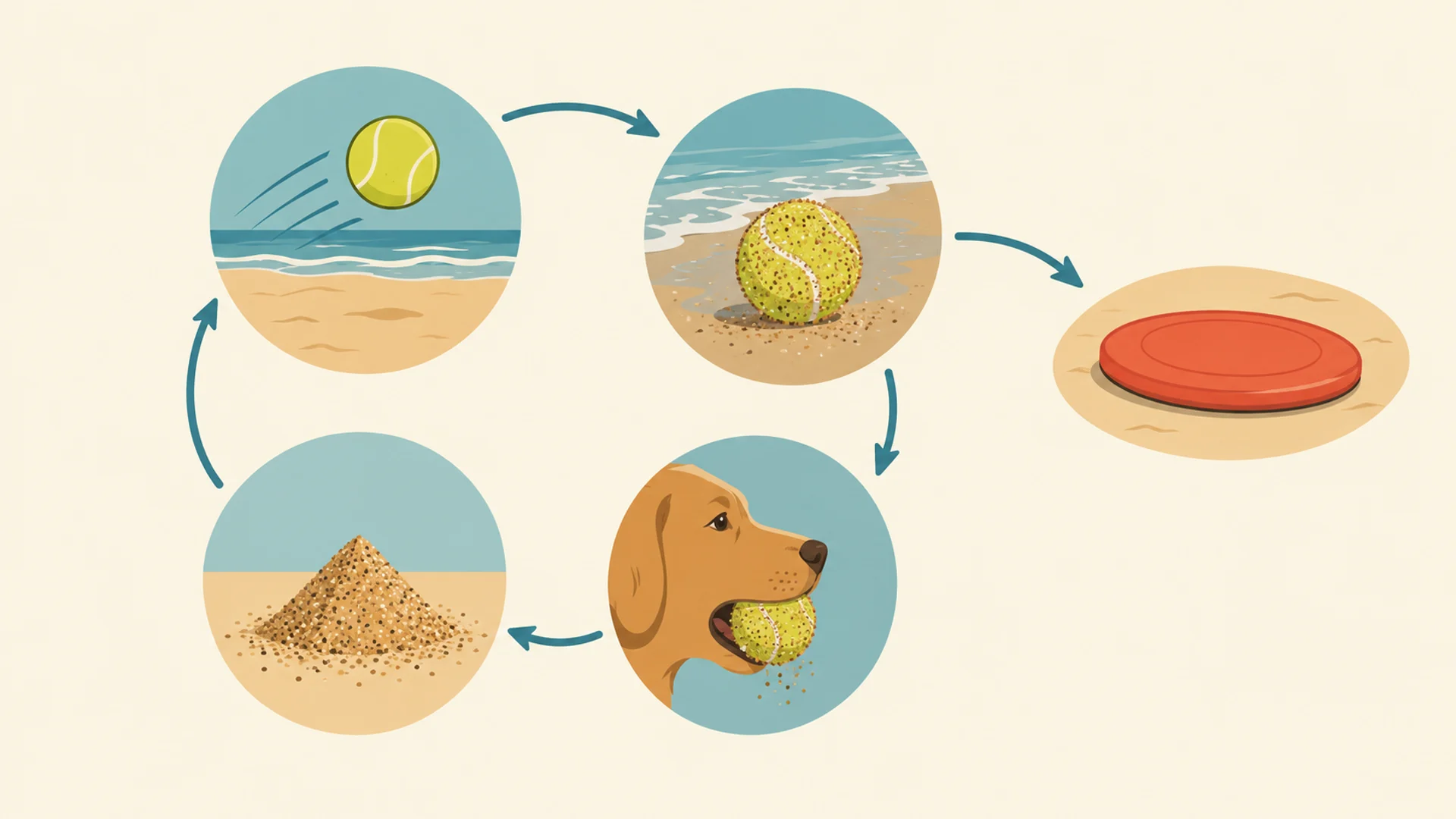
Here is the part almost nobody bundles with the seawater question, even though it comes from the identical behaviour. AKC’s list of how dogs swallow sand at the beach includes “Gulping down salty, sandy water” — the same gulp. The other three routes on that list are worth reading out loud, because they are all things you were planning to do anyway: “Grabbing a wet, sandy tennis ball over and over,” “Digging a big hole to lie in as the sand flies up in their face,” and “Licking the sand off of their paws and body.”
Sand behaves differently inside a dog than you would expect. AKC’s explanation is one sentence: “Particles of sand are very tiny, but when they get wet, they become heavy and compact into a solid lump.” Enough of it and you have an intestinal obstruction rather than an upset stomach.
This is not theoretical. A case series in the Journal of Small Animal Practice — Moles and colleagues, 2010, eight dogs with radiographically confirmed small intestinal sand impaction — found that “all dogs presented with signs of vomiting,” with anorexia, lethargy and abdominal pain also common. Four were treated surgically and four medically; seven of the eight survived. The authors’ conclusion is genuinely reassuring on prognosis: both routes “can be effective and both afford a good prognosis for recovery.” What the paper does not offer is a way to fix it at home.
Vomiting shows up at the top of both lists — salt and sand — which is exactly why a dog throwing up after a beach day is a call rather than a guess. Cornell’s Riney Canine Health Center is blunt about the obstruction side: “GI obstructions are emergencies often requiring surgical removal, and prompt veterinary intervention is critical to achieving the best outcome for your dog.” Cornell’s sign list — vomiting, loss of appetite, abdominal pain, diarrhoea, dehydration, lethargy — overlaps the salt list almost completely. You are not expected to tell them apart on the sand. The vet is.
Running a beach day so neither one happens
Almost all of this is preventable, and the prevention is unglamorous. The single highest-value item is the one Merck’s sentence turns on — fresh water that is actually available, not water that is in the car.
- Bring more fresh water than feels necessary, and put the bowl down. Merck’s condition for toxicosis is fresh water being unavailable. A bowl in the trunk counts as unavailable.
- Offer it on a schedule, not on demand. A dog mid-fetch will not ask. AKC suggests taking “a break away from the water every 15 minutes.”
- Swap the tennis ball for a flying disc. AKC’s specific recommendation, and it removes the highest-volume sand route in one move.
- Interrupt wave-biting. Chasing and snapping at surf is where the large-volume swallowing happens, not casual drinking.
- Rinse the dog before you leave. AKC: “When you leave the beach, bathe or hose off your pup as soon as possible” — it takes the licking route off the table for the drive home.
- Save two numbers before you go. Your vet, and the nearest 24-hour emergency hospital to the beach — not to your house.
- Watch that evening, not just at the beach. Vomiting arrives “within several hours,” which is usually after you are home.
If you are planning where to go in the first place, our guide to dog-friendly beaches in the Bay Area covers which stretches allow voice control and which have the seasonal closures, and the Baker Beach rules get into the water warning the Park Service actually posts there. For the freshwater side of the same problem — how much a working dog needs on a hot day — see how much water a dog needs on a hike.
Dogs and seawater FAQ
My dog drank ocean water and seems fine. Do I need to do anything?
Offer fresh water, get them out of the surf for a while, and plan to watch them through the evening rather than just the next hour. Merck describes vomiting appearing “within several hours after ingestion,” so a dog who is bright on the sand can still show something at home. If anything does appear — even diarrhoea — AKC’s advice is to call.
How much salt water is dangerous for a dog?
There is no published mouthful count, and any site giving you one is estimating. The threshold depends on body size, hydration, and how much fresh water the dog has had. What is documented is the condition that makes it dangerous: swimming or playing in the ocean “without having access to fresh water,” in Merck’s wording. That is the variable you control.
Should I make my dog drink a lot of fresh water right away?
Before anything is wrong, yes — constant access is the whole prevention strategy. If your dog is already vomiting or unsteady, this is where to be careful. Merck’s instruction for affected animals is fresh water “initially in small amounts at frequent intervals to avoid exacerbation of clinical signs,” because lowering blood sodium too quickly drives water into the brain. At that point it is a vet call, not a home fix.
What about my dog eating sand at the beach?
Same trip, same mouthful, different problem. Wet sand compacts into a solid mass and can obstruct the intestine. The documented case series of eight dogs had every one of them vomiting on presentation; half needed surgery and seven of eight recovered. Prevention is mostly about the fetch toy and rinsing off before the drive home.
Is it the same for a dog drinking from a lake or river?
The salt mechanism is specific to seawater, but the behaviour-change rule is not. The veterinarian quoted by AKC applies it to both: if behaviour changes after swimming in fresh or salt water, go in for bloodwork. Fresh water carries its own hazards — algae blooms and waterborne organisms among them — which local health departments post on the water body itself. The everyday version of that is a dog drinking puddle water, where the watching window is about a week rather than an evening.
Can I stop my dog drinking seawater altogether?
Not reliably, and it is the wrong goal to build a day around. Most dogs will take some. The realistic aim is keeping the volume low — a full bowl within reach, regular breaks off the water line, and interrupting wave-chasing, which is where the big swallows happen.
The bowl on the sand is the whole intervention.
Seawater is only dangerous to a dog with no alternative, and the veterinary literature says so in as many words. Put fresh water down where the dog is, break every quarter hour, throw a disc instead of a ball, and hose them off on the way out. If vomiting, wobbliness or confusion turns up afterwards, that is a phone call — not a glass of water and a wait.
Sources
- Merck Veterinary Manual — Salt Toxicosis in Animals (dogs developing hypernatremia after ocean swimming without fresh water; seawater ~3.5% sodium; toxicosis unlikely where fresh water is available; vomiting within several hours progressing to weakness, diarrhoea, tremors and seizures; fresh water in small amounts at frequent intervals; rapid sodium correction and cerebral edema; mortality >50% in affected animals) (checked 2026-09-18)
- American Kennel Club — Is It Dangerous for Dogs to Drink Salt Water? (a few mouthfuls may only cause diarrhoea while large amounts can be fatal; sign list; break away from the water every 15 minutes; call the vet for any sign including diarrhoea; Dr. Heather Loenser on bloodwork after any behaviour change) (checked 2026-09-18)
- American Kennel Club — What If My Dog Eats Sand? (wet sand compacting into a solid lump; the four ingestion routes including sandy tennis balls and gulping salty sandy water; signs; hose or bathe the dog when leaving the beach) (checked 2026-09-18)
- Moles AD, McGhite A, Schaaf OR, Read R. “Sand impaction of the small intestine in eight dogs.” Journal of Small Animal Practice 2010;51(1):29–33 (all eight dogs presented vomiting; four surgical and four medical management; seven of eight survived) (checked 2026-09-18)
- Cornell University College of Veterinary Medicine, Riney Canine Health Center — Gastrointestinal Foreign Body Obstruction in Dogs (sign list; obstructions are emergencies often requiring surgical removal; risk of peritonitis and sepsis) (checked 2026-09-18)
- Pet Poison Helpline — Salt Is Toxic To Pets (gastrointestinal and neurological effects; 24-hour line (855) 764-7661) (checked 2026-09-18)
This is general information, not a diagnosis. Anything to do with your own dog’s health — including whether a sign is worth a visit — is a conversation with your veterinarian or an emergency hospital. Guidance from the organisations above can change; confirm on the official page.