
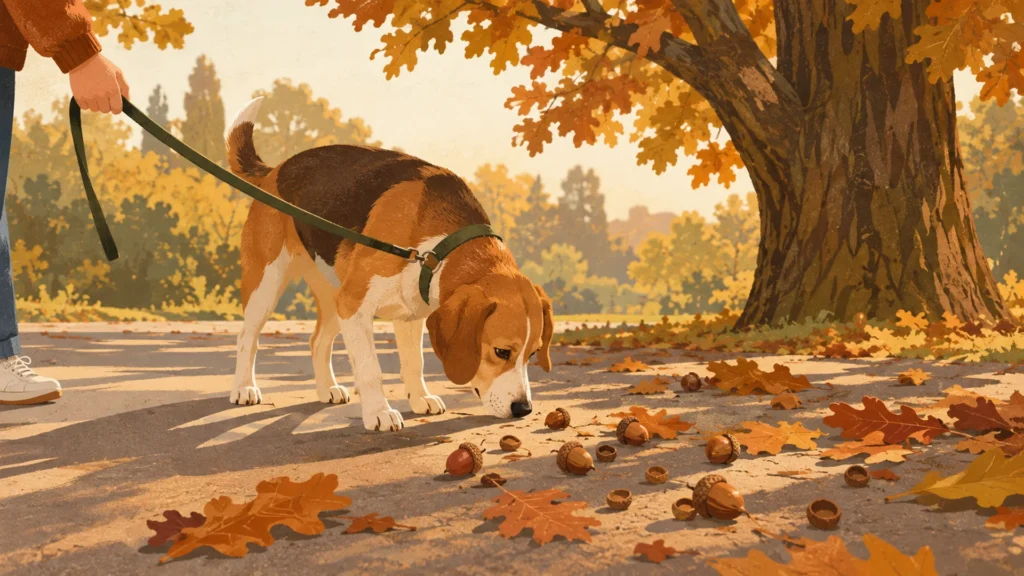
A dog who crunched up one or two acorns on a walk is very unlikely to be poisoned. The thing almost every page gets backwards is which hazard you are actually dealing with: acorn toxicity is, in the veterinary literature, largely a grazing-livestock disease. The Merck Veterinary Manual puts the threshold plainly: “Animals must eat ≥ 75% of their diet from oaks to become intoxicated.” No dog on a normal walk is doing that.
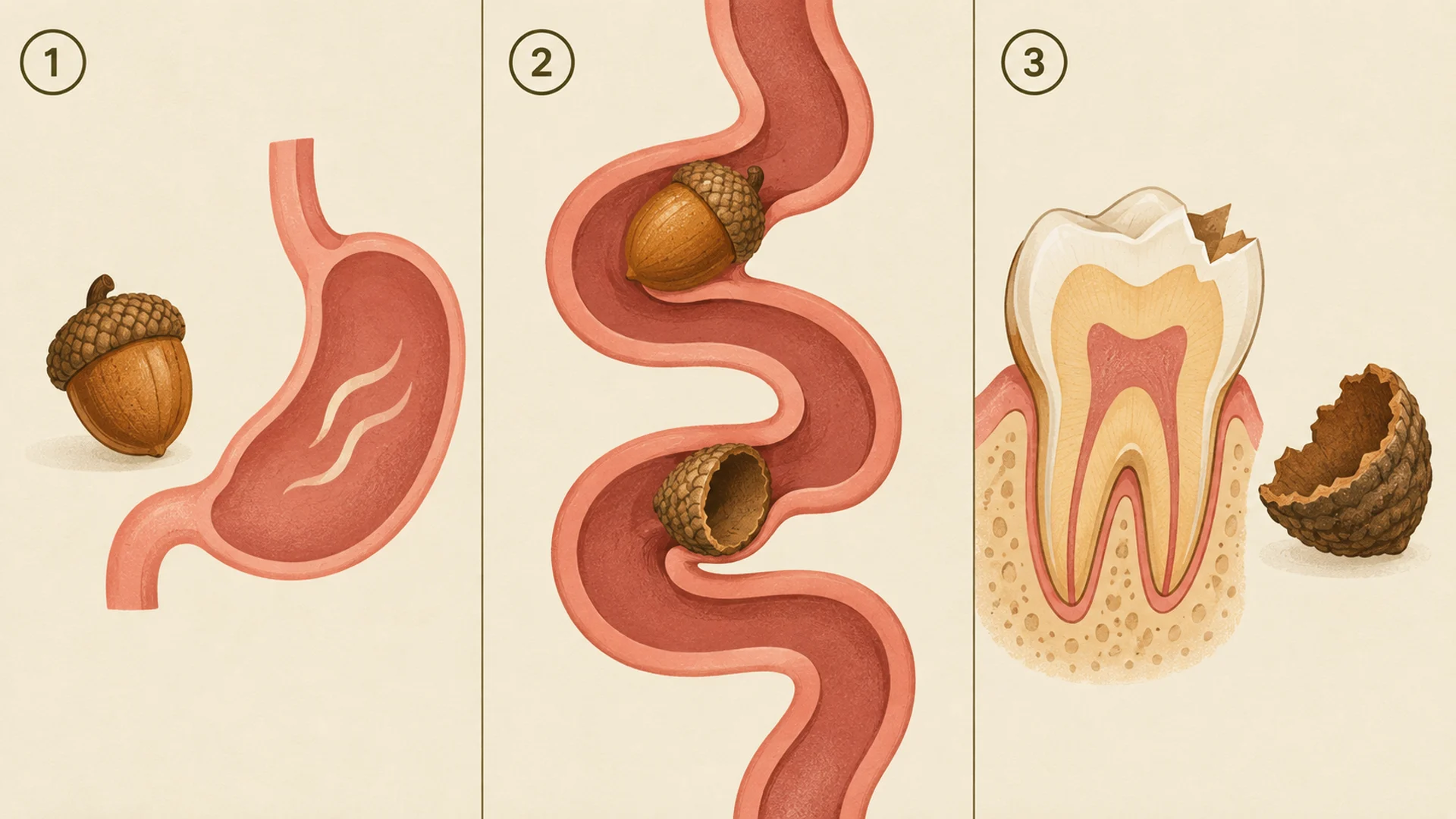
What can go wrong in a dog is mechanical, and it happens at much smaller numbers. The ASPCA’s own plant entry for oak — which, notably, is filed under “Toxic to Horses”, not dogs — still ends its clinical signs list with the line that matters here: “acorns can obstruct the digestive tract.” Texas A&M’s veterinary school makes the same point for dogs specifically, naming choking, intestinal obstruction and dental trauma from chewing alongside ordinary stomach upset.
So: call your vet or a poison line and tell them what you saw — that call is cheap and it is the right move. But go in knowing the honest question is usually how many, how whole, and how big is the dog, not how poisonous is an acorn. And do not try to make your dog vomit at home; whether that helps or makes things worse depends on what is in there, and that is a decision for the vet on the phone.
Where the “acorns are toxic to dogs” line comes from
It is not invented. Acorns and oak leaves contain tannins — gallotannin, in the ASPCA’s wording — and tannins genuinely cause a nasty, sometimes fatal syndrome. It is just that the syndrome belongs mostly to cattle and sheep.
Merck’s summary of oak toxicosis is worth reading in full if you want to stop worrying about the wrong thing. “Most animals are susceptible to oak poisoning; however, cattle and sheep are most commonly affected. Toxicosis has occurred in horses, llamas, exotic ruminants, moose, dogs, and rabbits.” Dogs are on that list — which is why nobody should tell you acorns are harmless — but they are on the far end of it, behind moose.
The two numbers in that entry are the ones to carry around. First, the dietary threshold: “Animals must eat ≥ 75% of their diet from oaks to become intoxicated.” Second, the exposure pattern: “Clinical signs of oak toxicosis in ruminants typically begin after animals consume large amounts of buds and leaves or acorns for 2 to 3 days or longer.” That is a description of an animal standing in an oak grove eating nothing else for days. It is not a description of a Labrador hoovering up four acorns by the bins.
Merck also notes there is no antidote — “No specific treatment exists for oak toxicosis” — and treatment is supportive. That sounds alarming out of context. In context it is one more reason the livestock framing does not transfer: the reason there is no antidote is that the classic cases arrive days into a kidney injury, not minutes after a snack.
What to do, by what you actually saw
The useful sorting question is not how toxic acorns are. It is what went in, in what state, and into what size of dog. Texas A&M’s Dr. Erin Ray frames it the same way: “Most dogs would need to ingest large quantities of acorns to become sick, but not all” — and most dogs tolerate the occasional acorn if they chewed it before swallowing. That last clause is doing a lot of work.
| What you saw | What you are really dealing with | The clock | What to do |
|---|---|---|---|
| One or two acorns, visibly crunched, medium or large dog, acting normal | Stomach upset at worst | Hours to about a day | Call and describe it; expect to be told to watch appetite and stool |
| A whole acorn swallowed without chewing, or several caps | An object-shaped problem, not a chemistry one | Can take days to declare itself | Call now, while there is still a choice about what to do next |
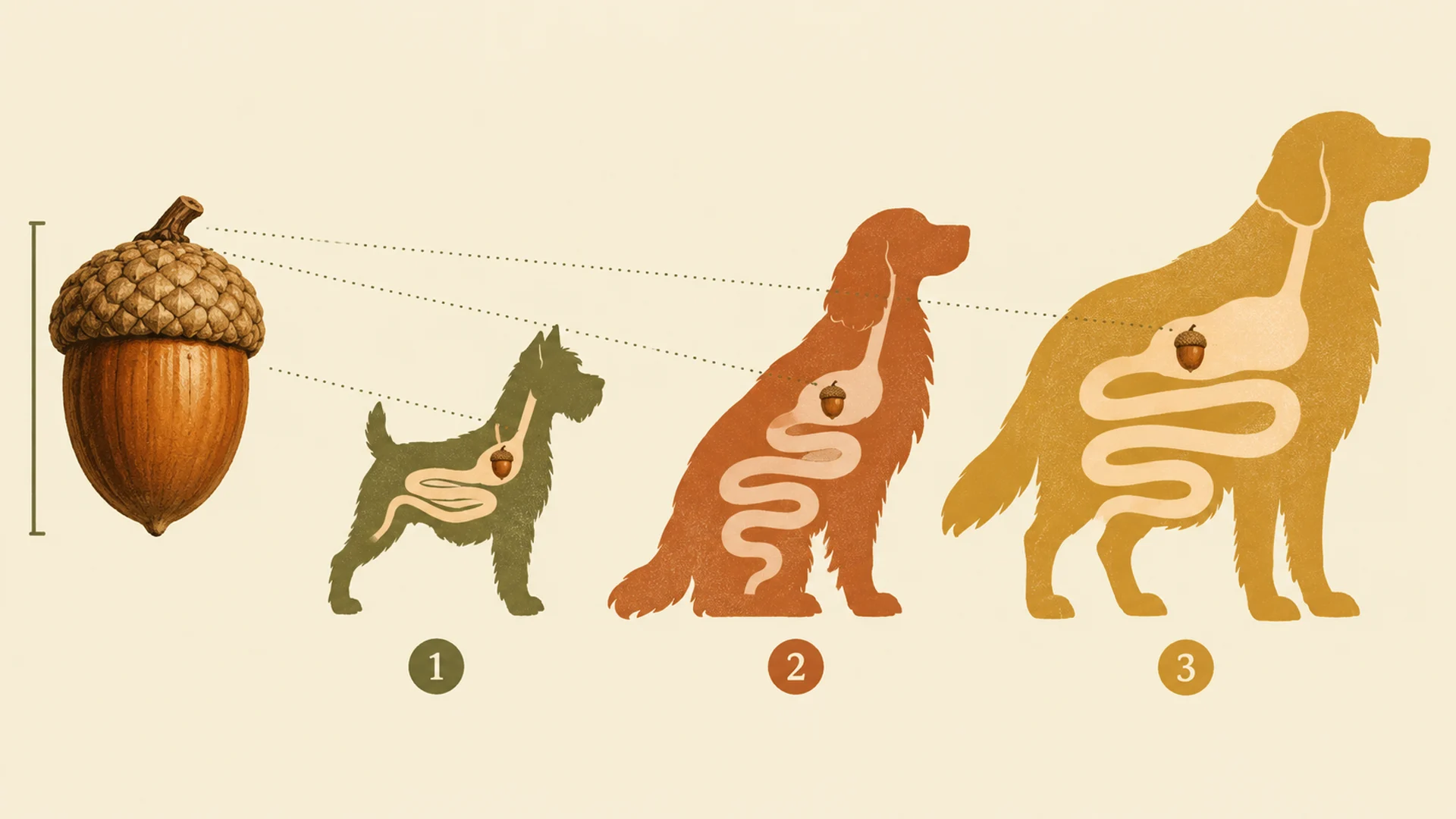
| Small dog or puppy, any whole acorn | Same shape, much narrower plumbing | Same — but the margin is smaller | Call now; say the dog’s weight first |
| Found the stash — a mouthful, a bowlful, the pile under the tree | Volume changes the answer for both hazards | Vomiting often same day | Vet or poison line now, before symptoms |
| Retching, gagging, pawing at the mouth, drooling, distressed | Possible airway or oesophageal obstruction | Immediate | Emergency vet — this one does not get a phone consultation |
| Repeated vomiting, off food, flat, painful belly — at any point in the next few days | The obstruction picture | Hours matter now | Vet, same day, and mention the acorns |
| Acorns that were damp, furry or mouldy | A different hazard entirely — mould, not tannin | Fast, sometimes under an hour | Call; say “mouldy” out loud, it changes the advice |
Obstruction is the one with a surgical clock
This is the hazard worth understanding properly, because it is the one where a delay costs something. Merck’s entry on gastrointestinal obstruction in small animals identifies exactly the dogs most likely to end up there: “Young cats and young large-breed dogs are more likely to develop foreign body obstruction.” Which is to say, the adolescent retriever who swallows things whole on principle — the same dog most likely to inhale an acorn without chewing it.
The signs Merck lists are deliberately ordinary: “anorexia, regurgitation, vomiting, diarrhea, lethargy, or shock,” depending on where the object is and how long it has been there. There is no dramatic tell. A dog who is off their food and quietly flat two days after an acorn incident is giving you the same information as a dog who is vomiting, and it is the kind of thing owners talk themselves out of on a Sunday.
The reason to act on it early is the sentence at the other end of that entry: “Outcome for animals with GI foreign body obstruction is good if the condition is recognized and treated quickly.” The prognosis drops once peritonitis or sepsis have joined in. Diagnosis is not guesswork either — plain radiographs, contrast studies or ultrasound settle it — which is the practical argument for going in rather than watching another night.
The teeth, which nobody mentions
Texas A&M’s list of acorn risks includes one that almost never makes it into an article about poisoning: dental trauma from chewing. An acorn shell is hard, roughly spherical and just the right size to sit between a dog’s carnassial teeth — the same geometry that makes bones, antlers and ice cubes a common cause of slab fractures.
Nothing about this is an emergency. It is worth knowing because it is the one acorn injury that is silent: a dog with a cracked tooth usually keeps eating, and it may be months before anyone notices. If your dog is an enthusiastic autumn acorn-cruncher, it is a reasonable thing to ask about at the next check-up rather than something to panic about tonight.
The first ten minutes
- Get the rest of them out of reach before anything else. Dogs who eat one acorn usually eat five. Whatever else happens, the count stops here.
- Count what you can, and say whether it was chewed. “Two, crunched up” and “one, swallowed whole” get different advice. Guess honestly rather than rounding down.
- Lead with the dog’s weight. The same acorn is a different object in a 9 lb dog and a 70 lb one, and it is the first thing the person on the phone needs.
- Mention the caps separately. The cup-shaped cap is a distinct shape and people leave it out because it is not the nut. Autocomplete is full of people asking about it for a reason.
- Do not induce vomiting on your own initiative. Bringing a hard, irregular object back up the oesophagus is not automatically an improvement. Ask; do not improvise.
- Call even if the dog seems fine. AKC chief veterinary officer Dr. Jerry Klein’s position is blunt: if you think your dog has eaten acorns, “it’s best to call your veterinarian right away.” The ASPCA Animal Poison Control Center is on (888) 426-4435, 24/7 — a consultation fee may apply.
- Write the date down. If something dull shows up in three days, the link to Tuesday’s walk is the single most useful thing you can hand the vet, and it is exactly what you will have forgotten.
- Watch appetite and energy, not just vomiting. Merck’s obstruction list starts with anorexia and lethargy. A dog who goes quiet and off their food has told you something.
Oak leaves, and the part that is specific to autumn
People search for this separately, and the answer is the same as for acorns with the same caveat attached. The tannins are in the leaves too — Merck notes risk rising during “oak budding and leaf growth periods,” and that clinical cases follow animals eating large amounts of buds, leaves or acorns for days on end. A dog who mouths a dry oak leaf off the pavement in October is not that animal.
What is genuinely autumn-specific is supply. Merck notes acorn production varies with precipitation, and anyone who walks the same route every year knows what a heavy mast year looks like: a pavement you cannot see under the nuts. The risk is not that acorns became more toxic. It is that the number your dog can reach in thirty seconds went up by an order of magnitude, and volume is the variable that matters for both hazards on the list.
The mould question belongs to the same season. AKC’s guidance notes that once nuts have fallen they “may become moist and develop a type of mold that can be toxic to dogs” — which is a separate problem from tannins, moves much faster, and is a reason the sodden pile that has been sitting under the tree since the last storm is worse than the acorn that dropped this morning.
What actually stops it
Nothing about acorn season is solved by vigilance alone. Dogs eat them because they are at nose height, they rattle, and they are free. The interventions that hold up are physical and boring.
Dr. Klein’s list is the short version: “Prevention is the best approach” — walk on lead through acorn season, avoid the routes where the nuts are thickest, and get “leave it” and “drop it” to the point where they work with a mouth already full. Texas A&M adds the home half: rake the yard, because the dog who grazes the same patch unsupervised every day is the one who gets to a quantity that matters.
Route choice does most of the work, and autumn stacks several of these on top of each other — the same walks that are suddenly thick with acorns are the ones where dry grass seeds are still a problem, which we get into in how to protect your dog from foxtails, and the ones you are increasingly doing in the dark, where you cannot see what your dog just picked up at all. That is its own argument for a shorter lead on the verge, covered in walking your dog in the dark. If this is the second thing your dog has eaten off the ground this month, our guide to what to do when a dog drinks puddle water uses the same sorting logic: work out which hazard you have before you decide how long to watch.
Dogs and acorns FAQ
How many acorns are toxic to a dog?
There is no published number, and anyone who gives you one is making it up. The only threshold in the veterinary literature is Merck’s, and it is a proportion of the diet rather than a count: “Animals must eat ≥ 75% of their diet from oaks to become intoxicated,” over two to three days or longer. For a dog on a walk, the number that matters is not the toxic dose but the number that could physically block something — and that can be one, if it went down whole into a small dog.
My dog only ate the cap, not the nut. Does that count?
It counts, and arguably it is the version worth calling about. The cap is a stiff, cup-shaped, largely indigestible piece of plant material, which is exactly the profile of a nuisance foreign body. It carries the same tannins as the rest, in a quantity that is not the issue. Say specifically that it was the cap when you ring.
Can dogs digest acorns?
Not really — and that is the point. A chewed acorn largely passes through as fibrous debris; a whole one is a hard object travelling through a tube. Which is why the state it went down in is the question the vet will ask first, and why “he crunched it up” is genuinely reassuring in a way that “he swallowed it” is not.
My dog ate acorns and is throwing up. Is that the poisoning?
Usually it is the far more ordinary thing: an irritant, indigestible object in the stomach. That does not make it ignorable. Merck lists vomiting among the signs of GI obstruction, so the question is not whether vomiting is expected but whether it settles. Repeated vomiting, or vomiting with lost appetite and lethargy, is a same-day vet visit — and mention the acorns unprompted, because it changes what they look for on the X-ray.
My puppy ate an acorn. Is it worse for puppies?
Treat it as more urgent, for two reasons that have nothing to do with tannins. The plumbing is narrower, so the same object represents more of the diameter; and Merck specifically flags young animals as the ones most likely to develop foreign body obstruction in the first place. Call rather than watch.
Are oak leaves toxic to dogs too, including dried ones?
Same compounds, same caveat. The tannin syndrome described in the literature follows animals eating large quantities of buds, leaves or acorns over days, not a dog mouthing a dead leaf on the pavement. Drying does not remove tannins, so a big pile of leaves eaten repeatedly is worth mentioning to your vet — but a single autumn leaf is not the thing to lie awake about.
Should I make my dog vomit before I drive in?
No — not without being told to. Whether decontamination helps depends on what was swallowed, how long ago, and what shape it is, and a hard irregular object coming back up has its own risks. Phone first; the ASPCA Animal Poison Control Center is on (888) 426-4435 and is staffed around the clock.
Ask how many and how whole, not how poisonous.
The toxicology is mostly a livestock story — Merck’s threshold is three-quarters of the diet, for days. The dog story is a shape story: a hard round object, sometimes a stiff cap, in a dog whose size decides how much room it has. So make the call, lead with your dog’s weight and whether it was chewed, and then watch the dull things — appetite, energy, stool — for a few days rather than watching for one dramatic symptom that may never come.
Sources
- Merck Veterinary Manual — Oak Toxicosis (Quercus Poisoning) in Animals (cattle and sheep most commonly affected, with toxicosis also recorded in horses, llamas, exotic ruminants, moose, dogs and rabbits; tannins as the toxic principle; animals must eat ≥ 75% of their diet from oaks to become intoxicated; signs beginning after 2 to 3 days or longer of large intakes of buds, leaves or acorns; acorn production varying with precipitation; no specific treatment, supportive care only) (checked 2026-09-22)
- Merck Veterinary Manual — Gastrointestinal Obstruction in Small Animals (young cats and young large-breed dogs most likely to develop foreign body obstruction; signs of anorexia, regurgitation, vomiting, diarrhea, lethargy or shock; diagnosis by history, bloodwork and imaging including plain and contrast radiographs and ultrasonography; outcome good if recognised and treated quickly, worse with peritonitis or sepsis) (checked 2026-09-22)
- ASPCA Animal Poison Control — Oak, Quercus species, family Fagaceae (listed as toxic to horses; toxic principle gallotannin; clinical signs of abdominal pain, constipation then diarrhoea, depression, frequent urination, discoloured urine and jaundice, with the note that acorns can obstruct the digestive tract) (checked 2026-09-22)
- Texas A&M School of Veterinary Medicine, Pet Talk — What To Know About Dogs and Acorns, with Dr. Erin Ray (gastrointestinal upset, choking hazard, intestinal obstruction and dental trauma from chewing; rare documented cases of liver or kidney damage; most dogs needing large quantities to become sick, but not all; raking yards, avoiding acorn-dense walking routes, and “leave it” training) (checked 2026-09-22)
- American Kennel Club — Can Dogs Eat Acorns and Other Tree Nuts?, with Dr. Jerry Klein (tannins, severe stomach upset, intestinal blockage and choking; fallen nuts becoming moist and developing mould that can be toxic to dogs; prevention as the best approach, on-lead walking through acorn season and “leave it” or “drop it”; calling your veterinarian right away) (checked 2026-09-22)
- ASPCA Animal Poison Control Center (888) 426-4435, available 24 hours a day, 365 days a year; a consultation fee may apply (checked 2026-09-22)
Veterinary guidance changes, and nothing here is a diagnosis or a substitute for your own vet, who knows your dog. If you think your dog has swallowed something they should not have, call a vet or a poison control line rather than waiting to see what happens.