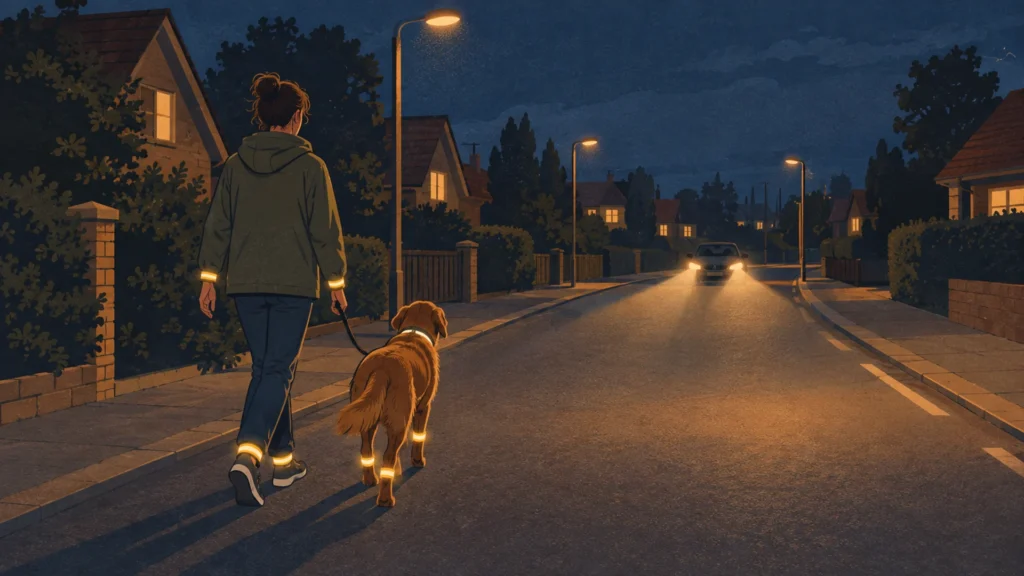
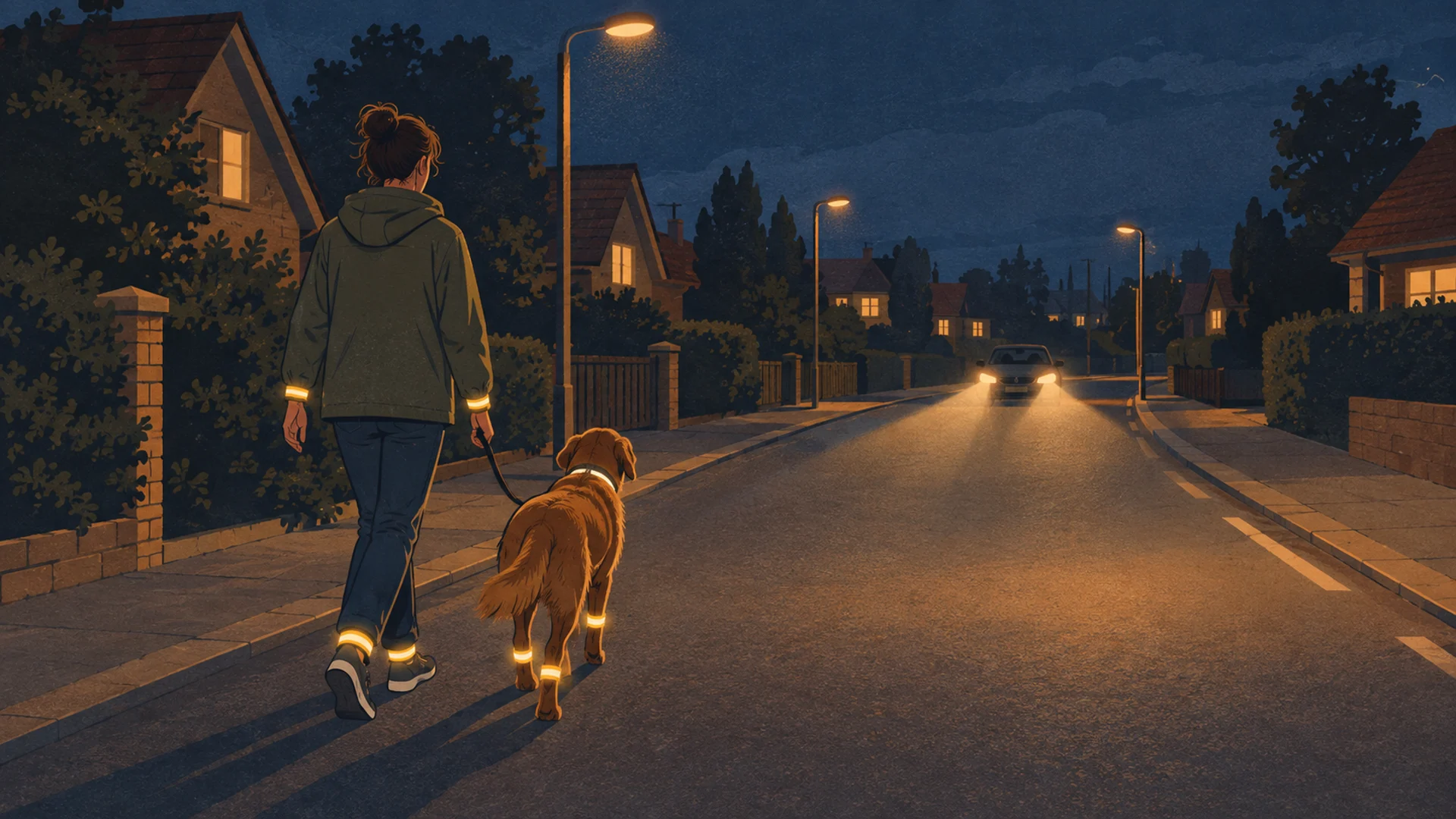
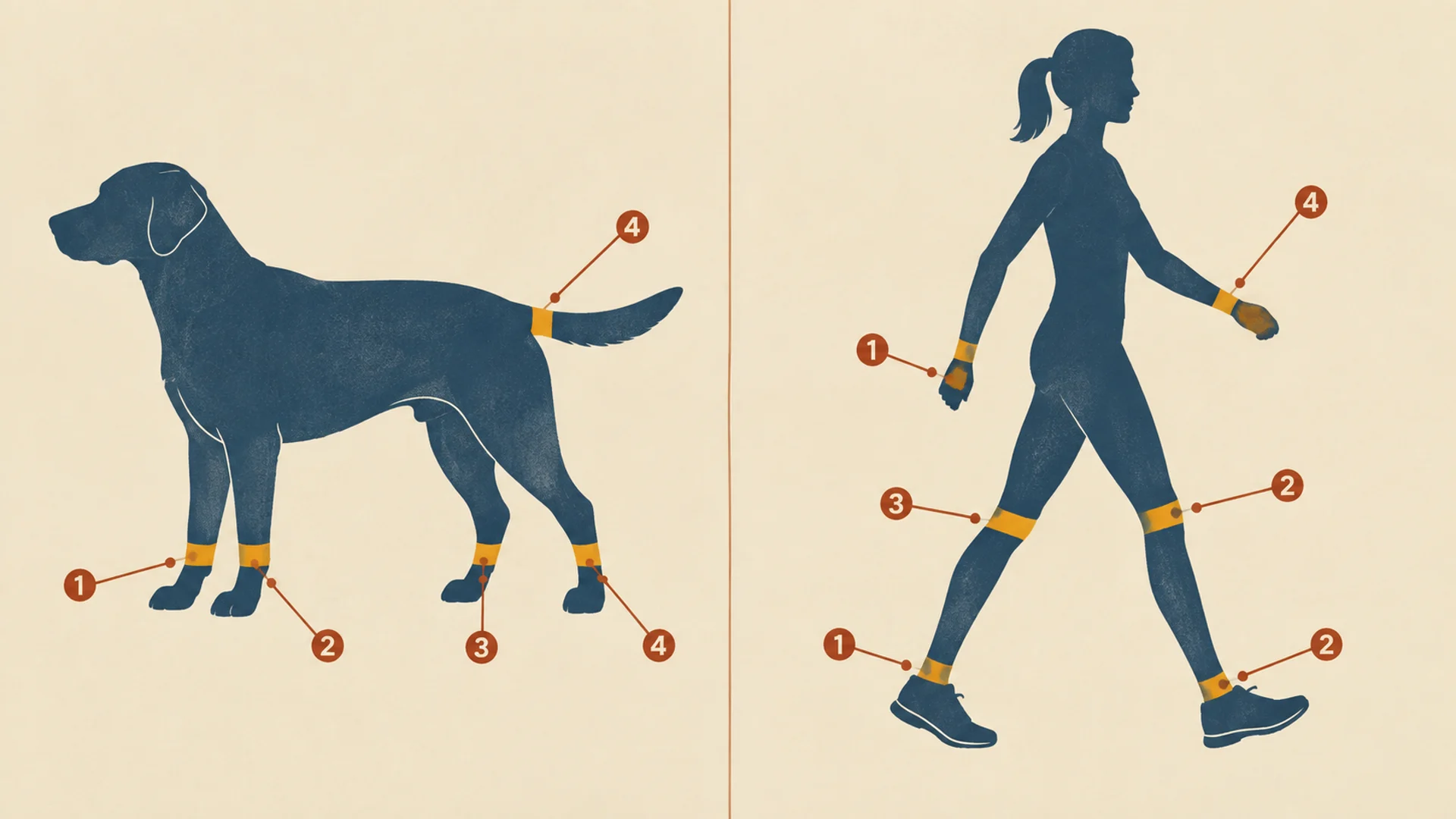
Walking your dog after dark is safe enough if you fix the one thing that actually fails: a driver’s ability to see you in time. Wear and fit reflective material on the parts that move — ankles, knees, wrists, and your dog’s lower legs and paws — rather than one patch on your chest or your dog’s back. In closed-road testing, that placement got people recognised from roughly three times farther away than a standard reflective vest alone.
Then walk where you can be seen: on a sidewalk if there is one, and facing traffic if there is not. Everything else — the light on the collar, the app, the route — is secondary to those two.
The number that should change how you dress
The walk feels routine because it is routine. The crash data is not. NHTSA counts 7,080 pedestrians killed and more than 71,000 injured on US roads in 2024 — one death every 74 minutes.
Where those deaths happen is the part worth internalising. In NHTSA’s Countermeasures That Work review, “76% of pedestrians were killed in collisions that occurred when it was dark, with another 4% occurring during dusk or dawn.” The same review puts 25% of pedestrian fatalities between 6 p.m. and 8:59 p.m. and another 26% between 9 p.m. and 11:59 p.m. — for most households, precisely the evening dog walk. And the gap is widening: across 2010–2019, deaths in the dark rose 58% while daylight deaths rose 16%.
Why “wear something reflective” is not enough
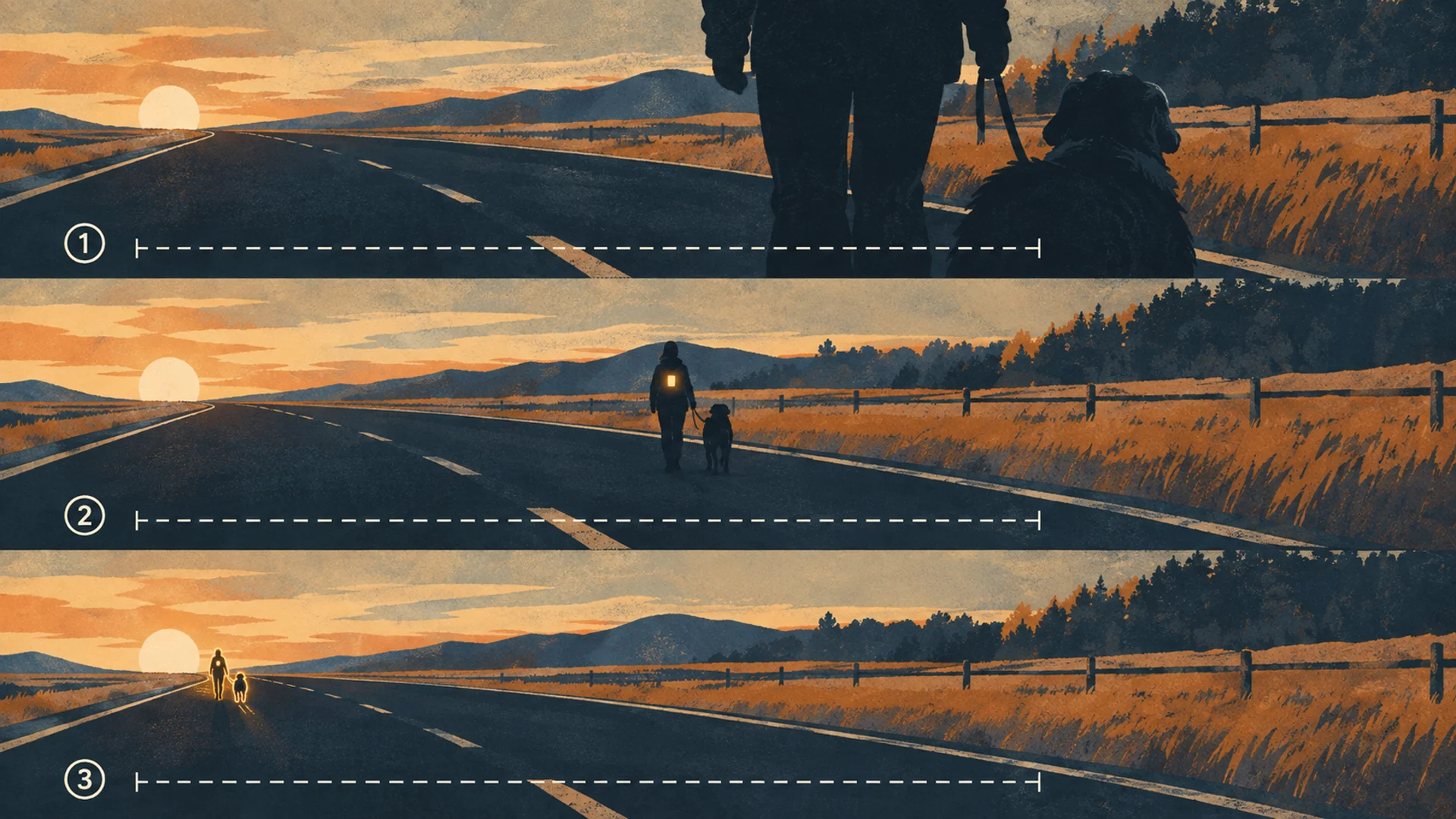
Researchers at Queensland University of Technology and Clemson put drivers on a closed road circuit and asked them to press a button the moment they recognised a pedestrian. In Wood, Tyrrell and Carberry’s 2005 study in Human Factors, drivers recognised just 5% of pedestrians in the worst condition — low beams, black clothing, oncoming glare — and 100% of those wearing retroreflective material arranged to depict biological motion.
The distances are the part that stays with you. Without glare, mean recognition distance ranged from 0.0 m — older drivers, low beams, a pedestrian in black — to 220 m (722 feet) for younger drivers on high beams seeing the biomotion configuration. Zero metres is not a rounding artefact: on average, those drivers had not recognised the person by the time they reached them.
Put the reflective material where the movement is
“Biomotion” is the plain fact that human and animal brains are extraordinarily good at recognising a living thing from the pattern its joints make while moving. A few points of light at the ankles and knees read as a walking person almost instantly. The same amount of reflective fabric, laid flat across a back or a chest, reads as a bright blob — and a bright blob could be a mailbox, a sign, or a reflector post.
A 2014 follow-up in Accident Analysis & Prevention tested this directly on road workers in four conditions: a standard vest; the vest plus thigh strips; the vest plus strips at the ankles and knees; and the vest plus strips arranged on the extremities in a biomotion configuration. Workers in the biomotion arrangement were recognised at significantly longer distances — roughly three times farther — than the vest alone, regardless of which way they were facing.
Two honest caveats. That study measured road workers, not dog walkers, and it measured recognition distance on a closed circuit rather than real-world crash outcomes. And in both studies, older drivers performed worse across every condition. You cannot choose the age or the headlights of the driver coming toward you; you can choose where your reflective material sits.
What this means for your dog
Most dog visibility gear is built the wrong way round. A reflective panel across the back of a harness or coat is one static rectangle a metre off the ground. Meanwhile the parts of your dog that never stop moving — four legs, at roughly twice your step rate — are usually the darkest thing on the road.
So, in rough order of value:
| Where | Why it works | Worth knowing |
|---|---|---|
| Your own ankles and wrists | Highest-value real estate you own. Your gait is the signal a driver reads fastest | Cheap slap-bands do this as well as expensive jackets |
| Your dog’s lower legs and paws | Same principle, lower to the ground, and closer to the road edge than you are | The hardest placement to buy off the shelf; see below |
| Leash and collar | Traces the line between you and the dog, so the pair reads as one connected object | The AKC notes thin retractable cords are hard to see in the dark |
| Coat or harness panel | Adds brightness, adds little shape information | Useful, but not a substitute for the two rows above |
| A steady LED clipped on | Visible without headlights — the only item here that does not need a beam to work | Steady beats flashing for judging distance |
The AKC’s own gear guidance points the same way: reflective collars, reflective leashes, and, if your existing harness has none, high-visibility reflective tape cut into strips and applied yourself. That last suggestion is more useful than it sounds — it is the cheapest way to get reflective material onto the low, moving parts of a dog, which is exactly where nobody sells it. Our Everyday Reflective-Band Small-Dog Paw Boots put a band right at the paw, but they only reach small dogs; for anything bigger, tape and a pair of scissors is the honest answer today.
Your dog can see better than you can
It is worth naming who the weak link is on a dark walk. Per the American Kennel Club, dogs “can see movement and light in the dark (and other low-light situations) better than humans can,” helped by a high number of light-gathering rods and by the tapetum lucidum — a reflective layer behind the retina that acts like a mirror inside the eye. Wild canines were crepuscular, most active at dusk and dawn.
Which means the stumbling, the missed kerb, the unseen broken glass and the dog you did not notice until it was ten feet away are all your limitations, not your dog’s. Plan the route for your eyesight. Pick pavement you already know, and save unfamiliar trails for daylight.
Where to walk, when there is no sidewalk
NHTSA’s walking guidance is short: use sidewalks whenever they exist, and where they do not, “walk facing traffic and as far from traffic as possible.” The reason sits in NHTSA’s own list of common crash types — a pedestrian walking along the road in the same direction as traffic “cannot see a vehicle approaching them from behind.”
Facing traffic also hands you the thing the research says you cannot count on: the chance to decide about a car yourself, rather than waiting to be seen. If a driver has not reacted by the time the headlights are close, you can step off the shoulder. You cannot do that with your back to them.
- Reflective at both ankles, both wrists — yours — before anything else.
- Something reflective low on the dog, plus a steady light that works without headlights.
- A fixed-length leash you can shorten in one motion. Long cord in the dark is a liability; our look at hands-free leashes covers the trade-off.
- Sidewalk if it exists; facing traffic if it does not.
- Collar with a current ID tag actually on the dog — not in a drawer.
- Phone charged, and a route you could walk without looking at it.
If your dog gets loose in the dark
Night is when a slipped collar turns into a search. The AVMA’s microchipping FAQ is blunt about the division of labour: microchips are excellent permanent identification, but “nothing replaces a collar with up-to-date identification tags,” because anyone who finds your dog can read a tag immediately, while a chip needs a scanner and an open shelter or clinic.
The AVMA also flags the failure mode that undoes most chips: a chip only works if it is registered and the contact details are current. And it is not a tracker — “a pet microchip is not a GPS device and cannot track your animal.” If you want location, that is a separate device on the collar.
Walking dogs after dark: FAQ
Is it safe to walk my dog at night?
Yes, with the visibility problem actually solved. The risk that rises after dark is traffic, not your dog: NHTSA attributes 76% of pedestrian deaths to dark conditions, with another 4% at dusk or dawn. Reflective material at the ankles, wrists and your dog’s legs, plus walking facing traffic where there is no sidewalk, addresses most of it.
Is a reflective vest enough?
It helps, but placement beats coverage. In closed-road testing, retroreflective strips arranged on the moving extremities got people recognised about three times farther away than a standard vest alone. If you own one vest, add ankle bands before you buy a second vest.
Reflective gear or an LED light?
Both, because they fail differently. Retroreflective material only returns light that hits it, so it does nothing for a cyclist with no light or a driver who has not reached you. An LED emits its own light and is visible without a beam, but gives a driver far less information about what you are. Pair a steady LED with reflective bands on the limbs.
Should the light flash or stay steady?
Steady is easier to judge distance and direction from; a flashing point gives an observer nothing to track between flashes. Neither is a substitute for reflective material arranged on the parts that move.
Can dogs see in the dark?
Better than we can. The AKC credits a high density of rod cells and the tapetum lucidum, a reflective layer behind the retina. Dogs are not nocturnal, but their ancestors were crepuscular — built for dusk and dawn. On a dark walk you are the one with the vision problem.
What time of evening is riskiest?
NHTSA’s data puts 25% of pedestrian fatalities between 6 p.m. and 8:59 p.m. and 26% between 9 p.m. and 11:59 p.m. In autumn, when sunset moves earlier each week, the routine 6 p.m. walk crosses into that window without anything about the walk itself changing.
Autumn is the season this catches people out. Nothing about the walk changes; the sun just sets earlier each week, and the same route is suddenly a night walk. Move the reflective bands onto the parts of you and your dog that move — and in heavy rain or smoke, shorten the walk rather than leaning on gear, the same call we make in what AQI is safe to walk your dog. Autumn brings one more visibility problem on rural and state land, with a completely different audience: see walking your dog during hunting season.
Sources
- National Highway Traffic Safety Administration — Pedestrian Safety (2024 fatality and injury counts; walking safety tips; common crash types) (checked 2026-09-11)
- NHTSA, Countermeasures That Work — Pedestrian Safety (light conditions, time of day, 2010–2019 trend) (checked 2026-09-11)
- Wood JM, Tyrrell RA, Carberry TP. “Limitations in drivers’ ability to recognize pedestrians at night.” Human Factors 2005;47(3):644–53 (checked 2026-09-11)
- Wood JM, Marszalek R, Lacherez P, Tyrrell RA. “Configuring retroreflective markings to enhance the night-time conspicuity of road workers.” Accident Analysis & Prevention 2014;70:209–14 (checked 2026-09-11)
- American Kennel Club — Can Dogs See in the Dark? (checked 2026-09-11)
- American Veterinary Medical Association — Microchipping: FAQs for pet owners (checked 2026-09-11)
Traffic safety figures are revised as new crash years are published, and local rules about where pedestrians may walk vary by state and municipality. Confirm current guidance on the official page. Anything concerning your own dog’s eyesight, mobility or health belongs with your veterinarian.