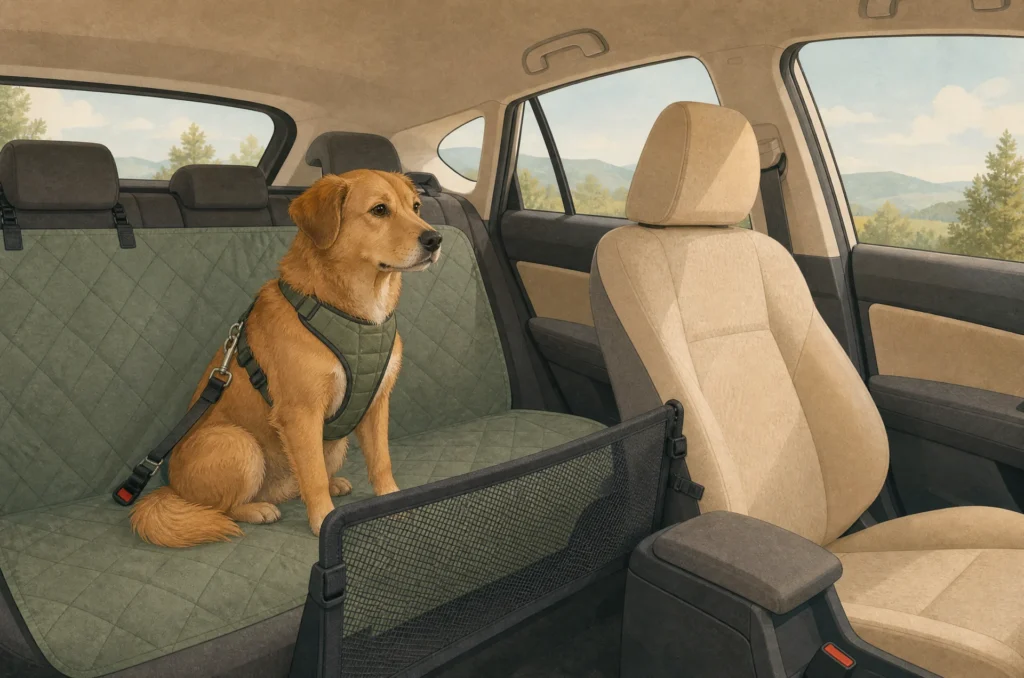
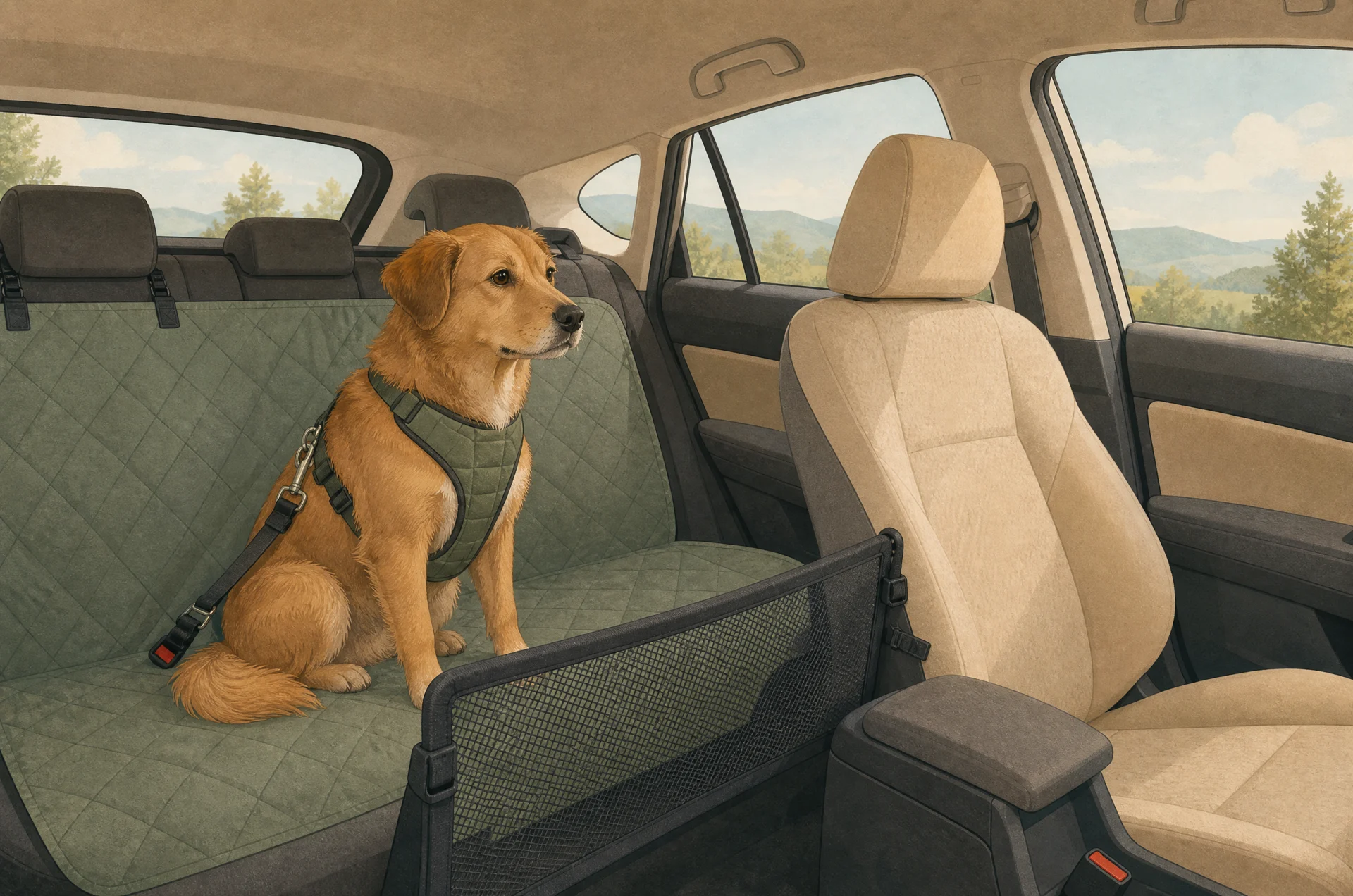
To keep a dog in the back seat, you have to hold the dog, not just block the gap. That means a car harness buckled into a rear seat belt, a belted booster seat for a small dog, or a crate that is strapped down. A mesh barrier between the front seats stops the climbing, and it is a good addition, but it is not a restraint. Tire the dog out before you leave, keep the first few trips short, and never leave the front seat as the fallback when the barrier fails.
The reason is the airbag, not good manners. The front passenger airbag inflates in less than 1/20th of a second, according to NHTSA, and anyone too close to it when it opens can be seriously or fatally hurt. The AVMA says in its pet safety in vehicles guidance that unrestrained pets “may be crushed by deployed airbags.” A dog that keeps landing in the front seat is sitting right where that happens.
Why dogs keep ending up in the front seat
If you read enough reviews of back-seat barriers, the same few stories keep coming up. One dog rode up front for years and now treats the back seat as a demotion. Another leans on the net every trip until the bungee cords give out, or squeezes past the edge where the net does not quite reach the door pillar. Some dogs simply go over the top to watch the passenger or keep guard. A few get tangled in the net itself.
What all of these have in common is a dog that is free to move and a boundary that it can test hundreds of times on every drive. A barrier on its own is asking the dog to give up. A restraint takes the question away. The AVMA’s list of proper restraints is short: “an appropriate safety harness, crate, or carrier.” A barrier is not on it.
Where in the car a dog should ride
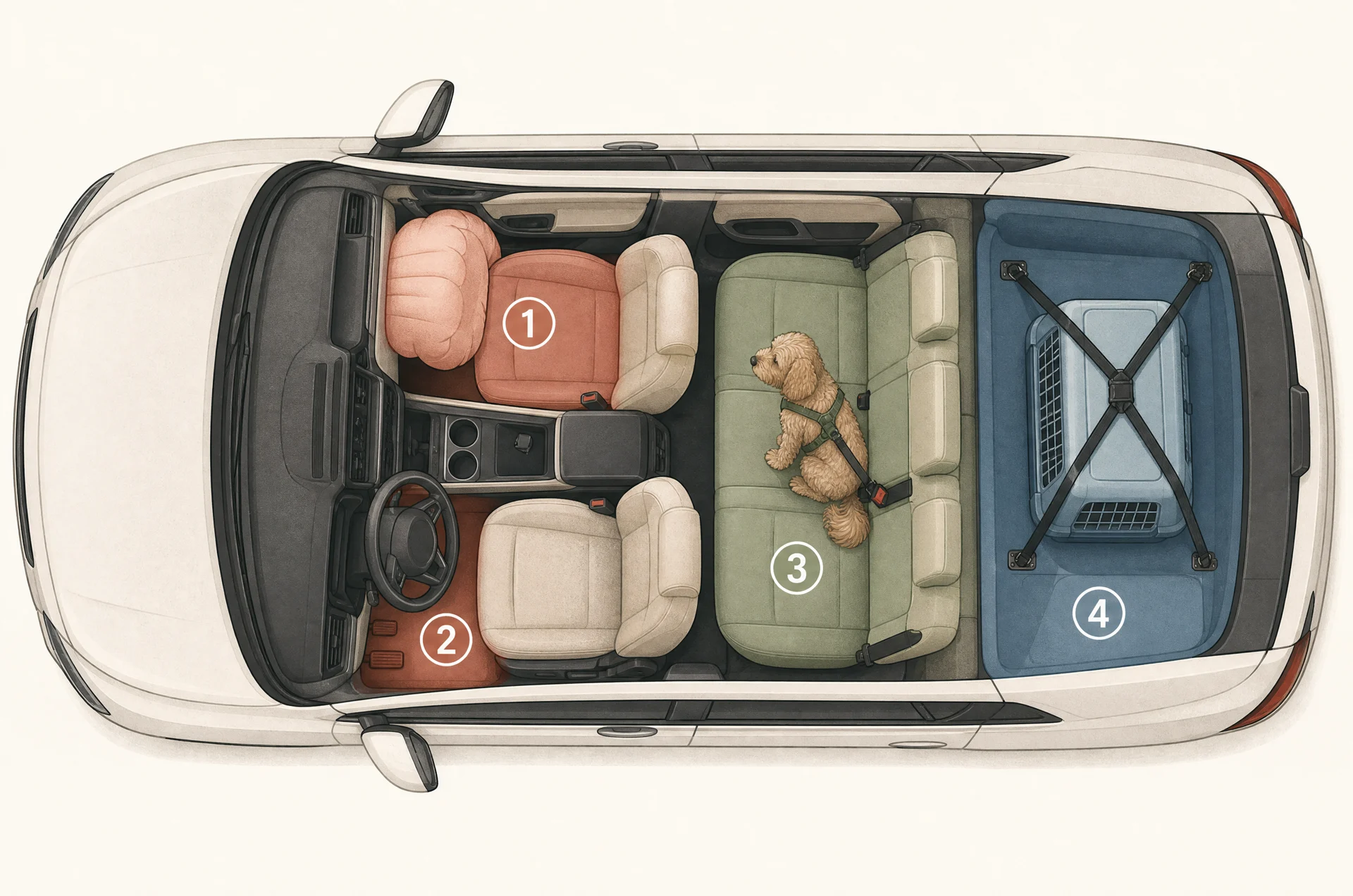
- ① Front passenger seat: no. AKC says it is “optimal for dogs to be in the backseat of the car over the front so that they’re not harmed by air bags.” Human car-seat safety follows the same logic. NHTSA says rear-facing car seats should never sit in front of an active airbag and children under 13 belong in the back.
- ② Your lap or footwell: never. The AVMA lists what goes wrong here: a small pet “could crawl down in the footwell, interfering with your use of the brake or accelerator pedal,” and a large pet leaning across your lap can block your view of the road.
- ③ Rear bench, restrained: the default. The Center for Pet Safety’s short version of safe travel ends with “Secure pets in the back seat.” For a crate or carrier, the AVMA adds that you should place it “as near to the center of the vehicle as possible” and secure it so it cannot move.
- ④ Cargo area: crates only, and check the anchors. The Center for Pet Safety’s cargo-area advisory warns that cargo anchors “are not always weight-rated for the forces generated in an accident.” Ask your vehicle manufacturer before you rely on them, and hold the crate down with strength-rated straps.
Four ways to hold a dog in the back seat
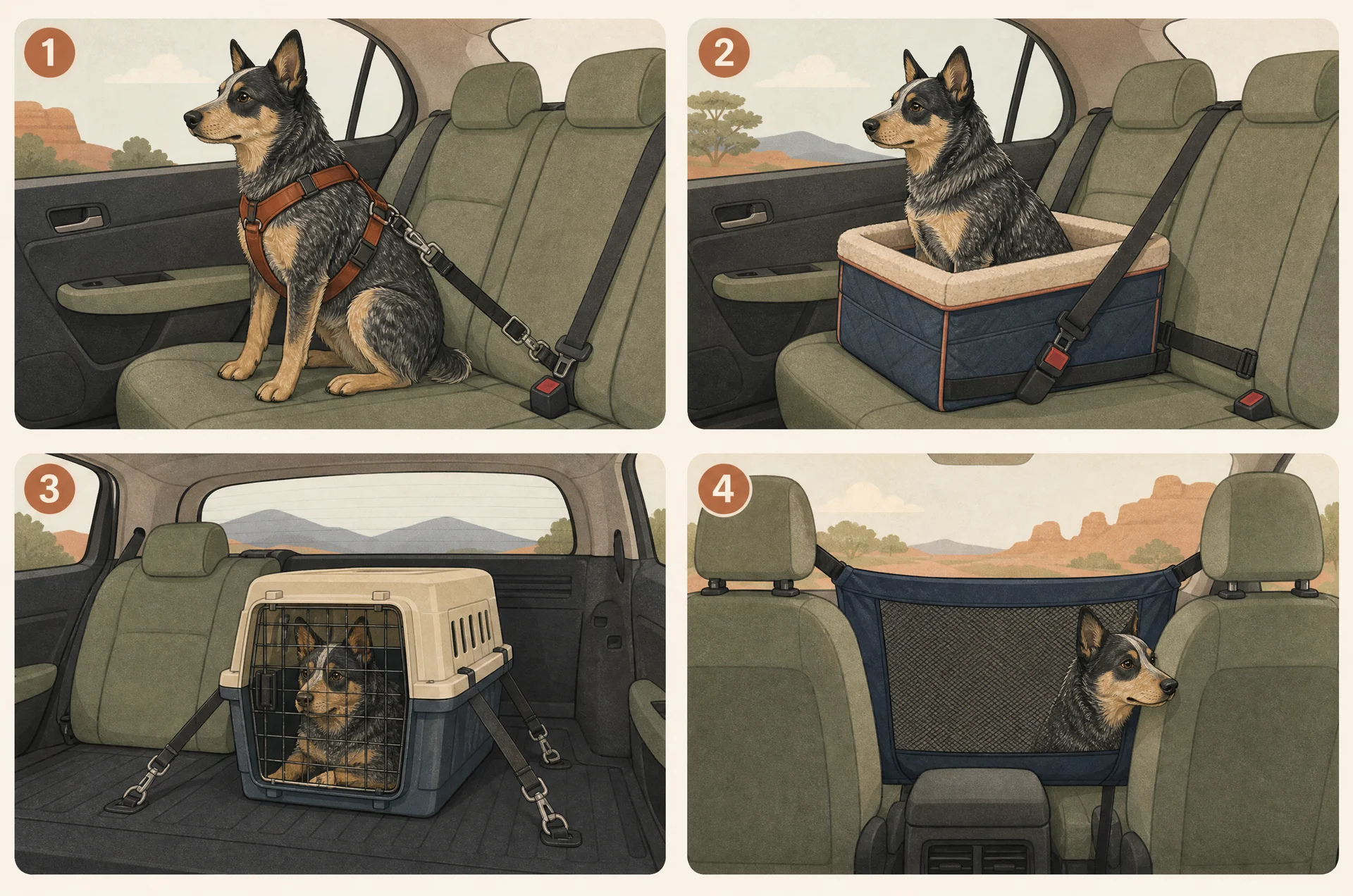
| Option | Stops the climb forward? | Holds the dog in a hard stop? | Best for | Watch for |
|---|---|---|---|---|
| Car harness + rear seat belt | Yes, if the connection is short | That is its job. Look for a crash-tested one. | Most dogs from mid-size up | A walking harness is not a car harness. Skip long extension tethers. |
| Booster or open-top car seat | Yes, with the internal tether set short | Only partly. It raises and contains a small dog, but an open-top seat is not an enclosure. | Small dogs who settle better when they can see out | Belt it in properly and clip the tether to a harness, never a collar |
| Crate, strapped down | Yes, completely | Only as well as the straps and anchors hold | Anxious dogs, long drives, SUVs with room | Cargo anchors may not be rated. A loose crate becomes a projectile. |
| Mesh or hard barrier between the seats | Mostly. Dogs work at the gaps. | No. It does not hold the dog. | Adding a boundary to one of the three above | Gaps at the door pillars, bungee fatigue, dogs getting tangled |
If your dog already rides in a seat or crate, our guides on installing a dog car seat so it does not slide and what “crash tested” really means cover the fitting. The short version is that the straps and buckles are where things fail, not the padding.
The zipline trap
A common fix for a dog that keeps climbing forward is a long tether or zipline. It clips to the harness and lets the dog walk the width of the bench. It seems like a good middle ground. The Center for Pet Safety disagrees firmly. It does not recommend extension tethers or zipline-style products, and it says they “cancel out any crash-protection benefit” of the harness they are attached to. It describes how the extra slack lets a dog be “thrown forward and then snapped back.” It also says CPS has received reports of spinal and orthopedic injuries. The AVMA makes a related point about tethers in pickup beds: the tether “could tangle, injure, or even choke your dog.”
So the connection should be short. Your dog should be able to sit, stand and lie down, but not reach the gap between the front seats. If that feels restrictive, the barrier is there to help with the rest.
Making a barrier actually work
A barrier works well when it is the second layer. It keeps noses, paws and flying toys out of your space while a harness or crate does the holding. To stop it becoming the thing your dog spends the drive testing:
- Close the side gaps first. Dogs rarely go through the middle of a net. They go around the edges by the door pillars. Pick a barrier wide enough for your car, and anchor it low as well as high so the bottom edge cannot be lifted with a nose.
- Check the cords every month. Elastic that a dog leans on every trip loses tension. A slack barrier is an invitation.
- Do not let the dog reach it. If the harness connection is short enough, the dog cannot get close enough to lean on the net, climb it or get tangled in it. That fixes three problems at once.
- Never use it as a restraint. In a hard stop, a barrier might catch a small dog, or it might not. Nobody has told you how strong it is, so do not plan around it.
Our Road Mesh Dog Car Seat Divider is this kind of product. Use it as a boundary in addition to a restraint, not instead of one.
Teaching a front-seat dog to settle in the back
A dog that has ridden up front for years is not being naughty. It is doing what it has always been allowed to do. The change is easier if the back seat quickly becomes the better seat:
- Burn energy first. AKC’s advice is that “the best dog passenger is a tired one.” A walk or a game of fetch before you leave makes it far more likely the dog will lie down.
- Start with short trips that end somewhere fun. If every drive ends at the vet or the groomer, the car starts to feel stressful. Short rides to the park or the beach teach the dog that the back seat leads somewhere good. AKC’s car comfort guide makes the same point.
- Make the spot theirs. Put down the dog’s own blanket and a chew it only gets in the car. Clip the harness in before you get in yourself, so the dog is never free in the cabin while you are distracted.
- Deal with nausea separately. Some dogs climb forward because they feel sick, not bossy. Skip the meal right before a drive, and if the dog drools, pants or throws up, talk to your vet. Our guide to car sickness and booster seats covers what a raised seat can and cannot do.
What the law says
There is no single US rule, and it changes from state to state. Some states write it down plainly. Hawaii’s statute HRS §291C-124 says no one driving may “hold in the person’s lap, or allow to be in the driver’s immediate area, any person, animal, or object” that interferes with control of the car. Elsewhere, a dog loose in the cabin may come under distracted-driving or animal-welfare laws instead. The AVMA also notes that driving with a dog loose in a pickup bed is “illegal in many states.” Rules change, so check your own state’s statutes or DMV before a long trip across state lines. Our car travel carrier guide covers setups for longer drives.
Can dogs ride in the front seat?
They can physically, but every source we checked advises against it because of the passenger airbag. NHTSA says airbags deploy in under 1/20th of a second and can seriously injure anyone too close to them, and the AVMA says unrestrained pets may be crushed by them. The back seat, restrained, is the answer from AKC, the AVMA and the Center for Pet Safety alike.
Can I turn off the passenger airbag so my dog can ride up front?
Not in the way you might hope. NHTSA only authorizes airbag on-off switches in four situations, and all of them involve people, such as a rear-facing infant seat with no usable back seat. Automatic “passenger airbag off” systems decide based on the weight and pressure on the seat, and NHTSA notes that anything adding or subtracting weight can cause a misclassification. A dog on that seat is exactly the kind of case those systems were not designed around. Move the dog, not the airbag setting.
Is it illegal to drive with a dog on your lap?
In some places, explicitly. Hawaii’s HRS §291C-124 bans holding an animal in your lap, or having one in the driver’s immediate area, if it interferes with control of the vehicle. Other states rely on broader distracted-driving rules. Whatever the law says, the AVMA’s reasons for keeping a dog off your lap are practical ones: pedals, visibility, and the airbag in the steering wheel.
Are dog seat belt ziplines safe?
The Center for Pet Safety says no. It does not recommend extension tethers or zipline-style products because the extra slack lets a dog be thrown forward and snapped back, and it says these add-ons cancel out the crash protection of the harness. Use a short, direct connection instead.
How do I keep a big dog in the back of an SUV?
A strapped-down crate in the cargo area, or a car harness on the rear bench. If you use the cargo area, check with your vehicle manufacturer that the anchors there are strength-rated. The Center for Pet Safety warns that many are not. A cargo barrier can keep the dog from coming over the seat back, but like any barrier, it should not be the only thing holding the dog.
My dog whines and paws at the barrier the whole way. What now?
Shorten the harness connection so the dog cannot reach the barrier, and work on the back seat as a good place with short, fun trips. If the dog is also drooling, panting heavily or vomiting, it may be car sickness or anxiety rather than protest. That is worth raising with your vet, who can help with both.
Sources
- American Veterinary Medical Association — Pet safety in vehicles (restrain with “an appropriate safety harness, crate, or carrier”; loose pets may interfere with pedals or the driver’s view and “may be crushed by deployed airbags”; crates near the centre of the vehicle, secured; a tether “could tangle, injure, or even choke your dog”; loose dogs in pickup beds illegal in many states) (checked 2026-09-28)
- National Highway Traffic Safety Administration — Air bags (inflation in less than 1/20th of a second; serious or fatal injuries if too close; children under 13 in the back seat; on-off switch authorization limited to four human circumstances; weight-sensing misclassification) (checked 2026-09-28)
- Center for Pet Safety — Warning: Extension Tethers Put Pets and Families at Risk (does not recommend extension tethers or zipline-style products; “clothes-line” effect; add-ons “cancel out any crash-protection benefit”; “Secure pets in the back seat”) (checked 2026-09-28)
- Center for Pet Safety — Cargo Area Connection Advisory (cargo anchors “are not always weight-rated”; verify with the vehicle manufacturer; secure crates with strength-rated anchor straps) (checked 2026-09-28)
- American Kennel Club — How to Keep Your Dog Comfortable During Car Rides (back seat over front because of airbags; a barrier helps prevent jumping forward; exercise before the drive; short pleasant trips; avoid feeding right before) (checked 2026-09-28)
- Hawaii Revised Statutes §291C-124 — Obstruction to driver’s view or driving mechanism (no holding an animal in the driver’s lap or immediate area where it interferes with control) (checked 2026-09-28)
Traffic laws and safety guidance change, and they vary by state and province. Check your own state’s statutes or DMV, and your vehicle’s owner’s manual, before you rely on any setup.
Hold the dog, then block the gap. Never the other way round.
A harness on a short connection, a belted seat or a strapped crate keeps the dog in the back. A barrier keeps the rest of the cabin clear. Put the two together, tire the dog out before you leave, and make the back seat the spot where good trips start. The front seat stays empty because the airbag in front of it was built for an adult, not a dog.