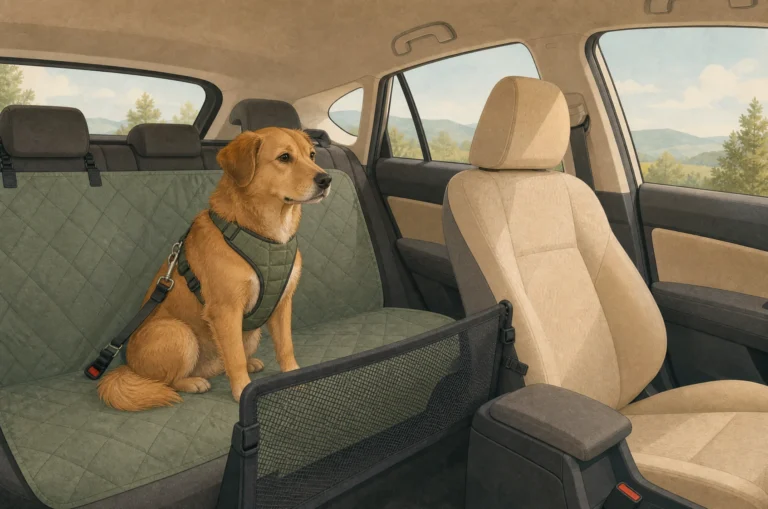
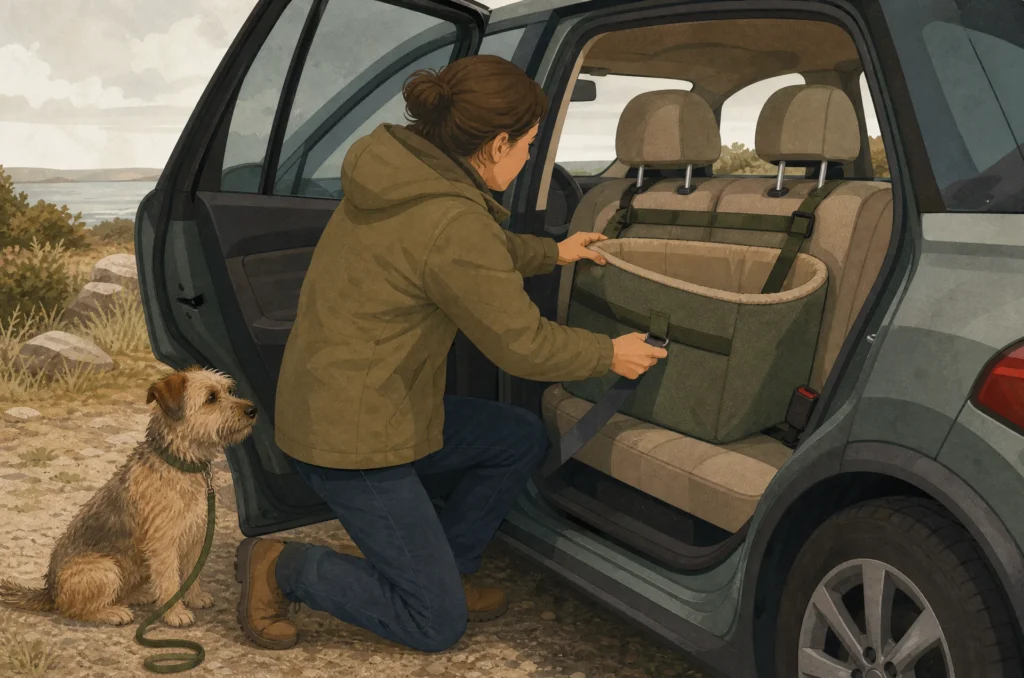
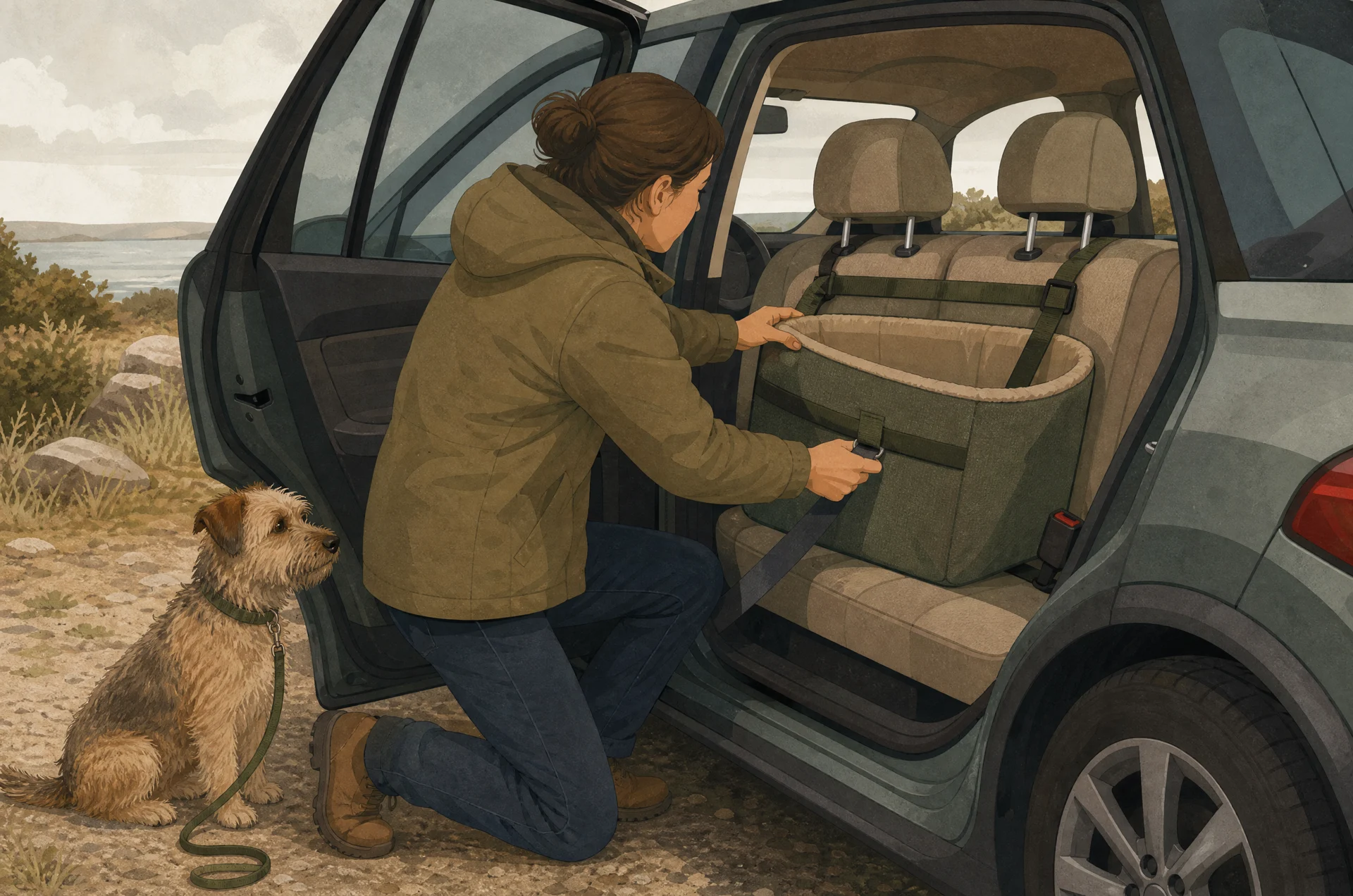
A dog car seat is held down by the vehicle’s seat belt, and steadied by a strap around the headrest posts. That is the whole installation. Run the belt through the loops on the back or underside of the seat, buckle it, pull it tight, then loop the top strap around both headrest posts and cinch until the seat stops rocking. Back seat only. Then clip the internal tether to a body harness — never a collar — and shorten it until your dog can sit, stand and lie down but cannot reach the edge of the seat.
The part most people get wrong is the part nobody photographs: the anchor. When the Center for Pet Safety crash-tested four popular pet travel seats, every single one failed at a connection — a plastic buckle, an anchor strap, a piece of wire hardware — not at the padding. If you only have five minutes, spend them on the straps.
Why the instructions in the box are usually so thin
Child car seats come with a booklet because they have to. Pet products do not. As the AVMA put it in a 2023 report on pets and vehicles, “There’s recommendations but there are no rules” — and “unlike restraints for humans, there are no standards or industry tests for them.” The same piece notes that the Center for Pet Safety is the only nonprofit running testing and performance requirements for this category at all.
That is why so many listings show a photo of the finished setup and leave you to reverse-engineer it, and why searching for your exact brand plus the word “instructions” is such a common move. It is also why the generic method below matters: the hardware in your car is standardised even when the product is not.
The four things in your back seat you could attach to — and what each one is for
Open a rear door and there are four pieces of hardware within reach. They are not interchangeable.
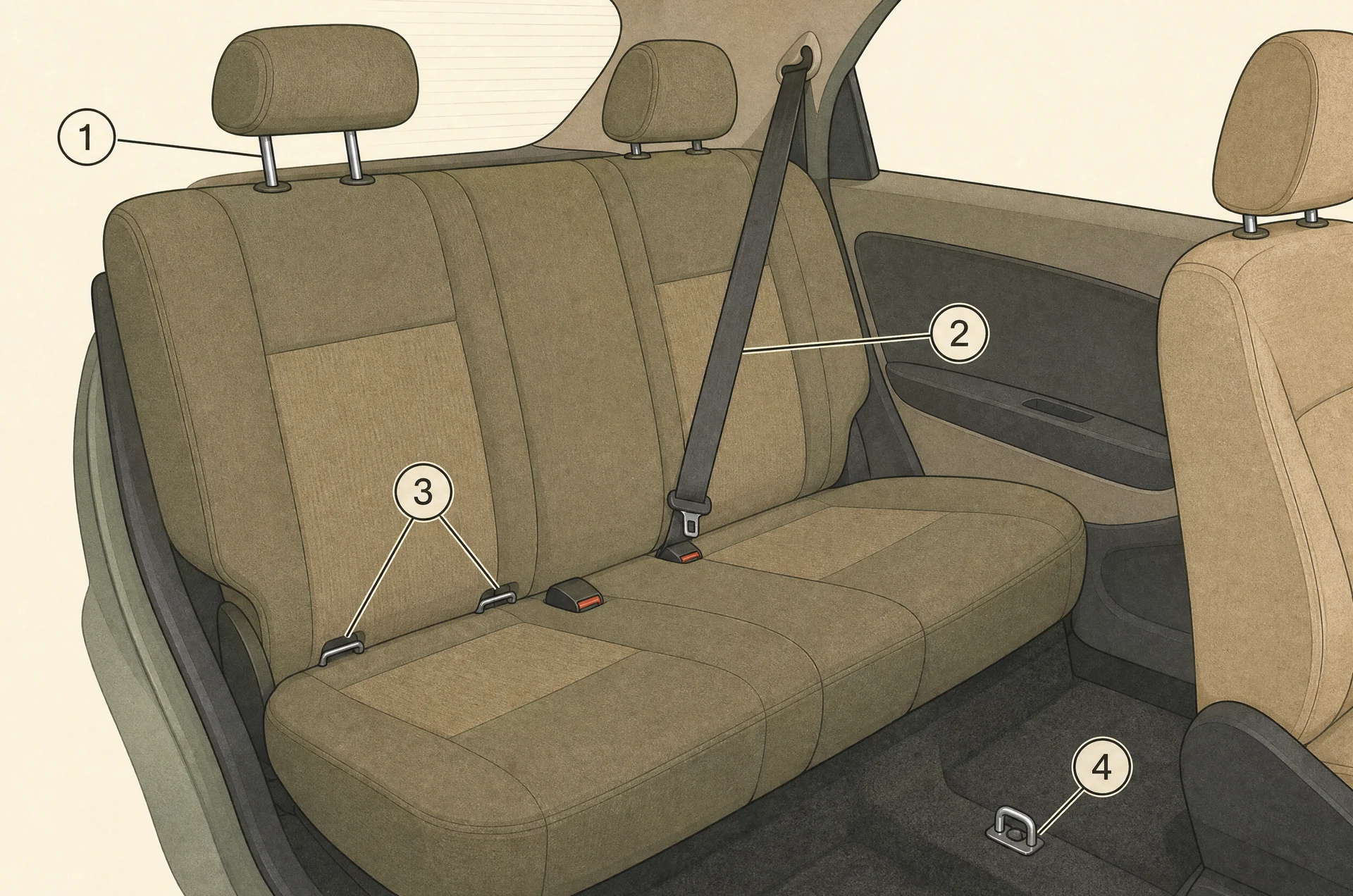
| Hardware | What it is designed for | Use it for a dog seat? |
|---|---|---|
| Seat belt | Restraining an occupant or a restraint device | Yes — this is the primary anchor. It carries the load. |
| Headrest posts | Holding the head restraint | Yes, as a secondary strap — it stops the seat tipping and sliding, but it is not the main attachment. |
| Lower anchors (two small bars in the crease) | Installing a child restraint | No. See below. |
| Floor or shelf loops | Depends entirely on the vehicle — could be a top tether anchor, could be a luggage tie-down | Only if your owner’s manual says what it is. |
Can you clip a dog seat to the LATCH lower anchors?
This is the question behind a lot of “dog car seat latch system” searches, and the honest answer is no — and for two separate reasons, both of which come straight from the people who set the rules for that hardware.
First, capacity. NHTSA’s car seat guidance explains that lower anchors carry a weight limit, expressed as a simple subtraction: lower anchor weight limit = 65 lbs – weight of car seat. The American Academy of Pediatrics puts the same number more bluntly on HealthyChildren.org: “All lower anchors are rated for a maximum weight of 65 pounds (total weight includes car safety seat and child).” Nobody has tested or rated those bars for a hook that came with a pet product, and no pet product carries the label that would tell you whether you were inside the limit.
Second — and this catches people who think they are being extra careful — NHTSA is explicit that you do not get to use both: “Every car seat needs to be installed using either the lower anchors or a seat belt to secure it in place, never both.” Belting a dog seat down and hooking its straps into the lower anchors is not a belt-and-braces upgrade. It is two load paths fighting each other.
The practical version: use the seat belt. It is in every seating position, it has no pet-specific caveats, and it is what almost every dog seat’s own strap loop was cut for.
The floor loop that is not an anchor
Several dog seats and back-seat dividers ship with hooks for “the bottom” and no guidance on where the bottom is. People end up hooking them around a seat rail, a wire under the cushion, or whatever metal loop they can find on the floor.
NHTSA’s warning here is worth reading twice, because it is about exactly this confusion: “To avoid confusing tether anchors with other hardware such as luggage tie-downs, be sure to read your vehicle’s owner manual carefully to find out where they are located in your particular vehicle.” A genuine top tether anchor is a rated structural point. A cargo tie-down is rated for cargo. They can sit a few inches apart and look nearly identical, and in sedans the real one is usually on the rear shelf rather than the floor at all.
If your manual does not identify a loop, treat it as decoration and tension the seat belt harder instead.
Install it: six steps, about four minutes
- Pick a rear seating position. The AVMA’s pet safety in vehicles guidance asks you to position a crate or carrier “as near to the center of the vehicle as possible, and secure it in place to prevent movement.” The same logic applies to an open-top seat. Front passenger seat is out — the CPS testing flagged one product whose own instructions recommended the front seat, noting that this exposes the dog to airbag deployment and to occupant compartment intrusion in a frontal crash.
- Empty the seat and find the belt path. Turn the dog seat over. There will be sewn loops, a webbing channel, or a pair of slots. That is where the belt goes — not around the outside of the seat, which lets it pivot.
- Thread and buckle the seat belt, then lock it. Pull the belt all the way out until it clicks and starts ratcheting back; on most cars that switches the retractor into a locking mode that will not let slack creep back in. Feed the slack back into the reel while pressing down on the seat.
- Loop the top strap around both headrest posts. Both, not one. A single post lets the seat rotate around it. If your headrests do not come up far enough, raise them one notch.
- Push-test. Press down hard on the middle of the seat and shove it firmly front-to-back and side-to-side with the flat of your hand. Anything more than about an inch of travel means go back and take up slack — usually at the belt, occasionally at the headrest strap.
- Now set the tether. Clip to the ring on the back of a body harness, never to a collar, then shorten it. See the next section for how short.
Tether length is the decision nobody tells you to make
Most seats ship with a tether far longer than any dog needs, adjustable only by a small slider that quietly loosens. Owners describe the two ends of that spectrum in almost identical terms: too long and a leg goes through the loop on a long drive, too short and the dog cannot lie down.
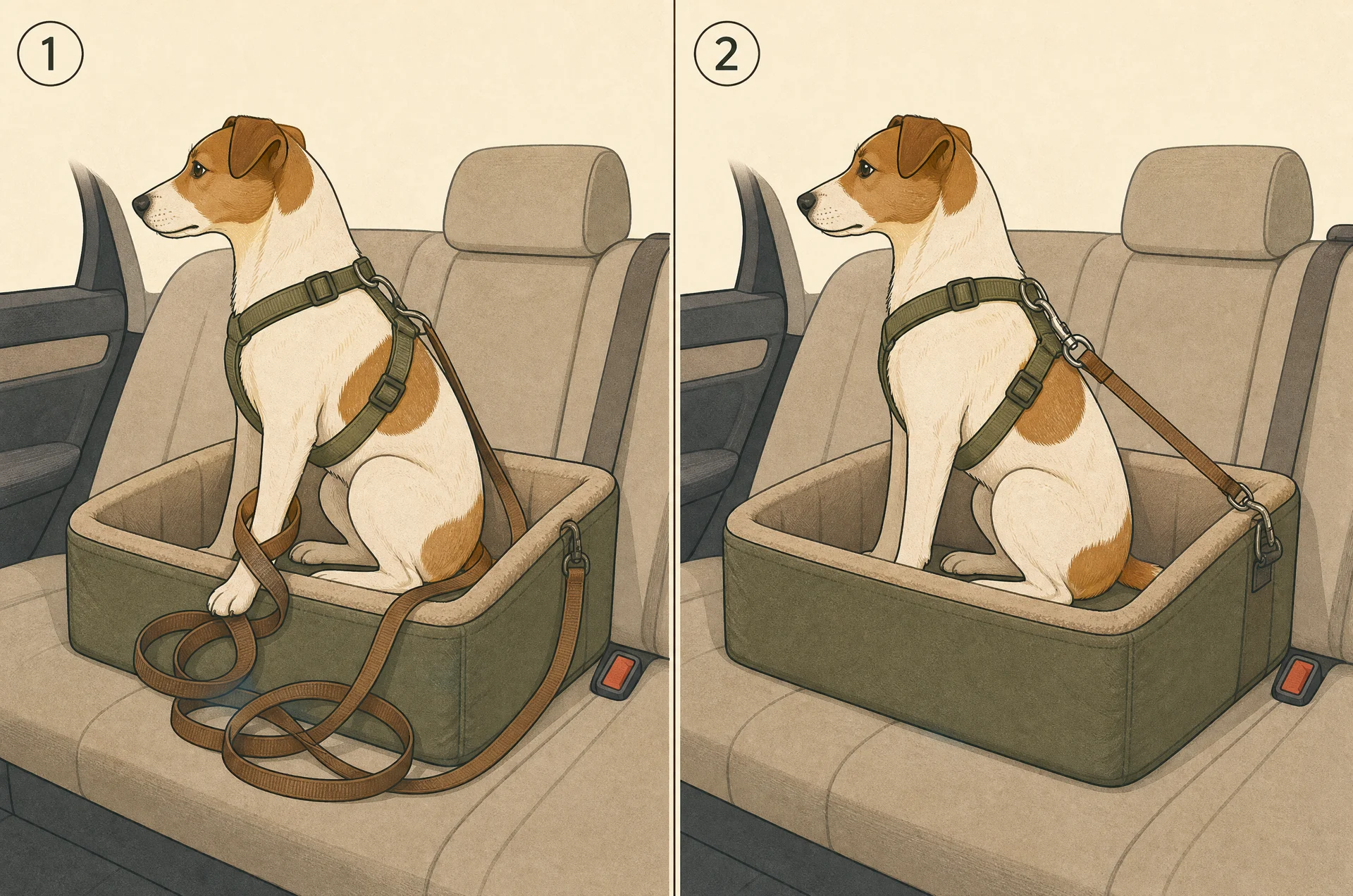
Set it like this: with your dog standing in the seat, shorten the tether until it is just barely slack. Then ask them to lie down. If they can settle without the strap going tight at the harness, you are done. If there is enough loose webbing to form a loop bigger than a fist, take up more. The AVMA makes the same point about tethers in a different context — writing about dogs in truck beds, it warns that a tether “could tangle, injure, or even choke your dog” — and the mechanism does not change because the setting is calmer.
Two more things about the tether, both from the CPS pet travel seat study. One: at least one product tested came packaged with imagery showing the dog connected by the collar, which concentrates every bit of deceleration force on the neck. Two: CPS notes that when a dog shifts out of the ideal position, “the collar or walking harness would be loaded, and these are not designed for crash protection.” An everyday walking harness spreads the load better than a collar. It is still not a crash restraint, and no amount of correct installation makes it one.
What “correctly installed” does and does not buy you
Being straight about this matters. In the CPS pilot, all four seats failed in some way at 30 mph: one rotated and rolled onto its side after a plastic buckle released; two had the anchor strap or its hardware fail outright, leaving the test dog completely unrestrained; the fourth “became a fully unrestrained projectile” when its seat connections gave way. CPS also notes that a pet travel seat, by definition, “does not offer full containment.” A good installation removes the failure mode you actually meet every week — the seat sliding off the bench under braking, the dog climbing forward into the footwell — and it does not turn an untested product into a tested one. If you want the fuller picture on that, we went through the whole study in are dog car seats crash-tested?
Two habits do more for everyday safety than any strap: keep the dog in the back, and never leave them in the parked car. The AVMA lists the blunt reasons for the first — unrestrained pets “may be crushed by deployed airbags, or thrown out or through windows or windshields” — and we covered the second in is it safe to leave my dog in the car? If you are still deciding between a booster, a secured carrier and a divider in the first place, start with the car travel setup guide rather than here.
How do you install a dog car seat without a seat belt?
You do not, if the seat is meant to be belted. A dog seat held on by the headrest strap alone pivots forward under braking — that strap is there to stop tipping, not to take the load. If your vehicle’s rear bench genuinely has no usable belt in that position, move the seat to a position that does.
Can I use the LATCH anchors for a dog booster seat?
No. Lower anchors are rated for child restraints, with a combined limit that NHTSA expresses as 65 pounds minus the weight of the car seat, and NHTSA also says a seat is installed with the lower anchors or the belt, never both. No pet seat carries the label that would tell you whether you were inside that limit. Use the seat belt.
Where do the bottom straps on a dog car seat or divider attach?
Usually nowhere specific, which is why so many people cannot find a home for them. Check your owner’s manual for a genuine top tether anchor before hooking anything to a metal loop on the floor — NHTSA warns that tether anchors are easily confused with luggage tie-downs. If the manual does not name it, leave those hooks unused and tension the belt instead.
How tight should a dog car seat be?
Push down on the middle of the seat and shove it hard front-to-back. More than roughly an inch of movement means there is slack somewhere. Retighten at the belt first, the headrest strap second.
Should the tether clip to a collar or a harness?
A harness, on the ring between the shoulder blades. A collar puts every bit of the force on the neck. CPS is clear that a walking harness is not designed for crash protection either — but it spreads a sudden load across the chest rather than the throat, which is the difference that matters in ordinary hard braking.
Can a dog car seat go in the front seat?
Not if you can avoid it. CPS singled out a product whose own instructions recommended the front seat and noted that this exposes the dog to airbag deployment and to occupant compartment intrusion in frontal crashes. The AVMA asks for the rear seat and for the restraint to be secured near the centre of the vehicle.
My dog is carsick — does raising the seat help?
Possibly, and for one specific reason rather than the height itself. We went through what the veterinary sources actually say in does a dog booster seat help with car sickness?
Sources
- National Highway Traffic Safety Administration — Car Seats and Booster Seats (lower anchor weight limit of 65 lbs minus the seat’s weight; lower anchors or seat belt, never both; tether anchors easily confused with luggage tie-downs; location of the lower anchor bars in the seat bight) (checked 2026-09-23)
- American Academy of Pediatrics, HealthyChildren.org — Car Seat Installation Information: Seat Belts and LATCH (“All lower anchors are rated for a maximum weight of 65 pounds”; use one system or the other) (checked 2026-09-23)
- Center for Pet Safety — Pet Travel Seat Pilot Study (2015) (all four seats tested failed at a connection point; collar and walking harness “are not designed for crash protection”; front-seat placement exposes the pet to airbag deployment and occupant compartment intrusion; a pet travel seat “does not offer full containment”) (checked 2026-09-23)
- American Veterinary Medical Association — Pet safety in vehicles (secure the crate or carrier near the centre of the vehicle to prevent movement; unrestrained pets may be crushed by airbags or thrown through windows; a tether “could tangle, injure, or even choke your dog”) (checked 2026-09-23)
- American Veterinary Medical Association — Data, safety regulations lacking when it comes to pets and vehicles (“There’s recommendations but there are no rules”; no standards or industry tests for pet restraints; Center for Pet Safety is the only nonprofit with testing and performance requirements) (checked 2026-09-23)
Vehicle hardware differs by model and safety guidance changes. Your owner’s manual is the authority on what the anchors in your own car are rated for — check it before attaching anything.
The belt holds it. The headrest strap steadies it. The tether is the part you have to think about.
Belt through the seat’s own loops and locked, top strap around both headrest posts, rear seat, push-test until it barely moves, then a short tether to a body harness. Leave the lower anchors for child seats, and leave any unidentified floor loop alone. It takes four minutes and it fixes the failure you will actually meet — the seat sliding, the dog climbing forward — even though it cannot make an untested product a tested one.