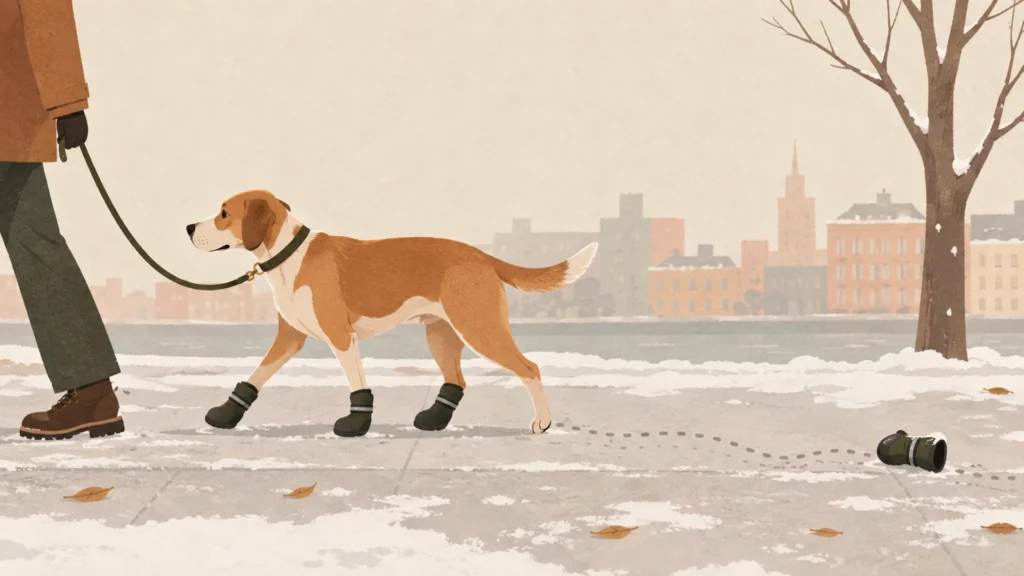
Dog boots that keep falling off need a fit check before a tighter strap. Check the paw measurements, whether the paw is fully seated, the model’s closure position, wear or debris on the fastening, and how your dog moves in them. Several problems can happen together; a kick or a twisted sole does not identify the cause on its own.
Start with the AKC’s loaded-paw measuring method, then follow the boot maker’s chart and try the boots indoors. Measure each paw, including front and rear, and check any length as well as width requirements. If a boot only stays on when the closure is uncomfortably tight, stop and reassess the size or design.
- Slides or rotates: check seating, dimensions, closure position and the condition of the fastening.
- Comes off with a kick: check comfort and fit before treating it as an acclimation problem.
- Only rear boots come off: measure those paws separately and observe walking without the boots.
- Fits standing, fails on a walk: use a short indoor movement check before trying a harder surface.
Choosing footwear for rough ground? Our guide to dog boots for hiking starts with terrain, practice and when to turn back.
Why fit, seating and the fastening all matter
A boot needs enough room for a weight-bearing paw without excess space that lets it shift. Its cuff and fastening also need to suit that dog’s leg and the manufacturer’s intended closure position. Check all of those together: more strap tension cannot correct the wrong shape, while a suitable size can still slip if the paw is only partly inserted or the fastening is clogged or worn.
Re-seat the paw with the boot fully opened, then close it as instructed. Stop if the dog shows discomfort. Persistent slipping after a careful fitting is a reason to try a different size or construction, not proof that your dog needs more training.
Measure each weight-bearing paw against the boot chart
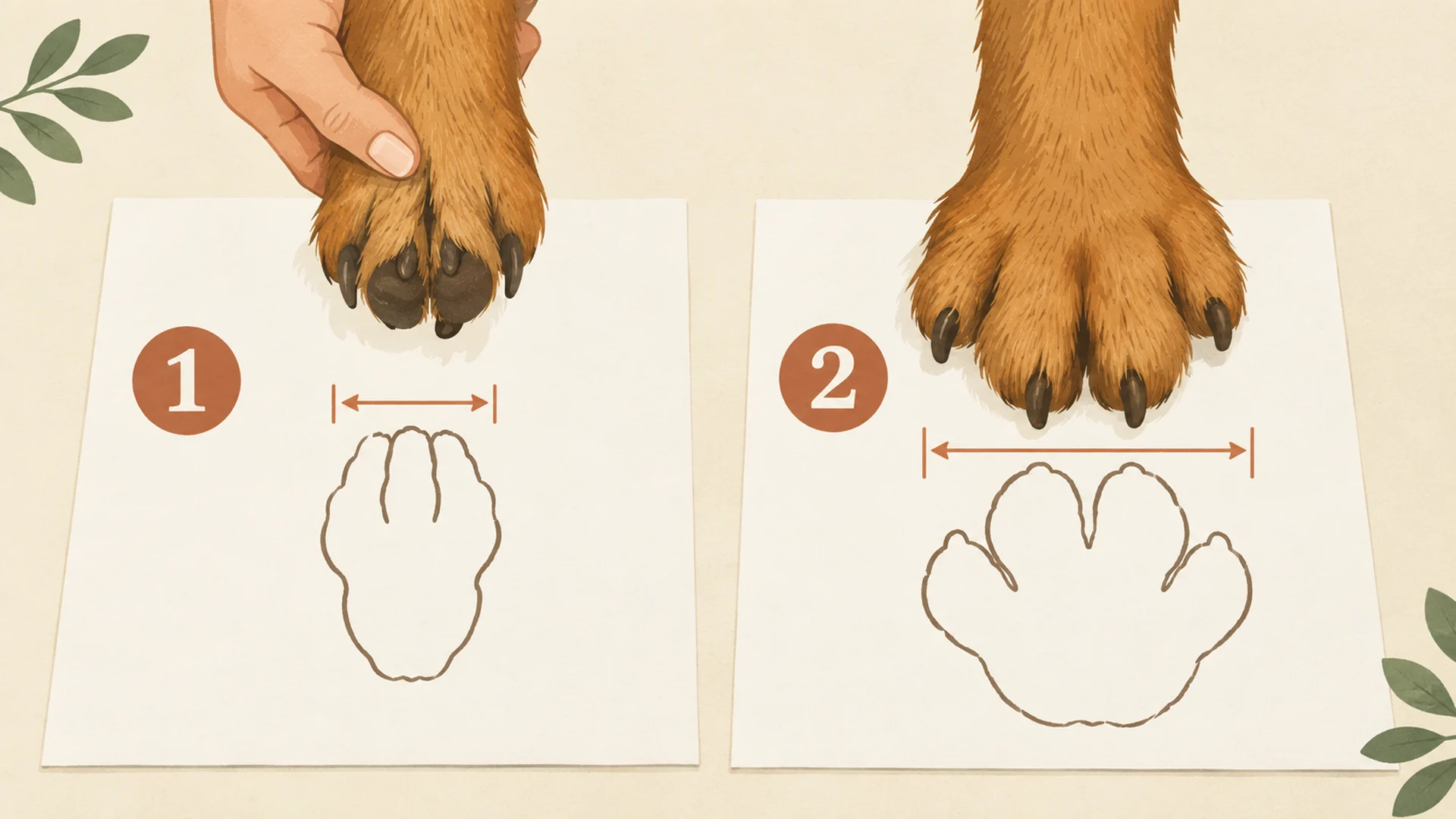
Measure with the paw bearing weight, using the maker’s method. Include every dimension its chart requests rather than assuming width alone determines fit. If the front and rear paws differ, check whether the seller supports the sizes you need instead of assuming a single four-boot size is suitable.
The AKC describes tracing a paw pressed onto paper and measuring its widest point. Use the method the chosen boot maker requests, including any required length, and record each paw separately rather than assuming the set is uniform.
Use body weight only to narrow a shortlist, then use the actual paw chart. The Merck Veterinary Manual describes differences in paw conformation between breeds; that is context for checking the individual paw, not evidence for a particular boot size or a diagnosis.
Dog boot slipping: what to check next
| What you see | Possible checks | Next step |
|---|---|---|
| Sole rotates around the paw | Wrong shape or dimensions, partial seating, closure position | Re-seat and compare every required chart measurement; do not automatically size down |
| Boot slides off with the fastening closed | Paw not fully inserted, excess room, loose or worn fastening | Check the closure instructions and inspect the fastening before changing size |
| Dog kicks, chews or refuses to move | Discomfort, poor fit, foot pain or unfamiliar sensation | Remove the boots, inspect the paws and fit, then use short positive introductions if comfortable |
| Only rear boots slip | Different rear-paw dimensions, surface drag or a movement change | Measure separately; seek veterinary advice for new scuffing, dragging or limping |
Avoid improvised tape or a tight wrap to make an ordinary boot stay on. If your dog has a bandage, injury or prescribed protective boot, follow your veterinarian’s fitting instructions rather than adapting this general checklist.
An indoor test before the next walk
- Inspect the paws and check the chart measurements. Open each boot fully and make sure the paw reaches the intended position.
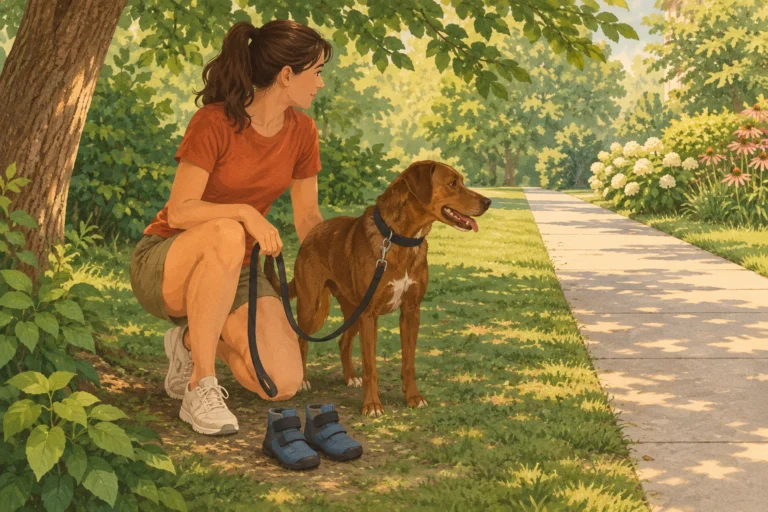
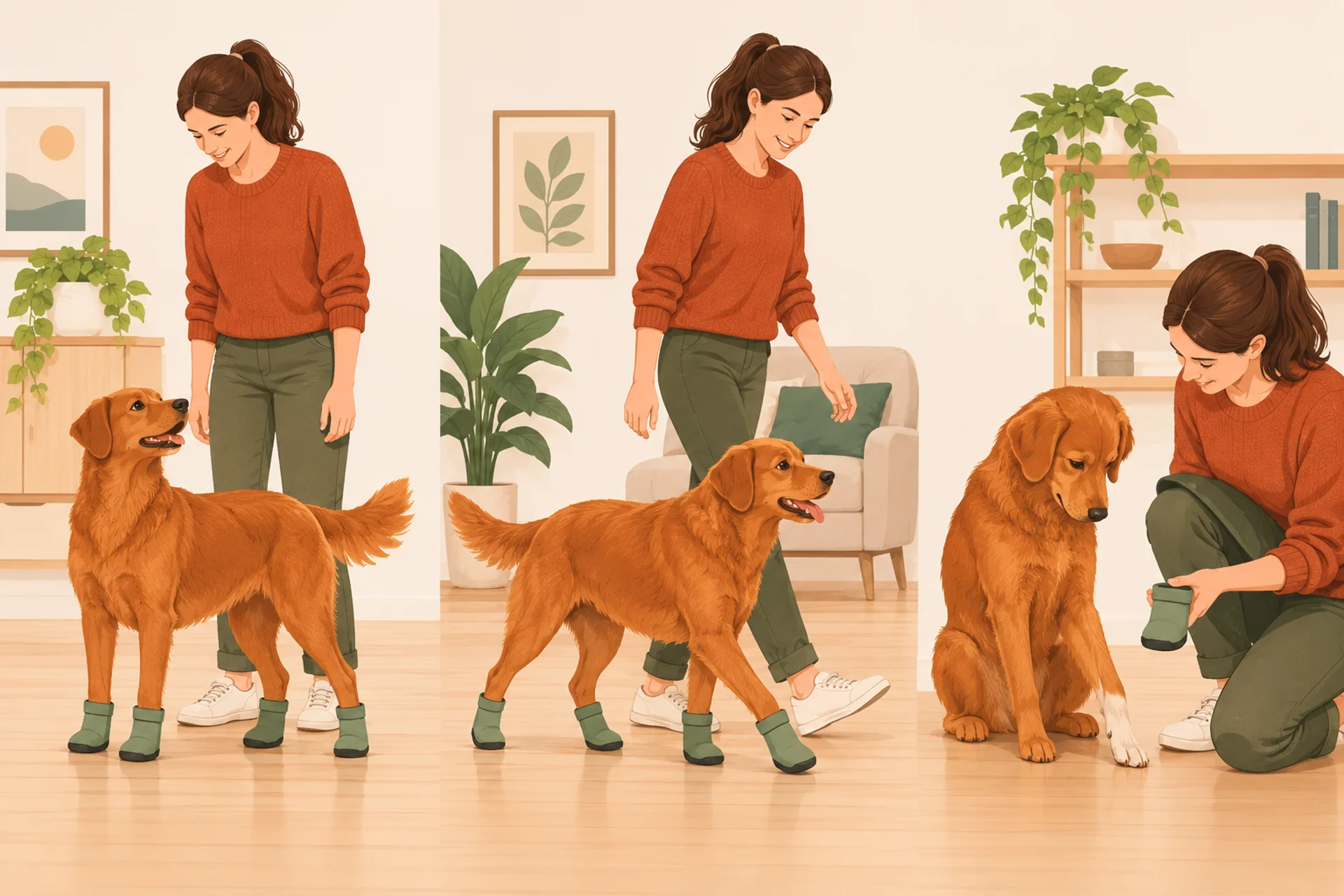
- Fasten as directed, then let your dog walk, turn and sit on a clear indoor surface. Use brief, rewarded sessions rather than forcing movement.
- Check whether the sole has rotated, the cuff has moved or the fastening has loosened. Remove the boots to inspect the skin and fur.
- If slipping repeats, stop and compare another size or design. A successful short indoor test still does not guarantee retention in running, deep mud or snow.
Compare the chart, intended surface and closure instructions for any shortlisted boot. More fastenings or a taller cuff do not establish that a model fits your dog. Our rain-boot guidance helps with the weather decision; this indoor check is about fit and comfort.
Keep one clear fit record before changing models
The AKC recommends an indoor test for retention, shape and traction. Make that test useful to the seller as well as to you. Write down the model and size, each required paw measurement, which foot loses the boot, and whether it shifts while standing, turning or walking. These are an editorial observation checklist, not a validated performance test.
Change one fitting variable at a time, within the manufacturer’s instructions. If you change the size, closure setting and surface together, you will not know which change mattered. Stop rather than continuing the comparison if there is rubbing, distress or abnormal movement. A short successful trial is evidence about that trial only; it does not establish that the boot will stay on during a long run or in deep mud.
When only the back boots keep coming off
Start by measuring the rear paws independently and comparing their fit, seating and fastening with the front pair. Note the surface and exactly when a boot moves. Do not infer a single cause from which boot falls off: a standing check, an indoor walk and an outdoor surface can give different results.
There is one version worth paying closer attention to. If the back boots come off on flat, dry ground, if the toes of the back boots wear through long before the rest, or if you can hear the back feet scuffing, watch how your dog walks without boots on. VCA Animal Hospitals notes that with a spinal cord problem, the toes may drag on the ground as the dog walks, wearing off the ends of the toenails. Cornell’s College of Veterinary Medicine says that if you hear toenails dragging or scuffing as they walk, or your dog is standing oddly or seems uncomfortable, that is a good reason to contact a vet right away. A boot that keeps getting dragged off may be the first thing you notice. It’s not something to solve with a tighter strap or a sturdier boot until your vet has had a look.
When your dog kicks, chews or freezes in boots
Unfamiliar boots can cause hesitation or high-stepping, but kicking, chewing and refusal can also accompany poor fit or discomfort. Remove the boots and check the paws and fit before continuing acclimation. An unusual movement is an observation, not a diagnosis of stubbornness or reassurance that nothing hurts.
The AKC’s step-by-step protocol for boots and winter gear is one boot at a time, and it is slower than most people expect:
- Put the boots on the floor and let your dog investigate them. Reward curiosity before anything goes on a foot.
- Put one boot on, reward, and take it straight back off. One boot, seconds long.
- Repeat with that single boot, stretching the time a little each session while treats or play keep going.
- Only when one boot is boring do you add the second, then the third, then the fourth — repeating the same build-up each time.
- Go outside only once all four are comfortable while your dog eats and plays at home.
- If your dog tries to remove a boot, shorten the time and go back to rewarding more often. AKC advises reducing the duration when a dog tries to remove the boot.
Two additions worth making. Train somewhere quiet, because a dog processing a strange sensation has no attention left for a busy street. And if your dog dislikes having their feet handled at all, that comes first — AKC says to desensitise the dog to you touching their feet before boots enter the picture. The same slow-introduction logic applies to everything else you put on a dog, which is why it shows up again in our guide to getting a dog used to wearing clothes.
Do you actually need boots?
Worth asking honestly, because a dog who hates boots and a household that fights them every morning may be better served by a different tool. (For the full winter version, including why paw pads cope with cold better than you’d expect, see do dogs need boots in winter, and for whether boots change how a dog walks, are dog boots bad for dogs.)
Winter exposure may justify boots. Ice, snow and de-icing products can make a route uncomfortable. The AKC recommends checking and cleaning between the toes. The ASPCA warns that pets can ingest ice-melt residue when licking their paws; even products described as pet-friendly can cause stomach upset. Prevent exposure, clean paws after walks and contact your veterinarian for suspected ingestion or symptoms. Boots are an additional barrier, not a reason to ignore the route.
Hot surfaces are another reason to change the plan. The AKC warns that pavement can burn paw pads. Choose a cooler route or time rather than assuming boots make a hot walk safe. There is no need to solve retention on a surface you can avoid.
Alternatives depend on the exposure. The ASPCA discusses paw wax or booties as barriers for sensitive feet exposed to ice melts. Neither substitutes for cleaning off residue or veterinary advice for irritated skin. If footwear cannot be worn comfortably, ask about an appropriate alternative and change the route; do not treat wax as equivalent protection against every surface.
When it isn’t a boot problem at all
A sudden change in boot tolerance, persistent licking of one foot or limping after removal deserves veterinary advice. Merck describes painful lesions between the toes that can be associated with licking and lameness. Several problems can look alike, so observations alone cannot identify the cause.
Record which foot is affected, when the change began and whether the walking surface changed. Share a short video of the movement if your veterinarian requests one. Do not keep practising through pain or use a tighter boot to hide a new problem; diagnosis and treatment belong with your veterinarian.
How do I keep my dog’s boots from falling off?
Measure each loaded paw, check the maker’s full chart, seat the paw fully and inspect the fastening. Try brief indoor walking and turning, then remove the boots to check for rubbing. If slipping repeats, reassess the size or design. Kicking can mean unfamiliarity or discomfort; check both rather than tightening harder.
Why do my dog’s back boots keep falling off?
Check the rear-paw measurements separately, then seating, closure and the surface where slipping starts. Do not assume the cause from the location alone. New dragging, scuffing or limping without boots needs veterinary advice; Cornell recommends prompt contact for these changes.
Should dog boots be tight?
Follow the boot maker’s fitting instructions. The closure should secure a correctly seated paw without painful pressure or rubbing. A tighter strap cannot compensate for an unsuitable shape or size. Remove the boot for discomfort, swelling, limping or persistent chewing, and ask your vet about a sore or injured paw.
Can I tape my dog’s boots on?
It’s a popular suggestion and it isn’t a good one. Tape turns an adjustable closure into a fixed wrap on a limb, and a wrap that is too tight is not something you’ll notice mid-walk. Reassess the fit, closure and intended use instead of adding adhesive. For a prescribed protective boot or bandage, follow your veterinarian’s instructions.
How do I measure my dog’s paws for boots?
Use the maker’s method with the paw bearing weight. Trace the paw if instructed and measure the required width and length, checking front and rear paws separately. Compare every required dimension with that exact chart. Do not choose from body weight alone or assume all four paws need one size.
Why does my dog walk weird in boots?
An unfamiliar sensation can cause high-stepping or hesitation, but poor fit and pain can also change movement. Remove the boots and inspect the paws and fit first. If comfortable, introduce them gradually with rewards. New limping, dragging or scuffing without boots needs veterinary advice rather than more training.
Measure the paw that’s carrying weight, not the one in your hand.
To help dog boots stay on, check the complete fit: loaded paw measurements, full seating, cuff position and a sound fastening. Use short indoor movement checks, then reassess the surface and design if slipping repeats. A dog that kicks a boot off may be uncomfortable, not simply untrained. Keep the after-walk paw check even when boots stay in place.
Sources
- American Kennel Club — Choosing the Right Dog Boots or Shoes for Your Dog (checked 2026-11-13)
- American Kennel Club — How to Care for and Clean Dog Paws and Paw Pads (checked 2026-11-13)
- American Kennel Club — Dog Winter Clothes: How to Get Your Dog to Wear Them (checked 2026-11-13)
- American Kennel Club — How to Protect Dog Paws From Hot Pavement (checked 2026-11-13)
- ASPCA — Keeping Pets Safe during Winter: The Dangers of Ice Melts (checked 2026-11-13)
- Merck Veterinary Manual — Interdigital Furunculosis in Dogs (checked 2026-11-13)
- VCA Animal Hospitals — Ataxia in Dogs (checked 2026-11-13)
- Cornell University College of Veterinary Medicine — Diseased spinal disks (checked 2026-11-13)
Guidance and product formulations change. Anything involving a sore, swollen or suddenly boot-intolerant foot is a conversation for your veterinarian, not a checklist.