
A well-built cat backpack is safe for a cat who has been introduced to it properly. The design is not the hazard. What varies — enormously, and invisibly from the product name — is build, and a badly built pack fails in three specific ways: a zip that comes open, heat that builds without any outward drama, and something arriving at ground level that your cat cannot flee from.
The packs that genuinely are not safe share a profile. The floor sags when the bag is lifted, so the cat braces on all four legs for the whole trip. A sealed acrylic dome carries the view while a token strip of mesh carries the air. There is no internal tether, so an opened zip is an escape. And the interior is sized to a photograph rather than to a cat. Judge those four things, ignore whether the label says “backpack cat carrier” or “cat backpack” — they are two spellings of one product — and the safety question mostly answers itself.
Backpack, or a regular carrier?
This is the choice people are actually weighing, and the trade is straightforward once it is stated plainly. A backpack buys you both hands and a cat carried close to your body weight line, which is why it wins for walks, errands, transit and anything involving stairs. What you give up is control of the opening. A hard-sided carrier’s door faces you and sits at the end of your arm; a backpack’s opening sits behind your shoulder or against your chest, out of your line of sight, and it can be reached by strangers and snagged on doorframes.
That is the real difference, and it points at the two things worth insisting on in a pack: an internal tether, and zip pulls that cannot be nudged open by a paw or a passer-by. Get those and the backpack’s weakness is covered. Miss them and you are carrying an unsecured opening you cannot see.
For vet visits specifically the traditional carrier usually still wins, because a wide top-opening box lets a vet examine a cat sitting in the base instead of hauling them out of a tube. Plenty of households end up owning one of each and using them for different jobs, which is a sensible outcome rather than a failure to decide.
Do cats actually like them?
Some do, genuinely. Many tolerate them. A meaningful minority never will, and that is worth knowing before spending money rather than after.
The variable is not the pack, it is the cat, and the best predictor is how your cat already behaves about confinement and novelty. Cats who walk into a carrier on their own, who sit in windows watching the street, who greet visitors rather than leaving the room — these cats usually take to a backpack within a handful of outings. Cats who hide when a suitcase appears, who have to be poured into a carrier for vet visits, or who startle at the vacuum are being asked to do something much harder, and enthusiasm is not the realistic target for them.
It is also worth being honest that liking it and tolerating it look different, and that the difference matters. A cat who is settled will shift position, look around, knead the blanket, maybe doze. A cat who has gone completely still and flat is not calm — freezing is a stress response, and it is the one most often misread as a cat enjoying the ride. The introduction routine further down is what moves a cat from the second state to the first, and no amount of it will work on every cat.
A note on the wording, since it sends people here: “backpack cat carrier” and “cat backpack” describe the same product. Marketplaces stuff both strings into the same title because both get typed. Listings that lead with cat backpack skew slightly toward the visual end of the market — the porthole, the pastel colourways — while those leading with carrier more often show the base and the size chart. It is a tendency, not a taxonomy, and it is no substitute for looking at the bag.
The four checks that separate a carrier from a bag with a window
Every one of these is visible in a good listing, and the absence of a photo showing it is itself an answer.
| Check | What good looks like | How to spot it in a listing | Why the cat cares |
|---|---|---|---|
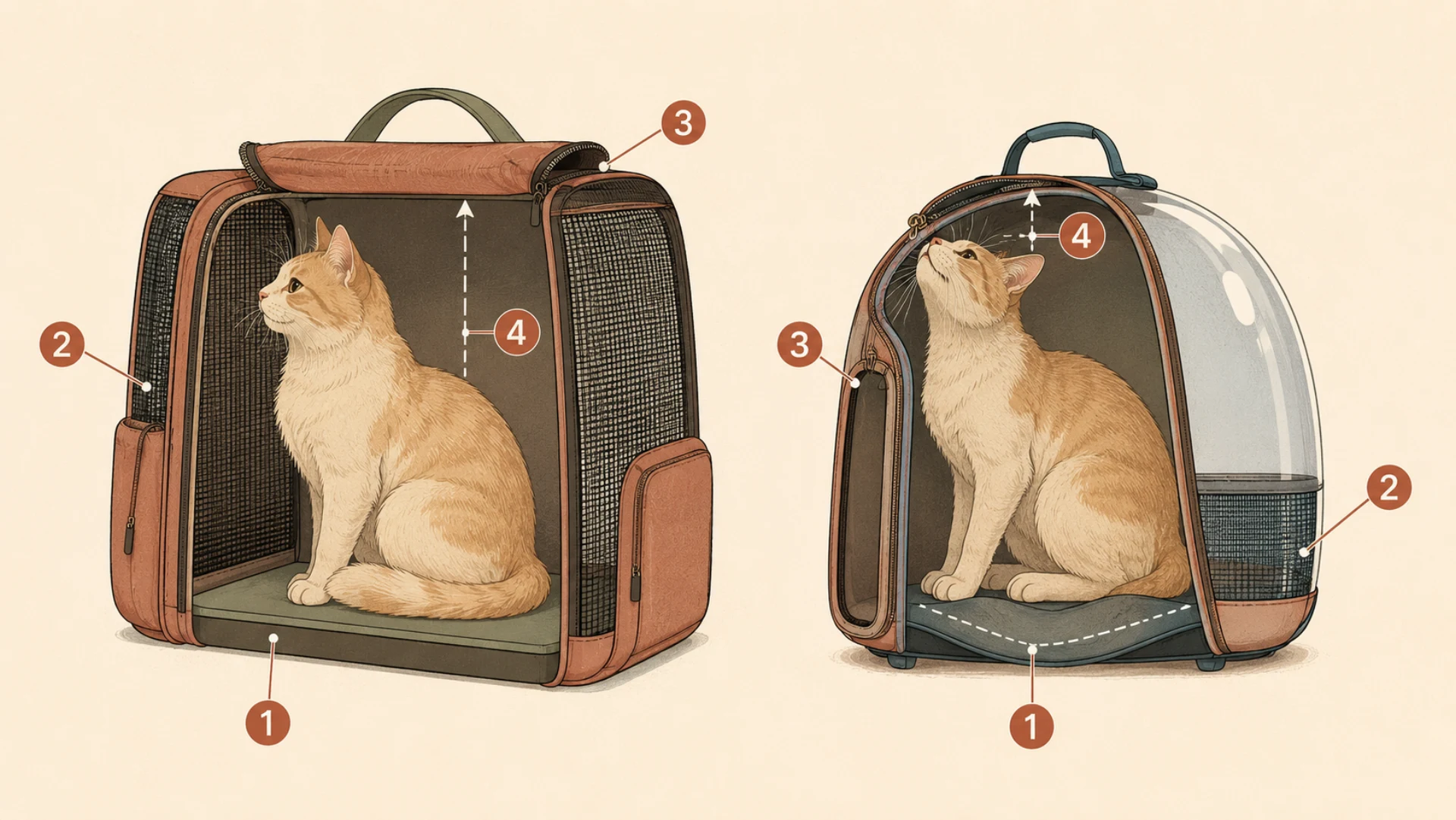
| The floor | A rigid or firmly padded base panel that stays level when the bag hangs from the straps | A photo of the pack lifted, not sitting on a table; a removable board mentioned in the description | A sagging floor makes a cat brace all four legs for the whole trip — the fastest way to teach one to hate the bag |
| Ventilation | Mesh across more than one face, positioned at the cat’s height | Count mesh panels against acrylic area in the side-on photos | Cats run warm and stress raises that further; a window is a view, not airflow |
| The opening | A wide top or roof opening, ideally as well as a front door | Look for a photo of the pack open, showing the whole cavity | Cats can be lowered in vertically far more easily than pushed in horizontally |
| Interior length | Longer than your cat measured nose to base of tail, with headroom to sit up | Interior dimensions in the size chart — not the exterior box size | A cat that cannot turn around or lie straight has nowhere to settle on a long trip |
| Internal tether | A short leash clip anchored inside, near the opening | Usually a single close-up photo; sometimes only in the description | It is the difference between an open zip and a cat in a car park |
| Carry system | Padded shoulder straps, a chest strap, and a back panel that holds shape | Photos worn on a person, from behind and from the side | An unstable pack sways with every step, and sway is what most cats object to |
The ventilation row is the one worth being stubborn about. A backpack is a small sealed volume carried against a warm human back, and the ASPCA lists the signs that it has gone wrong — “excessive panting or difficulty breathing, increased heart and respiratory rate, drooling, mild weakness, stupor or even collapse” — and notes that flat-faced animals, Persian cats among them, are more susceptible because they cannot pant as effectively. If your cat is one of those, weight the mesh higher than anything else on the list.
Notice that only one of those six is about looks. The roof-opening question in particular deserves more weight than most shoppers give it — enough that it has its own guide in why the roof door wins for most cats, which applies to backpacks exactly as it does to hard carriers.
How much should your cat be able to see?
This is the question underneath most bubble-versus-mesh arguments, and the honest answer is that it depends on the cat rather than the design. Visibility is a spectrum, and cats sit at different points on it.
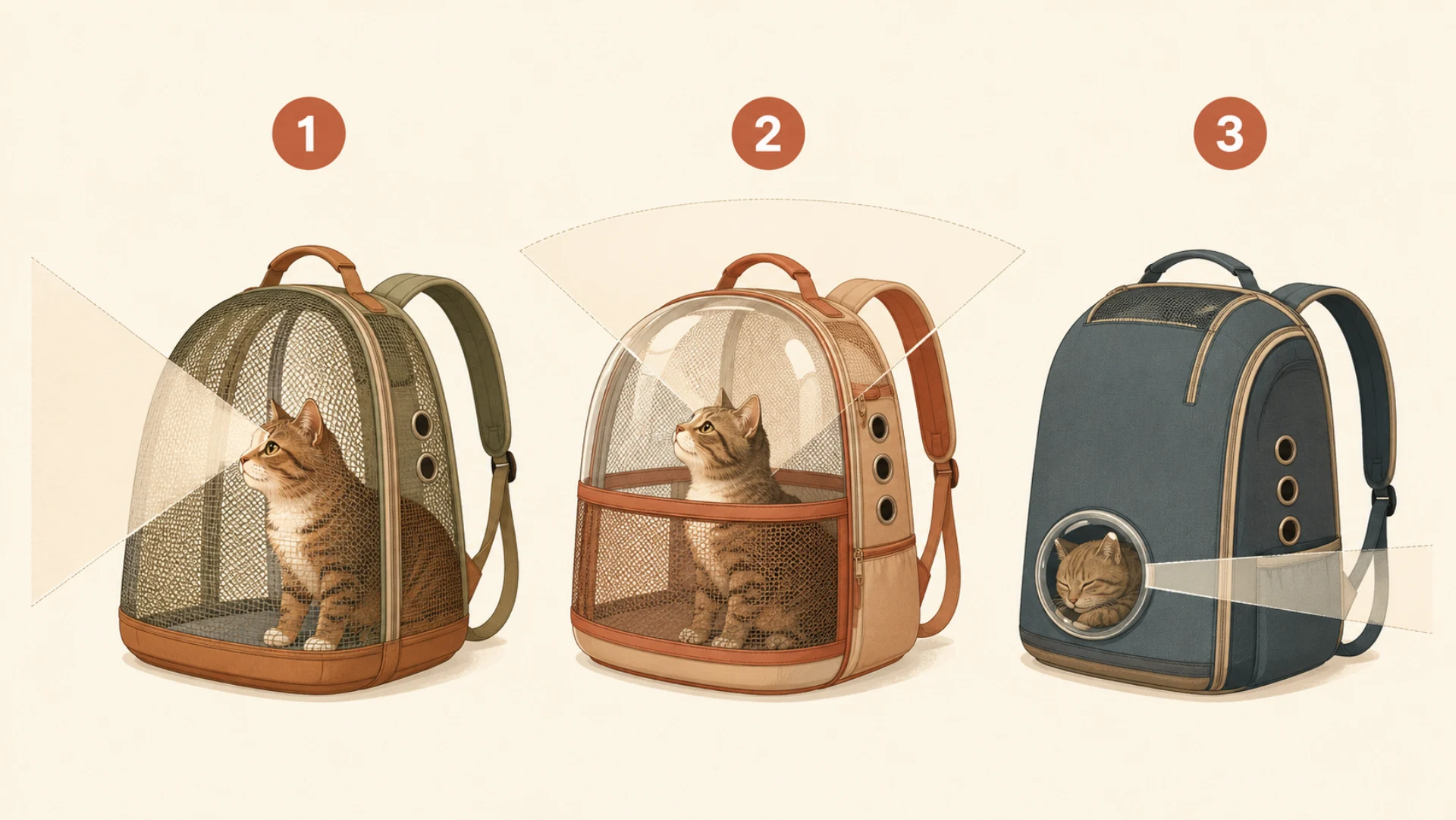
A confident cat — one who sits in windows, greets visitors, follows you to the door — usually rides better with more to look at. Open mesh gives them the street plus the airflow, and they tend to settle within a few outings.
A cautious cat does the opposite. More visibility means more things arriving unannounced: dogs, buggies, a bus. For these cats a mostly enclosed shell with one modest window is not deprivation, it is a den with a peephole, and they will often relax in it faster than in a mesh pack. The Cornell Feline Health Center’s description of a frightened cat is the checklist to read them against: “ears flattened and held outward, whiskers flattened or pressed downward onto the face”, dilated pupils, and lying prone with the tail tucked under the body. If you are choosing between the two, our comparison of bubble windows, mesh and domes goes deeper on the heat trade-off specifically, which is the one place the visual choice becomes a welfare choice.
Two things stay constant at every point on that spectrum. Airflow is non-negotiable regardless of how much the cat can see — concealment should come from opaque fabric with mesh elsewhere, never from sealing the pack. And no window arrangement fixes a bad base.
Measure the cat, not the breed
Weight ranges on listings are a filter, not a fit. Two ten-pound cats can need different bags: a compact one curls into a small footprint, a long-bodied one needs length more than volume. Take three measurements before you shop — nose to base of tail with the cat standing, shoulder height sitting, and current weight — then check them against the interior dimensions in the product’s own size chart rather than the box dimensions in the title.
The mistake worth naming: buying up a size for comfort. Extra room in a backpack is not the kindness it is in a crate, because a cat in an oversized pack slides on every step instead of bracing against walls that are where they expect them. Snug enough to lie straight and turn around, no larger, is the target.
Three ways an outing goes wrong
Specification arguments are about comfort. These three are about the trip ending badly, and they are worth more attention than the window style.
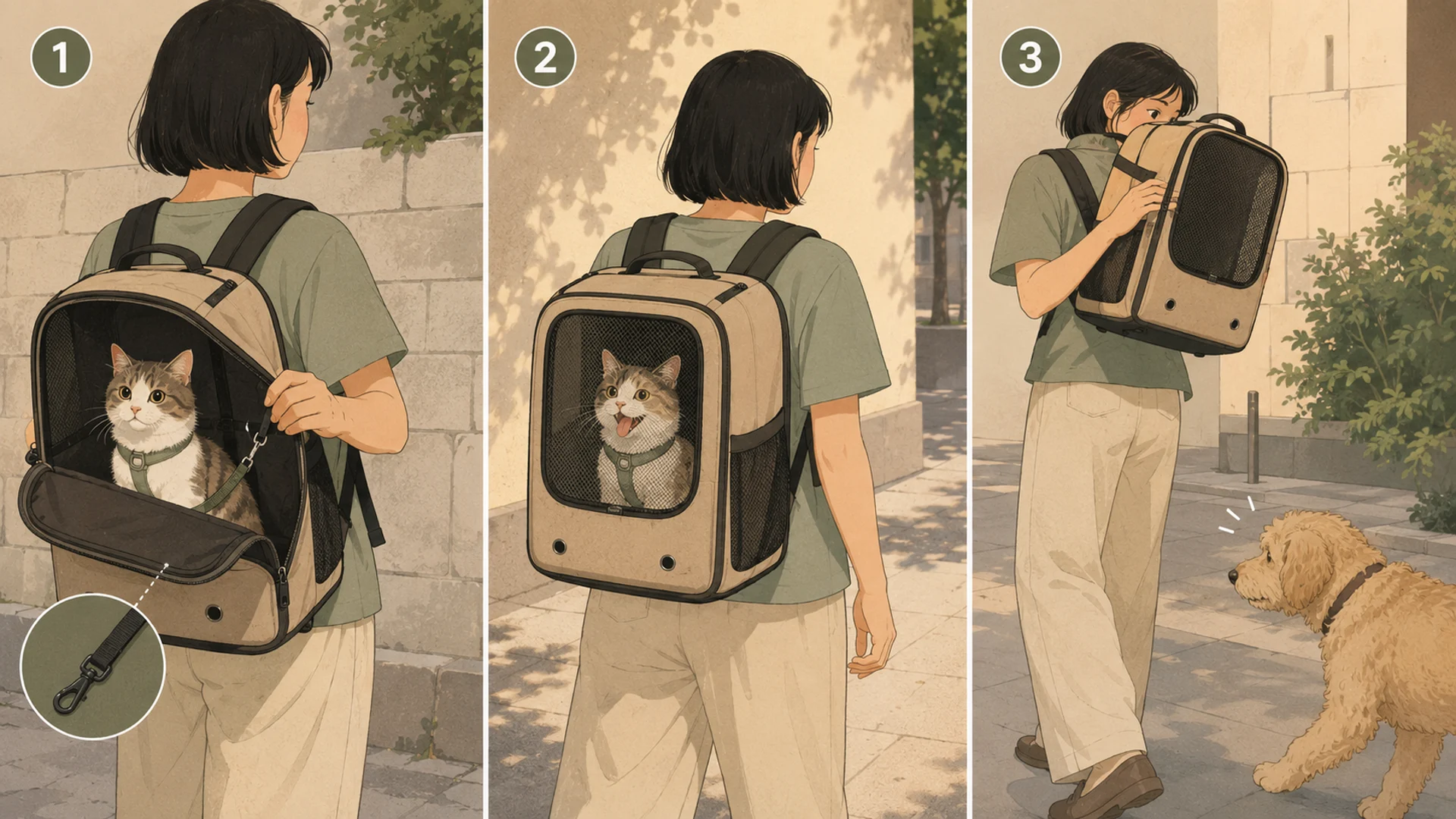
The zip opens. Sometimes it is a snag, sometimes it is a well-meaning stranger, and once in a while it is a cat with time on their paws. This is what the internal tether is for, and it only works if the other end is clipped to a properly fitted harness rather than a collar. Back it up with identification that survives the bag: FEMA’s preparedness list asks for a collar with ID tag and a harness or leash, plus a microchip with your address and phone number kept up to date — and a chip registered to a number you changed three years ago is a chip that does nothing.
Heat builds without a scene. This is the failure mode people miss, because it does not look like an emergency until it is one. A cat in a pack cannot move to shade, cannot stretch out on a cool floor, and is sitting against a body running at 37°C. Check at ten minutes rather than at the door, and treat open-mouth breathing as a stop signal rather than a curiosity — cats do not pant casually. The ASPCA’s rule about parked vehicles applies with force here: never leave the pack, with the cat in it, in a car while you run an errand.
Something arrives at ground level. A loose dog, a scooter, a toddler at exactly eye height. A cat in a pack cannot flee, which is the whole bargain you have made on their behalf, so the response has to come from you: turn the pack away from the thing, lift it rather than setting it down, and put distance between them without running. This is also the argument for keeping early outings short and boring. A cat who has had six uneventful trips has a reserve of calm to spend on the seventh; a cat whose first outing included a labrador does not.
None of this makes a backpack a bad idea. It makes it a piece of equipment with a competent user attached, which is a different thing. The same pack, kept by the door and already familiar, is also the one you would reach for in an emergency — our guide to evacuating with a cat covers why that familiarity is worth building before you need it.
The introduction decides whether the money was wasted
More backpacks fail on introduction than on specification. The pattern that works is unhurried and boring, and it is the same one FEMA publishes for getting a pet used to a carrier — leave it out where the pet already spends time, leave it open, feed treats near and inside it, and add a familiar blanket. In practice: leave the pack open on the floor for a week with meals served inside it, then zip it closed with the cat in it for thirty seconds while you sit next to it, then lift it a few inches and set it down, then walk one lap of the hallway. Only after all of that does the front door come into it.
Watch for the signals that mean stop: open-mouth breathing, flattened ears held there, repeated pushing at the zip, or a cat who goes completely still and does not move at all. Freezing is not calm. End the session before any of those escalate and go back a step next time.
If a cat refuses the upright backpack posture after genuine patience, that is information, not failure — some cats simply prefer to be carried level. A wide soft carrier or a tote is the better shape for them, and our guide to choosing a cat carrier for travel covers those alternatives.
Matching the pack to the cat
For the cat who wants the street. The Trail Fresh-Air Capsule Cat Backpack Carrier leads with ventilation, which is the right priority for a cat who rides alert and for warm afternoons. Check the interior dimensions on the product page against your cat’s measured length before choosing a size.
For a view plus airflow. The Trail Dome-View Cat & Small Dog Backpack Carrier puts a clear dome overhead and lets mesh panels carry the air at the sides — the compromise for households that want the skylight without a sealed shell.
For the cat who prefers a den. The Everyday Round-Porthole Cat Backpack Carrier keeps the shell mostly solid with a single round window, which suits cautious riders. If your cat turns out to prefer being carried level rather than upright, the Everyday Soft Tote Pet Carrier is the flat-bottomed alternative. Compare the full range in Carriers.
Cat backpack safety FAQ
Are cat backpacks safe for cats?
A well-built one is, used sensibly. Safety comes down to a base that stays flat so the cat is not bracing, real airflow rather than a sealed acrylic shell, a tether clipped to a harness so an opened zip is not an escape, and outings kept short enough that the cat can be read the whole time. A pack that fails any of those is not made safe by keeping the trip short.
What is the difference between a backpack cat carrier and a cat backpack?
Nothing reliable. Both phrases describe a carrier worn on the back, and most listings use them interchangeably to catch both searches. The real difference is between well-built and poorly built examples of the same product: judge the floor, the mesh, the opening and the interior dimensions instead of the wording.
How much should a cat be able to see out of a backpack?
As much as that individual cat wants. Confident, window-sitting cats usually settle faster with open mesh and a wide view. Cautious cats often do better with a mostly enclosed shell and one modest window, because fewer things arrive unannounced. Airflow stays constant either way — concealment should come from fabric, never from sealing the pack.
How do I know what size cat backpack to buy?
Measure your cat nose to base of tail standing, and shoulder height sitting, then compare those to the interior dimensions in the product’s size chart — not the exterior size in the title. Weight ranges are a filter, not a fit. Resist sizing up: a cat slides in an oversized pack instead of settling against walls where they expect them.
Can a cat backpack replace a regular carrier?
For short errands and walks, often yes. For vet days it depends on the cat and the clinic — a wide top-opening carrier is usually easier to examine a cat in, because the vet can work with the cat sitting in the base rather than lifting it out. Many households end up with one of each, the same way they end up pairing a backpack with a travel litter station for longer trips.
How long can a cat stay in a backpack carrier?
Keep early outings to a few minutes and build slowly; for a settled cat, plan around an hour of movement with a break, shade and water offered. The clock matters less than the cat: open-mouth breathing, held-flat ears, or complete stillness all mean stop and cool down, whatever the elapsed time says.
The concept is fine. The floor is what decides it.
Cat backpacks are safe when the build is sound and the handler is paying attention, and unsafe in the specific ways a bad build allows: a sagging base, a sealed shell, an unsecured opening, a cat that does not fit. Check the floor, the mesh area, the opening and the interior dimensions against your measured cat, insist on an internal tether clipped to a harness, introduce it over weeks rather than days, and treat heat as the failure mode that arrives quietest. If your cat still refuses after genuine patience, that is an answer too — some cats want to be carried level, not worn.
Sources
- ASPCA — Hot weather safety tips (checked 2026-09-02)
- Cornell University College of Veterinary Medicine, Cornell Feline Health Center — Feline behavior problems: aggression (checked 2026-09-02)
- FEMA / Ready.gov — Prepare Your Pets for Disasters (checked 2026-09-02)
Nothing here is veterinary advice. Suspected heat stroke is an emergency — get your cat out of the pack, out of the heat, and call a veterinarian immediately. If your cat is flat-faced, elderly, or has a heart or airway condition, ask your own vet before you start taking them out in a pack.