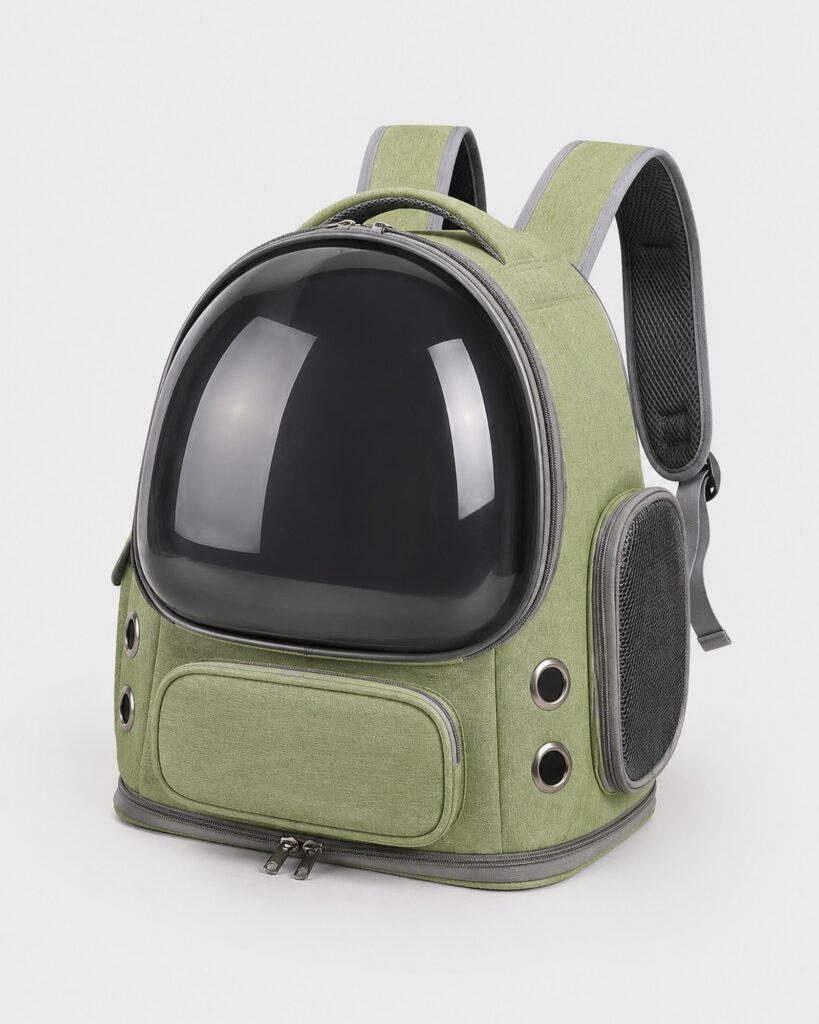
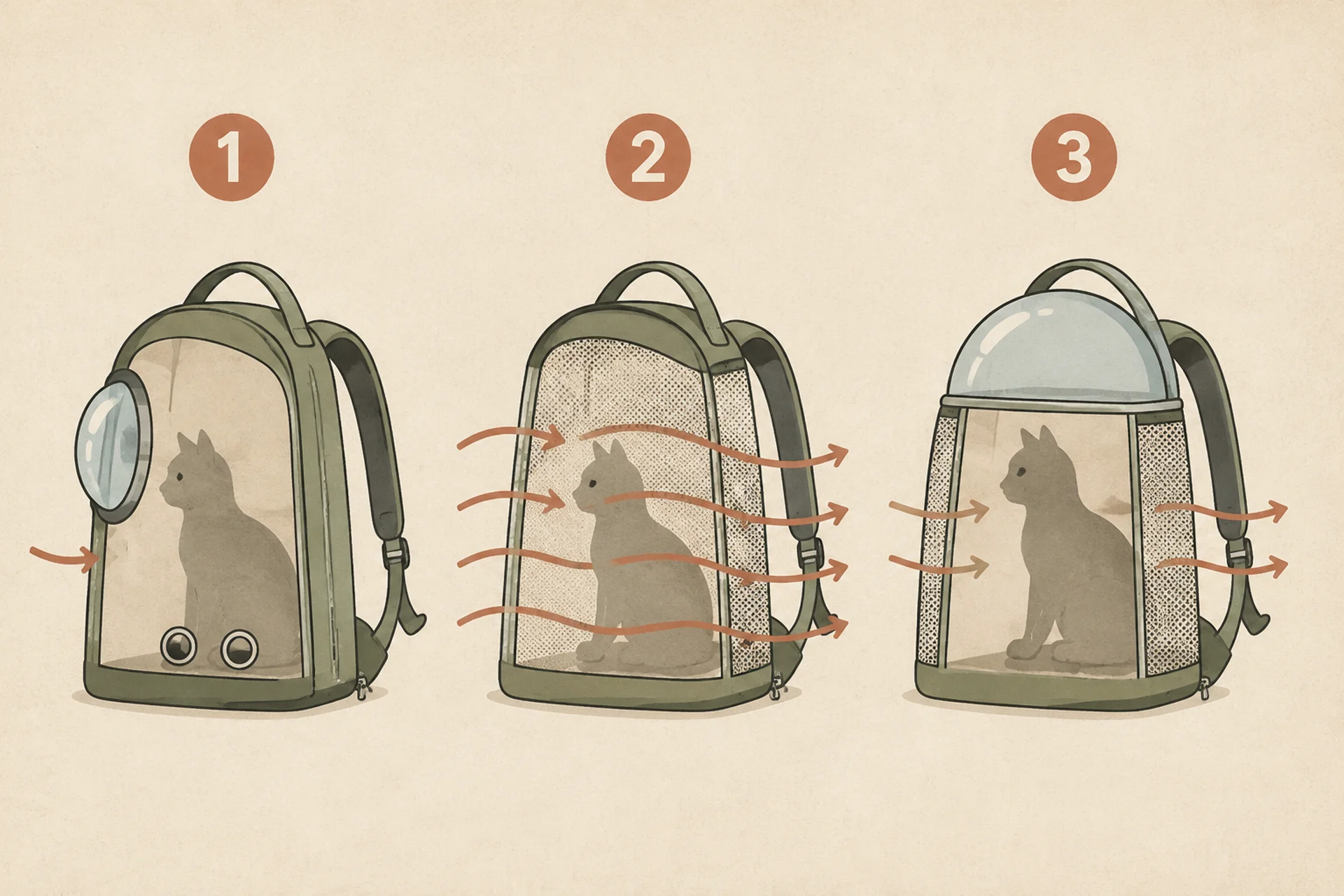
The bubble window is for you. The mesh is for your cat. A round acrylic porthole gives a fisheye view and a very good photo, and it does nothing at all for airflow — air has to come through mesh panels and vents somewhere else on the pack, or it does not come through.
That does not make bubble packs bad. It makes the ratio the thing to judge. Buy a pack where the acrylic is an accent and mesh does the ventilating, keep outings short, and never let a closed pack sit in the sun with a cat inside.
What the bubble actually does
The acrylic dome gives your cat a wide, curved view out of one panel and gives you the planet-explorer photo. That is genuinely the whole feature list. It does not vent. Worse, the curve eats interior headroom at exactly the height a sitting cat wants to put its head, so a bubble pack often has less usable space than its external dimensions suggest. Measure the interior height on the product page, not the outside of the shell.
Vent holes drilled into the acrylic help less than they look like they should. A handful of coin-sized holes in a rigid panel move a fraction of the air that a full mesh side does, because air needs somewhere to go as well as somewhere to enter. A pack with mesh on two opposing faces gets a through-draught. A pack with a bubble on one face and vents on the same face mostly gets a warm pocket.
Bubble vs mesh vs dome, honestly
| Design | Strength | Watch out for | Best for |
|---|---|---|---|
| Rear bubble window | Widest view; the look people buy it for | No airflow through the acrylic; runs warm; steals headroom | Short cool-weather outings, confident cats, photos |
| Full mesh | Best airflow; lightest; the cat can smell as well as see | Less structure; shy cats can feel exposed on all sides | Warm days, longer carries, cats who like watching |
| Top dome + mesh sides | Skylight view with a through-draught at cat height | Slightly heavier than pure mesh; dome can catch direct sun | Most cats, most of the year — the middle path |
Heat is the real question
Cats are less equipped than dogs to deal with a warm enclosed box, and the signs come later. Cornell’s Feline Health Center lists the signs of heat stroke in cats as “Weakness/collapse, Excessive panting, Drooling, Vomiting, Diarrhea.” Note where panting sits on that list — not as a normal cooling behaviour the way it is in a dog, but as a symptom. A cat breathing with its mouth open in a carrier is not cooling itself off efficiently; it is telling you something has already gone wrong.
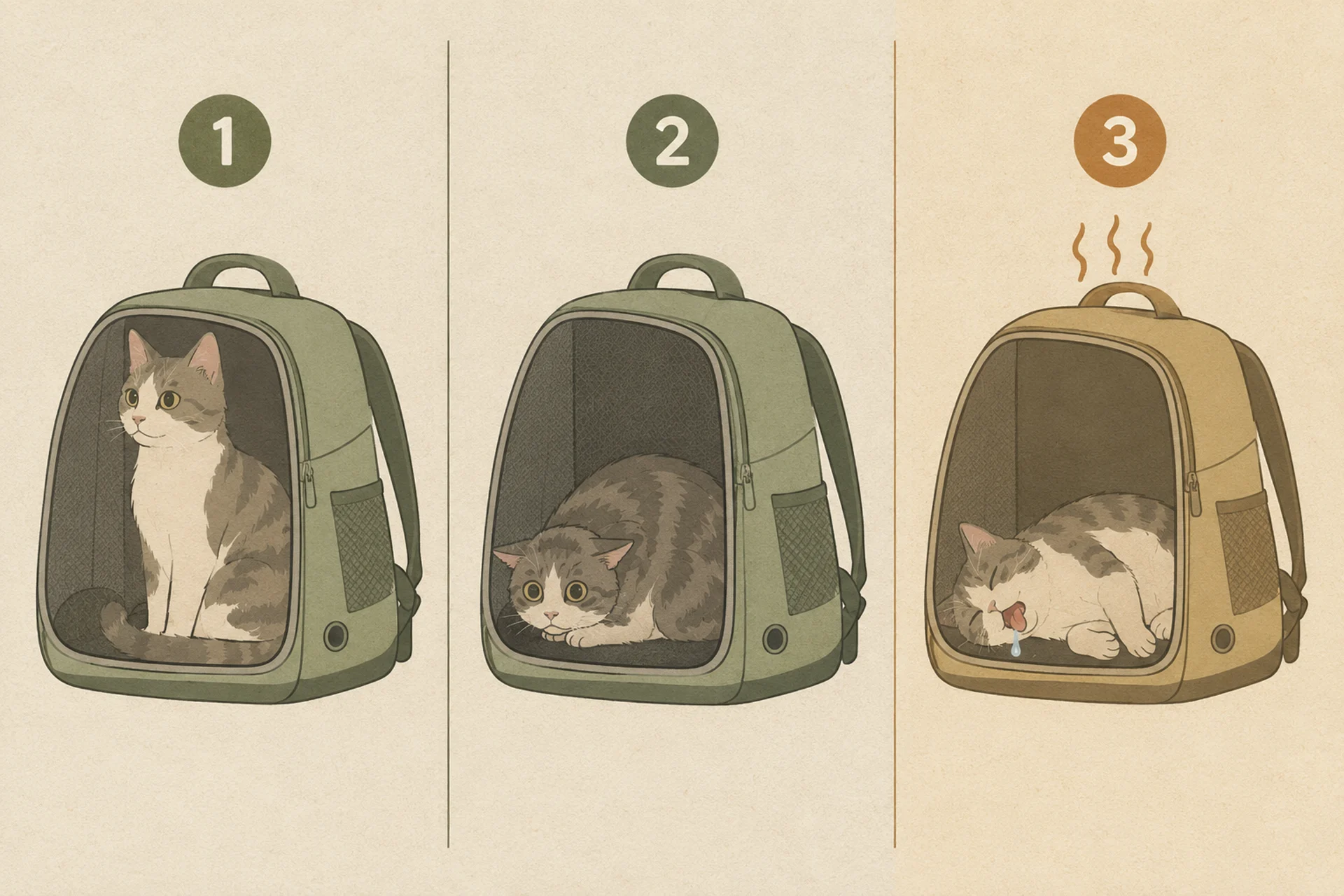
Two extra factors stack on top of the pack itself. Stress raises a cat’s temperature, and a first outing is stressful by definition. And flat-faced cats start further behind: the ASPCA’s hot weather guidance names Persians alongside Pugs as breeds at greater risk because they pant inefficiently, and adds elderly, overweight and heart- or lung-compromised animals to the list. If your cat is on it, mesh area is not a preference, it is the specification.
If a cat does overheat, Cornell’s instruction is to move them to a cool area with a draught, gently wet the fur with cool — not very cold — water, and contact a veterinarian immediately. The Merck Veterinary Manual adds a warning worth remembering before you improvise: do not immerse the animal in cold water. It also gives the reference point most owners never learn — normal rectal temperature for dogs and cats is about 101.5–102°F (38.6–38.9°C).
How to judge a pack in three minutes
- Count the ventilating faces, not the vents. Two opposing mesh panels beat six holes in one rigid panel.
- Check whether mesh sits at cat height. A mesh strip along the top does little for a cat lying on the floor of the pack.
- Look for interior height in the specs. Then subtract for any dome that curves inward.
- Test the pack in the sun before your cat does — leave it closed on a sunny step for ten minutes and put your hand inside.
- Confirm there is an internal tether clip. A cat who bolts at a door is the failure mode nobody plans for.
Will your cat actually like it?
Some cats love watching the street go by; others find the movement and exposure genuinely distressing, and the window style has nothing to do with which one you have. Find out at home, cheaply, before you commit.
Leave the pack open on the floor for a week or two with a familiar blanket and treats inside, so it becomes furniture rather than an event. Feed a meal beside it, then in it. Close it for thirty seconds, then open it. Do a lap of the hallway on your back before you do a lap of the block. A cat who leaves the room when the pack comes out is answering the question — and the answer is not “buy a nicer window.”
On the walk itself, keep the first outings to a few quiet minutes and end them while your cat is still calm. Most cats do better in a pack that lets them turn around and lie down than in one that only lets them sit and look out, which is another quiet argument against the deep-bubble shapes. For an hour-plus outing, plan shaded stops, offer water, and treat open-mouth breathing as the end of the trip rather than a stage of it.
Which window style, in our line
The Trail Dome-View Cat & Small Dog Backpack Carrier takes the middle path — a clear top dome for the view, with mesh panels doing the ventilating at cat height. For warm days and longer carries, the Trail Fresh-Air Capsule Cat Backpack Carrier leads with airflow. If the round-window look is the point, the Everyday Round-Porthole Cat Backpack Carrier pairs the porthole with mesh rather than relying on the acrylic alone. Check the weight range and interior dimensions on each product page against your own cat’s measurements — and browse the rest in Carriers.
Bubble backpack FAQ
Are bubble windows bad for cats?
Not inherently — the issue is proportion. A pack that is mostly acrylic with token mesh runs warm and stuffy. A pack that is mostly mesh with a window element keeps air moving while still giving the view.
Do bubble cat backpacks get hot?
An enclosed acrylic space in direct sun behaves like a small greenhouse, and the acrylic itself does not ventilate. In shade, on a cool day, a well-vented bubble pack is fine. In sun, on a warm day, mesh area is what keeps the interior liveable.
How long can a cat stay in a backpack carrier?
Around an hour is a sensible ceiling for most cats on a moving outing, with water at breaks. For longer days choose a pack the cat can fully turn around in, plan shaded stops, and stop at the first open-mouth breathing.
Is panting normal for a cat in a carrier?
No. Cornell’s feline heat safety guidance lists excessive panting among the signs of heat stroke in cats. Treat open-mouth breathing as a reason to get your cat cool and still, and call your veterinarian if it does not resolve quickly. The car version, step by step, is in cat panting in the car.
Bubble window or dome window for summer?
A top dome with mesh sides generally handles heat better than a rear bubble, because the mesh sits at cat height where air actually moves. In hot climates, mesh area matters more than window shape.
My cat hides when I get the backpack out. What now?
Slow the introduction down rather than pushing through it. Leave the pack open and unused for a couple of weeks with familiar bedding inside, feed near it, then in it. If the avoidance persists, a low-stress ground-level carrier may simply suit your cat better than a pack.
Still deciding between a backpack and a traditional carrier shape? Our comparison of backpack cat carriers vs cat backpacks breaks down when each wins, and the top-loading carrier guide covers the easier-to-load alternative for cats who dislike being posted through a front door.
Buy the window for you. Buy the mesh for your cat.
If the astronaut look is the goal, pick a design where the acrylic is an accent and the airflow does the work. Your cat gets the view without the greenhouse, you still get the photo, and the outing ends because you decided to end it — not because your cat started panting.
Sources
- Cornell University College of Veterinary Medicine, Cornell Feline Health Center — Feline Heat Safety (checked 2026-08-24)
- ASPCA — Hot Weather Safety Tips (checked 2026-08-24)
- Merck Veterinary Manual — What to Do in a Dog or Cat Emergency (checked 2026-08-24)
Veterinary guidance is updated over time. Confirm current advice on the official pages, and talk to your own veterinarian about your cat — especially if they are flat-faced, elderly, overweight, or have a heart or breathing condition.