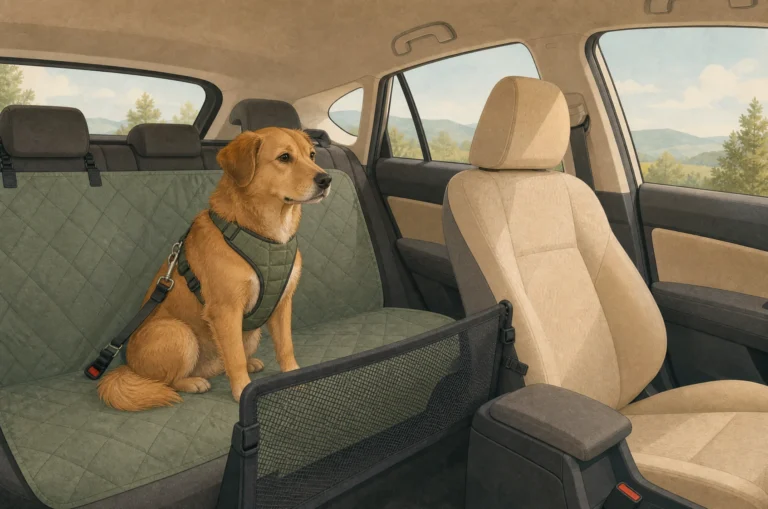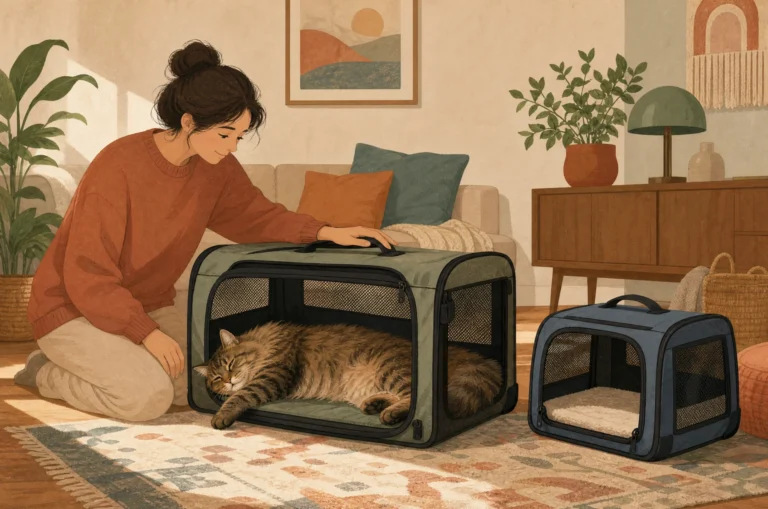
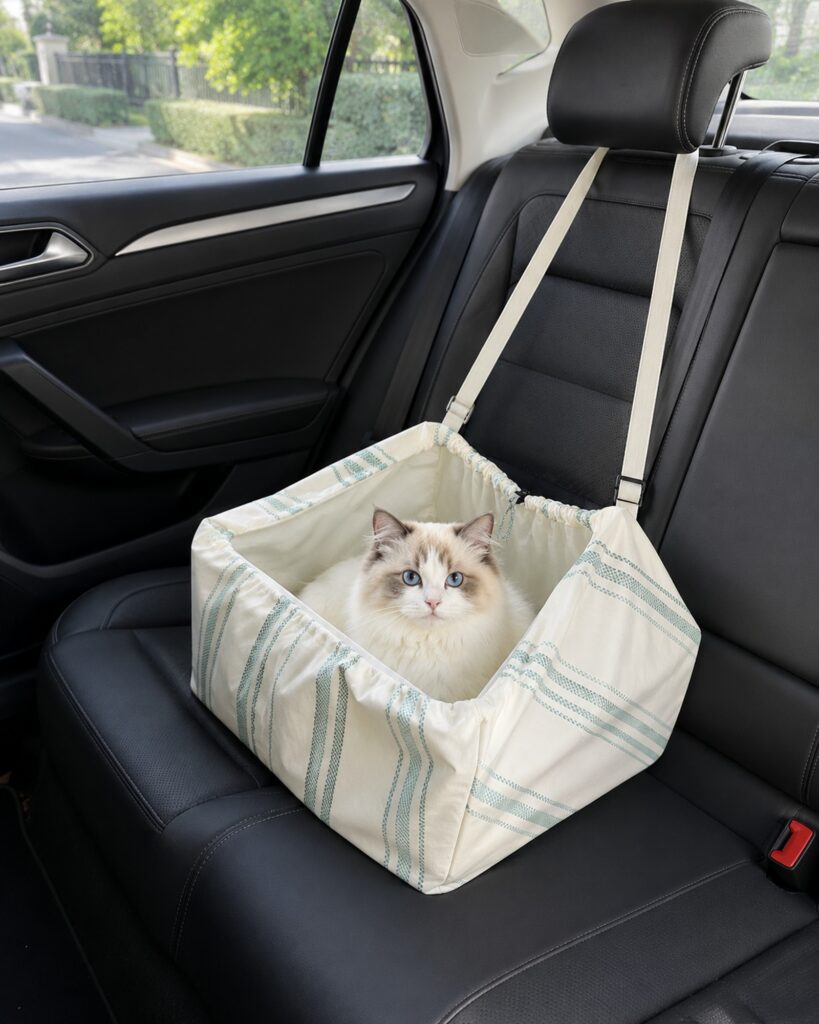
You do not need a litter box in the car. You need a plan for where one goes at each stop, and almost no cat will use a box in a moving vehicle anyway. Trying to run one in the footwell means an unsecured tray and a loose cat — the two things every travel-safety page tells you to avoid. The ASPCA’s travel guidance is to keep a pet in a carrier “large enough for your pet to stand, sit, lie down and turn around in,” secured so it cannot slide.
And the thing worth watching on a cat road trip is not whether the box gets used. It is whether your cat urinates at all once you arrive. Cornell’s Feline Health Center is unambiguous about why: “The time from complete urinary obstruction until death may be less than twenty-four to forty-eight hours.”
The real risk on a cat trip is not the mess
Most of what is written about travel litter boxes is about containment — scatter, smell, the upholstery. Worth solving, but it is the small half of the problem.
The larger half is that travel is a stressor, and stress is directly implicated in feline lower urinary tract disease. Cornell states it plainly: “Stress seems to be an important factor in the development of FIC,” listing environmental changes and disruptions to routine among the sources. A cat who is holding it in an unfamiliar hotel room, on unfamiliar litter, is sitting in exactly that combination.
And the consequence is not evenly distributed. Cornell: “Male and neutered male cats are at greater risk for obstruction than females because their urethra is longer and narrower.” If you are travelling with a male cat, the single most useful thing you can do on arrival is confirm that he has produced urine — not that the box looks tidy.
The signs to know, in Cornell’s wording, are that affected cats “strain to urinate, make frequent attempts to urinate, and produce little, if any, urine,” often “crying out in pain.” A cat going in and out of the box without result is not being fussy about the new litter. Cornell calls urethral obstruction “a true medical emergency” requiring “immediate veterinary attention.”
What to do at each stage of the trip
| Stage | Litter setup | What to watch |
|---|---|---|
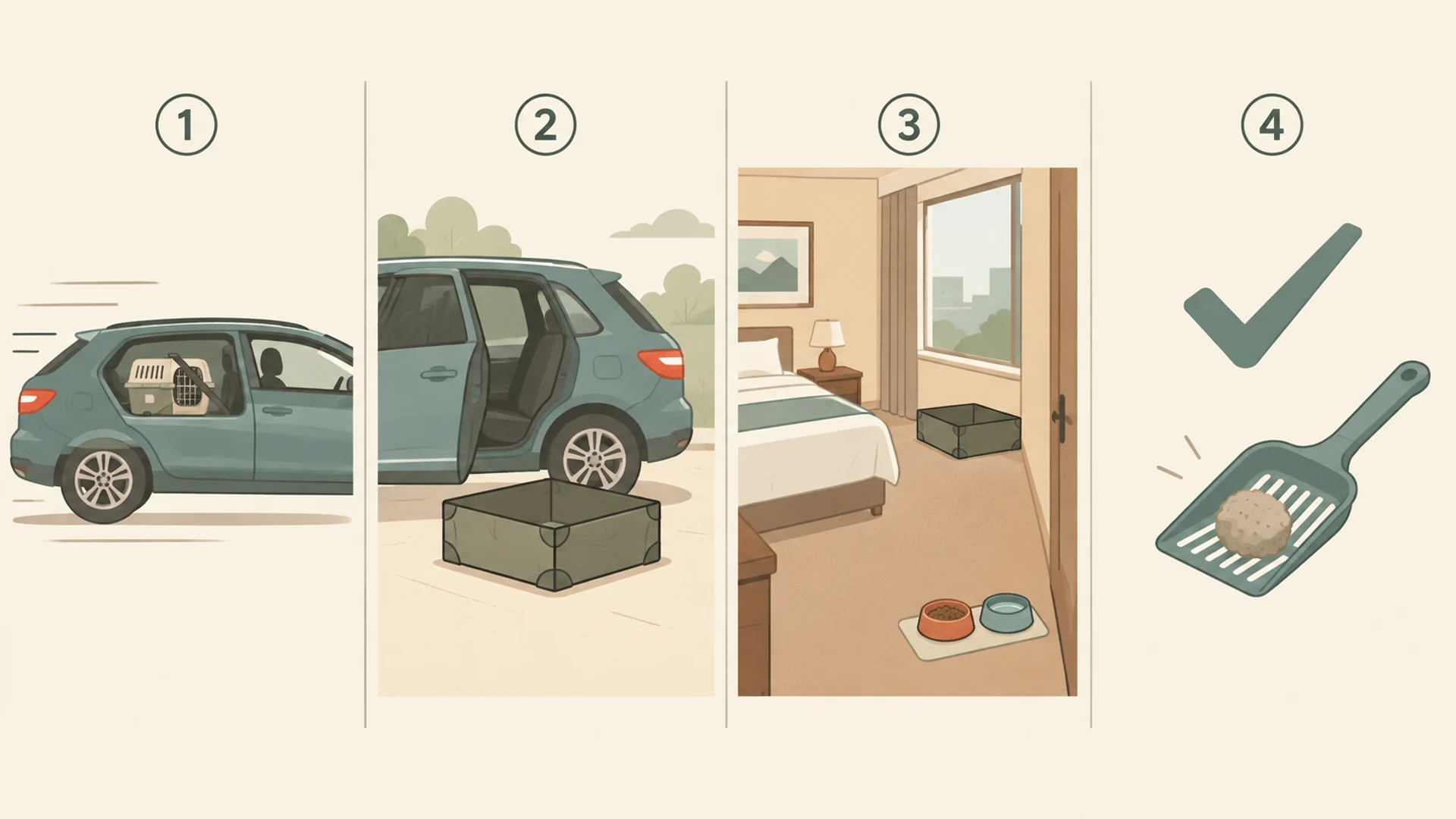
| Moving | None. Cat stays in a secured carrier; an absorbent pad under the bedding is the whole plan | Panting, drooling, continuous vocalising — signs of distress rather than bathroom need |
| Parked break | Tray set up inside the vehicle with doors shut, or in a contained space — never outdoors off-leash | Most cats decline. That is normal on a break and not yet a concern |
| Overnight or arrival | Full setup, familiar litter, away from food and water bowls, somewhere quiet | Whether urine is actually produced within the first several hours |
| Air travel | Nothing loose in the cabin carrier. Plan the setup for the other end | Airline rules vary; TSA defers to the carrier on what is allowed |
How long can a cat reasonably hold it?
There is no published hour count, and anyone giving you a firm one is guessing. Healthy adult cats routinely go overnight at home without using a box, which is why a daytime drive rarely forces the issue. The variable that matters is not elapsed hours but whether the cat resumes normal urination once settled somewhere quiet.
What that means practically: stop trying to force a roadside bathroom break, and start treating the first evening at the destination as the checkpoint. Set the box up before you unpack anything else, put it somewhere with a wall at its back and a clear exit, and keep it well away from the food and water bowls. Then scoop it once before bed, so you actually know.
Bring the litter your cat already uses if you can carry it. A change of texture or fragrance on top of a change of room is one variable too many, and consistency of routine is exactly what Cornell’s environmental advice for FIC points at. Pack it sealed and separate from everything else.
The tray itself: what actually matters on the road
Three things, in order. High enough walls that a cat covering up in a strange room does not redecorate it. A surface that wipes clean, because you will be doing that in a hotel bathroom without your usual kit. And a packed size that does not permanently occupy the boot for a two-night trip.
Disposable cardboard trays work for one-way trips and are genuinely fine. For repeat travel, a folding fabric station is easier to live with — the Road Fold-Away Cat Litter Box Station opens into a high-walled space with adjustable straps and wipe-clean fabric, and folds flat afterwards. Whatever you use, set it up at home first and leave it near the usual box for a few days, so its first appearance is not in an unfamiliar room.
That same rehearsal logic applies to the carrier, and it is the higher-value thing to practise. The ASPCA’s advice for getting a pet used to the car is “taking them on a series of short drives first, gradually lengthening time spent in the car.” Two more from the same page that people skip: “avoid feeding your pet in a moving vehicle,” and “Never leave your animal alone in a parked vehicle. On a hot day, even with the windows open, a parked automobile can become a furnace in no time, and heatstroke can develop.” That last one rules out the tempting plan of leaving the cat set up in the car while you eat.
Flying: the litter box is a destination problem
Nothing loose belongs in an under-seat carrier, and in any case you will be opening it at security. TSA’s instruction is: “Please remove your pet from the carrying case and place the case through the X-ray machine. You should maintain control of your pet with a leash and remember to remove the leash when carrying your pet through the metal detector. Animal carriers will undergo a visual and/or physical inspection.” A tray of litter inside that case makes a difficult moment worse.
On whether you can bring litter or a box at all, TSA does not decide it — the page lists both carry-on and checked status for small pets as “Check with Airline,” and adds: “Small pets are allowed through the checkpoint. Please check with your airline for their policy.” So the answer is your carrier’s, not the government’s, and it can change. Confirm it on the airline’s own current page before you fly.
Plan instead for the far end: an absorbent pad in the carrier for the flight, a flat-packed tray in the checked bag or bought on arrival, and a sealed bag of familiar litter if your allowance can take the weight.
A cat travel bathroom checklist
- A secured carrier the cat can stand, sit, lie down and turn around in
- An absorbent pad under the bedding for the ride — the actual in-transit plan
- A flat-packing tray with high walls, rehearsed at home first
- Familiar litter, sealed and packed separately
- Scoop, waste bags, wipes, and a spare pad
- The address of a 24-hour veterinary hospital near your destination, saved before you leave
- A note to yourself to check the box before bed on the first night
If you are still choosing the carrier itself, our guide to cat carriers for car trips covers securing it in the vehicle, and backpack cat carriers vs cat backpacks covers the build checks that matter more than the label. For a trip you did not plan, evacuating with a cat works through the same kit under time pressure.
Travel litter box FAQ
Do cats need a litter box in the car?
Not while the car is moving, and most will not use one. A loose tray is an unsecured object and using it means a cat out of the carrier — both of which work against the basic advice to keep a pet contained and the carrier secured. Offer a box at parked stops if the trip is long, and count on the destination setup doing the real work.
My cat hasn’t peed since we arrived. Should I worry?
Watch it closely, and know the line. Straining, repeated trips to the box producing little or nothing, or crying out are the signs Cornell lists, and it calls urethral obstruction “a true medical emergency” needing immediate attention — with the time from complete obstruction to death possibly under twenty-four to forty-eight hours. Male cats are at higher risk. When in doubt this is a call to a vet, not a wait-and-see.
How do you travel with a cat litter box on a plane?
You largely don’t. Keep the cabin carrier dry with an absorbent pad, because TSA will have you take the cat out and put the empty case through the X-ray. Whether litter or a tray can travel at all is set by the airline, not TSA — its own page lists small pets as “Check with Airline” for both carry-on and checked bags.
Should I bring my cat’s usual litter or buy some there?
Bring it if the weight works. A new room, a new tray and a new litter texture at once is a lot of change, and routine consistency is part of what reduces stress-linked urinary trouble. If you cannot carry it, buy the closest match you can and set the tray up before anything else gets unpacked.
Where should the litter box go in a hotel room?
Somewhere quiet with a wall behind it and a clear escape route, well away from the food and water bowls, and not in a bathroom whose door can swing shut. Set it up first, before the cat is let out of the carrier, so the room already has an answer when they start looking for one.
Can I use a carrier with a built-in litter area instead?
For transport, no — a carrier needs to stay dry and stable, and loose litter spreads through mesh and takes away the level floor the cat is standing on. Keep the two jobs separate: carrier for moving, tray for stopping.
Nothing in the car. Everything at the stop. Check that it worked.
The travel litter box question is really three questions, and only one of them is about the tray. During the drive the answer is an absorbent pad and a secured carrier. At the destination it is a high-walled tray, familiar litter, and a quiet corner set up before the cat comes out. And on the first evening, the answer is to look in the box — because with cats, and especially male cats, the absence of urine is the finding that cannot wait.
Sources
- Cornell University College of Veterinary Medicine, Cornell Feline Health Center — Feline Lower Urinary Tract Disease (urethral obstruction is a true medical emergency requiring immediate attention; time from complete obstruction to death may be less than 24–48 hours; male and neutered male cats at greater risk due to a longer, narrower urethra; stress an important factor in feline idiopathic cystitis; straining, frequent attempts producing little or no urine, crying out) (checked 2026-09-18)
- ASPCA — Travel Safety Tips (carrier large enough for a pet to stand, sit, lie down and turn around in; secure it against sliding; acclimate with a series of short drives; avoid feeding in a moving vehicle; never leave an animal alone in a parked vehicle) (checked 2026-09-18)
- Transportation Security Administration — Small Pets (remove the pet from the carrying case and X-ray the case; maintain control with a leash; carriers undergo visual and/or physical inspection; carry-on and checked status listed as “Check with Airline”) (checked 2026-09-18)
Airline and TSA rules change, and this is general information rather than veterinary advice. Confirm carrier policy on your airline’s current page, and take anything to do with your cat’s urination or health to your veterinarian.