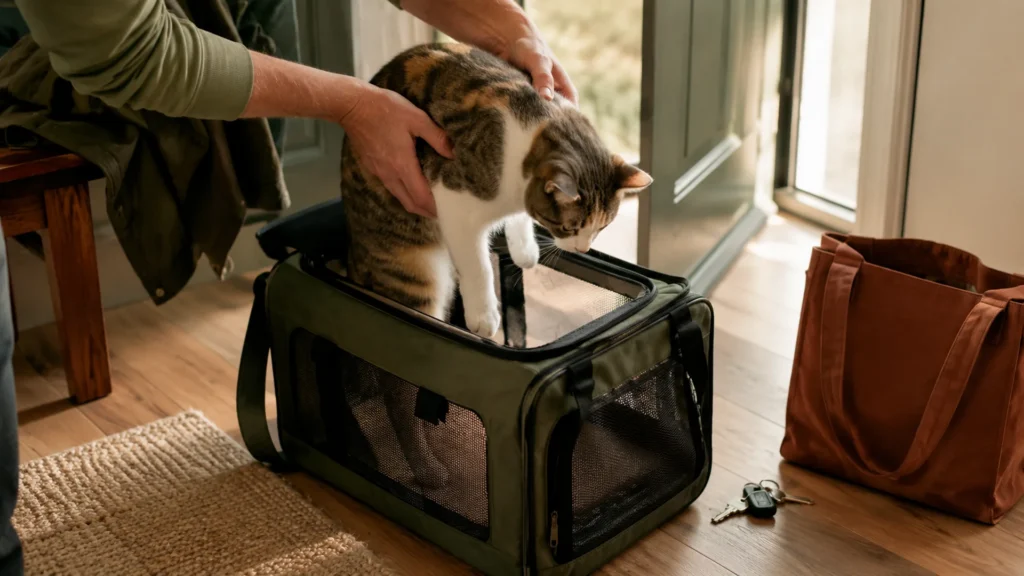
A top loading cat carrier makes the hardest part of cat travel easier: getting the cat in, and getting the cat back out. International Cat Care puts it plainly: a carrier that opens at the top “is much easier to use as your cat can be gently lifted in or out.” On the bad days, when your cat bolts at the sight of the carrier, the same guidance is to wrap the cat in a familiar-smelling towel and place cat and towel in together, quickly but gently. A top opening “makes this much easier.”
The other end of the trip matters just as much. The AAHA’s advice on cat vet visits says not to “tip or drag your cat out of the carrier,” and to use top-opening or removable-top carriers to reduce handling stress. The same checklist also asks for a front door for voluntary entry. So a roof door does not replace training. It is the door you want when training has not happened yet.
Why the top door wins for most cats
AAHA’s checklist for a good cat carrier lists both doors. It should have “a front door for voluntary entry” and “a removable top or top-opening design allowing for easy veterinary access.” The top door is the one that earns its place on difficult days:
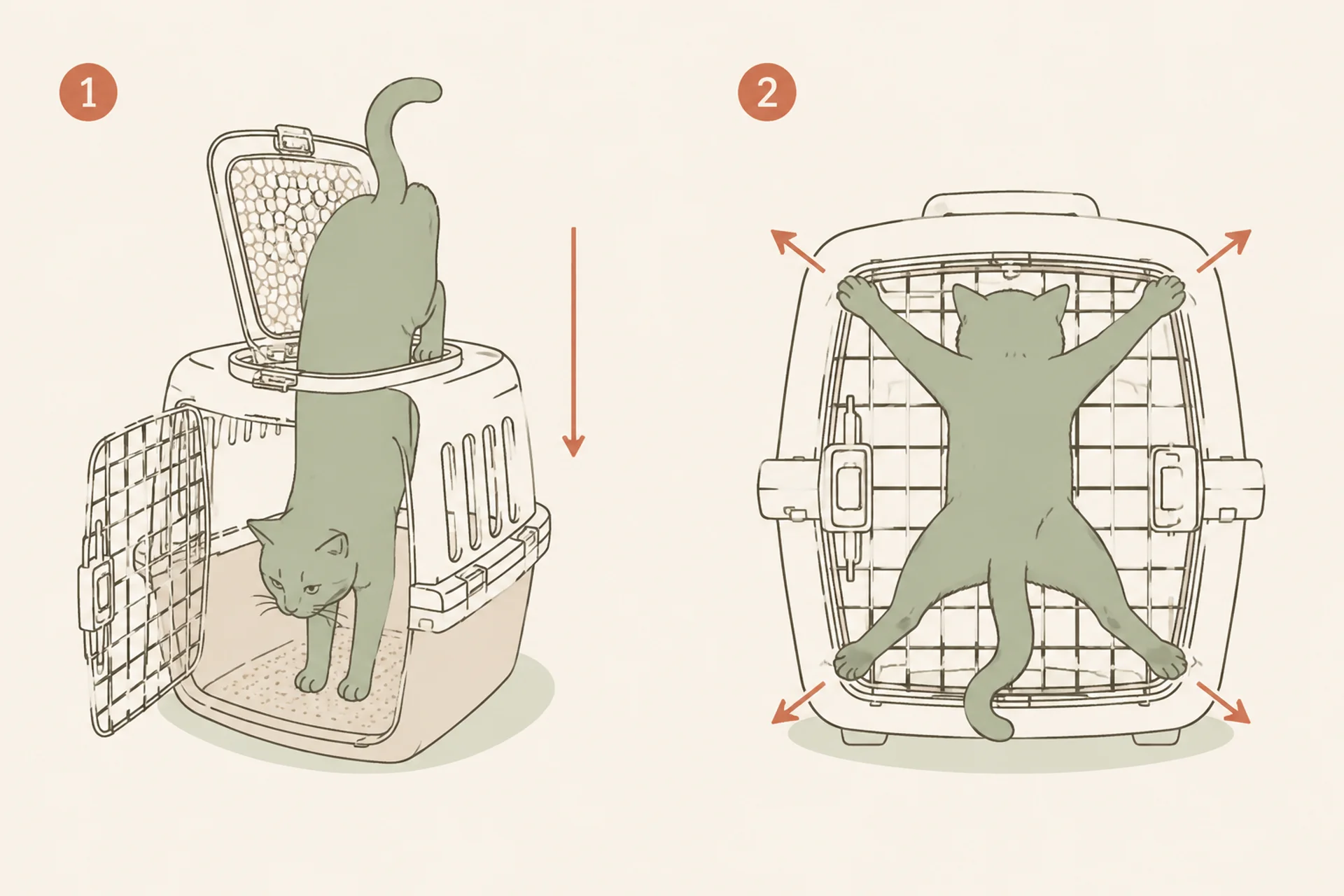
- Loading is a lower, not a push. Hind legs first, and the cat is inside before the objection is filed.
- No doorway to brace against — the classic starfish block only works on a front gate.
- At the vet, the exam can start in the carrier base. Cat Friendly Homes notes that many cats “feel more secure and experience less anxiety when they can remain in their carrier during the exam.”
- Mid-trip checks are safer. A roof hatch opens a hand-sized gap; a front gate opens an exit.
- Cleaning is easier when you can reach the whole floor of the carrier from above.
Where a front or end door still earns its place
Top access is for you; a second door is for the cat. Confident cats walk into a carrier that opens at the front, especially if it lives out in the house as a nap spot, and a walk-in entry is less dramatic than being lifted. The ideal is both: roof for loading days, front for voluntary entries. A single top hatch with no other door also makes under-seat airline use harder, since in-cabin checks usually happen through a side or front opening — for flight-day picks, start with our under-seat size guide instead.
Soft roof, hard roof: two kinds of top loader
| Type | How the roof opens | Strengths | Watch for |
|---|---|---|---|
| Soft-sided, zip roof | Mesh panel zips back across the top | Light, packable, quiet; mesh doubles as ventilation and a viewing panel | A determined cat can push a cheap zip — look for full-length pulls and a clip or lock point |
| Hard-shell, hatch roof | Rigid hatch hinges or lifts out of the roof panel | Structure a cat cannot collapse; wipes clean; base doubles as an exam tray | Heavier to carry; check the hatch latches on both sides so it cannot be nosed open |
What to check before you buy
The roof opening should be longer than your cat is wide — measure the cat, not the box photo. The floor should be rigid enough not to fold when you lift the carrier one-handed with the cat inside; a sagging base is the fastest way to teach a cat that carriers are unstable. Ventilation should come from more than the roof itself, because the roof is the panel your hands and the seat above will block most often. And every zip or latch needs a second action — a clip, a lock slider, a two-sided catch — between a clever cat and the street.
Weight ranges in listings are a filter, not a fit. Check the interior dimensions against your cat standing, turning, sitting and lying down. That four-position test is the AAHA’s, and our guide to what size carrier a cat needs shows how to measure for it. For a large cat, the roof opening matters as much as the interior: a big cat that has to be folded through a small hatch will fight the next time.
How to get a cat into a carrier: three levels, from best to last resort
Most searches about this come down to the same thing: you have an appointment and a cat under the bed. There are three levels. Use the highest one your cat and your schedule allow.
Level 1: the cat walks in on its own (weeks ahead)
This is the only approach that gets easier each time. The AAHA’s guidance is to make the carrier “a permanent and familiar feature in the home.” Leave it out in a spot your cat already likes, with soft bedding, and pair it with treats or attention. If your cat is already afraid of the carrier, AAHA says not to start by putting treats inside. Toss them near the carrier first, then just inside the entrance, then further in, at the cat’s pace. It is also never too late to start: one of the vets quoted by AAHA carrier-trained their own first cat at age 12.
Level 2: the towel wrap (the day of, cat panicking)
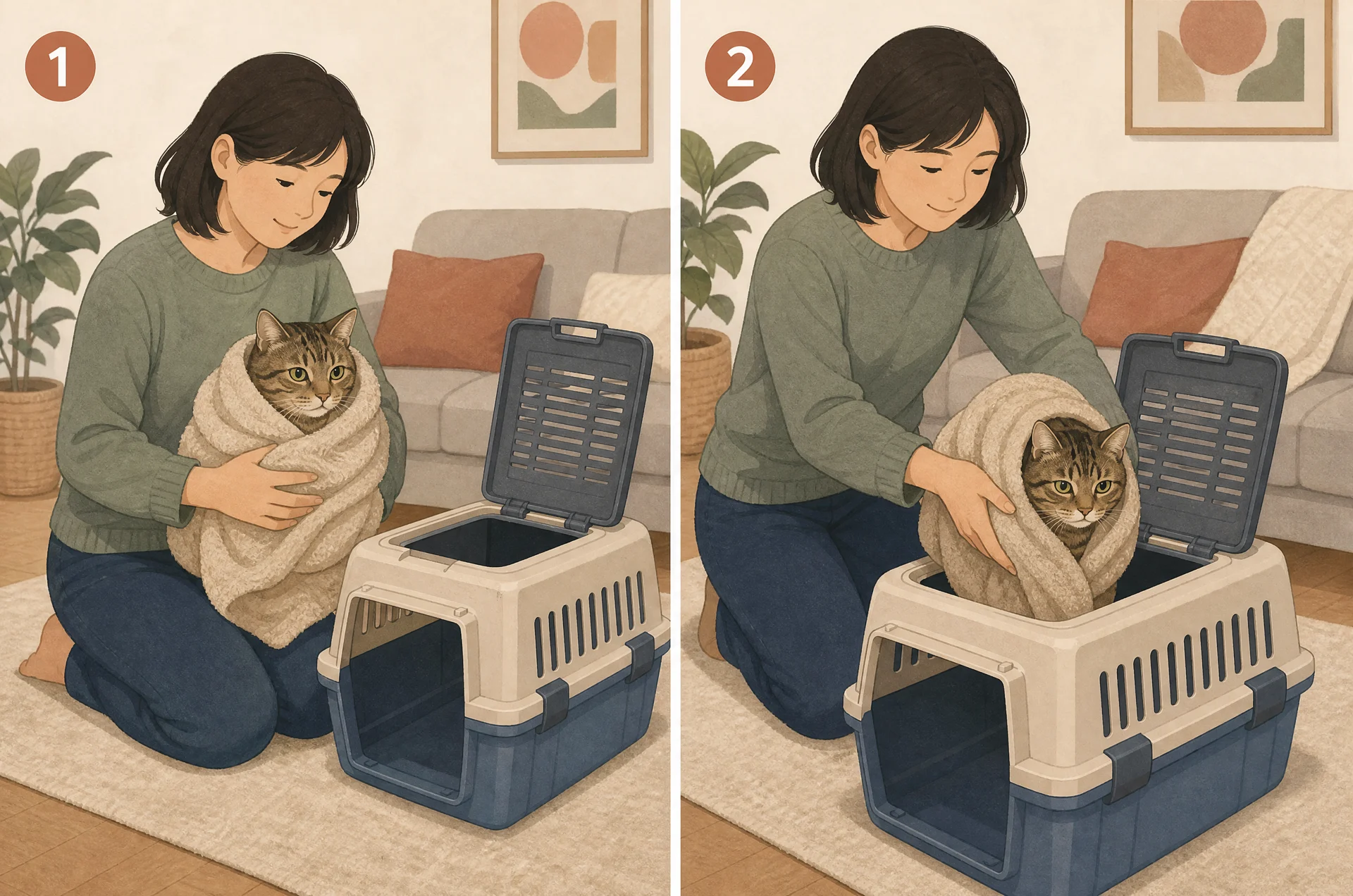
International Cat Care’s instructions for a cat that panics at the sight of the carrier: stay calm, keep the carrier close but out of sight, wrap your cat in a thick towel or blanket that smells familiar, and place the cat and towel into the carrier “quickly but gently.” A top-opening carrier “makes this much easier,” because you lower the bundle straight down instead of trying to push it through a front door. Leave the towel in the carrier. It smells of home and it absorbs accidents.
Level 3: backwards, hind legs first (when you have to go now)
Open the roof fully and prop it so it cannot fall shut. Lift the cat with one hand under the chest and one under the hindquarters, and lower it hind legs first, facing away from the carrier. A cat that cannot see the carrier coming has nothing to brace against. Close the roof as the paws land. This is also the answer to “how do I get my cat into a carrier by myself”: with a top door you only need two hands, and neither of them has to hold the carrier.
Be honest with yourself about the cost. AAHA warns that “forcing a cat into a carrier even one time can undo weeks or months of careful training.” Levels 2 and 3 get you to today’s appointment. Level 1 is what makes the next one easier. If your cat is older and suddenly fights being lifted, AAHA also notes that resistance “may be due to pain rather than fear alone,” which is worth mentioning to your vet. For emergencies, when you have ten minutes to leave the house, see evacuating with a cat.
Getting a scared cat out of the carrier
The same rule applies in reverse: do not tip the carrier or shake the cat out of it. AAHA’s clinic advice is to leave your cat in the carrier until the vet is ready, “allow your cat to exit voluntarily whenever possible,” and use a top-opening or removable-top carrier when the cat will not come out. With a hard shell that splits in half, the vet can lift the top off and examine the cat where it sits.
- At the vet: open the roof, let the cat see out, and give it time. One of the vets quoted by AAHA says new graduates often feel rushed by owners to get the cat out immediately, and that it is better to open the door and let the cat come out on its own while you talk.
- A new cat at home: put the carrier down in a quiet room, open the door or roof, and walk away. Coming out is the cat’s decision. If you lift it out while it is frightened, the carrier becomes the scary part.
- Carrying it there: AAHA advises against carrying the carrier by its handle. Hold it close to your body with both arms so it does not swing, and cover it with a light cloth. International Cat Care says the same: hold the carrier “underneath rather than by the handle.”
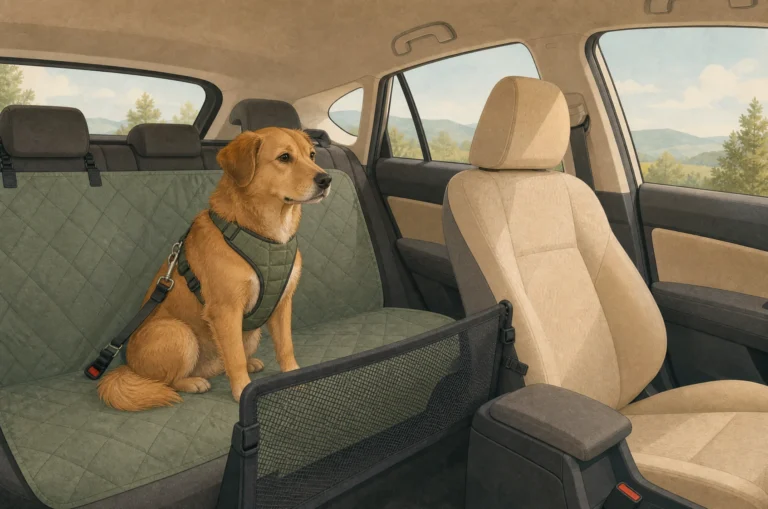
In the car, Cat Friendly Homes passes on the Center for Pet Safety’s advice to belt the carrier into the back seat only if it has been crash-tested, and otherwise to put it on the back-seat floor. Our car trip guide covers the setup, and our travel carrier guide covers longer trips.
Top loaders in the TuckTrail line
The everyday zip-roof. The Everyday Soft Top-Open Pet Carrier is the duffel-style pick: the mesh roof zips fully back for loading, wraparound straps take the weight, and a low corner window gives a nose-height view without an escape route.
The hatch-roof hard shells. The Sky Top-Window Hard-Shell Pet Carrier pairs a translucent roof hatch with a metal front gate — roof for loading, gate for walk-ins — with side vent slats and a fold-flat handle. The Sky Standard-Roof & Top-Window family offers the same shell with a compact size and a choice of roofs.
Soft-sided with a full mesh roof. The Sky Soft-Sided Mesh Pet Carrier runs mesh across the entire top with a front porthole and a lift-out pad, for cats who settle faster when they can see up. For car-seat setups and drives, our car trip guide covers how to secure whichever you choose. Browse the full set in Carriers.
Top loading cat carrier FAQ
Are top loading carriers better for cats?
For loading and for vet visits, yes — gravity beats pushing, and clinics can examine a cat in the carrier base. For voluntary entries at home, a front or end door is friendlier. The best carriers give you both.
Can a cat escape through a zip-top roof?
A cheap single zip, sometimes. Look for full-length double pulls that meet at a clip or lock point, and clip them closed on every trip. Hard hatches should latch on both sides. No roof should be the only thing between a motivated cat and open air.
How do I get a scared cat into a top loading carrier?
Keep the carrier out of sight, wrap the cat in a familiar-smelling towel, and lower cat and towel in together through the open roof. That is International Cat Care’s method for cats that panic. Then start the slow work for next time: carrier left out as furniture, treats tossed near it first, never forced. AAHA warns that forcing a cat in even once can undo weeks of training.
How do I get a cat into a carrier by myself?
Use a carrier with a top opening, prop the roof open and set it on the floor, then lower the cat hind legs first with one hand under the chest and one under the hindquarters. With a front-only door you need a third hand to hold the carrier upright. With a roof door you do not.
How do I get a scared cat out of a carrier?
Do not tip it or shake the cat out. Open the door or roof, give the cat time, and let it come out on its own. The AAHA recommends this at the vet, and it works at home too. If the cat has to come out, lift the whole top off a split-shell carrier, or lift the cat gently through the roof.
Do vets prefer top loading carriers?
The AAHA recommends a “removable top or top-opening design allowing for easy veterinary access,” and Cat Friendly Homes recommends a carrier whose top half comes off so the cat can stay in the base during the exam. If your cat is fearful, tell the clinic when you book. AAHA encourages owners to ask ahead about ways to make the visit less stressful.
Are top loading carriers airline approved?
No carrier is approved by every airline — cabin rules are about under-seat dimensions and soft-sided flex, not the door position. A soft top loader can fly if it meets your airline’s published size; check our size guide before booking.
What size top loading carrier does my cat need?
Inside, the cat should be able to stand, turn around, sit and lie down comfortably. That is the AAHA’s test, and the full method is in what size carrier for a cat. The roof opening should be comfortably wider than the cat’s shoulders. Measure the cat and ignore the marketing photo. The same interior-dimension rule applies to worn carriers; see the build checks in our backpack cat carrier guide.
Sources
- American Animal Hospital Association — Helping your cat cope with veterinary visits (a good carrier has “a front door for voluntary entry” and “a removable top or top-opening design”; toss treats near the carrier before inside; forcing a cat in “even one time can undo weeks or months”; do not tip or drag the cat out; let the cat exit voluntarily; carry with both arms, not by the handle; resistance may be pain) (checked 2026-09-28)
- International Cat Care — Taking your cat to the vet (a top-opening carrier “is much easier to use as your cat can be gently lifted in or out”; towel-wrap method for a panicking cat, “quickly but gently”; hold the carrier underneath rather than by the handle; cover the carrier while travelling) (checked 2026-09-28)
- Feline VMA, Cat Friendly Homes — Choosing the perfect cat carrier (top and front openings; top half removable so the cat can stay in the base for the exam; belt the carrier into the back seat only if crash-tested, otherwise on the back-seat floor) (checked 2026-09-28)
This is general handling guidance, not veterinary advice. If your cat’s fear of the carrier or of travel is severe, ask your veterinarian about options before the visit.
Buy the door you load through, keep a door they walk through.
The roof opening earns its price twice per trip — once at your front door, once at the clinic. Pick a zip roof for light errand duty or a latched hatch for structure, insist on a locking second action, and if your cat is the confident kind, choose a model with a front door too and let them commute on their own four feet.