If you live somewhere that issues evacuation warnings and orders, the household with a cat in it is supposed to leave one step earlier than everyone else. California’s official statewide wording is explicit about it: an Evacuation Warning means “those who require additional time to evacuate, and those with pets and livestock should leave now”. Not stand by. Not pack. Leave.
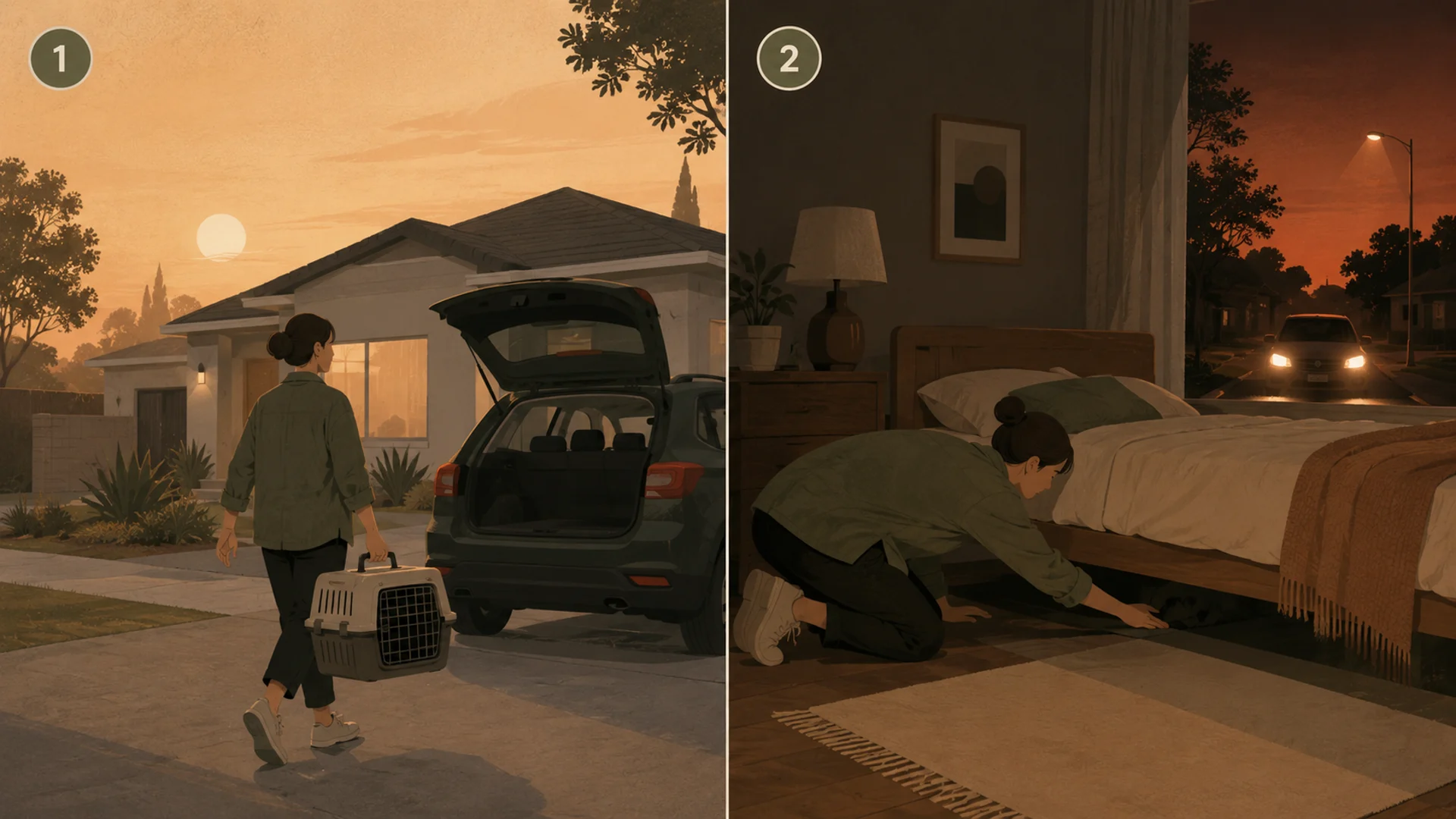
That single line is the whole plan, because the thing that makes cat evacuations go badly is not the fire or the flood. It is the twenty minutes you spend on your stomach with a torch, talking to a cat who has gone under the bed and has no intention of coming out.
Most pet-evacuation advice is a shopping list. Food, water, records, carrier. All of it correct, none of it the part that fails. What fails is the transition from “we should probably get ready” to “the cat is in the car,” and cats are uniquely good at stretching that transition past the time you have.
Warning, Order, and the line that applies to you
California standardised this language after the 2017 and 2018 wildfire seasons, when neighbouring counties used different words for the same thing. The result is short enough to memorise:
| Term | What it officially means | What it means with a cat |
|---|---|---|
| Evacuation Warning | “Potential threat to life and/or property. Those who require additional time to evacuate, and those with pets and livestock should leave now.” | This is your line, not the next one. Cat in the carrier, carrier in the car, go. |
| Evacuation Order | “Immediate threat to life. This is a lawful order to leave now. The area is lawfully closed to public access.” | If you are still catching the cat at this point, you are behind. Take the cat however you can and leave. |
| Shelter in Place | “Go indoors. Shut and lock doors and windows.” | Bring the cat into one closed interior room with you, with the carrier open in it. |
Cal OES puts it plainly on its own public page: a warning means “impending danger to your life or property”, an order means the threat is immediate. The pet clause exists because the people who wrote it had watched what happens without it.
Outside California the wording varies — some places use Ready / Set / Go, some use voluntary and mandatory. Terms are set locally and they change, so look yours up now and sign up for your county’s alert system while you are there. FEMA’s pet preparedness page is the national starting point and points you to your local emergency management office for the specifics.
Why a cat costs you the extra half hour
A frightened cat does not run out of the front door. It goes down and inward, into the smallest dark space it can reach, and stops responding to its name. The Cornell Feline Health Center describes the posture you will be looking at once you find them: fearful cats show “ears flattened and held outward, whiskers flattened or pressed downward onto the face”, dilated pupils, and a tendency to lie prone with the tail tucked under the body.
The trigger is usually you. Sirens, smoke, raised voices, suitcases coming out of cupboards — a cat reads all of that half an hour before you say anything, and has chosen a spot by the time you go looking. Which is why FEMA’s line on this is one of the most useful sentences in pet preparedness, and one almost nobody acts on: “Make note of where your pets hide, so you can easily find them in case you have to leave your house quickly.”
Do it this week. Find the three places your cat goes when the vacuum comes out, write them down, and work out which you can close off in ten seconds. On the day, shutting doors behind you as you move through the house is worth more than any amount of calling.
The carrier problem, solved in advance or not at all
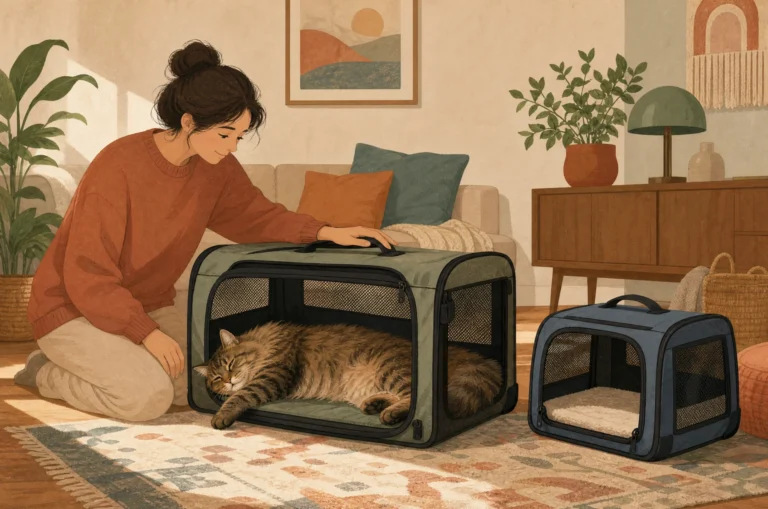
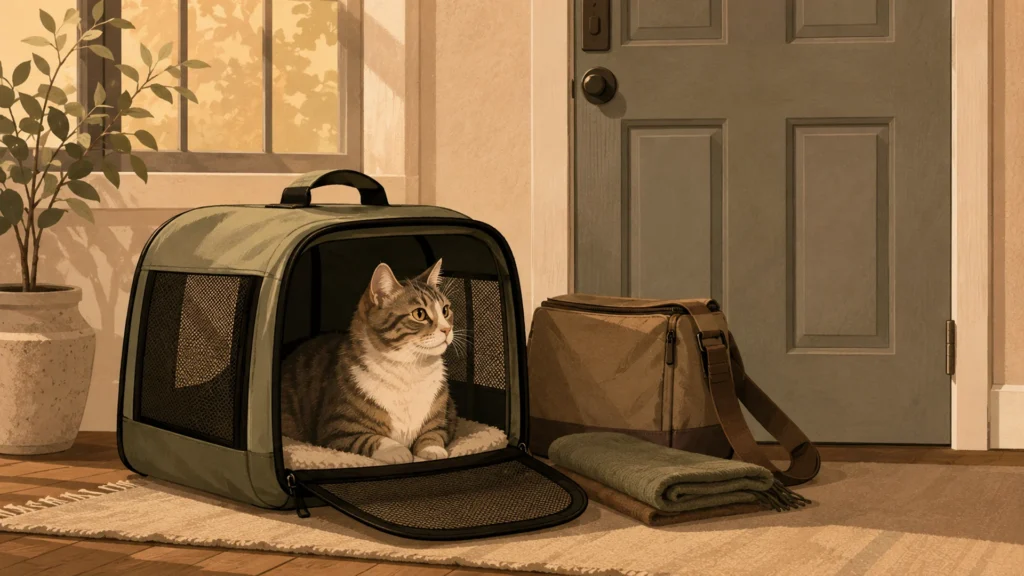
A carrier that lives in the garage and appears twice a year is a vet-visit signal, and a cat who has learned that will not walk into it while the sky is orange. FEMA’s fix is entirely boring: leave the carrier out in places your pet frequently visits, leave it open, feed treats near and inside it, and add a favourite blanket or small bed so it smells familiar.
Two additions. One carrier per cat — FEMA lists a “traveling bag, crate or sturdy carrier, ideally one for each pet,” and two cats in one box is how you get a fight in the footwell. And keep them by the door, not stacked in a loft. A top-opening carrier is far easier to load a resisting cat into, which is the same reason it wins at the vet: see top-loading cat carriers and choosing a cat carrier for travel.

- Carrier, one per cat, stored where you can reach it without a stepladder.
- Food and water in a waterproof container — the ASPCA suggests seven to ten days of pop-top or dry food and seven days of bottled water in the larger at-home kit.
- Medication in a waterproof container, plus a copy of the prescription.
- Litter and a disposable tray. The ASPCA’s cat list names scoopable litter and disposable trays; aluminium roasting pans work.
- A photo of you with your cat, which FEMA recommends specifically because it documents ownership if you are separated. Records in the same pouch.
- A pillowcase — on the ASPCA’s cat list, and the thing that gets a cat out of a house when the carrier is not winning.
- Microchip details checked this year. A chip with a disconnected number does nothing.
If the cat will not come out
Assume it will happen, because it usually does. The sequence that works is unglamorous: stop moving, drop your voice, close the doors to rooms you have already cleared, and bring the carrier to the cat rather than the cat to the carrier. If you can reach them but they are braced, a towel or pillowcase over the cat first removes most of the fight — a cat that cannot see the room stops trying to get back into it.
What matters more than technique is the clock. Everything above takes five minutes when the street is quiet and twenty-five when there are engines outside. If your county has issued a warning and your cat is still loose in the house, that is the moment to go and get them, not the moment to keep watching the map.
One thing not to do: leave them. FEMA is unusually blunt about it — “If local officials ask you to evacuate, that means your pet should evacuate too. If you leave your pets behind, they may end up lost, injured or worse.”
Know where you are going before you need to go there
The destination is the half people discover too late. FEMA notes that many public shelters and hotels do not allow pets inside, and the ASPCA’s disaster preparedness guidance agrees: not all shelters accept pets, so arrange a safe haven in advance. Work through its list — a friend or relative outside your immediate area, a pet-friendly hotel far enough away to still be open, your own vet, or a boarding facility that takes emergency intakes. Pick two, in different directions, and put the numbers in your phone rather than on a fridge magnet you will not be standing in front of. The ASPCA also suggests a rescue alert sticker on a visible window listing the types and number of pets in the home along with your vet’s details, for the case where the emergency arrives while you are at work.
Evacuating with a cat: FAQ
Should I really leave at a warning rather than an order?
If you have a cat, yes — that is what the official wording asks. California’s standard terminology puts households with pets in the same group as people who need additional time, and tells that group to leave at the warning. Other states word it differently, so check your county’s definitions now. The principle travels even when the vocabulary doesn’t: loading a cat takes longer than loading a person.
How do I get a cat into a carrier quickly?
Mostly by having done the slow work first: carrier left out and open in a room the cat uses, treats fed near and inside it, a familiar blanket in the bottom. On the day, shrink the space rather than chase — close doors behind you, bring the carrier to the cat, and load through the top if the carrier opens that way. A towel over the cat before lifting removes most of the struggle.
What if I’m not home when the evacuation is called?
This is what the buddy system is for. FEMA recommends arranging in advance with a neighbour, friend or relative who can care for or evacuate your pets if you cannot — which means they need to know where your carriers are, where your cat hides, and how to get in. The ASPCA’s rescue alert sticker covers the other case, where responders reach the house first.
Is a backpack carrier good for evacuation?
It has one real advantage: it leaves both your hands free, which matters if you are also carrying a bag, a child, or a second carrier. The trade is that it is harder to load a resisting cat into an upright pack than into a top-opening box, so it works best for a cat already used to one. If you are weighing the two, our comparison of backpack cat carriers covers what separates a real carrier from a bag with a window.
What about smoke if we’re staying put?
Sheltering in place means doors and windows shut, and if wildfire smoke is the reason, the indoor air matters for your cat too. There is no published air-quality threshold specific to cats, so treat human guidance as the floor rather than the ceiling and keep them in the cleanest room you have. We go through how we read the numbers for dogs in what AQI is safe for a walk; the same caution applies indoors.
Bottom line
The plan is three sentences long. Know where your cat hides and be able to close those doors. Keep a carrier per cat out, open and familiar, near the exit. And when the warning comes, treat it as your order, because the official wording already does.
Everything else on the list is worth having, and none of it is the part that goes wrong. The part that goes wrong is time, and the only place to buy more of it is at the start.
Sources
- California Governor’s Office of Emergency Services (Cal OES) — California Standard Statewide Evacuation Terminology (checked 2026-09-02)
- Cal OES News — Evacuation Warning vs. Evacuation Order (checked 2026-09-02)
- FEMA / Ready.gov — Prepare Your Pets for Disasters (checked 2026-09-02)
- ASPCA — Disaster Preparedness (checked 2026-09-02)
- Cornell University College of Veterinary Medicine, Cornell Feline Health Center — Feline behavior problems: aggression (checked 2026-09-02)
Evacuation terminology is set locally and changes. Confirm the definitions your county uses, and sign up for its alert system, on the official emergency management page for where you live. Nothing here is veterinary advice; if your cat has a medical condition, ask your own vet what an evacuation kit should contain for them.