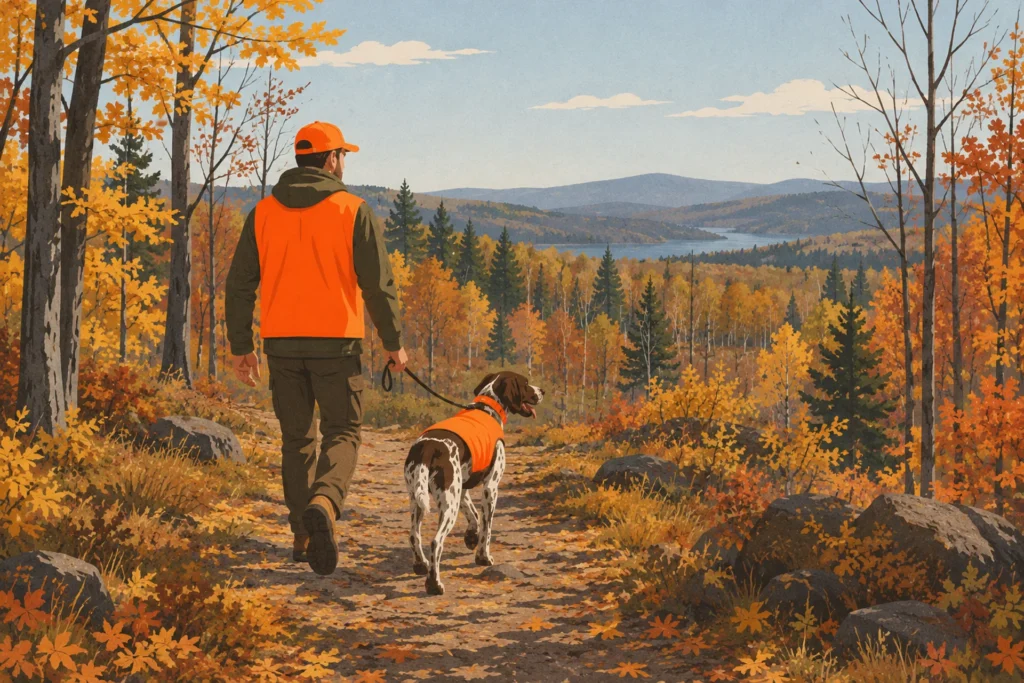
You almost never have to stop walking. Most trails stay open through hunting season, and the safety advice from state wildlife agencies is unglamorous and specific: find out which season is actually open where you walk, go in the middle of the day rather than at dawn or dusk, favour busy trails over quiet ones, keep the dog on a leash, and put blaze orange on both of you.
The part people get wrong is the first step. Most of us assume we know whether hunting happens where we walk, and most of us have never checked. It takes about five minutes, once a year.
Step one: find out whether anyone is hunting where you walk
Two assumptions cause most of the trouble. The first is that a trail with a car park and a signboard must be a park, and parks do not have hunting. The second is that national parks certainly do not. The second one is wrong: the National Park Service states plainly that “some NPS units permit hunting”, managed in cooperation with state governments.
State land is the bigger surprise for most dog walkers, because the trails there are maintained and signposted exactly like the ones that are not hunted. New York’s Department of Environmental Conservation describes maintaining “hiking, biking, skiing, and snowmobile trails in many areas of Forest Preserve lands in the Adirondack and Catskill parks, as well as in State Forests, Wildlife Management Areas, and Unique Areas open to hunting”. The same page puts roughly 600,000 hunters in the field in that one state.
| Where you walk | Hunting usually allowed? | Where to check |
|---|---|---|
| City or county park | Rarely | The parks department page for that specific park |
| State forest, state land, Wildlife Management Area | Commonly yes | Your state fish and wildlife agency |
| National forest or BLM land | Commonly yes, under state seasons | The forest or field office page, plus state season dates |
| National park unit | Varies by unit | That park’s own regulations page |
| Private land you have permission to cross | Ask the owner directly | The landowner — every season, not once |
Once you know the land manager, the season dates come from one place: your state’s fish and wildlife agency publishes them, usually as a downloadable digest. Vermont Fish & Wildlife’s advice to non-hunters starts there — “Know when hunting takes place. Season dates are available in the free Vermont Hunting and Trapping Official Regulations Digest”. Every state has an equivalent. Seasons are not one block: archery, muzzleloader, rifle, small game and waterfowl all run on different calendars, and the rifle deer season is the one that changes how a trail feels.
Timing and place do more than anything you can buy
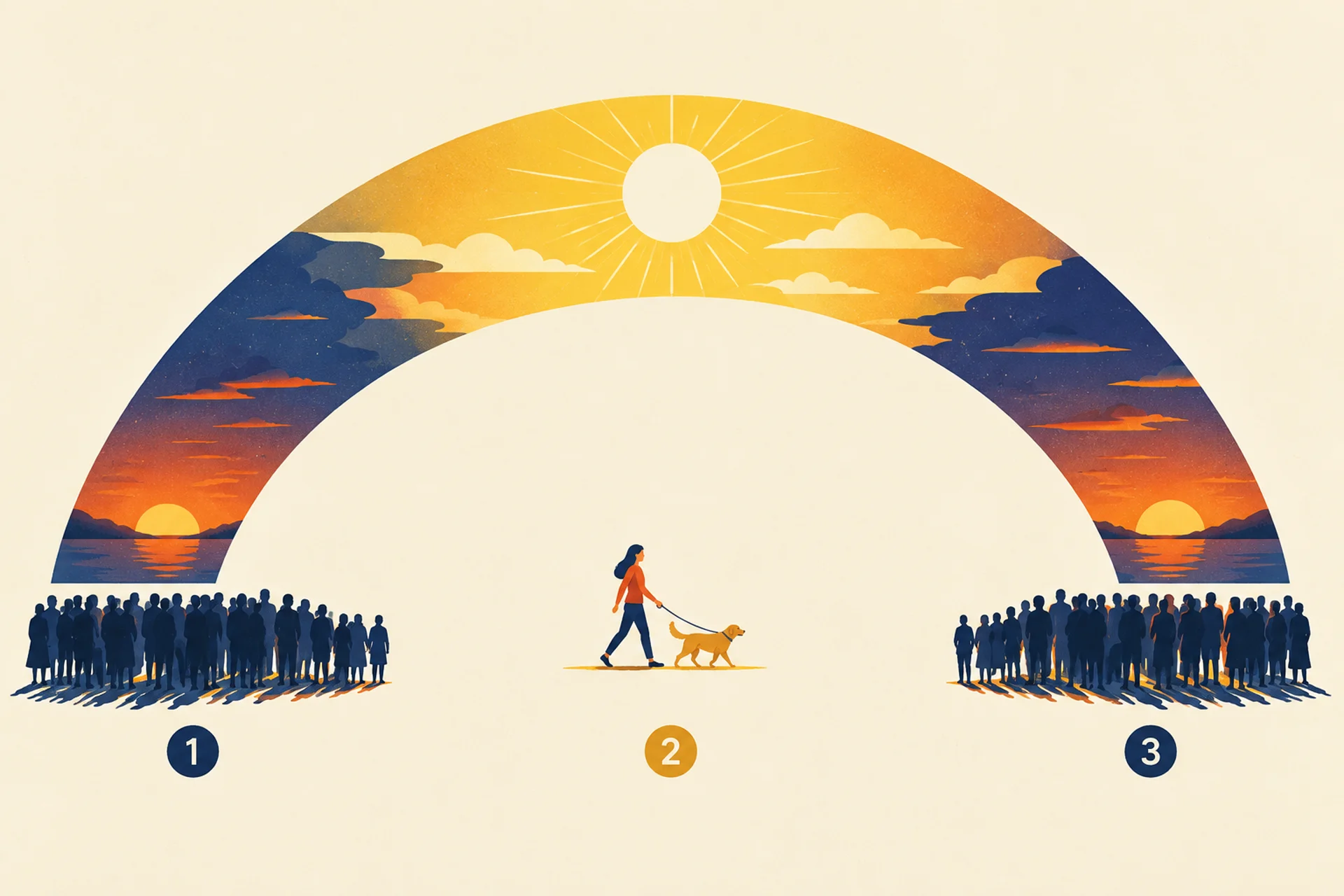
Vermont Fish & Wildlife’s guidance for hikers and dog walkers is worth reading as a sequence rather than a list. “Plan outings closer to the middle of the day — the lighting is better and fewer people are hunting then,” it says, and then: “Favor high-use public areas or trails — hunters tend to avoid areas where many other people are already hiking or walking their dog.”
That second line inverts the instinct most dog owners have, which is to take a nervous or reactive dog somewhere empty. During rifle season the empty trail is the one with hunters on it. If your walk depends on solitude, this is the six weeks to swap to pavement, a city park, or a beach — and if you are walking early because of the season’s shorter daylight, our guide to walking your dog in the dark covers the other visibility problem that arrives at the same time of year.
Orange — and who it is actually for
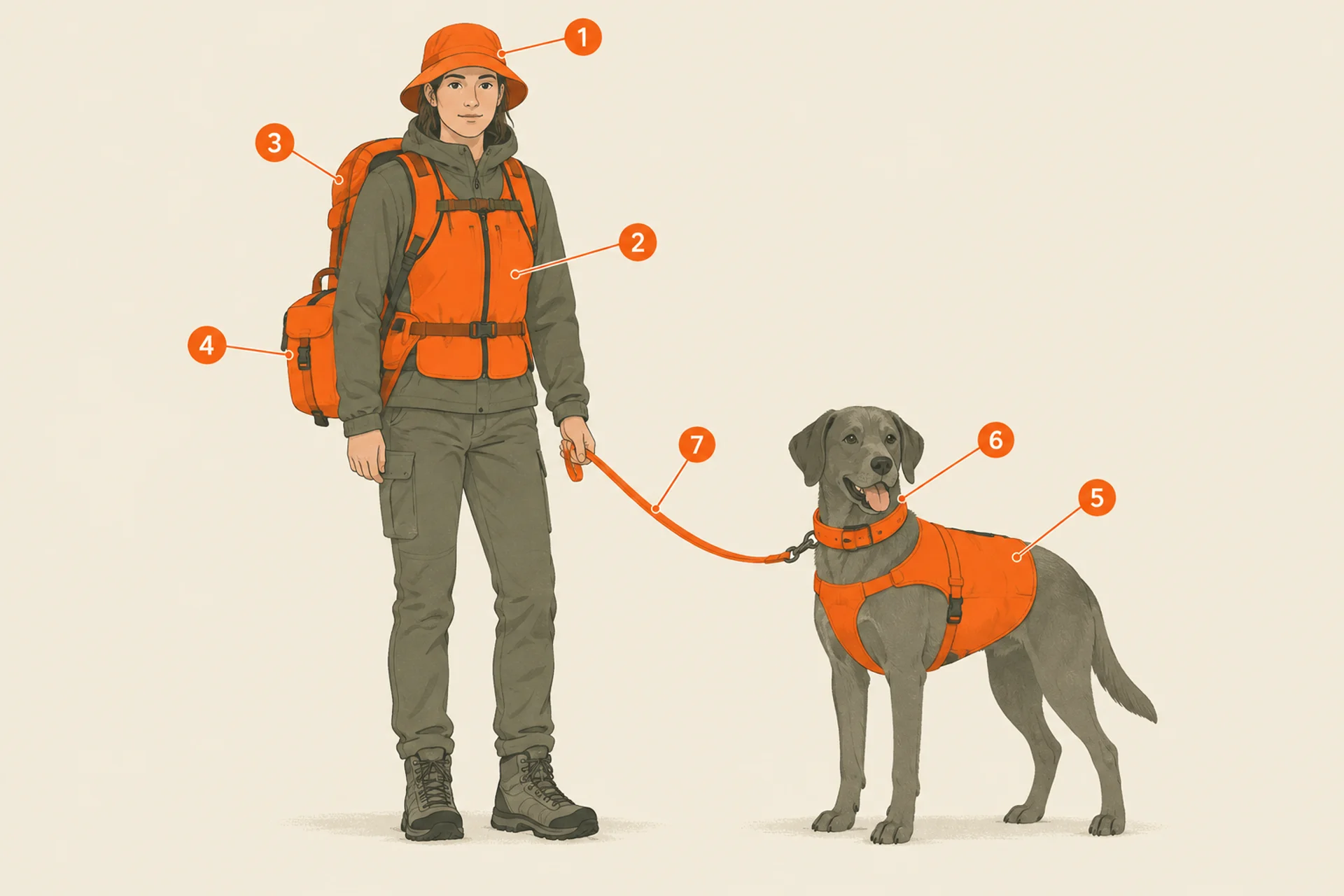
Blaze orange laws generally apply to hunters, not to you. Non-hunters are encouraged rather than required in most states, and the encouragement is unanimous. New York’s DEC asks people to “wear blaze orange, blaze pink, or another bright color during fall and winter months to be seen more easily and from greater distances,” and adds that “pet owners are also encouraged to affix a bright colored vest or scarf on their dogs and keep pets leashed at all times.” Vermont’s version is the same: “Walk dogs on leash and consider getting a bright orange collar or vest for your dog.”
It is worth being clear about why. The orange is not for your dog’s benefit or comfort — it is a signal aimed at a person’s eyes several hundred yards away, through brush, in flat light. That framing tells you where to put it. Orange low on the dog’s back does nothing if the dog is standing in ferns; orange over the shoulders and along the top line is what is visible from a distance, and a collar adds a second bright mark at the end that moves most.
The rest of the list
- Leash, for the whole season. Both agencies say it outright. A loose dog moving through brush is the shape and speed of game, and it is also the dog most likely to bolt at the first shot.
- Be loud, not stealthy. Talk, whistle, let the tags jingle. The hiking instinct to move quietly is exactly wrong here.
- If you see a hunter, make sure they see you. Call out and wait for an answer rather than slipping past. Nobody is annoyed by this.
- Skip opening weekend. The first days of rifle season put the most people in the woods, many of whom only hunt that week.
- Rethink white and tan gear. A white-tipped tail flagging through undergrowth is the exact movement a hunter is trained to read. Orange over it, or a different trail.
- Plan for gunfire. A sound-sensitive dog can panic at a shot from a field you cannot see. Know your recall, and if it is shaky, keep the leash short — this is one of the situations where a fixed-length line beats a retractable leash.
What this does not mean
It does not mean the woods are dangerous or that hunters are careless. Hunting-related shooting incidents are rare, and blaze orange requirements are a large part of why. What is common is the smaller friction: a dog that flushes a deer someone has been sitting on for three hours, a walker who startles a hunter at forty feet, a recall that fails at the worst moment. Almost all of it is solved by a leash, a bright colour and a look at a calendar — and the same trail is yours again in January.
Hunting season and dog walking FAQ
When is hunting season?
There is no single answer — it varies by state, by species and by weapon, and dates shift year to year. Archery seasons often open in early autumn, with firearm deer seasons later in the autumn or early winter. Your state fish and wildlife agency publishes the current dates; that page is the only one worth trusting.
Do I legally have to wear blaze orange if I am just walking my dog?
In most states the orange requirements are written for hunters, and non-hunters are encouraged rather than required. Rules differ by state and sometimes by land type, so check your own state agency’s page before assuming either way.
Does my dog need an orange vest, or is a collar enough?
A vest is visible from further away and from more angles, because it covers the top line and both sides. A bright collar or bandana is meaningfully better than nothing and is what both Vermont and New York suggest as a minimum. If your dog will only tolerate one item, make it the one that sits over the shoulders.
Can dogs see blaze orange?
Not the way we do, and it does not matter. The orange exists so that a person at a distance can pick your dog out of brush. It is a signal to other humans, so judge it on how visible it is to you across a field, not on your dog’s opinion of it.
Is it safe to hike with a dog during hunting season at all?
Generally yes, and the agencies that manage the land say so. The precautions they ask for are timing, bright colour, a leash and noise. If you cannot do all four on a particular trail — a dog who cannot be leashed, a walk that only works at dawn — that trail is the one to swap out for a few weeks.
What about the walks near home that are not in the woods?
Hunting is generally not permitted in city and county parks or within municipal limits, but “generally” is doing work in that sentence, and some suburban areas run controlled deer culls on specific dates. The parks department page for your own park is a two-minute check.
Sources
- Vermont Fish & Wildlife Department — Sharing the Outdoors During Hunting Season (midday timing, high-use trails, leashing dogs, bright orange collar or vest, where season dates are published) (checked 2026-09-12)
- New York State Department of Environmental Conservation — Share the Woods Safely (blaze orange for non-hunters, bright vest or scarf on dogs, leashing, maintained trails on lands open to hunting) (checked 2026-09-12)
- National Park Service — Hunting (some NPS units permit hunting; managed with state governments) (checked 2026-09-12)
Season dates, blaze orange rules and land-access rules are set state by state and change every year. Confirm the current rules on your own state wildlife agency’s page and on the land manager’s page for the specific trail before you go.
Check the calendar, then the clock, then the colour.
Find out which seasons are open where you walk, move your walk to the middle of the day, choose the busy trail over the quiet one, keep the leash on, and put orange over the shoulders of both of you. That is the whole method, and it takes one evening a year to set up. Autumn walks in dry western grass carry a second, quieter hazard worth two minutes at the trailhead: foxtails and how to check for them.