
There is no official AQI cutoff for dogs. Not from the EPA, not from Cornell’s veterinary school, not from any public-health agency. The numbers repeated across pet blogs — usually 100, sometimes 150 — are borrowed from human guidance and presented as though a vet published them. Nobody did.
What the authorities actually say is more useful: the EPA’s pet fact sheet tells you to reduce your pet’s exposure to smoke the same way you reduce your own, using the Air Quality Index. So the honest working rule is this — treat your dog as a member of a sensitive group, move one band earlier than the guidance for healthy adults, and let your dog’s breathing overrule the number on your phone.
What the AQI number actually measures
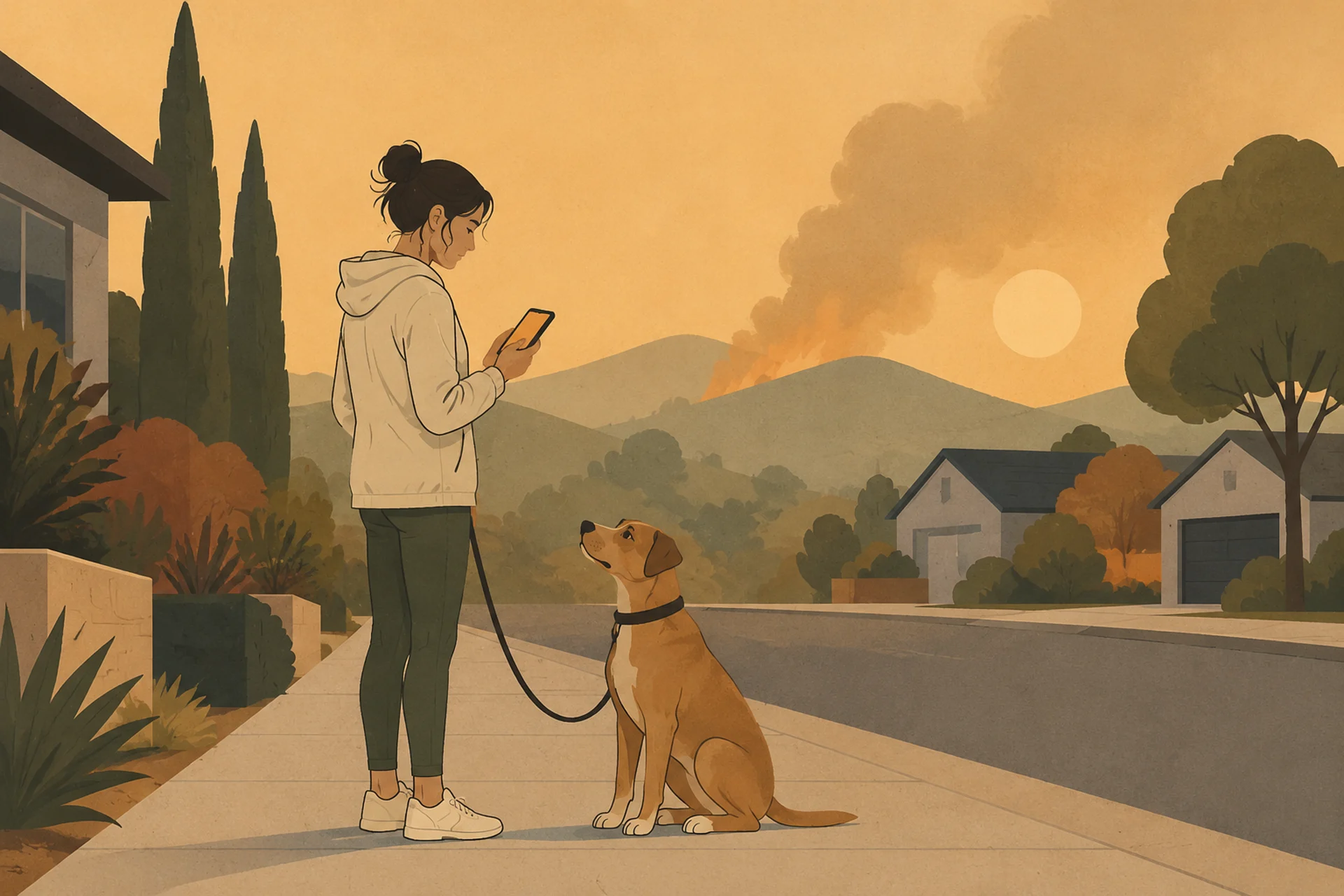
The AQI is a single scale standing in for five pollutants: ozone, particle pollution (PM2.5 and PM10), carbon monoxide, sulfur dioxide and nitrogen dioxide. According to AirNow’s AQI basics page, an AQI of 100 for any pollutant “generally corresponds to an ambient air concentration that equals the level of the short-term national ambient air quality standard.” The value you see is whichever pollutant scores worst right then — during a smoke event, almost always fine particles.
The six bands are fixed: Good 0–50, Moderate 51–100, Unhealthy for Sensitive Groups 101–150, Unhealthy 151–200, Very Unhealthy 201–300, Hazardous 301 and up. Those names describe risk to people. Translating them for a dog is where every pet article quietly starts guessing — so here is the translation, with the guessing labelled as guessing.
| AQI band | Healthy adult dog | At-risk dog |
|---|---|---|
| 0–50 · Good | Normal walks, normal running, normal everything | Normal |
| 51–100 · Moderate | Normal walk length; skip the sprint session if the sky looks hazy | Shorten the walk; watch the breathing on the way home |
| 101–150 · Unhealthy for Sensitive Groups | Walk, but shorter and slower — no fetch, no running, no hills | Bathroom breaks only |
| 151–200 · Unhealthy | Bathroom breaks only, kept short | Bathroom breaks only, and call your vet if there is any cough |
| 201+ · Very Unhealthy / Hazardous | Out the door and straight back in; everything else indoors | Out and back in; keep your vet’s number to hand |
Read that as a starting position, not a standard — one reasonable way to apply the EPA’s “as you would reduce your own” instruction to an animal that cannot tell you its chest feels tight. Your vet knows your dog; this table does not.
Why the number on your phone may be behind the air outside
The real-time AQI in an app is not a reading from the last five minutes. It is the NowCast, a weighted average built from up to twelve hours of past hourly data. AirNow explains that “the NowCast uses longer averages during periods of stable air quality and shorter averages when air quality is changing rapidly, such as during a wildfire.”
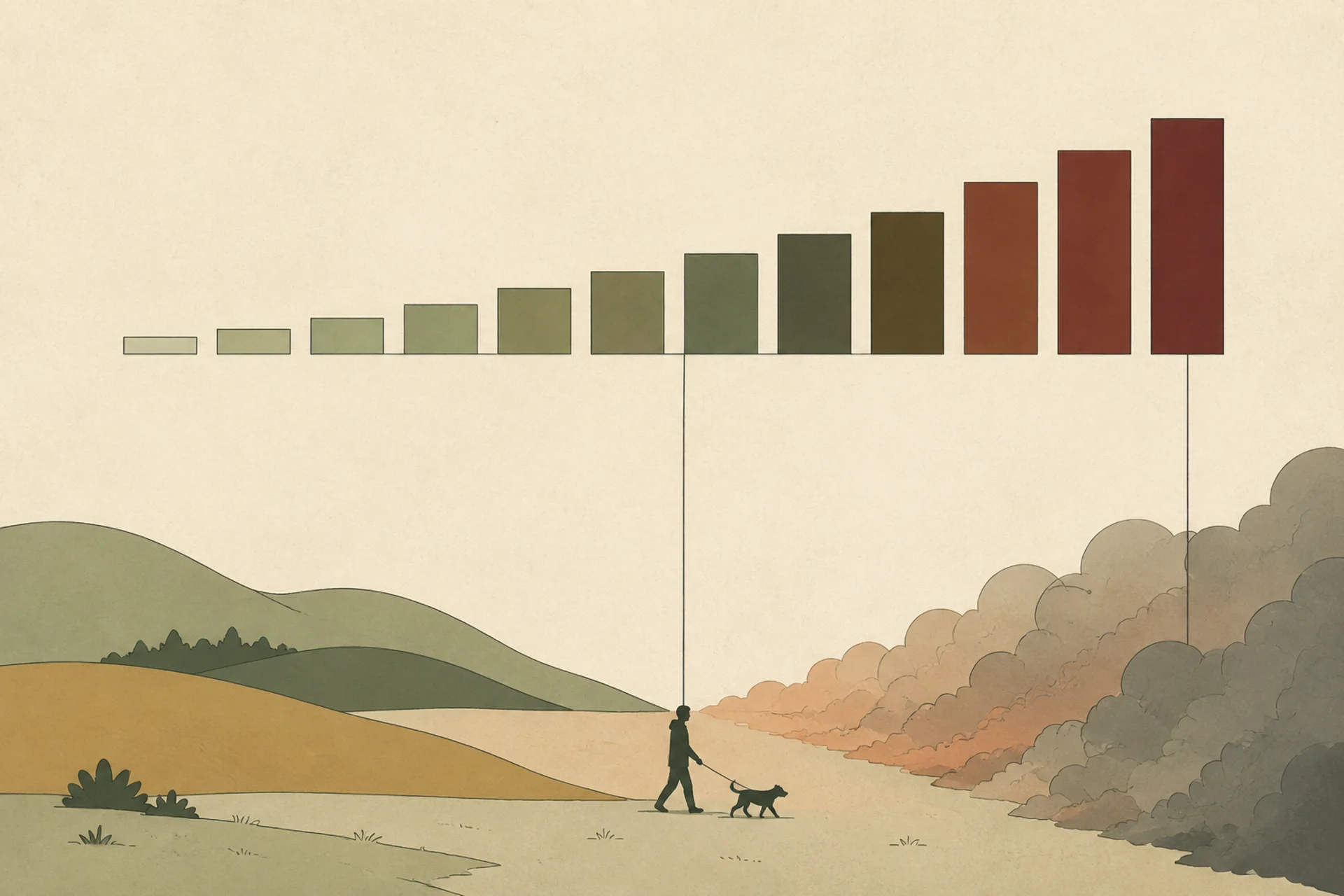
The weighting does tilt toward recent hours when conditions shift quickly — that is what it is for. But the consequence holds: at the leading edge of a plume, the reading is still pulled down by cleaner air that is already gone. If the light has turned orange and you can smell smoke on your porch, you know more than the app does. Check the AirNow Fire and Smoke Map, which the EPA’s pet guidance points owners to, and trust your senses first.
Which dogs need the earlier line
Cornell’s Riney Canine Health Center is direct about who is most vulnerable: “Brachycephalic (short-muzzle breeds) such as Bulldogs, Boston Terriers, Pugs, and geriatric or pediatric animals are more susceptible to poor air quality,” and dogs with pre-existing heart disease or asthma are at increased risk. The EPA draws the same circle from another angle — older, younger or pregnant animals, and those with heart or lung disease, need watching during all periods of poor air quality.
One multiplier is easy to miss in late summer: the EPA fact sheet states plainly that exposure to smoke and heat together is much worse than smoke alone. A dog who handles a hazy 110 AQI morning may not handle the same air at four in the afternoon. Given the choice, take the morning.
The signs that end the walk
- Red or watery eyes — Cornell lists irritation of the throat, nose and eyes as the most common signs of exposure.
- Coughing or gagging that starts on the walk and does not settle within a minute or two.
- A fast respiratory rate while your dog is resting. Learn your own dog’s baseline on a clean-air day.
- Any difficulty breathing — open-mouth effort, flared nostrils, a hunched stance with the elbows pushed out.
- Unusual fatigue, or a dog who stops on a route they normally love. Believe them.
The first four come straight from Cornell’s list. If any persist once you are indoors, call your veterinarian rather than waiting it out — nothing here substitutes for someone who can put a stethoscope on your dog’s chest.
What helps, and what does not
Masks do not help. Cornell puts it bluntly: people can wear masks, but “unfortunately, our pets cannot, which may put them at a greater risk.” Consumer dog masks do not seal on a muzzle. Spend the effort on exposure time instead, which is the variable you actually control.
Indoor air is where the real gain is. Cornell and the EPA point the same way: keep windows and doors closed as long as you can stay cool, run a portable air cleaner, and fit high-efficiency filters to your HVAC system if they are compatible. The EPA suggests setting up one cleaner-air room rather than filtering the whole house — and a room your dog will actually lie in beats a better one they avoid. Keep water available at all times — and when the air clears enough to head back out, how much water a dog needs on a hike covers what to put in the pack. If the smoke is close enough that evacuation is on the table, the animal that will slow you down is the one that hides: our guide to evacuating with a cat covers why the warning, not the order, is the line for a household with pets.
Swap the exercise, don’t just cancel it. Cornell’s advice is to avoid running or hiking until air quality improves — but a dog with no outlet for three smoky days will find one. Scatter a meal across the rug, do five minutes of trick work, freeze a stuffed toy. Sniffing and problem-solving tire dogs out at a fraction of the breathing rate of a run, and the trails keep: our Bay Area dog beach guide and the Muir Woods access rules will still be there when the sky clears. And if shifting the walk to early morning or after sunset is how you dodge the worst of the haze, the visibility problem becomes the new one to solve — see walking your dog in the dark.
If the smoke is local, the walk question can become an evacuation question fast. The ASPCA’s disaster preparedness guidance is uncompromising: “DO NOT LEAVE YOUR PETS BEHIND. Remember, if it isn’t safe for you, it isn’t safe for your pets.” Build the kit — food, two weeks of medication, records, water, a carrier, spare leash, recent photos — before you need it.
Why nobody publishes a number
It is worth knowing how thin the ground is under all of this. Search the veterinary literature for smoke and dogs and you mostly find acute structure fires, not wildfire haze — one of the better-cited papers, a retrospective study published in 2014, covers 13 cats and nine dogs presented after household fires. Long-term, low-dose smoke exposure in companion dogs is simply not well studied yet. That gap is why no veterinary body publishes a dog-specific threshold; anyone quoting you a precise one is filling it with invention.
Walking dogs in smoke: FAQ
What AQI is too high to walk a dog?
No veterinary authority publishes a number. A defensible working line: shorten and slow walks above 100, drop to bathroom breaks above 150, and move both thresholds one band earlier for flat-faced, senior, puppy, pregnant, or heart- and lung-compromised dogs.
Can dogs wear masks in wildfire smoke?
No. Cornell’s guidance notes that pets cannot wear masks, which is part of why they are at greater risk than we are. Consumer dog masks do not seal against a muzzle. Control exposure time and indoor air instead.
Is the AQI on my phone the air right now?
Not exactly. The real-time value is the NowCast, a weighted average drawn from up to twelve hours of past hourly data. It weights recent hours more heavily when conditions change fast, but at the front edge of a plume it can still read lower than the air you are standing in.
My dog coughed after a smoky walk. Is that an emergency?
A cough that settles within a couple of minutes indoors is worth noting. One that persists, or comes with fast resting breathing, gagging or laboured breathing, is a call to your veterinarian. Do not try to diagnose it from a website — including this one.
Are small dogs worse off because they are closer to the ground?
That gets repeated a lot and there is no good evidence for it — fine particles from wildfire smoke mix through the air column rather than pooling at ankle height. Size is not the risk factor here. Muzzle shape, age, pregnancy and existing heart or lung disease are.
Use the number as a prompt, not a permission slip.
Nobody has published a dog-specific AQI threshold, and the honest version of this advice admits it. Treat your dog as a sensitive group, move a band earlier if they are flat-faced, old, young, pregnant or already short of breath, remember the reading leans on the last twelve hours, and stop the moment your dog’s breathing tells you to.
Sources
- Cornell University College of Veterinary Medicine, Riney Canine Health Center — Dog safety during poor air quality alerts or wildfire smoke (checked 2026-08-24)
- U.S. Environmental Protection Agency — Protect Your Pets From Wildfire Smoke (PDF fact sheet) (checked 2026-08-24)
- AirNow.gov — AQI Basics: the six categories and their ranges (checked 2026-08-24)
- AirNow.gov — Using the Air Quality Index, including how the NowCast is calculated (checked 2026-08-24)
- ASPCA — Disaster Preparedness for pets (checked 2026-08-24)
- Dörfelt R, Turković V, Teichmann S. Smoke inhalation in dogs and cats — a retrospective study over 5.5 years. Tierärztliche Praxis Ausgabe K, 2014;42(5):303-9 (checked 2026-08-24)
Air quality guidance and agency recommendations change. Confirm current conditions and advice on the official pages before you head out, and talk to your own veterinarian about your dog.