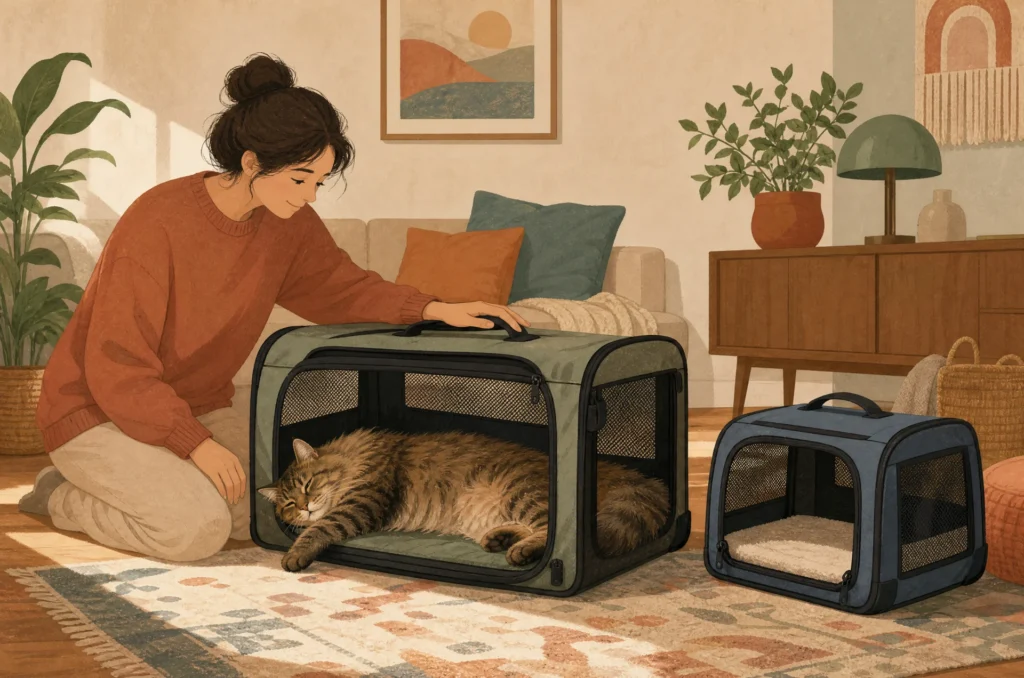
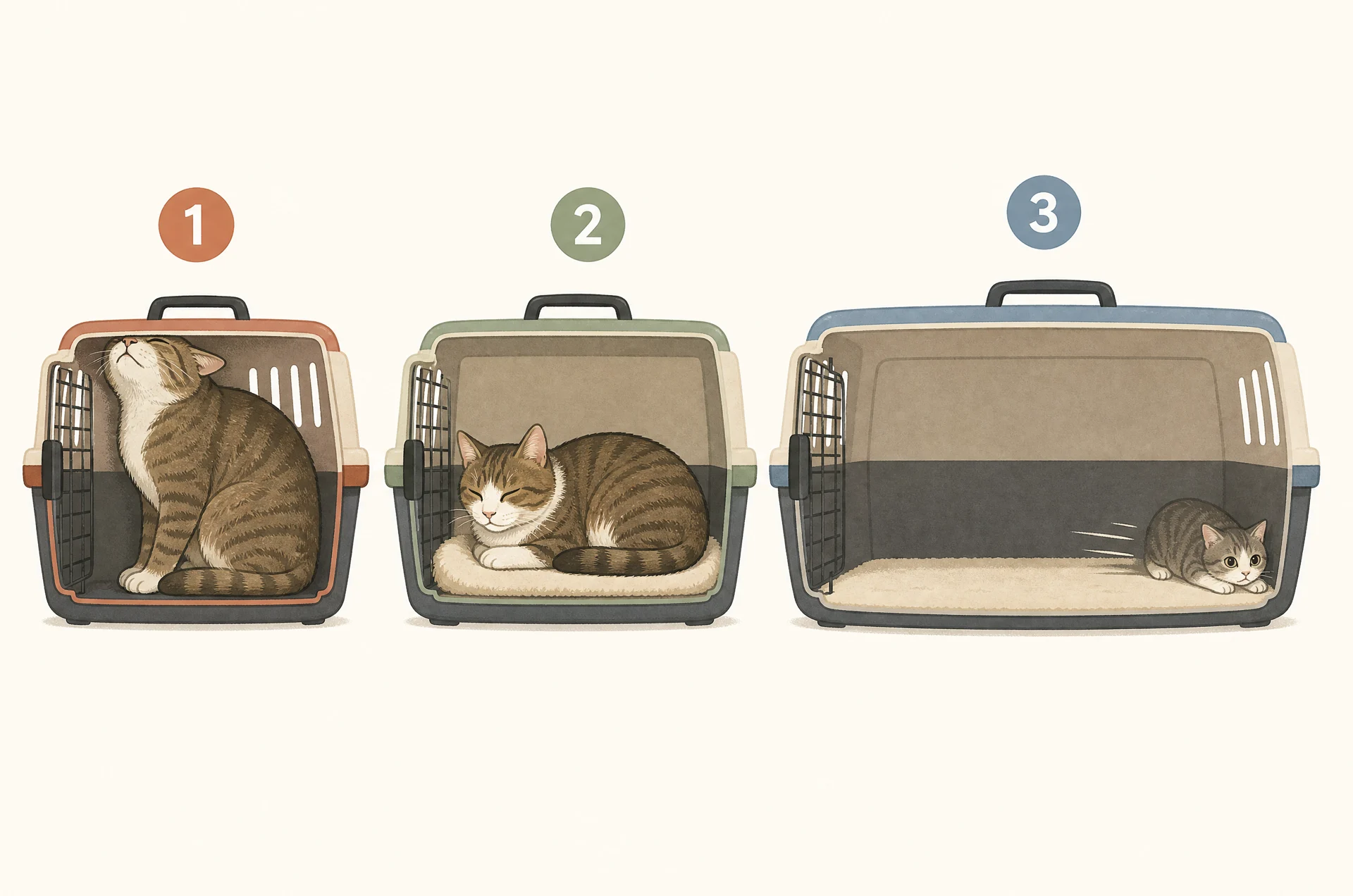
Size a cat carrier to the cat, not to the weight on the label. The test veterinary groups actually use is simple: your cat should be able to stand, turn around, sit, and lie down comfortably inside it. That is the first item on the American Animal Hospital Association’s checklist for a good carrier, and it is the same standard US federal rules apply to cats shipped by airlines and other carriers.
Bigger is not automatically better, though. International Cat Care points out that “larger is not necessarily better” for a cat’s sense of security, because cats like small spaces. So the right carrier is the smallest one your cat can stand, turn and stretch out in. For most cats that means measuring the cat, checking the inside dimensions, and ignoring weight ranges, which vary a lot from brand to brand.
Why the weight on the label doesn’t answer the question
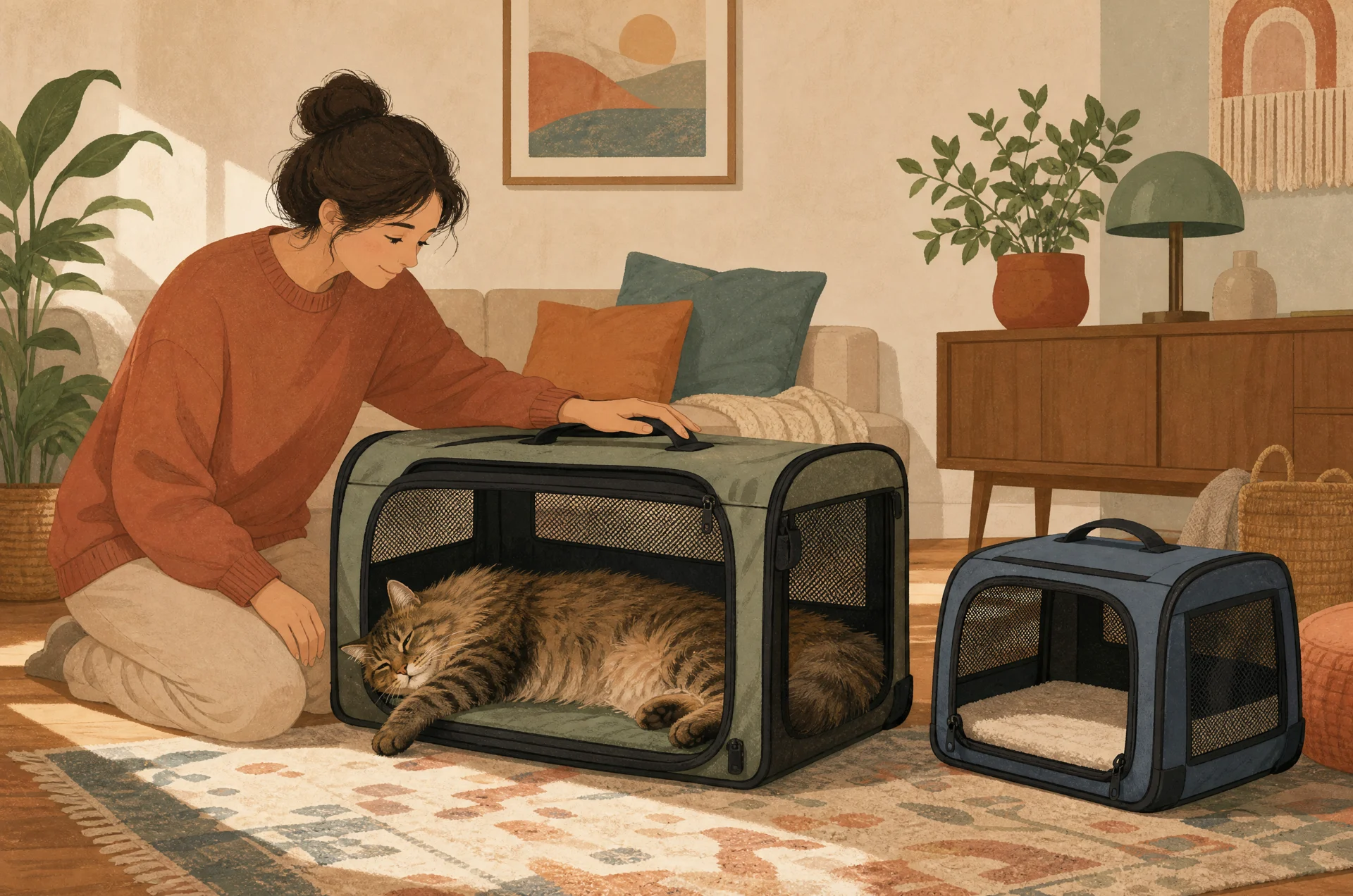
Most carriers are sold by weight: “fits cats up to 15 lb,” “large cats up to 20 lb.” Weight tells you whether the carrier can hold the load. It tells you almost nothing about whether the cat fits. Buyer reviews of popular carriers keep describing the same problem: a cat well under the stated limit that can sit up but can’t lie down. Long-haired cats fill the space with fur. Long, lean cats run out of floor before they run out of weight allowance. Two cats of the same weight can need very different boxes.
There is a second trap. Listed dimensions are often the outside of the carrier, and sometimes they are just wrong. Soft walls bow inward, frames and padding take up space, and expansion panels change the numbers once they’re unzipped. The inside floor and the inside height are the two numbers that matter, and the only reliable way to get them is to measure the carrier yourself.
What the rules actually say
No veterinary body publishes an inches-per-pound formula. They all describe the same thing in words: enough room to move and to rest.
| Source | What it says about size | What it means for you |
|---|---|---|
| AAHA | A good carrier should “allow your cat to stand, turn around, sit, and lie down comfortably”; each cat should have their own carrier | The everyday standard for vet trips and car rides |
| 9 CFR § 3.15(e) (USDA Animal Welfare regulations) | Enclosures for dogs and cats in transport must give “enough space to turn about normally while standing, to stand and sit erect, and to lie in a natural position” | This federal rule covers animals transported in commerce, not your car. It’s still a useful benchmark |
| International Cat Care | Larger “is not necessarily better”; IATA standards recommend a container large enough to stand up in and turn around with ease | Aim for enough room, not the biggest box |
| United Airlines (in-cabin example) | Soft carrier max 11 × 18 × 11 in, hard carrier max 9 × 17.5 × 12 in; “no weight or breed limitations,” but the carrier must fit under the seat | For flying, the under-seat box caps the size, and the cat has to fit inside it |
The four-position test, at home
The quickest way to know whether a carrier is too small is to watch your cat use it. Leave it open on the floor with a familiar blanket inside, which the AAHA recommends anyway so the carrier stops being a signal that something scary is coming. Then check four things over a few days.
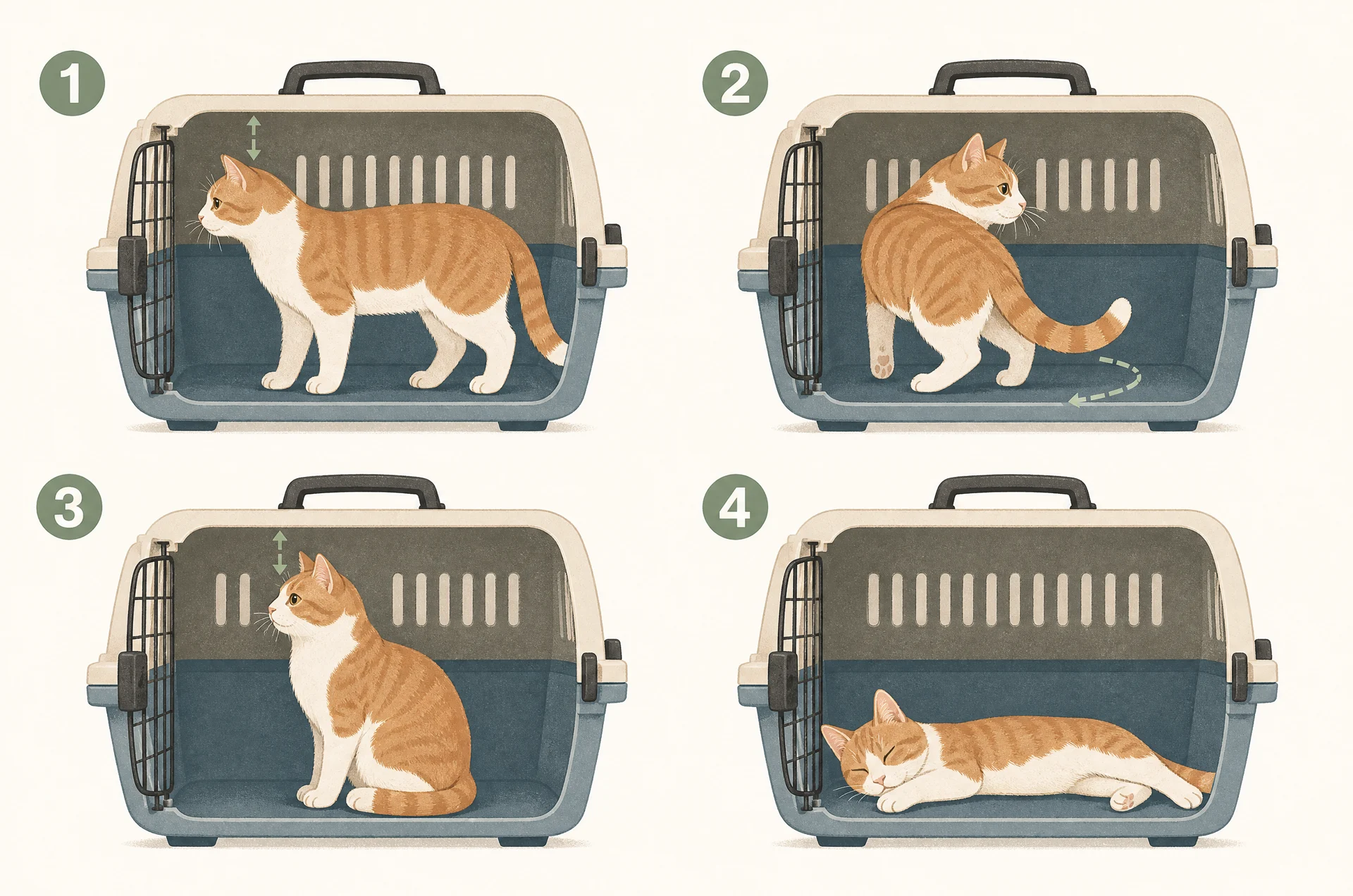
- Stand: the cat can stand on all four feet without crouching or pressing its back against the roof.
- Turn: it can turn around to face the other way without having to fold itself in half against the walls.
- Sit: sitting upright, its ears clear the top. Cats that sit with their heads tipped down are telling you the roof is too low.
- Lie down: it can lie on its side, not only in a tight loaf. This is the one that most often fails, and the one that matters most on anything longer than a short drive.
If you’re buying before you can test, measure the cat instead. Measure its length from nose to the base of the tail while it’s standing, and its height from the floor to the top of its head while it’s sitting. Then compare those numbers with the carrier’s interior floor length and interior height. If the cat’s measurements are the same as the carrier’s or bigger, it won’t pass the lie-down or sit test. Size charts that tell you to add a few inches are a reasonable starting point. They’re a retail rule of thumb, though, not a veterinary one, so the four-position test still has the final word.
Can a cat carrier be too big?
Yes, and there are two reasons. The first is how the cat feels. International Cat Care notes that cats “like to sit in a small space and are less likely to move around” in one, so a huge crate can feel less secure, not more. The second is what happens in a moving car. In a box with lots of empty floor, a cat slides into the walls on every turn and every brake.
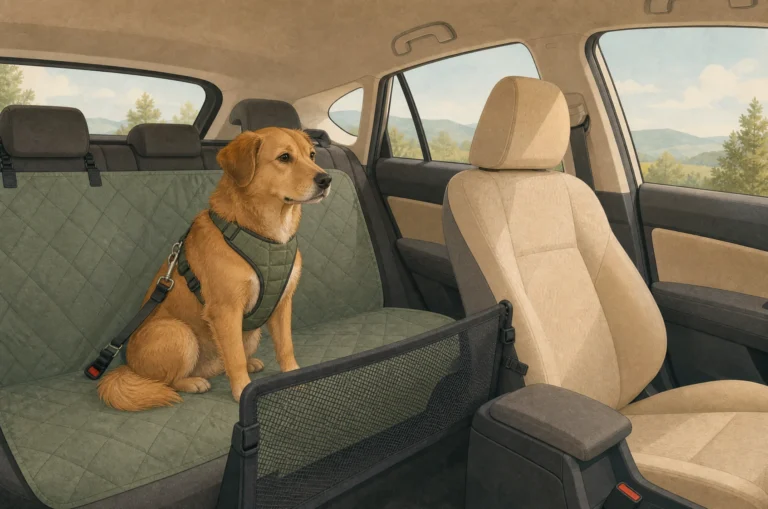
Size also changes where the carrier can go in the car. The Feline Veterinary Medical Association’s Cat Friendly guide cites the Center for Pet Safety’s advice to belt a carrier onto the back seat only if it has been crash-tested, and to put all others on the floor of the back seat. A carrier that is too big for the footwell has to ride on the seat, where it’s less stable. If you use a big dog-style crate for long drives, International Cat Care suggests you still bring a small carrier to move the cat between the car and the building. Our car-trip carrier guide covers placement in more detail.
Large cats, long-haired cats, and older cats
These are the cats that weight-based charts fail most often.
- Large and long cats (Maine Coons, big-framed mixes, long-bodied cats): go by length first. The cat has to lie on its side, so the interior floor has to be longer than the cat. Top-opening and end-opening carriers that open all the way are easier to load a big cat into without folding it through a small door.
- Long-haired cats: fur takes up space, and it traps heat. Leave a bit more room than you would for a short-haired cat of the same size, and choose real airflow. On hot days, our guide to a cat panting in the car explains what to watch for.
- Older cats: the AAHA article quotes a feline behaviour specialist saying that 96 to 97 percent of cats over 12 have osteoarthritis. She adds that a cat who protests being put in a carrier may be doing so because it’s “actually really uncomfortable.” For an older cat, room to lie flat and a removable top (so no one has to pull the cat out through a door) matter more than they do for a young one. If you think pain is involved, ask your vet.
Two cats, one carrier?
Veterinary advice is consistent here: don’t. The AAHA says that in a multi-cat home “each cat should have their own carrier.” International Cat Care gives the reasons: separate carriers allow better airflow, more room, and less chance of overheating. It also warns that even close companions can get stressed on a journey and behave out of character, and that can damage their relationship. If you use a two-cat carrier, treat it as two compartments and size each one for a single cat using the same four-position test.
Flying: when the carrier limit and the cat don’t match
For cabin travel, the airline sets the outer limit and your cat has to fit inside it. United, for example, publishes a maximum of 11 × 18 × 11 in for a soft carrier and says there are no weight or breed limits. The only test is whether the carrier fits under the seat. An 11-inch-tall bag is plenty for most cats. For a very large cat, the question is whether it can still stand, turn and lie down in the biggest bag the airline allows. If it can’t, that is a real reason to rethink cabin travel, and it’s worth raising with the airline before you book. Our under-seat size guide compares published limits across airlines. Policies change, so always confirm on the airline’s own page.
Buying for a kitten
A carrier sized for the adult cat is usually the better buy, since the AAHA notes carrier training is easiest in kittenhood and you want the kitten to grow into the carrier it trains on. Until the kitten fills it, fold a towel or a firm pad in to take up the extra floor, so it has less room to slide on the drive.
Cat carrier size FAQ
What size carrier for a 15 lb cat?
There isn’t one right size, because a 15 lb cat can be compact or long. Measure the cat’s standing length (nose to base of tail) and seated height, then pick a carrier whose interior is larger than both, and check that the cat can stand, turn, sit and lie down in it. A carrier rated “up to 15 lb” is often a tight fit for a 15 lb cat.
How do I know if my cat carrier is too small?
Watch your cat inside it. If it can’t lie on its side, has to duck its head to sit, or can’t turn around without scrunching up, the carrier is too small. That’s the stand-turn-sit-lie-down standard the AAHA uses.
Can a cat carrier be too big?
Yes. International Cat Care says larger is not necessarily better, because cats feel more secure in a small space, and a cat in a big empty carrier slides around in a moving car. Pick the smallest carrier that passes the four-position test.
How big should a cat carrier be for 2 cats?
Ideally, don’t share one. Both the AAHA and International Cat Care recommend a separate carrier for each cat, for airflow, space, and to avoid travel stress spilling into the cats’ relationship. If you use a two-compartment carrier, size each compartment for one cat.
What size carrier for a large cat or a Maine Coon?
Go by length rather than weight. The interior floor needs to be longer than the cat so it can lie on its side, and the interior height has to let it sit without ducking. Many carriers labelled “large” still don’t pass for a big long-haired cat. Measure the inside before you commit.
What size carrier for a cat on a plane?
The airline sets the maximum, usually a soft carrier that fits under the seat. United’s limit, for example, is 11 × 18 × 11 in. Within that limit, the cat still needs to be able to stand and turn around. Check your airline’s current page before you buy, because limits differ by airline and aircraft.
Sources
- American Animal Hospital Association — Helping your cat cope with veterinary visits (a good carrier allows the cat to stand, turn around, sit and lie down comfortably, is well ventilated, easy to clean, with a front door and a removable or top-opening top; each cat should have its own carrier; carrier training easiest in kittenhood; leave the carrier out with bedding; a feline behaviour specialist on osteoarthritis in cats over 12 and carrier reluctance from pain) (checked 2026-09-27)
- International Cat Care — Travelling with your cat (larger is not necessarily better, cats like a small space; use a small carrier to and from the car even with a large crate; IATA standards recommend a container large enough to stand up and turn around; separate carriers give better airflow, more room and less overheating; travel stress can harm cats’ relationship; backpack carriers can be unpleasant when a cat can’t hide) (checked 2026-09-27)
- 9 CFR § 3.15 — Primary enclosure requirements (dogs and cats in transport) (§ 3.15(e)(1): space to turn about normally while standing, to stand and sit erect, and to lie in a natural position) (checked 2026-09-27)
- Feline Veterinary Medical Association (Cat Friendly Homes) — Choosing the perfect cat carrier (Center for Pet Safety: belt a carrier to the back seat only if crash-tested, otherwise the back-seat floor; top and front opening; removable top half; leak-proof bottom with absorbent bedding) (checked 2026-09-27)
- United Airlines — Traveling with pets (soft carrier max 11 × 18 × 11 in; hard carrier max 9 × 17.5 × 12 in; no weight or breed limitations; carrier must fit under the seat) (checked 2026-09-27)
Airline limits and carrier rules change. Always confirm on the official page before you travel.
Stand, turn, sit, lie down. Then stop.
Skip the weight range and watch your cat. The right carrier is the smallest one your cat can stand in, turn around in, sit up in without ducking, and lie on its side in. Check the inside dimensions, not the outside. Give big, long-haired and older cats more room than the label suggests. Give each cat its own carrier. For flying, the cat still has to pass the same test inside the airline’s under-seat limit.