You cannot make a dog foxtail-proof with gear. The two things that actually work are choosing where you walk — a dried seed head has to touch your dog before it can do anything — and running a deliberate check over your dog before you get back in the car, starting with the ears, the spaces between the toes and the nose.
That order is not arbitrary. Those are the places foxtails are actually found, according to the largest case series published on the subject. Most of what you will read online leads with the worst-case story — a seed migrating into a lung or the brain — and that does happen. But it is the rare tail of the distribution, and organising your caution around it means you spend your worry in the wrong place and skip the ear check.
Why a foxtail is not just a burr
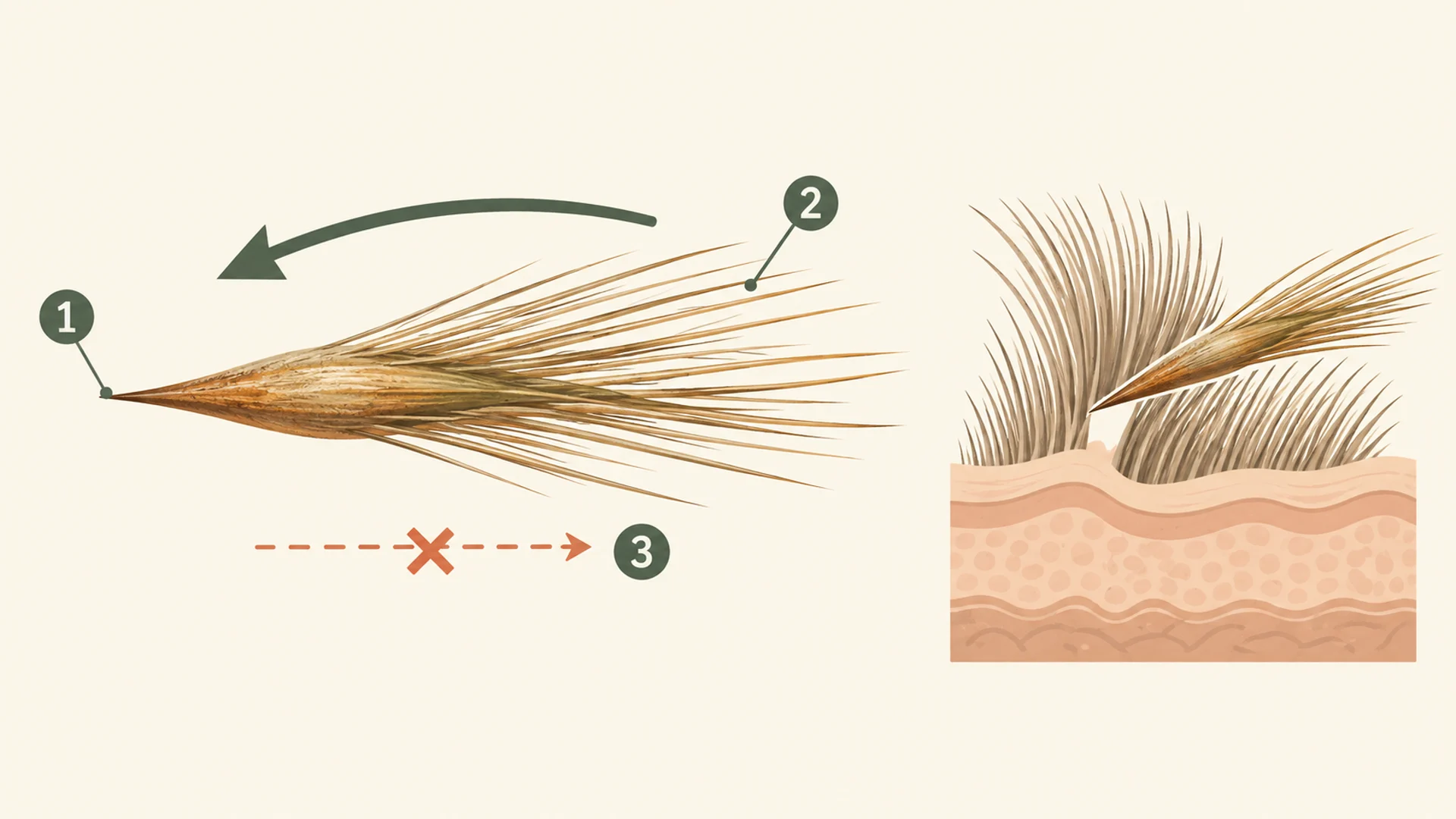
A burr sticks to fur and comes out when you pull it. A foxtail is built to do the opposite. It is the dried seed head of certain wild grasses, shaped so it can drill itself into soil, and the UC Davis School of Veterinary Medicine puts the consequence plainly: “once the foxtail is in the body it cannot reverse direction and come out on its own.”
The mechanism is the bristles. Pet Poison Helpline describes the awn as a “sharp, barbed, seed head” whose “tiny barbs on the awn’s surface promote forward motion and deeper migration.” Every step your dog takes, every muscle movement, every swallow works the seed one direction only. There is no equilibrium it settles into and no point at which it breaks down — UC Davis is blunt that “the only treatment for foxtails is removal.”
Where they actually end up
Here is the number the rest of the internet does not use. UC Davis’s teaching hospital reviewed every confirmed case it saw over ten years and published the result: 754 dogs and 37 cats with confirmed foxtail foreign bodies between 2009 and 2018. In dogs, the paper reports, “the most common location… was the aural canal, cutaneous/subcutaneous space, and nasal canal” — the ear, the skin, the nose. Most of the animals “presented in the summer months.”
Two conclusions follow, and they pull in opposite directions, which is why most articles only give you one of them.
The first is reassurance. The same paper concludes that “the short-term outcome for foxtail-associated lesions is good, and most cases can be managed on an outpatient basis.” A foxtail is not usually a catastrophe. It is usually a vet visit.
The second is the reason to take it seriously anyway: the same sentence continues that “a minority of cases develop life-threatening disease.” Pet Poison Helpline lists what that minority looks like — pyothorax, pneumothorax, peritonitis, spinal infection — and states that awns “can and do cause fatalities in domestic animals/pets every year.”
So: likely a manageable problem, occasionally a very bad one, and entirely preventable by not letting the seed touch your dog in the first place. That is a good argument for ten minutes of care, not for staying home.
When and where you will meet them
Foxtails are only dangerous once they are dead. Green grass is harmless; the seed heads become weapons when they dry and harden, which UC Davis places “typically during the summer months” while adding that “cases are seen throughout the year in warm climates.” The AKC gives a wider window still, describing the risk period as running from May to December, and notes the plants “grow throughout North America but are more prevalent in southwestern states, such as California.”
If you want to know when your own season ends, the botany is more useful than the calendar. The University of California’s statewide Integrated Pest Management program lists the foxtail grasses as summer annuals and gives their flowering windows: green foxtail from May through November, giant foxtail June through November, yellow foxtail June through December. It also describes the habitat in a way that reads like a walking route: “roadsides, ditch banks, fields, pastures, cropland, orchards, vineyards, gardens, and other disturbed sites.”
Disturbed ground is the operative phrase. This is why the trail verge, the gap between the parking lot and the trailhead, the strip beside a fire road and the unmown edge of a sports field are consistently worse than the middle of anything.
| Where you are | Risk | What to do differently |
|---|---|---|
| Paved path, mown lawn, sand, wet coastal bluff | Low | Normal walk. Still glance at the paws afterwards in season. |
| Wide fire road with mown or bare margins | Low to moderate | Keep to the centre. Most of the seed is in the untouched edge. |
| Singletrack through waist-high dry grass | High | Leash, keep your dog behind or in front of you on the tread, full check after. |
| Off-leash field, vacant lot, unmown park edge | Highest | This is where the case reports come from. Pick a different field until the rains. |
Route is the real lever
Every authority that gives prevention advice gives the same first item, and it is not a product. UC Davis leads with “being observant of where your dog walks and plays” and “avoiding areas where foxtails grow in the summer months. Stick to paved paths as much as possible. If you must walk through areas with foxtails, keep your dog on a leash.” The AKC’s version is the same instruction from the other end: “stick to paved walking paths and more manicured areas.”
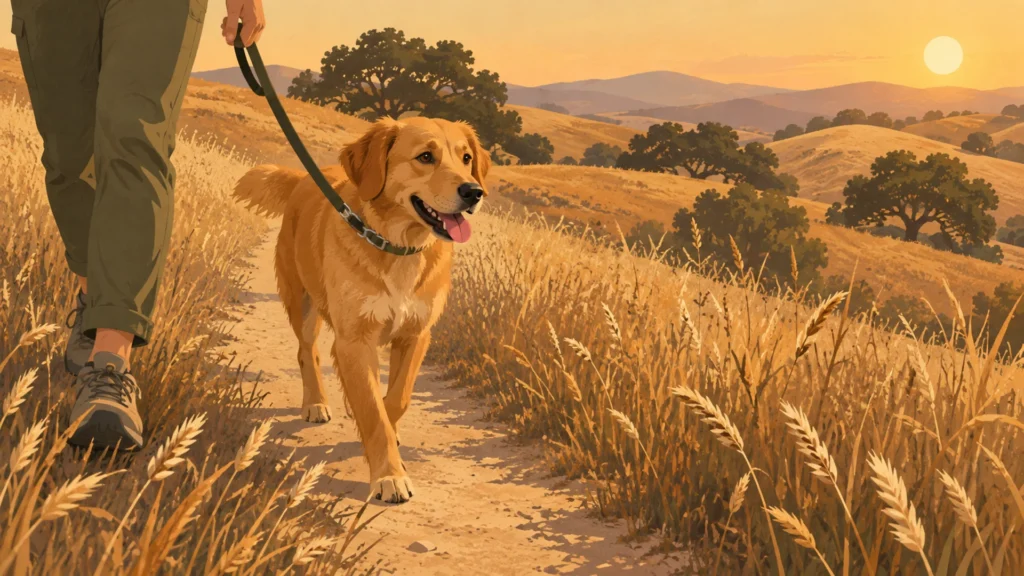
The leash part is the piece people skip, and it is doing more work than it looks. A dog on a six-foot lead travels the tread. An off-leash dog travels the interesting parts, which in a dry California summer means nose-first through exactly the stand of seed heads you were avoiding. In the East Bay Regional Parks, for what it is worth, the rule already applies in a lot of the places you would want to let a dog run: “Dogs must be leashed (six-foot maximum) and under control at any posted area, parking lot, picnic site, lawn, or developed area and all areas where grazing animals are present.”
Trimming is the one grooming change with a clear rationale behind it. UC Davis recommends “keeping the hair between the toes, ears, and belly trimmed, especially for longhaired dogs,” because “foxtails can easily attach to long hair.” A seed that never catches in the fur never gets the chance to work its way to skin. If your dog has feathered feet and you walk dry grass, this is the cheapest thing on the list.
The check that matters, in the order the data suggests
Do this before you get back in the car, while you are still standing at the trailhead and can see what you are doing. It takes about two minutes once you have done it a few times.
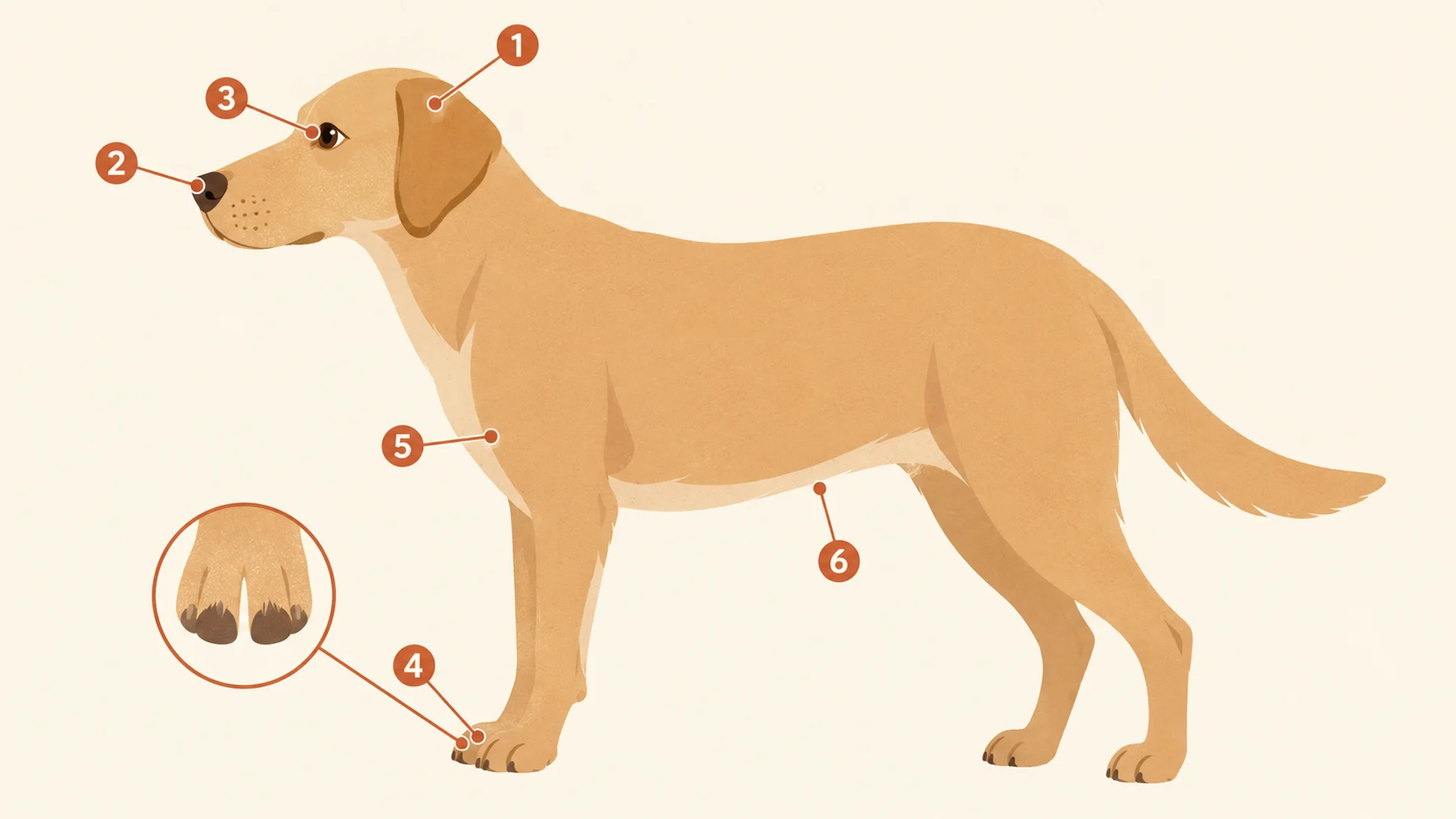
- Ears first. The single most common site in the 791-case series. Lift the flap and look into the opening, not just at the outside.
- Between every toe, all four feet. Spread the toes apart. A seed sitting in the web is easy to see and easy to miss if you only look at the top of the paw.
- Nose and muzzle. You are looking for a seed caught in the whiskers or at a nostril, before it gets inhaled.
- Eyes. Third most common site in dogs and by far the most common in cats. Look at the inner corner.
- Armpits, groin, belly. Thin skin, fine fur, and directly in the path of anything brushed at knee height.
- Head, neck, mouth and genitals. The East Bay Regional Park District’s own list for dog owners: “be sure to check the head, neck, ears, eyes, nose, mouth, genitals, and between the toes.”
- Run your hands over the whole coat. Long-coated dogs carry seeds home in the feathering and shed them onto the sofa, the bed and each other.
What gear does and does not do
This is where most foxtail articles turn into a shopping list, so it is worth being precise about how much of the problem gear actually covers.
Boots protect the paws. That is real — between the toes is one of the sites you will genuinely be checking — but it is one entry point out of six or seven, and the case data says it is not the most common one. A dog in boots can still take a seed in the ear. If your dog already tolerates boots and you walk dry grass, they help; if getting boots on is a twenty-minute wrestling match, the trimming and the check will do more for you. Our guide to why dog boots keep falling off covers the fit problem, and the Everyday Cinch-Top Dog Paw Boots are the pair on our shelf built around the cinch that keeps them on.
Mesh head nets exist and UC Davis does list them — “using a safety net that can be attached to a dog’s collar” — with an immediate caveat in the same breath: “remember that this won’t protect other parts of the body, so proper grooming is still important.” They cover the face, ears and eyes, which is a meaningful share of the sites that matter, and they are a hard sell for most dogs. They are the right call for a dog who has already had one removed from a nostril and is going back into the same terrain.
The AKC adds one more: keeping the coat short, or “have them wear a long-sleeved onesie when outdoors.” A smooth outer layer gives seeds nothing to hook into. It is the same logic as the trim, applied with fabric.
When to stop checking and call the vet
There is a clear line between what you can do at the trailhead and what needs a clinic, and UC Davis draws it in one sentence: “if you find a foxtail on your pet that is easily accessible, you can remove it with tweezers… If the foxtail is embedded in the skin, causing redness or swelling, take your pet to a veterinarian.” The AKC’s phrasing is the same boundary: “pet owners should only attempt to remove easily visible foxtails on the surface of the skin,” because partially embedded ones risk being “pushed deeper into tissues.”
If you do pull one out, UC Davis adds the part people forget: make sure you got the whole seed head, because “remnants can still migrate through the pet’s body.” If you are not sure it came out intact, that is a phone call, not a wait-and-see.
The signs that send you to a vet without finding anything are behavioural, and they map onto the entry points. The East Bay Regional Park District’s short version for trail users: “if your dog repeatedly shakes its head, a foxtail may have entered the ear canal. Sneezing may indicate that a foxtail is in the nasal passage. Repeated licking or scratching in the same area may be due to an embedded foxtail.” UC Davis’s list is longer — persistent sneezing, snorting, nasal discharge, head shaking, pawing at the head, head tilting, gagging, limping on one limb, excessive licking of one spot, uncontrolled blinking and swelling around an eye — and makes the timing argument explicitly: “in general, foxtail retrieval is easier the sooner it is identified.”
One honest caveat from the same page, and the reason your own observation matters more than any symptom list: “unfortunately, these signs are also found with a variety of other ailments. Unless you are aware that your pet has been exposed to foxtails, it can be difficult to determine the source of the animal’s discomfort.” Telling your vet where you walked yesterday is genuinely useful diagnostic information. Say it unprompted.
Foxtails and dogs: FAQ
How do dogs get foxtails?
By contact with dried seed heads, almost always off the beaten tread — the unmown verge of a trail, a vacant lot, a field edge, disturbed ground beside a road. UC IPM lists the habitat as roadsides, ditch banks, fields, pastures, cropland, orchards, vineyards and gardens. The seed catches in fur or goes straight into an ear, nostril or eye, and from there it only travels inward.
What do foxtails look like on a dog?
Like a small dried barley head: a spindle roughly the size of a grain of rice or a little longer, straw-coloured, with fine stiff bristles all pointing the same way. On a light-coated dog they are genuinely hard to see, which is why the check is done by hand as well as by eye.
Can I pull a foxtail out myself?
Only one sitting loose on the surface, and only if you can lift the whole thing out with tweezers in one piece. UC Davis is explicit that anything embedded, red or swollen belongs to a veterinarian, and that a fragment left behind can keep migrating. Digging at a partly buried seed drives it deeper.
When does foxtail season end?
There is no single date. UC Davis says the seeds are most dangerous once dried and hardened, typically in summer, but that cases turn up year-round in warm climates; the AKC gives May to December. The UC IPM flowering windows run as late as December for yellow foxtail. In practice, in a Mediterranean climate, the hazard drops once the grass has been wet for a while — so treat the first sustained rains as the end of the season rather than a month on the calendar.
Do foxtails eventually dissolve or work their way out?
No. This is the most important misconception to drop. The barbs make backward movement impossible, and the seed does not break down in tissue. UC Davis states that the only treatment is removal.
Are foxtails only a California problem?
No, though California is the epicentre. The AKC says they grow throughout North America and are most prevalent in southwestern states. Pet Poison Helpline notes the range has spread further, with the plants introduced into parts of the Midwest and the east coast through groundcover plantings and landscaping.
Pick the path, then check the ears
From roughly May until the rains return, assume any unmown dry grass in the western US is carrying seed heads that can only travel one direction. Keep your dog on the tread and on a lead through the worst of it, trim the feet and ears on a long-coated dog, and run the two-minute check — ears, toes, nose, eyes, armpits, groin — before you drive home. Surface seeds come out with tweezers; anything embedded, swollen, or accompanied by head shaking, sneezing or one-spot licking is a call to your veterinarian, and sooner is easier. None of this is a reason to skip the walk. If you are planning a longer day out, our notes on water on a hike and walking during hunting season cover the other things worth knowing before you park, and once the rains have knocked the seed heads down the ground hazard changes rather than disappears — what to do when a dog eats acorns covers the one that arrives with the same autumn weather.
Sources
- UC Davis School of Veterinary Medicine, Animal Health Topics — Foxtails and Dogs (checked 2026-09-20)
- Philp HS, Epstein SE, Hopper K. “Clinical and clinicopathological characteristics, treatment, and outcome for dogs and cats with confirmed foxtail foreign body lesions: 791 cases (2009–2018).” Journal of Veterinary Emergency and Critical Care, 2022;32(5):653–662 (checked 2026-09-20)
- American Kennel Club — Are Foxtails Harmful to Dogs? What Every Owner Should Know (checked 2026-09-20)
- Pet Poison Helpline — Foxtail Grass: Foreign Body in Domestic Animals (checked 2026-09-20)
- University of California Statewide Integrated Pest Management Program — Foxtails (Setaria species): identification, habitat and flowering season (checked 2026-09-20)
- East Bay Regional Park District — Dog safety in the parks: foxtails, ticks, leash rules (checked 2026-09-20)
Veterinary guidance and park rules are revised periodically. Confirm on the official pages before you travel, and talk to your own veterinarian about anything you find on your dog — nothing here is a diagnosis or a substitute for an examination.