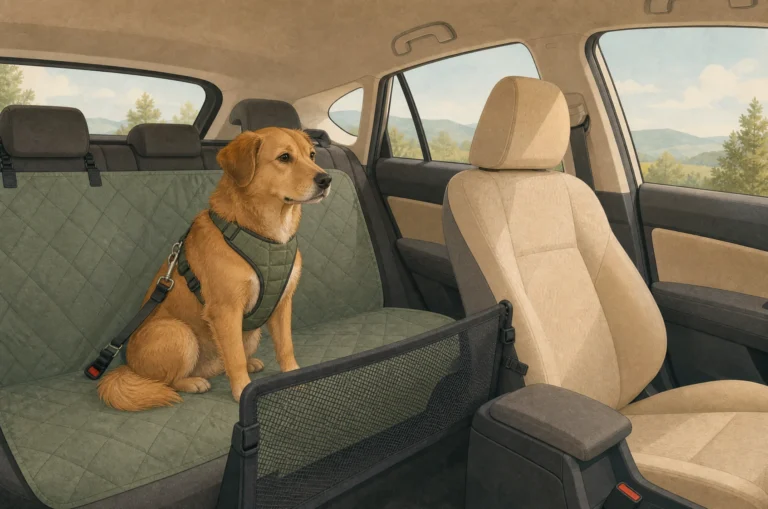
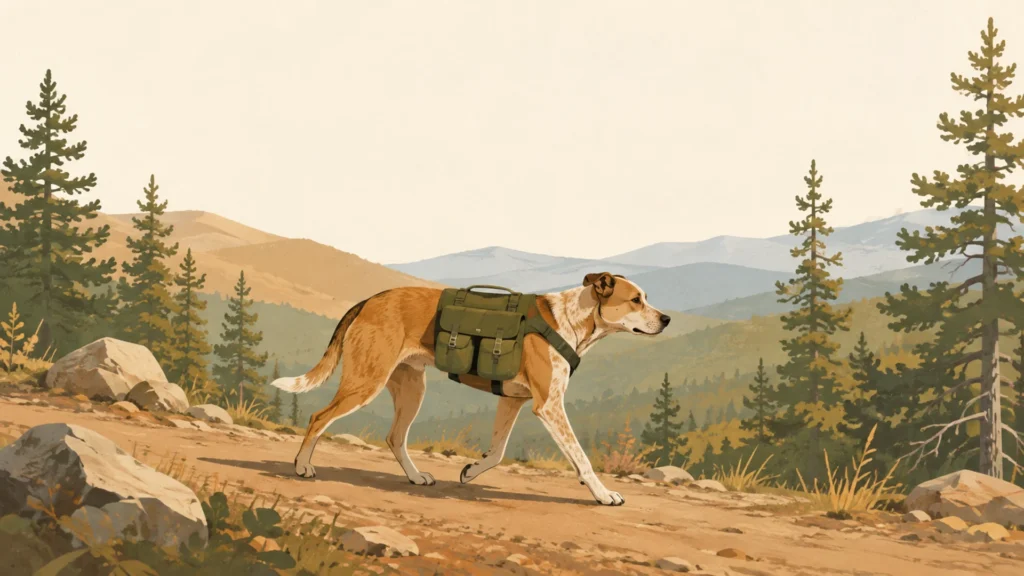
Start under 10% of body weight, and treat 10% as a ceiling rather than a target. That is the most defensible answer available, and it is lower than the 10–25% range you will see repeated everywhere — because that range has no study behind it, while 10% is the point at which a load has actually been measured changing how a dog moves.
In the one relevant gait study, loads at 10% of body mass already altered stride and pushed more force through the front legs in healthy working dogs, and how much they did so depended on the breed and on the shape of the load. So the number is a starting point, not a permission slip: build up over weeks, and treat heat and the individual dog as the real limits.
Two adjacent questions get answered further down, because they are the ones people are usually really asking: whether a weighted pack is a good way to tire a dog out (the evidence points the other way), and how much a dog can carry in its mouth, which turns out not to be a weight question at all.
Where the 10–25% rule came from
Try to trace it. Every guide cites another guide. Some attribute it to “vets,” some to sled-dog practice, some to nothing at all. The range itself is the giveaway: a rule that spans from 10% to 25% is not a measurement, it is a range wide enough that no one can be wrong.
That does not make it useless as a rough ceiling. It makes it a bad thing to buy a pack around, because it invites you to load to a number instead of watching the dog.
What happened when researchers actually measured it
In September 2025, the Journal of Experimental Biology published “The biomechanics of working dog locomotion II: Loaded trotting” by Charles and colleagues — a gait study of 10 Labrador retrievers, 10 spaniel-breed dogs and 7 shepherd-breed dogs, trotting unloaded and then carrying loads.
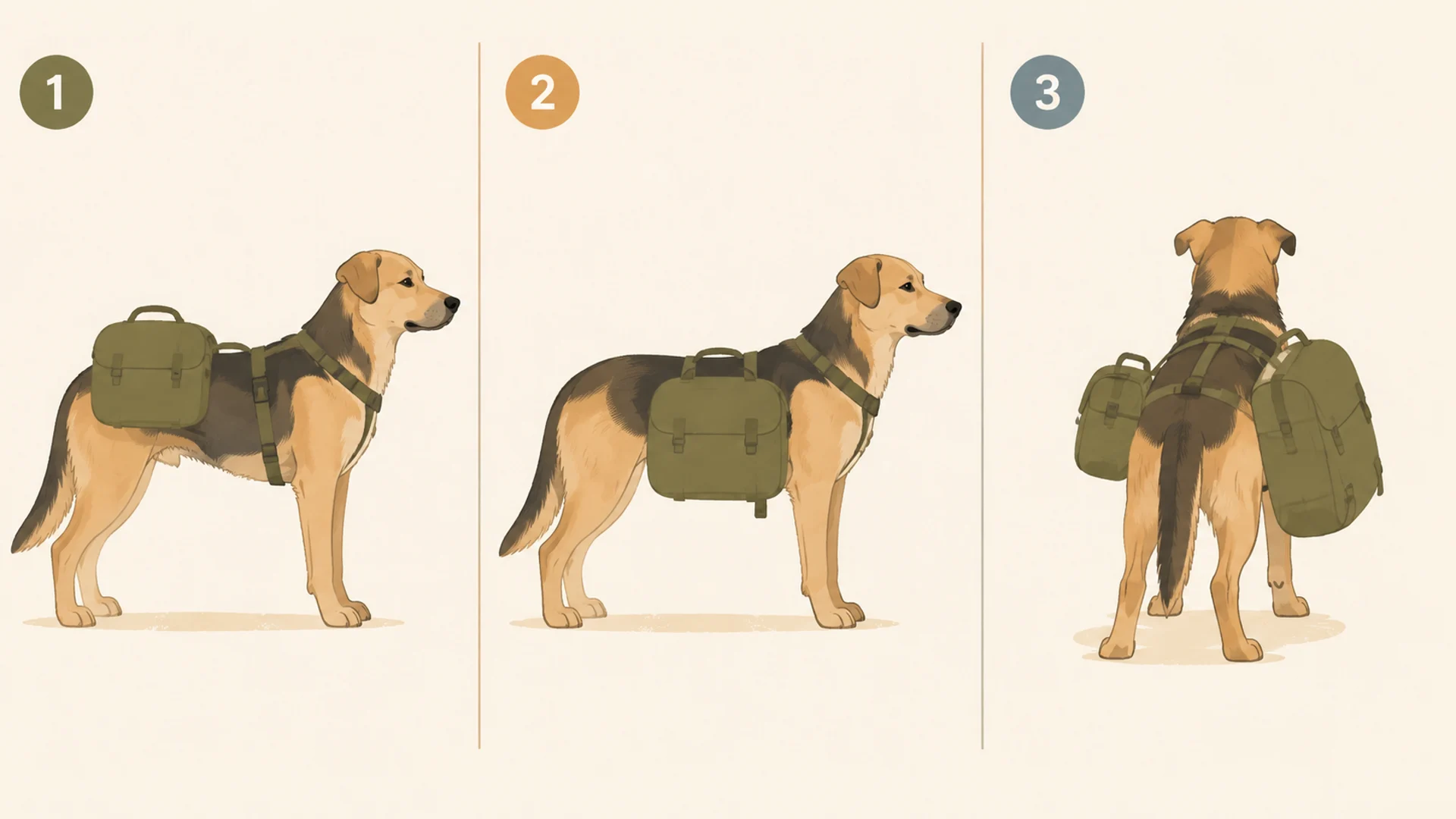
Three load conditions were tested: bags distributed symmetrically across a harness at 10% of body mass, and a cylindrical tube carried along the midline at 5% and at 10% of body mass. The findings that matter for anyone buying a dog pack:
- 10% is not “nothing.” Loads at this level produced measurable changes in stride and in joint loading, not just a shrug from the dog.
- The front legs take it. All breeds experienced greater forces on their forelimbs in both loading conditions compared with unloaded trotting.
- Breed changes the answer. The impact of load type and mass was breed-specific, with the shepherd breeds showing the greatest changes in stride timing relative to trotting unloaded.
- Coping is not the same as unaffected. Spaniels held their stride length and velocity better than the other groups, but showed larger differences in joint kinematics and moments — consistent with a higher degree of muscular effort to keep moving normally.
- Shape matters, not just mass. A symmetric pair of bags and a single midline tube of the same weight did not behave the same way.
That last point is the one no percentage rule can capture. A pack that hangs low and balanced is a different load from the same weight riding high or sitting off to one side.
The dogs that should carry nothing at all
Before any percentage, there is a list of dogs for whom the right load is an empty pack or no pack.
| Dog | Why | What to do instead |
|---|---|---|
| Puppies and adolescents | Growth plates have not closed. The AKC’s guidance is that “excessive, prolonged activity, like jogging, can be extremely detrimental on the bones and joints of growing puppies” | Carry everything yourself until skeletal maturity — and ask your vet, since the timing differs enormously by size |
| Long-backed and dwarfed breeds | Dachshunds, Basset Hounds, Corgis, Pekingese and similar builds are predisposed to intervertebral disk disease | No pack. Talk to your veterinarian before adding any load to that back |
| Flat-faced breeds | They cannot pant efficiently, so the heat cost of extra work lands sooner | Shorter, cooler outings; no added weight |
| Overweight dogs | They are already carrying a load, and obesity compounds disk-disease risk in predisposed breeds | Work on the body condition first, with your vet |
| Senior dogs and dogs with joint, heart or breathing conditions | Extra forelimb force is the last thing an arthritic shoulder or elbow needs | Vet conversation before any pack, and usually an empty one at most |
On puppies specifically, the AKC’s guide to puppy growth is blunt: “it is never recommended to do road work or jogging on a dog less than 14 to 18 months of age, especially large and giant breeds, until the growth plates have fully fused.” If that is the standard for an unloaded run, a loaded hike is not the exception. How much walking a young dog should be doing at all is covered in our guide to how far a puppy can walk.
On body shape, the AKC Canine Health Foundation’s overview of intervertebral disk disease names “chondrodystrophoid (dwarfed) breeds of dogs whose normal cartilage development has been altered” — Dachshunds, Beagles, Shih Tzus, Lhasa Apsos and Pekingese — as most susceptible, notes that German Shepherds, Labrador Retrievers and Doberman Pinschers are commonly affected among non-dwarfed breeds, and adds that “obese dogs of predisposed breeds are especially likely to suffer from IVDD.”
Heat is the limit before weight is
A pack is a piece of insulation strapped over the ribs, on a dog that has almost no way to shed heat through its skin. Cornell’s Riney Canine Health Center puts the physiology plainly in its summer heat safety guidance for dogs: “dogs only have sweat glands on their paws so their primary method of dissipating heat to cool themselves is through panting.”
The same page advises that “strenuous exercise should be especially avoided during the hottest parts of the day, very humid days and during the early summer when pets may not yet be acclimated to the higher temperatures,” and names the dogs at higher risk: brachycephalic breeds, plus dogs that are “overweight, elderly, those with underlying heart or breathing conditions, and those with thick or dark colored coats.”
Early warning signs it lists are worth memorising because they arrive before the emergency does: “heavy panting, seeking shade, whining, reluctance to play and drooling.” Difficulty breathing, vomiting, bloody diarrhoea, weakness, confusion, seizures or collapse are veterinary emergencies — stop, cool the dog, and call your vet. Air quality is the other invisible ceiling on a working dog’s day, which we covered in what AQI is safe to walk your dog.
What a dog pack is actually for
The useful framing is not “how much can the dog carry” but “what is worth the gait change.” The measured cost of a load is real, so the contents should earn it.
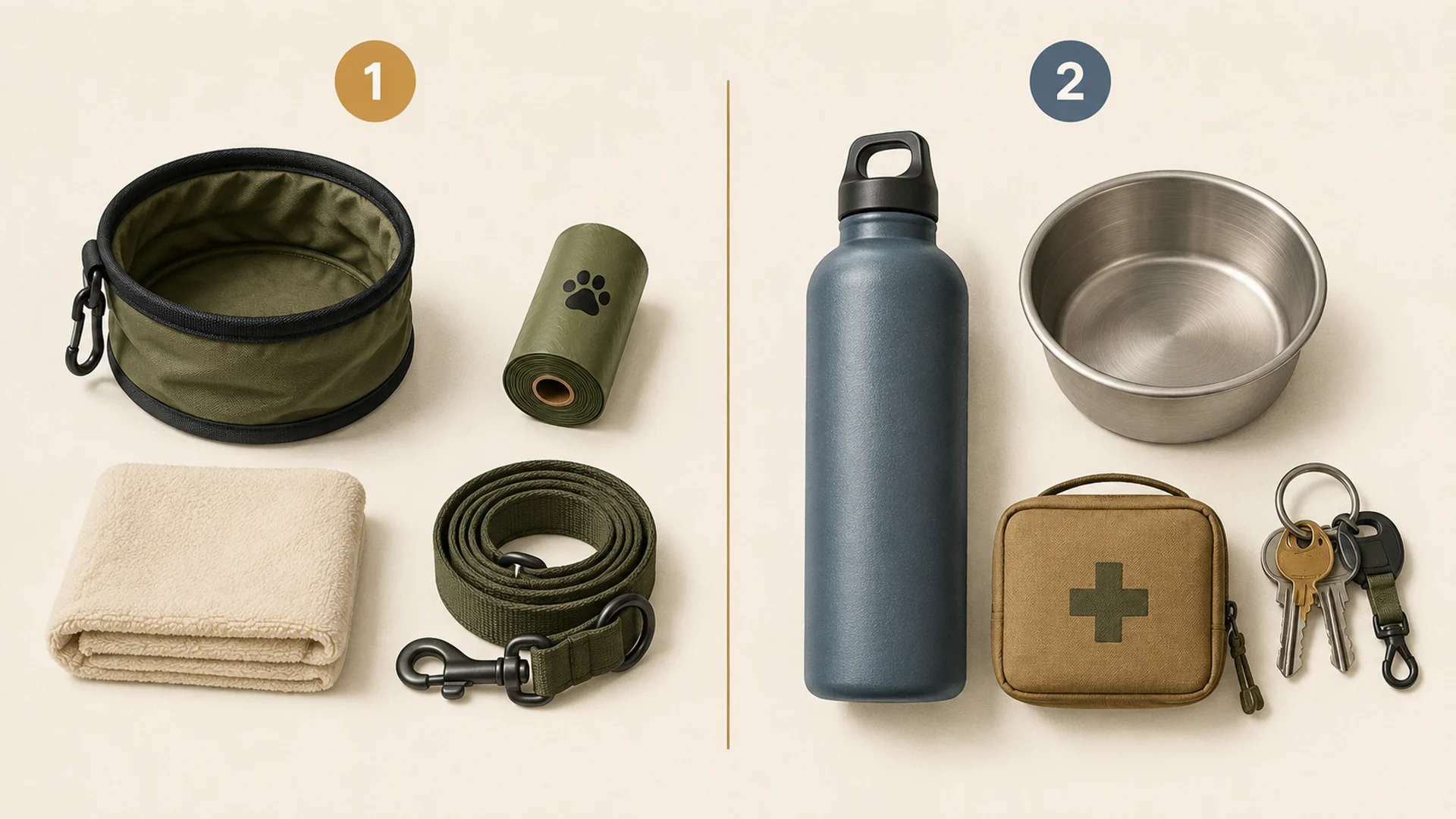
- Balance side to side before you think about total weight. Uneven panniers are worse than a slightly heavier balanced pair.
- Ride it low and forward, over the ribs, not over the hips. Sway on a long back is what you are trying to avoid.
- Nothing hard against the spine. Soft, flat items only next to the dog.
- Do not put the water on the dog. It is the heaviest thing you carry, it sloshes, and it is the thing you need access to when your dog is already struggling. How much water a dog actually needs on a hike works out how much that is — a litre is a kilogram, so the answer changes the whole load.
- Empty pack first, for several ordinary walks. Then a token weight. Then build over weeks, not over one weekend.
- Watch the trot, not the wag. A shortening stride, a dropped head, or the dog falling behind on a trail it normally leads means take the load off now.
- Take the pack off at every stop. Rest means rest, and it lets heat out from under the panels.
Weighted packs, and the “tire them out” idea
A large share of the people weighing a dog pack are not planning a backpacking trip. They have a dog with more energy than the day can absorb, they have read that a weighted pack drains it faster, and they want to know how much weight makes that work.
The honest answer is that nothing establishes the benefit, and the one piece of measurement we have points gently the other way. The loaded-trotting study found greater forelimb forces under load in every breed group tested, and breed-specific changes in the timing of the stride — largest in the shepherd-breed dogs. The spaniels were the interesting case: they held their stride pattern steady while showing larger differences in joint angles and joint moments. A dog can look unaffected and still be spending more to look that way.
That matters because the mechanism people are counting on — effort — is the same mechanism that generates heat, and a dog’s cooling is already the bottleneck. Cornell’s heat guidance is blunt about the equipment side of it: dogs have sweat glands only on the paws and rely on panting, so anything that adds both work and insulation over the trunk stacks two problems at once. A pack is insulation, whether or not it is marketed as one.
If tiring the dog is genuinely the goal, the low-risk versions are more sniffing time, more varied terrain, and more decision-making — none of which put load through the front legs on a warm afternoon. A weighted pack is a reasonable thing to use for a purpose (carrying something you need carried). It is a poor thing to use as a substitute for a longer or more interesting walk.
Carrying it in their mouth is a different question
This comes up alongside the pack question often enough to deserve a straight answer: people want a mouth-carry equivalent of the 10% figure. There isn’t one, and chasing a number here misses the actual hazard, because the thing that hurts dogs who carry objects in their mouths is almost never the weight.
It is the object. The best-documented version is the stick injury, and the numbers are sobering for something so ordinary. In a retrospective study of 41 dogs with acute oropharyngeal or oesophageal stick injury, published in Veterinary Surgery, 27 had oropharyngeal injuries and 14 had oesophageal ones — and five of the dogs with oesophageal injury died. Thirty-four of the 41 showed cervical emphysema on radiographs, which the authors describe as a frequent finding indicating “trauma to the deeper cervical tissues.” Their conclusion is the part worth carrying around: acute penetrating injury of the oropharyngeal region, treated appropriately, “has a better prognosis than acute esophageal penetration.”
That is not an argument against a dog carrying anything. It is an argument that the question “how much” is the wrong one. A retriever carrying a soft dummy across a field is doing something it was bred for. The same dog running with a stick planted end-on in the ground is the mechanism in that paper. What decides the risk is whether the object can be driven backwards into the throat — so the useful swaps are the boring ones: a soft toy or a rubber dummy instead of a stick, and not throwing the thing that has a point on it.
Weight does become relevant in one narrow way: a heavy object carried in the mouth changes head and neck posture over distance, so a dog carrying its own rigid toy for a long walk is worth watching for the same stride changes you would watch for under a pack. But there is no published figure, and any site giving you a percentage for mouth carry has made it up.
One naming note, because it causes real confusion when shopping: a pack a dog wears is not the same product as a pack you carry a dog in. We untangled those two in dog backpack carrier vs dog carrier backpack.
Dog backpack weight FAQ
How much weight can a dog carry in a backpack?
There is no published veterinary standard. The commonly repeated 10–25% of body weight is an unsourced rule of thumb. The one measured reference point is that loads at 10% of body mass already alter gait and increase forelimb forces in healthy working dogs, so treating 10% as a ceiling rather than a target is the conservative reading.
Does the pack itself count towards the weight?
Yes. Weigh the loaded pack, not the contents. On a small dog a sturdy empty pack can be a meaningful fraction of the total on its own.
At what age can a dog start carrying a pack?
Not while the growth plates are open. The AKC’s guidance against road work and jogging before 14 to 18 months, especially in large and giant breeds, is the relevant benchmark, and maturity timing varies widely by size. Ask your veterinarian about your specific dog rather than using a fixed age.
Can a Dachshund or a Corgi wear a hiking pack?
We would not, and we would ask a vet first. Dwarfed, long-backed breeds are the ones the AKC Canine Health Foundation names as most susceptible to intervertebral disk disease, and adding load over that back is not a risk worth taking for the sake of carrying poo bags.
Will a pack tire my dog out faster in a good way?
Sometimes that is the goal, and it can work. But the study data suggests dogs may be spending more muscular effort to look unaffected, and heat load rises with both effort and insulation. If tiring the dog is the aim, more sniffing time and more varied terrain is a lower-risk way to get there.
How much weight can a dog carry in its mouth?
There is no published figure, and the question is aimed at the wrong variable. What injures dogs carrying objects is the object, not its mass — a Veterinary Surgery study of 41 dogs with acute stick injuries found 14 with oesophageal penetration, five of which died. Soft dummies and rubber toys instead of sticks removes most of the risk, and for long carries watch the same stride changes you would watch for under a pack.
Do dogs like wearing backpacks?
Some clearly do, and a dog with a job is often a settled dog. But “looks happy” is weak evidence here, because the gait study found dogs holding their stride steady while their joint mechanics changed underneath — a dog can mask effort. Judge it on movement rather than enthusiasm, introduce the pack empty over several ordinary walks, and take it off at every stop.
How do I tell the pack is too heavy?
Watch movement rather than mood. A stride that shortens, a head that drops, a dog that stops leading, or one that lies down at stops when it normally does not. Combine that with the early heat signs — heavy panting, seeking shade, drooling, reluctance to keep going — and take the load off at the first of them.
And plan for the reverse case too. A dog carrying a pack is a dog you may one day have to carry — how to carry an injured dog covers what to do when the legs run out miles from the trailhead.
Sources
- Charles JP et al., “The biomechanics of working dog locomotion II: Loaded trotting,” Journal of Experimental Biology 228(17), September 2025 (10 labradors, 10 spaniel breeds, 7 shepherd breeds; bags at 10% body mass and a midline tube at 5% and 10% body mass; greater forelimb forces under load in all breeds; breed-specific spatiotemporal effects, greatest in shepherds; spaniels maintained stride but showed larger joint kinematic and moment differences) (checked 2026-09-05)
- Doran IP, Wright CA, Moore AH. “Acute oropharyngeal and esophageal stick injury in forty-one dogs.” Veterinary Surgery 2009;38(1):31–39 (41 dogs; 27 oropharyngeal and 14 esophageal injuries; five dogs with esophageal injury died; cervical emphysema on radiographs in 34 dogs indicating trauma to deeper cervical tissues; acute oropharyngeal penetration carrying a better prognosis than esophageal penetration) (checked 2026-09-21)
- American Kennel Club — Puppy Growth Chart: When Does My Puppy Finish Growing? (growth plates and closure; excessive prolonged activity such as jogging is extremely detrimental to growing puppies; no road work or jogging under 14 to 18 months, especially large and giant breeds) (checked 2026-09-05)
- AKC Canine Health Foundation — Overview of Intervertebral Disk Disease (chondrodystrophoid breeds — Dachshund, Beagle, Shih Tzu, Lhasa Apso, Pekingese — most susceptible; German Shepherd, Labrador Retriever and Doberman Pinscher commonly affected among non-dwarfed breeds; obese dogs of predisposed breeds especially likely to be affected) (checked 2026-09-05)
- Cornell University College of Veterinary Medicine, Riney Canine Health Center — Summer Heat Safety Tips for Dogs (sweat glands only on the paws, panting as the primary cooling method; avoid strenuous exercise in the hottest parts of the day, on humid days and before acclimation; higher-risk groups; early and emergency signs of overheating) (checked 2026-09-05)
Veterinary guidance is updated periodically. Confirm on the official pages, and talk to your own veterinarian about your own dog — nothing here is a diagnosis, a medication recommendation, or a substitute for an exam.
Load the dog last, and lighter than the internet tells you.
The percentage everyone quotes has no study behind it. The measurement that does exist says 10% of body mass is already enough to change how a dog moves and to push more force through the front legs. Start with an empty pack, keep the water on your own back, balance it side to side over the ribs, and let heat and the dog’s own gait set the ceiling.