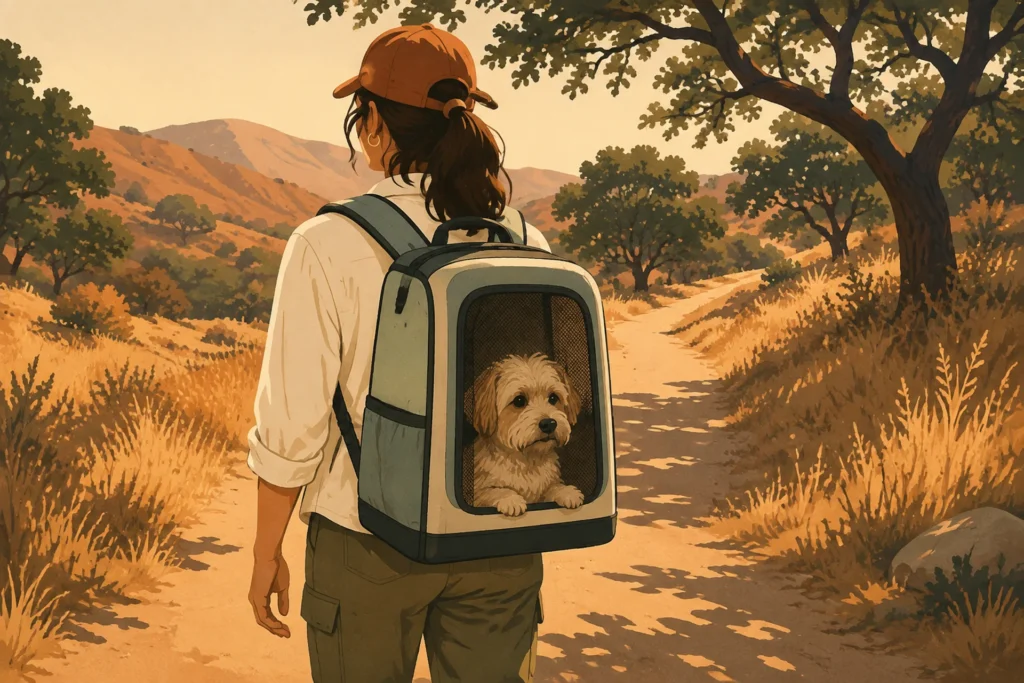
For a small, healthy, adult dog on a short outing, yes — with one large caveat that decides almost everything: a backpack carrier presses one entire wall of the enclosure against a warm, working human body, and it puts your dog where you cannot see or hear them. Heat is the hazard, not comfort, and the format removes the two channels you normally use to notice a problem early.
So it is not really a yes or no. It is safe in proportion to four things: ventilation that still works once the bag is on your back, a base that holds its shape, interior dimensions checked against your dog standing up, and a habit of stopping to look. Flat-faced, overweight, elderly or unwell dogs have the least margin on all four, and should be a conversation with your vet before a purchase. Everything below works through those in order.
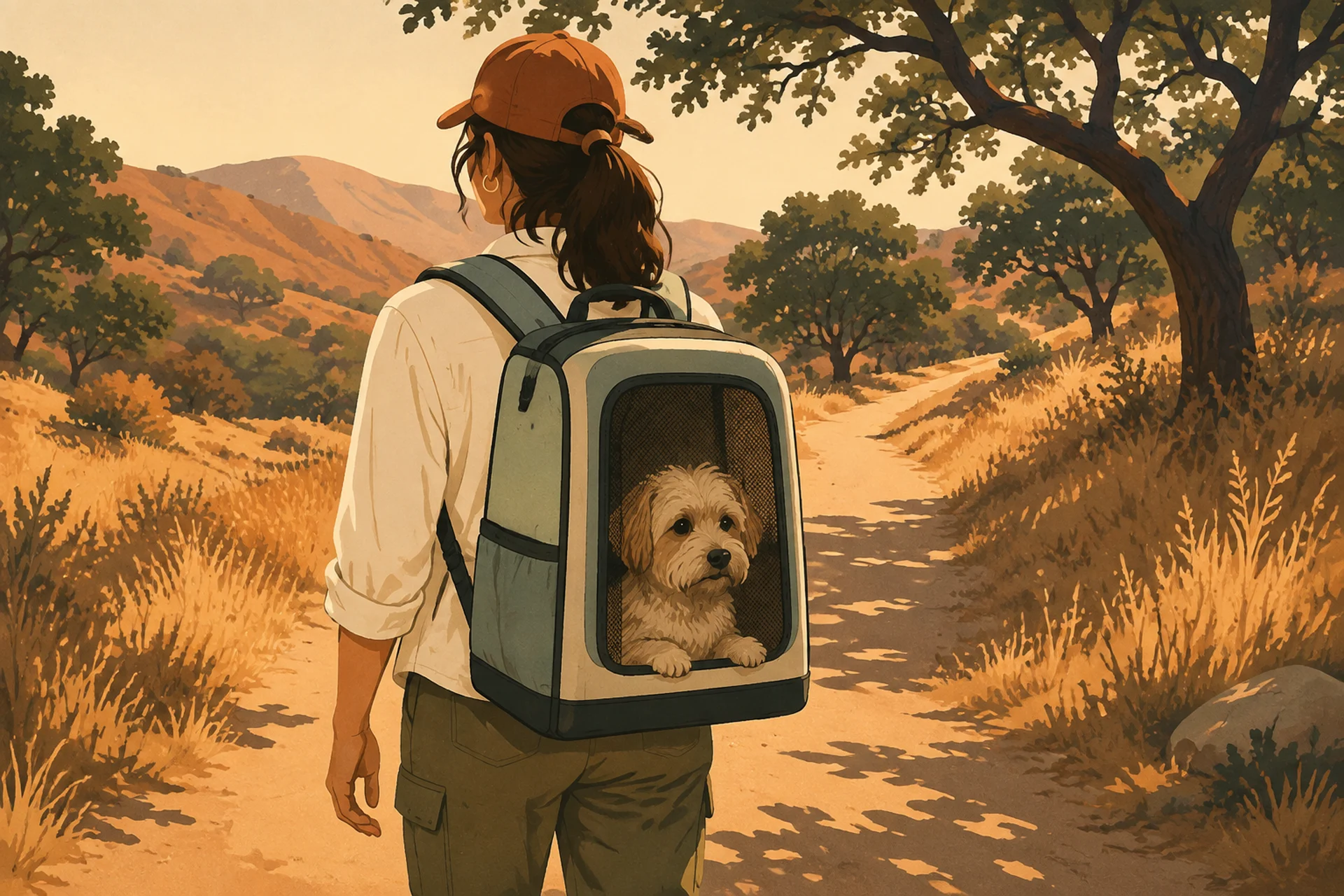
Heat is the hazard, not comfort
A backpack carrier does something no other carrier format does: it presses one entire wall of the enclosure flat against a warm, working human body. Whatever ventilation that panel was designed to provide is gone the moment you put the bag on.
That matters more for a dog than most people assume, because dogs have very little else to work with. Cornell’s Riney Canine Health Center states it plainly: “Dogs only have sweat glands on their paws so their primary method of dissipating heat to cool themselves is through panting.” Panting needs moving air. The same page lists who has the least margin: brachycephalic breeds — Pugs, Bulldogs, Boston Terriers, Boxers — who “cannot pant as efficiently,” plus overweight dogs, elderly dogs, dogs with heart or breathing conditions, and dogs with thick or dark coats. Merck’s account of the canine hair coat notes it “helps regulate body temperature” — useful outdoors, less so sealed inside a bag against your back.
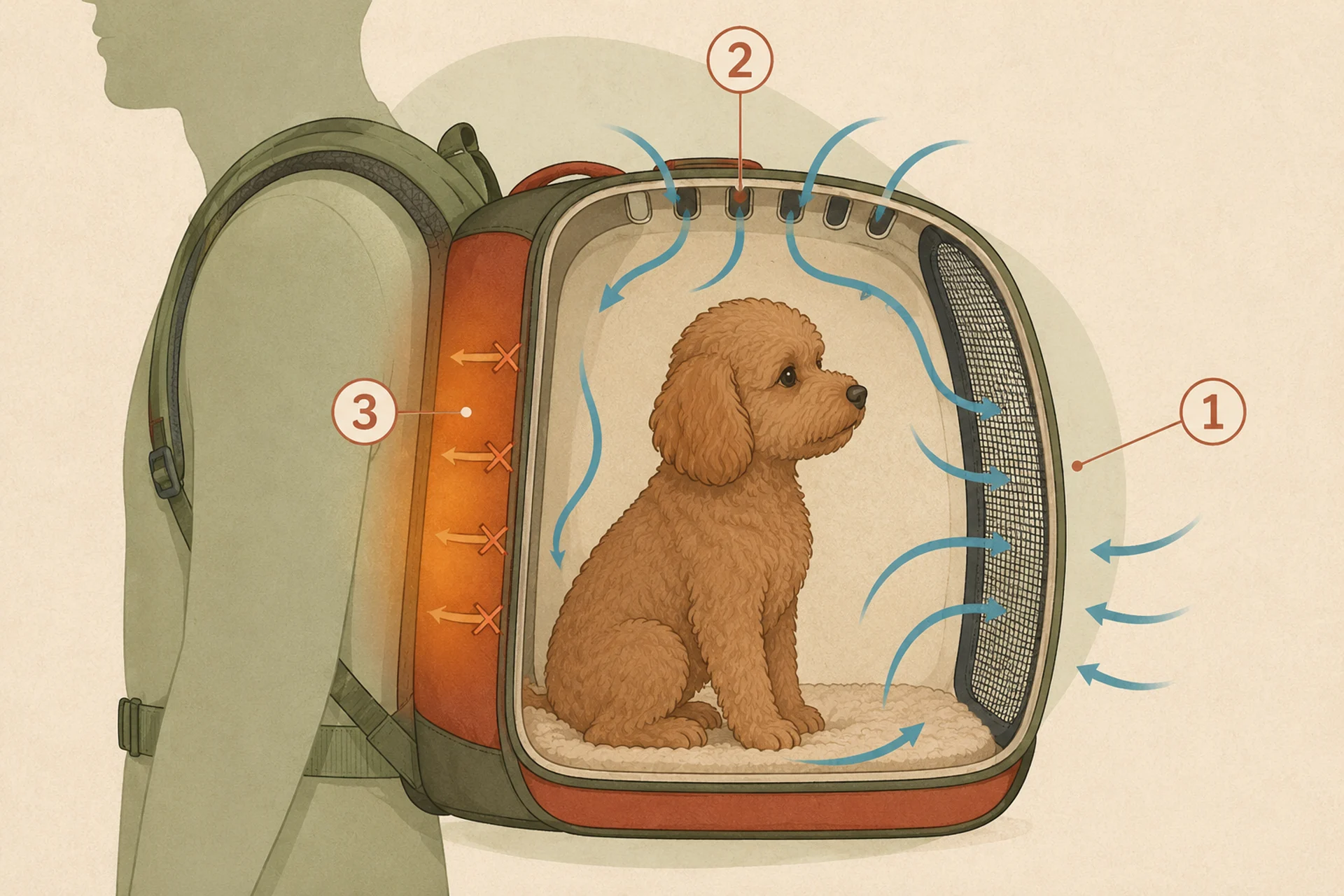
The practical rule: at least two of the outward-facing surfaces should be open mesh, and the top should vent. A single small window on the front panel looks charming in product photos and does close to nothing on your back in July.
Size: the only published yardstick
Nobody publishes minimum dimensions for pet backpacks. But there is a published standard for pet travel containers generally, and it is the most useful measuring stick available. IATA’s Container Requirements 1 for cats and dogs say the container must let the animal “turn about normally while standing,” “stand and sit erect,” and “lie in a natural position.” It gives an actual formula, built from four measurements you can take at home with a tape measure.
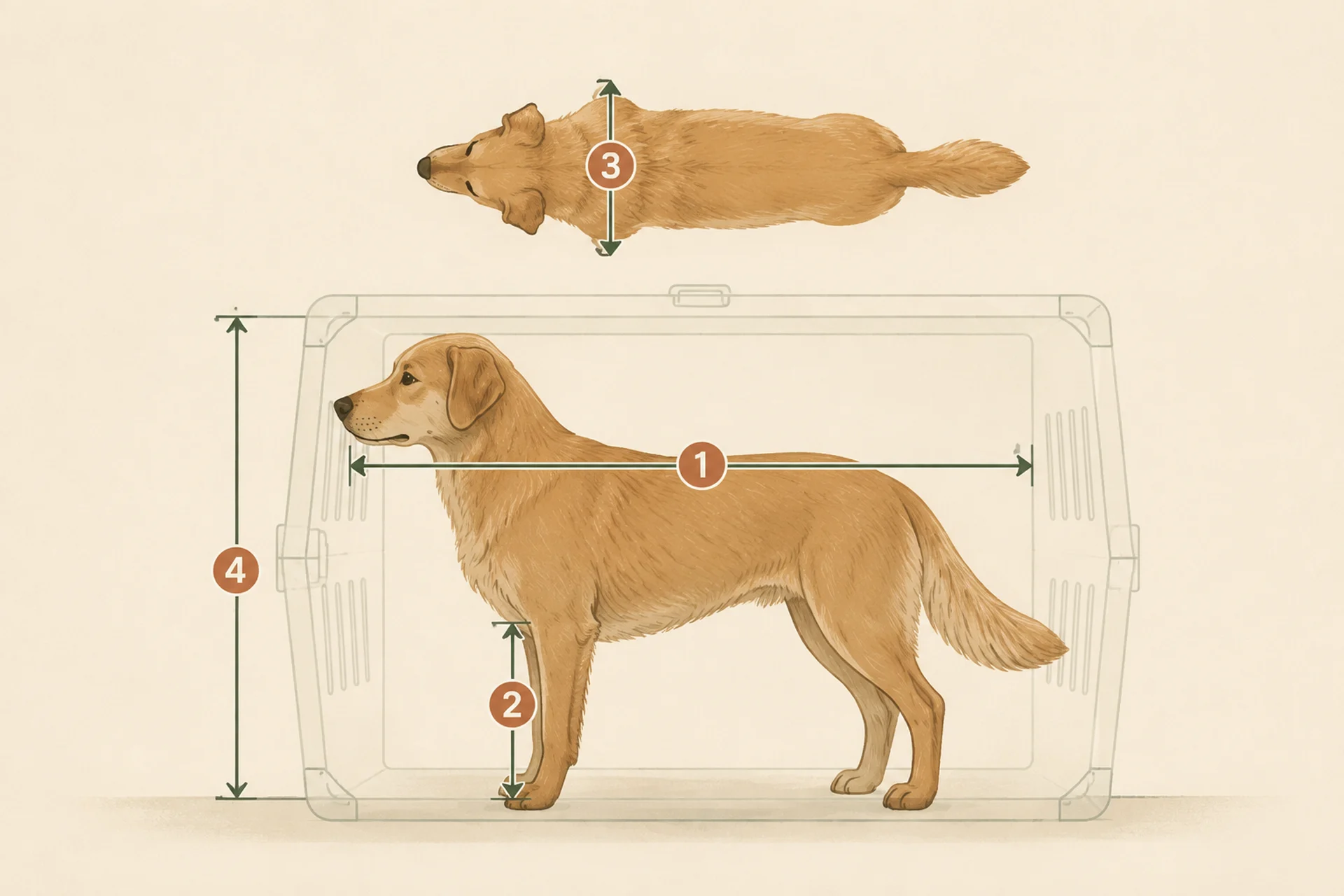
| Measure | How to take it | What it sets |
|---|---|---|
| 1 · Length | Tip of nose to the base of the tail | Interior length, plus half the ground-to-elbow height |
| 2 · Ground to elbow | Floor to the point of the elbow, standing | Feeds the length calculation above |
| 3 · Width at the widest point | Usually across the shoulders | Interior width — double it |
| 4 · Standing height | Floor to the top of the head or ear tips, whichever is taller | Interior height, plus whatever bedding you add |
Two details in that standard are worth carrying over even when you are only walking to the park. Height is measured to the top of the head with the dog standing, not curled up asleep in the shop — and IATA specifies that snub-nosed breeds need containers roughly ten percent larger, which is the same brachycephalic airway problem showing up in a different document. If your dog is flat-faced, buy up a size and treat the heat guidance above as non-negotiable.
What you cannot see behind you
Front carriers let you glance down. A backpack does not, so build a habit instead: stop every fifteen or twenty minutes, swing the bag around, and actually look.
What you are looking for is breathing. Cornell puts a healthy dog’s resting rate at “12-30 breaths per minute” and lists the signs that something is wrong: rapid open-mouth breathing, a bluish tinge to the gums or muzzle, visible abdominal effort, the head and neck extended to maximise airflow, wheezing or snorting or whistling, weakness or collapse. Their instruction if you see those is to get to an emergency veterinary hospital — not to finish the walk and see how things go.
Learn your own dog’s normal at rest on an ordinary day, so the comparison means something when you are three miles out.
Which dogs this format suits
| Situation | Backpack carrier? |
|---|---|
| Small dog, moderate weather, trail with rests and a long walk out | Yes — the format’s home ground |
| Puppy not yet cleared for long distances, or a senior who tires halfway | Yes, with vet sign-off first |
| Dog who settles better with a view and stays calm in enclosed spaces | Yes — pick generous outward mesh |
| Flat-faced breed, warm day, or any dog above the bag’s rating | No — or a front carry where you can watch them |
| Anxious dog who has never trained to the bag | Not yet — acclimate at home first |
| Errand where the dog could simply walk | No. A walked dog beats a carried one. |
The AKC’s hiking guidance is worth borrowing wholesale here: check with your vet about what your dog can handle, be cautious with the very young and the very old, avoid overly hot weather because “dogs are much more susceptible to the dangers of excessive heat than humans,” and carry water for the dog as well as yourself.
A note on the two names you will see
One thing not worth any of your attention: the word order. Backpack carrier, carrier backpack, backpack dog carrier — retailers use all three for the same shelf, and some listings use two of them in a single title to catch both searches. There is no category boundary hiding in the grammar. What does vary, enormously, between two bags with identical names is interior height, base rigidity, where the mesh sits, and how the load rides against your spine. Judge those.
Buying checklist
- Measure your dog standing — length, elbow height, shoulder width, head height — before you look at a single listing.
- Count the ventilated surfaces that will still face open air once the bag is on your back. One decorative window is not ventilation.
- Press the base. If it folds under your hand it will fold under your dog.
- Check the manufacturer’s weight rating against your dog’s actual weight, and stay under it.
- Try the straps loaded. A carrier that hangs low pulls your shoulders back and swings on every step.
- Confirm the opening you will actually use — side, front or top — is reachable while the bag sits on the ground.
- Acclimate at home for a week or two before the first real outing, with the bag open and treats inside.
TuckTrail picks
The Trail Dome-View Cat & Small Dog Backpack Carrier pairs a wide outward view with side ventilation for short walks and trail breaks; the Trail Campus Pet Backpack Carrier is the softer everyday version. The rest of the range sits on the carriers shelf.
Backpack carriers: FAQ
Are dog backpack carriers safe?
For a small, healthy adult dog on a short trip, and with the right bag, yes. The risks that make them unsafe are specific and avoidable: an enclosure that loses its ventilation the moment it is worn, a bag too small for the dog to stand and turn in, a collapsing base, and a wearer who never stops to check. Dogs who cannot pant efficiently — brachycephalic breeds especially — along with overweight, elderly and unwell dogs carry much less margin, and that is a question for your veterinarian rather than a product page.
Is a dog carrier backpack different from a dog backpack carrier?
No. They are two orderings of the same words for the same product, used interchangeably across retailers. Ignore the phrasing and compare interior height, base support, mesh placement and strap design instead.
How big should the inside be?
The published yardstick is IATA’s: the dog should be able to stand, sit erect, turn around normally and lie in a natural position. Measure nose to tail base, ground to elbow, shoulder width and standing height, and check those against the listed interior dimensions rather than the pictures.
Can a French Bulldog or Pug use one?
With more caution than most. Cornell lists brachycephalic breeds as unable to pant efficiently and at higher risk of overheating, and IATA specifies roughly ten percent more container space for snub-nosed dogs. If you do use one, keep it cool, keep it short, size up, and talk to your vet first.
How long can a dog stay in a backpack carrier?
No authority publishes a number, and any article that gives you one made it up. Work from stops instead: check your dog every fifteen to twenty minutes, offer water, and let them out to move whenever the terrain allows.
How do I know my dog is in trouble in there?
Breathing is the signal. Cornell’s distress list is rapid open-mouth breathing, bluish gums, abdominal effort, an extended head and neck, noisy breathing, weakness or collapse — any of which means an emergency veterinary hospital, immediately. Learn your dog’s resting rate on a normal day so you have something to compare against.
Backpack, sling, or front carrier?
Backpacks win on distance and on keeping both hands free; front carriers and slings win on being able to see your dog. Our comparison of slings, backpacks and purse carriers works through the trade-off, and how to carry a small dog covers the in-arms basics.
Safe enough is a property of the bag and the habit, not the format
A backpack carrier is as safe as the four things you controlled when you bought it and the one habit you keep afterwards. Pick on ventilation that still works when the bag is worn, a base that holds its shape, interior dimensions checked against your dog standing up, and a habit of stopping to look. If your dog is flat-faced, heavy-coated, elderly or unwell, ask your veterinarian before the format — not after you have bought the bag. For matching a bag to a small dog’s size, start with our small-dog carrier sizing guide. And if what you actually wanted was a pack the dog wears rather than one you wear, see how much weight a dog should carry in a backpack.
Sources
- Cornell University College of Veterinary Medicine, Riney Canine Health Center — Summer heat safety tips for dogs (checked 2026-08-25)
- Cornell University College of Veterinary Medicine, Riney Canine Health Center — Recognizing and responding to canine respiratory distress (checked 2026-08-25)
- IATA — Traveling with Pets, Container Requirements 1 (size formula and snub-nosed allowance) (checked 2026-08-25)
- Merck Veterinary Manual — Structure of the Skin in Dogs (checked 2026-08-25)
- American Kennel Club — Hiking With Your Dog: safety, training and gear tips (checked 2026-08-25)
Container standards and veterinary guidance are revised periodically. Confirm on the official pages, and talk to your own veterinarian about whether this format suits your dog.