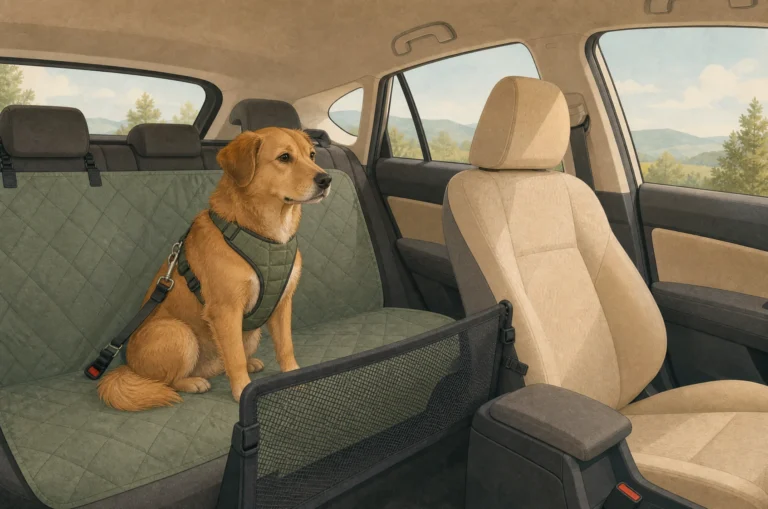

Yes, on both — if you book the pet option. Uber has Uber Pet: one pet per trip, no breed or size restrictions, and it costs more than a standard ride. Lyft has a Pet ride mode: up to four people and one well-behaved animal, for an extra fee that goes to the driver, and only in the US. Book a standard ride instead and it is up to the driver whether your dog gets in.
A pet ride is never guaranteed. On every major US ride-hail app the driver gets to decide, and declining your dog is allowed. A service animal is a completely different question: federal transportation rules say the operator shall permit it, and no app policy can opt out of that. 49 CFR § 37.167(d) is one sentence long: “The entity shall permit service animals to accompany individuals with disabilities in vehicles and facilities.”
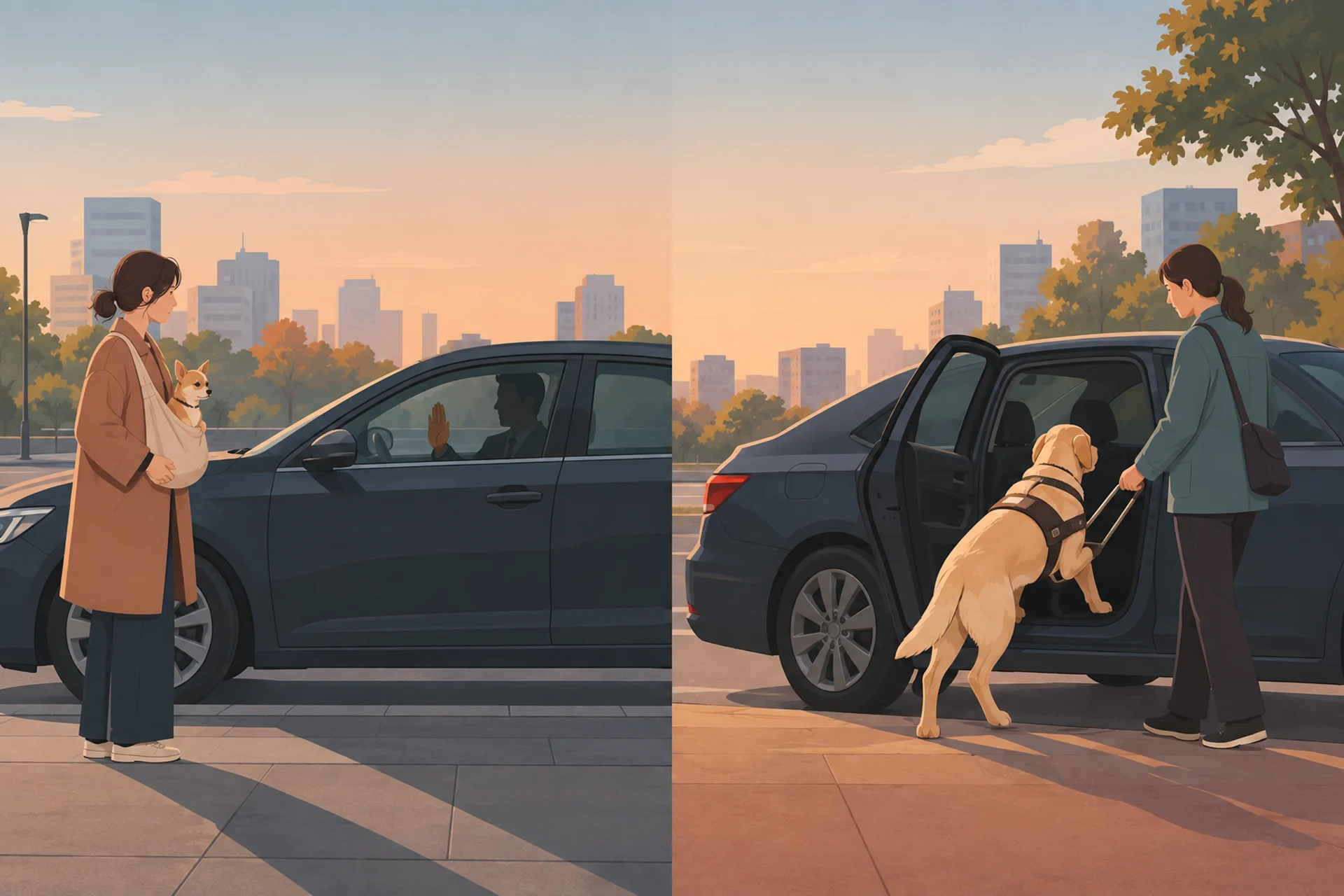
So there are really two answers on this page. If you are travelling with a pet, your job is to make yes the easy choice for a driver who is allowed to say no. If you are travelling with a service animal, your job is to know that the refusal you just got was illegal, and what to do about it.
One more thing worth knowing before you open an app: the robotaxi answer is different from the human answer. Waymo’s rider rules say leave pets at home, full stop.
The line that decides everything
Almost every argument at the kerb comes from one confusion, so it is worth settling first. Under the ADA, a service animal is narrow: “a dog that is individually trained to do work or perform tasks for a person with a disability.” Comfort is not a task. The Justice Department’s own FAQ is blunt about it — emotional support, comfort and therapy animals “have not been trained to perform a specific job or task,” so they do not qualify as service animals under the ADA.
That means an emotional support dog, legally, rides as a pet. A driver may decline it exactly as they may decline any other pet. This is not a loophole anyone is exploiting; it is the actual line, and knowing which side you are on saves a lot of arguing with someone who is also correct.
When it is genuinely not obvious that a dog is a service animal, there are only two questions anyone is allowed to ask: “(1) is the dog a service animal required because of a disability? and (2) what work or task has the dog been trained to perform?” Not for papers. Not for a demonstration. Not for a diagnosis. Waymo, notably, publishes those same two questions as the script its support team uses if it needs to check — and says “No need to tell us about your service animal ahead of time or bring any paperwork. They don’t need to wear a special ID tag, vest, or harness.”
What the law actually says about cars for hire
People assume rideshare sits in some unregulated gap. It does not. The Department of Transportation’s ADA regulations cover private entities in the business of transporting people, and § 37.29(c) spells out what taxi-style operators may not do: they “shall not discriminate against individuals with disabilities by actions including, but not limited to, refusing to provide service to individuals with disabilities who can use taxi vehicles, refusing to assist with the stowing of mobility devices, and charging higher fares or fees for carrying individuals with disabilities and their equipment than are charged to other persons.”
Put § 37.29 and § 37.167(d) together and you get the two halves people usually only know one of: the ride cannot be refused, and it cannot cost more. The ADA says the same thing from the business side — if a company charges a deposit or fee for pets, “it must waive the charge for service animals.”
There is one narrow exit, and it is about behaviour rather than species: a service animal may be removed when “the dog is out of control and the handler does not take effective action to control it” or “the dog is not housebroken.” Allergies and fear of dogs are not on that list.
Service by service, as published today
| Service | Pet (non-service) | Service animal |
|---|---|---|
| Uber, standard ride types | Driver’s call — “drivers may choose whether or not to allow the pet in their vehicle” | Permitted on any ride type; no need to select Uber Pet |
| Uber Pet | The ride option built for it; one pet per trip; may cost more than other options | Not required — and you should not have to pay for it |
| UberX Share | Not allowed | Permitted |
| Waymo (driverless) | No — rider rules say leave pets at home | Welcome if small enough to ride; emotional support and therapy animals are not |
| Lyft, Pet ride mode | The ride option built for it; up to four people and one well-behaved animal; extra fee goes to the driver; US only | Not required — drivers must take a service animal even on a standard ride |
| Lyft, standard ride | Driver’s call | Permitted |
| Local taxi apps | Set by each company; check that app’s own help centre before you book | Covered by the same federal rules as everyone else on this table |
Lyft Pet rides, in the actual words
Lyft’s answer to Uber Pet is a ride mode rather than a separate car class, and its help page is short enough to quote nearly whole. “Pet rides is a ride mode that allows you to bring your pet along for an additional fee, which goes directly to the driver.” You pick it in the app like any other option, and it “fits up to four people and one well-behaved animal.” Two details matter. First, “Pet rides are only available in the U.S. at this time,” so if you are searching for a pet-friendly Lyft in Canada, the answer on that page is not yet. Second, Lyft asks that pets “ride in a carrier, on a blanket, or at your feet” — not on the seat, not on a lap.
The page does not print a fee amount, so neither do we; the app shows it in the fare before you confirm. It also does not say “dogs only.” It says one animal, which covers a cat in a carrier. And it ends with the line that matters most for handlers: drivers must take a passenger with a service animal “even if you don’t request a Pet ride.”
Uber Pet, in the actual words
Uber Pet is the only mainstream product in the US built specifically around this problem, so it is worth reading closely rather than assuming. Uber’s own page sets out the shape of it: “You can bring one pet per trip, such as a dog or a cat,” and “Uber Pet trips may include an additional fee compared to other ride options.” On restraint it is specific without being fussy — “Keep your dog or cat safe and secure with a leash, harness, or carrier. Any other pets should travel in a carrier.” A rabbit or a cat, in other words, is a carrier animal; a dog on a lead is fine.
Two lines in that policy are the ones that actually cost people money. First: “If your pet leaves waste, excessive hair, or causes damage to the vehicle, you may also be charged a cleaning fee.” Second, the quieter one: “always keep your pet with you. Do not leave them unattended.” That second rule is why a rideshare cannot be used as a waiting room — a point with the same logic as our guide to leaving a dog in a parked car.
On the service-animal side, Uber’s legal policy does not hedge. Drivers are prohibited from “denying service to a rider because of the rider’s service animal,” and “drivers who engage in discriminatory conduct in violation of Uber’s policy may lose their ability to use the Driver App.” The money half is there too: “riders with service animals are not required to pay cleaning fees for hair or shedding from a rider’s service animal.” And on the paperwork question that trips up so many handlers — “service animals are not required to wear a tag, be registered, or display any kind of proof.”
How much does Uber Pet cost, and why can’t I see it?
Uber does not publish one US price for it. Its rider help page says only that “Uber Pet will cost more than other vehicle options,” and the difference is built into the upfront fare the app shows you before you book. So the honest way to find the price is to compare Uber Pet with UberX for the same trip in the app. If you schedule an Uber Pet ride in advance, which Uber says is possible “in some areas,” you will also see a reservation fee in that upfront fare. The possible cleaning fee described above is separate and only applies if something goes wrong.
If Uber Pet is not in your list of ride options, Uber’s pages do not explain why, and we are not going to guess at a city list. The practical fallback is the one that works everywhere: book a standard ride, message the driver straight away to say you have a small dog in a carrier and a blanket for the seat, and accept that they can say no. That is the same rule the help page states for any pet outside Uber Pet.
The same page also answers the question people ask about big dogs: “There are no breed or size restrictions.” A large dog is allowed on Uber Pet. The practical limit is the car and whether your dog can get in and settle calmly.
The robotaxi answer nobody expects
Type “can I bring my dog in a” into Google and the first thing it offers is Waymo. It is a reasonable guess — no driver means nobody to object, and the car is not somebody’s personal vehicle. The published answer is still no. Waymo’s rider rules put it under a heading of its own: “Leave pets at home — Some passengers may have allergies, so leave pets at home out of respect to future Waymo riders. Service animals are always welcome.”
The reasoning is worth sitting with, because it explains the whole category. A human driver decides one ride at a time and can weigh your particular clean, calm terrier against their own tolerance. A driverless fleet cannot; the car goes straight to the next passenger, who may be allergic, and there is nobody aboard to notice hair on the seat. So the rule has to be set once, for everybody, in advance. The same page also notes that cleaning fees start at $50 for a self-reported mess and $100 for one that goes unreported — numbers set for vomit and spills, but they tell you how the fleet thinks about seat condition.
For a service animal the rules reverse: “Service animals that are small enough to ride in our vehicles are always welcome to join riders with disabilities,” with the explicit exclusion that “all other animals, including emotional support or therapy animals, are not allowed to ride in our cars.”
How to make a pet ride actually go well
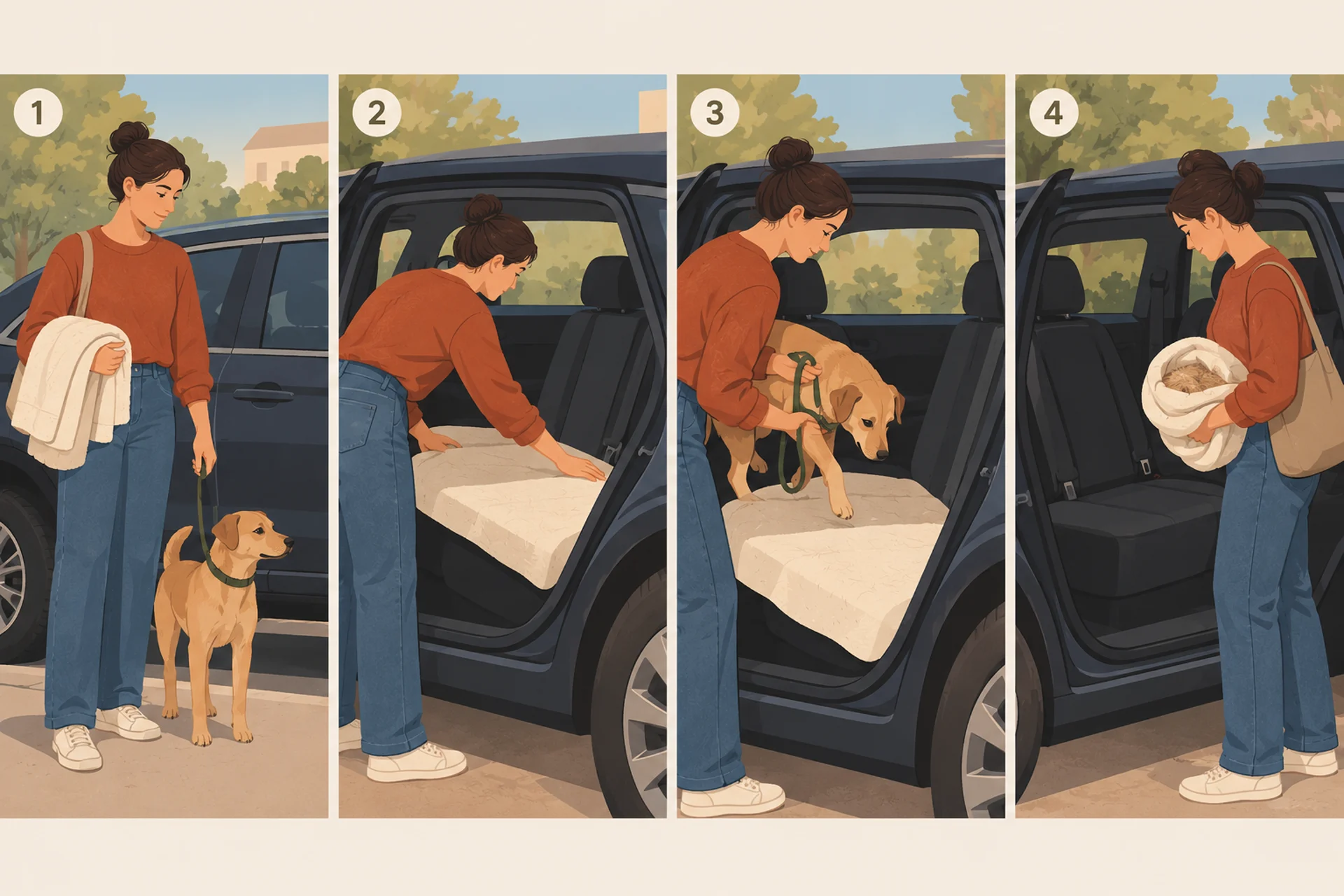
Given that a driver may decline, the practical goal is to remove every reason to. Almost all of it happens before the car arrives.
- Book the pet option where one exists. Requesting a standard car and hoping is how cancellations happen. Uber’s own advice is that “not all ride options allow pets” and that Uber Pet “is the best way to request a ride specifically designed for travelling with pets.”
- Message the driver the moment the ride is accepted. Small dog, in a carrier, bringing a blanket. A driver who wants to decline can do it now, at no cost to either of you, instead of at the kerb when you are late.
- Bring the blanket even if you also have a carrier. Uber suggests “a blanket or towel to help protect the seat” for a reason: it is the visible signal that you have thought about their car, and it is what you carry the hair out in.
- Be waiting outside with the dog already contained. Loading time is the part drivers are quietly rating. A sling or soft carrier that you can get in and out of one-handed is worth more here than any feature on the listing — the same handling argument we make in how to carry a small dog.
- Keep the lead short inside the car, and never let the dog into the footwell of the driver’s side. An unrestrained dog moving around a moving car is its own risk, which is the subject of our piece on whether dog car seats are crash tested.
- Do not get out and leave the dog in the car, ever. It is against Uber’s policy and it is the fastest way to a fee and a deactivated account.
If you are travelling with a service animal and get refused anyway, the useful move is not to argue at the kerb — it is to report the cancellation in the app afterwards. Both the federal rules above and the platform’s own policy are on your side, and a refusal that is never reported is a refusal that never gets counted.
One piece of kit does most of the work. The thing that turns a maybe into a yes is arriving with the dog already contained and the seat already covered. The Everyday Mesh-Comfort Sling Pet Carrier is the version of that we reach for on short urban hops, because the dog stays on you rather than on the upholstery. Any sling or soft tote you can load one-handed does the same job.
Dogs in rideshare: FAQ
Can an Uber driver refuse my dog?
Yes, for a pet. Uber’s rider help states that for non-service animals “drivers may choose whether or not to allow the pet in their vehicle.” Booking Uber Pet rather than a standard ride is what changes the odds, because the driver has opted into pet trips in advance.
How much does Uber Pet cost?
Uber does not publish a fixed price. Its help page says Uber Pet “will cost more than other vehicle options,” and the extra is included in the upfront fare. Compare it with UberX for the same trip in the app to see the difference. A cleaning fee may be added only if your pet leaves waste, excessive hair or damage.
Does Lyft allow dogs?
Yes, through its Pet ride mode: up to four people and one well-behaved animal, with an extra fee that goes to the driver. It is currently US-only, according to Lyft’s help page. Lyft asks that pets ride in a carrier, on a blanket or at your feet. On a standard Lyft ride, it is the driver’s decision.
Can I take my cat in an Uber or Lyft?
Yes. Uber Pet allows one pet “such as a dog or a cat,” and Lyft’s Pet rides allow one animal. Use a carrier for a cat. Uber says a dog or cat may be on a leash, harness or in a carrier, but a carrier is safer for a cat, and Lyft lists a carrier first.
Can a driver refuse my service dog?
No. Federal transportation rules require operators to permit service animals in vehicles, and taxi-style providers may not refuse service or charge more because of a disability. Uber’s own policy adds that a driver who knowingly refuses may permanently lose access to the driver app. Report it in the app rather than arguing at the kerb.
Does my emotional support dog count?
Not under the ADA. Comfort animals have not been trained to perform a task, so they are not service animals, and in a rideshare they travel as pets — which means the driver may decline. Waymo says so explicitly; emotional support and therapy animals are not allowed in its cars.
Does my dog have to be in a carrier?
For Uber, a dog or cat can travel “with a leash, harness, or carrier”; any other kind of pet must be in a carrier. A carrier is not usually required for a dog, but it is the single thing most likely to get you accepted and to keep you out of a cleaning fee.
Can I take my dog in a Waymo?
No. Waymo’s rider rules ask you to leave pets at home because of other passengers’ allergies. Service animals small enough to ride are always welcome, with no advance notice and no paperwork.
Will I be charged extra for hair?
You can be, for a pet. Uber’s pet page says a cleaning fee may apply for “waste, excessive hair, or damage.” For a service animal the opposite is true: riders are not required to pay cleaning fees for shedding, and drivers are not entitled to them.
Sources
- eCFR — 49 CFR § 37.167 Other service requirements (checked 2026-09-16) — paragraph (d), the one-sentence requirement that the entity shall permit service animals to accompany individuals with disabilities in vehicles and facilities, and paragraph (a) confirming the section applies to public and private entities.
- eCFR — 49 CFR § 37.29 Private entities providing taxi service (checked 2026-09-16) — paragraph (c), the prohibition on refusing service to individuals with disabilities and on charging higher fares or fees for carrying them and their equipment.
- U.S. Department of Justice — ADA Requirements: Service Animals (checked 2026-09-16) — the definition of a service animal, the rule that a pet deposit or fee must be waived for service animals, and the two grounds for removal (out of control, not housebroken).
- U.S. Department of Justice — Frequently Asked Questions about Service Animals and the ADA (checked 2026-09-16) — the two questions staff may ask, and the exclusion of emotional support, comfort and therapy animals from the ADA definition.
- Uber — Uber Pet (checked 2026-09-16) — one pet per trip, the possible additional fee, leash/harness/carrier wording, the blanket suggestion, the cleaning-fee language, the rule against leaving a pet unattended, and that a service animal needs no special ride option.
- Uber Help — Riding with pets (checked 2026-09-16) — that drivers may choose whether or not to allow a pet, that service animals are permitted at all times, and that pets are not allowed on UberX Share.
- Uber Help — Uber Pet (Pet Friendly Rides) (checked 2026-09-25) — Uber Pet costs more than other vehicle options; one pet; no breed or size restrictions; advance requests in some areas with a reservation fee in the upfront fare; cleaning fee for waste, excessive hair or damage.
- Lyft Help — Pet rides for riders (checked 2026-09-25) — Pet rides as a ride mode with an additional fee that goes to the driver; up to four people and one well-behaved animal; US only; pets in a carrier, on a blanket or at your feet; service animals accommodated without a Pet ride.
- Uber — Service Animal and Assistive Device Policy (United States) (checked 2026-09-16) — the prohibition on denying service because of a service animal, loss of driver app access for discriminatory conduct, no cleaning fees for service-animal shedding, and no tag, registration or proof required.
- Waymo — Waymo Rider Rules (checked 2026-09-16) — “Leave pets at home,” the allergy reasoning, that service animals are always welcome, and the published cleaning-fee amounts.
- Waymo — Service animals (checked 2026-09-16) — service animals small enough to ride are welcome, emotional support and therapy animals are not, no advance notice or paperwork, and the two confirming questions support may ask.
Platform policies change more often than laws do, and each company publishes its own. Confirm in the app’s help centre before you book, and treat the federal rules above as the floor nobody can go below.
A pet ride is a favour. A service animal ride is a right.
Book the pet option, message the driver before they pull up, bring a blanket and arrive with the dog already contained — that is the whole game, because the person deciding is allowed to say no. If it is a service animal, none of that applies: the ride is required, the fee is not, and the place to settle a refusal is in the app afterwards, not on the pavement.