A cat carrier for the car has a different job than one for a walk through a store or a wait in a vet lobby. In the car the carrier is restraint first and luggage second: it has to stay put in a hard stop, hold a cat who may be panicking, and keep enough airflow that a stressed cat can cool itself.
Two decisions do most of the work. Pick a carrier big enough that your cat can — in the ASPCA’s words — “stand, sit, lie down and turn around in” it, and then secure it so it “will not slide or shift in the event of an abrupt stop.” Everything else is comfort.
Where the carrier goes
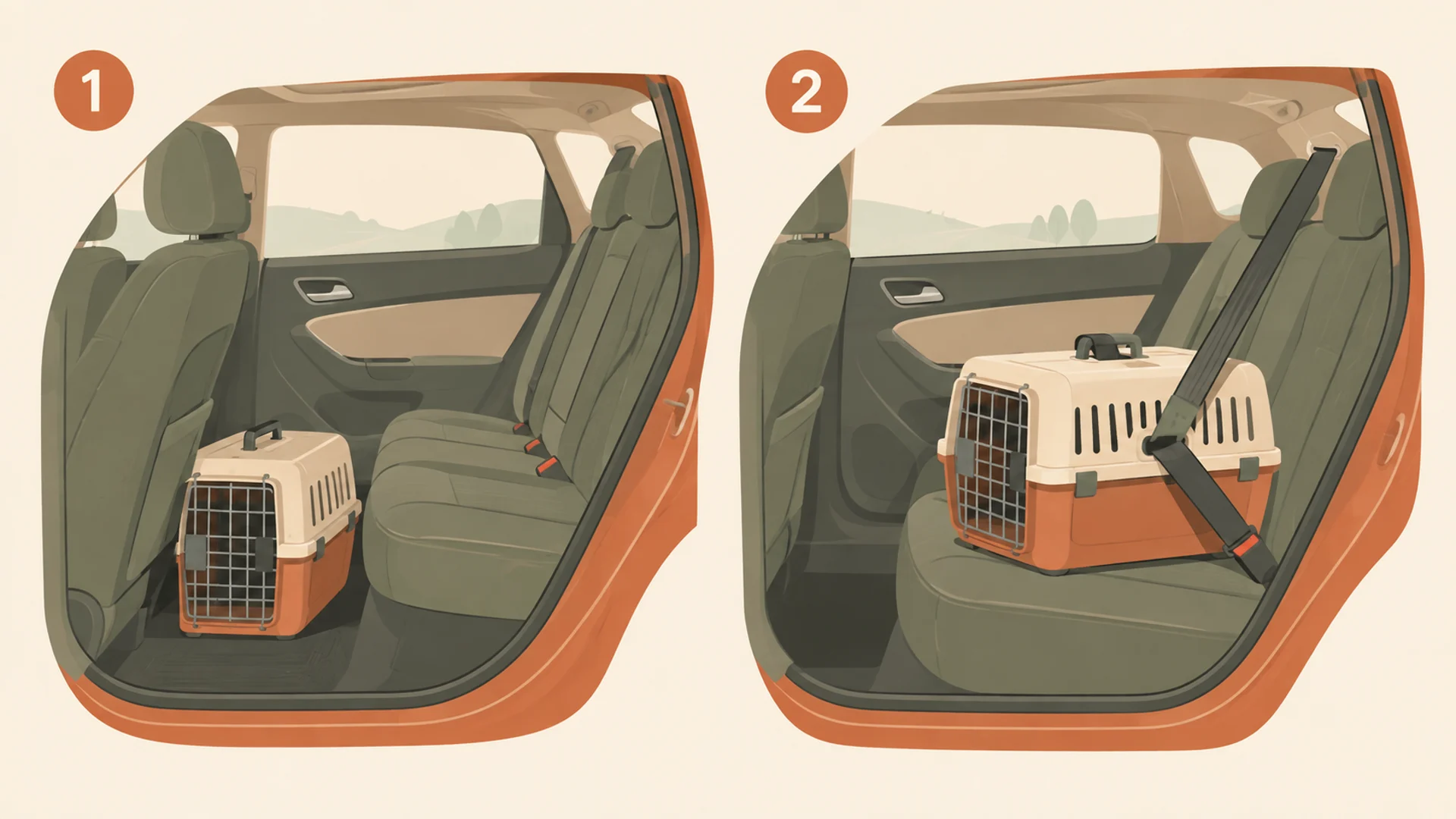
Position matters more than the carrier you bought. Cornell’s Riney Canine Health Center, in its guidance on travelling safely by car, recommends securing a carrier “on the floor behind either front seat,” noting that “this position offers the most protection in case of an accident.” The advice is written for dogs, but the physics is the same for a cat: the rear footwell is a box with walls on four sides, so the carrier has nowhere to go.
The bench seat also works, but only if a belt runs through a strap or loop on the carrier and is buckled. A carrier resting loose on a seat is not restrained — it is a projectile waiting for a hard stop. And a loose cat is worse still: Cornell notes that unrestrained pets “are a distraction to drivers and are at risk of injury in the event of sudden stops or accidents.”
Soft carrier, tote, or backpack?
All three can ride in a car. They differ in what happens at either end of the drive, and in how much structure they keep when a cat throws their weight around inside.
| Carrier type | Best for | Watch out for |
|---|---|---|
| Soft carrier | Vet visits, short drives, and calmer loading | A base that folds under load. Press on it — if it flexes, the cat is standing on a hammock. |
| Tote carrier | House-to-car-to-clinic transitions and quick errands | Zippers that a determined cat can push open, and mesh panels that end up pressed against a seat back. |
| Backpack carrier | Parking, walking, and hands-free carry once the car is stopped | Never a restraint while driving. Round shells in particular cannot be belted flat. |
| Hard-sided crate | Long drives and cats who scramble | Bulk, and a door that must actually latch rather than just close. |
A word about the phrase “crash-tested,” which you will see on carrier listings. There is no US federal crash standard for pet carriers, so the term refers to voluntary testing by independent labs — and very few cat-sized carriers have been through it. Treat it as a claim to check rather than a certification to trust. We went through what the one independent study actually found in are dog car seats crash-tested.
Entry style is a loading decision
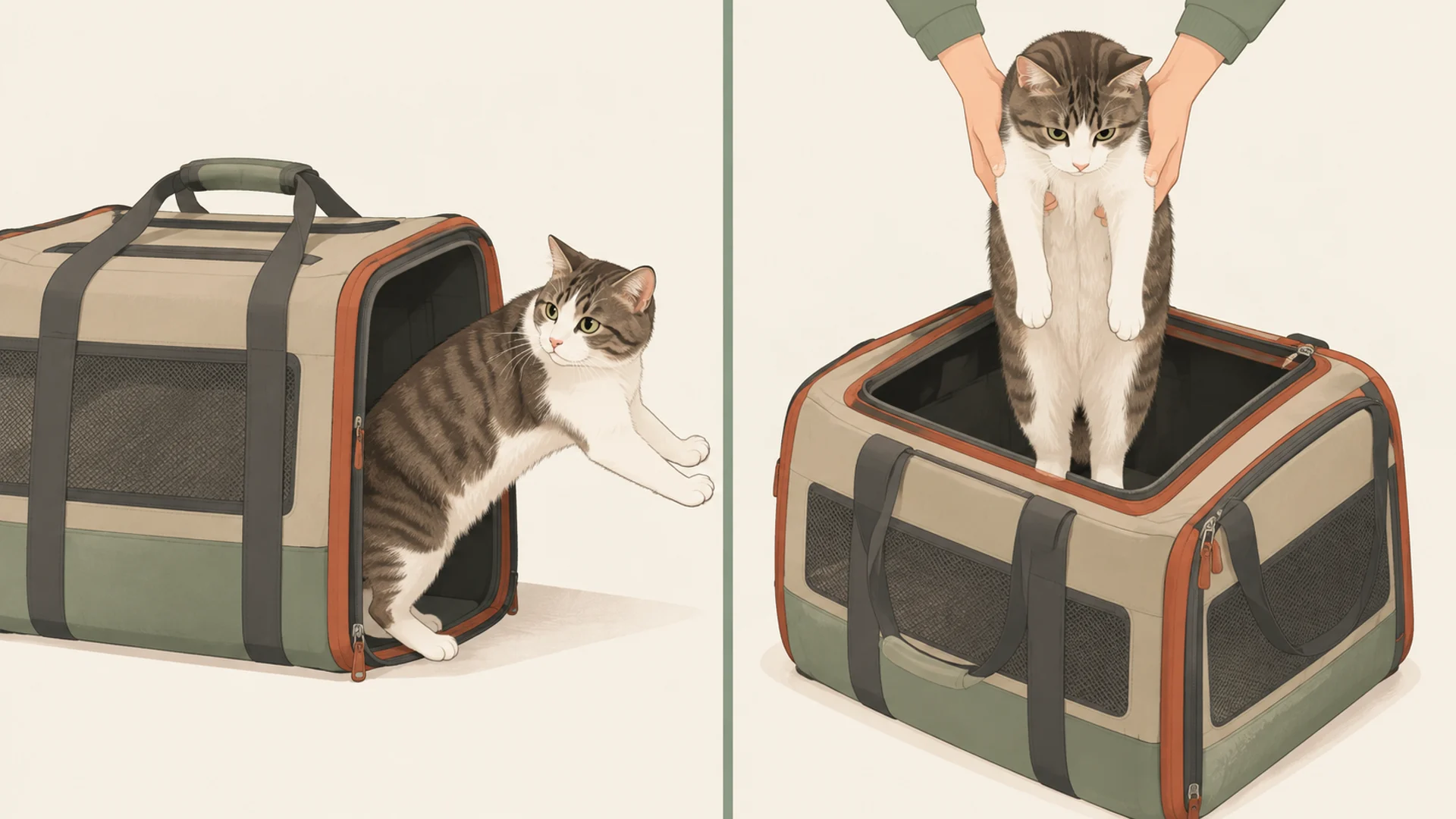
Most of the difficulty in a cat car trip happens in the ninety seconds before the car moves. A cat who braces against a front door will often drop into a top opening without a fight, which is why top-loading and dual-entry designs are worth the extra money if your cat has ever had to be posted through a small hole backwards.
The other half of that problem is the carrier’s reputation. If the carrier only appears on vet days, the cat learns exactly what it means. Cornell’s travel guidance suggests building up gradually — “begin with short rides (even just out the driveway, down the street, or to a nearby park) before you attempt longer trips.” Left open at home with a familiar blanket in it for a week or two, the carrier stops being an ambush.
Motion sickness and the pre-trip meal
Cats who drool, vomit or cry through a whole drive are usually reacting to a mix of anxiety and motion. One controllable variable is timing: Cornell’s guidance is to “avoid feeding your pet 4-6 hours before travel to reduce the risk of nausea.” Water is a different matter and should stay available at parked stops.
Line the carrier with something absorbent regardless — an accident on a two-hour drive is a much smaller problem when the liner comes out and a spare goes in. If your cat is severely distressed by car travel every single time, that is worth raising with your veterinarian rather than managing alone; there are medical options, and the decision about them is theirs to make, not a checklist’s.
Never leave the cat in the parked car
This is the one absolute in the whole guide. The National Weather Service states it without qualification: “It is NEVER safe to leave a child, disabled person or pet locked in a car, even in the winter.” The ASPCA puts the same rule in both directions — on a hot day “a parked automobile can become a furnace in no time,” and in cold weather “a car can act as a refrigerator.”
Plan the stops around that. Fuel and food stops happen with the cat’s carrier coming inside with you, or with a second adult staying in the running car, or not at all.
TuckTrail pick
For cats who resist front-door loading, the Everyday Soft Top-Open Pet Carrier opens from the top so you can lower a cat in rather than push them through. Check the size chart on the product page against your own cat’s measurements before ordering.
Car trip packing checklist
- Absorbent liner, plus one spare sealed in a bag. If your cat has had an accident on a drive before, here is what to do when a cat pees in the carrier and how to get the smell out.
- A small towel that already smells like home.
- Wipes and waste bags.
- Water and a collapsible bowl for parked stops.
- Current ID tag and up-to-date microchip registration.
- A harness and leash for the cat, so a carrier can be opened indoors without a bolt.
- Your vet’s number and the address of an emergency clinic near your destination.
Car cat carrier FAQ
Where should I put a cat carrier in the car?
On the floor behind a front seat if it fits — Cornell’s travel guidance calls that the most protective position, because the footwell boxes the carrier in on all sides. Otherwise on the rear bench with a seat belt through a strap on the carrier. Keep it closed the entire time the car is moving.
What size carrier does my cat need for a car trip?
Big enough to stand, sit, lie down and turn around in, per the ASPCA — and no bigger. Extra volume gives a cat room to be thrown around inside during a hard stop, which is the opposite of what you want on the road. For large, long-haired or older cats, see our cat carrier size guide.
Should I cover the carrier in the car?
Partial coverage settles a lot of cats by cutting the visual load. Keep at least one ventilation panel completely clear, and check that a draped towel is not sitting against the mesh.
Can my cat ride in a backpack carrier while I drive?
No. A backpack is a carry solution for after you park. Round and dome-shaped shells in particular cannot be belted flat against a seat, so they slide.
Should I let my cat out of the carrier on a long drive?
Not while the car is moving, and not at a rest stop unless the cat is harnessed and the doors are closed. A frightened cat in an open car interior is very hard to recover.
My cat screams for the entire drive. Is something wrong?
Usually it is fear rather than pain, and gradual carrier conditioning plus short practice drives helps most cats. If it happens every time regardless, or comes with drooling and vomiting, ask your veterinarian — there are things they can do, and it is their call to make. If your cat starts panting, that is a different signal — see cat panting in the car for what to do in the next five minutes.
Restraint first, comfort second.
The best cat carrier for car trips is the one that fits your cat closely, opens in a way your cat tolerates, and ends up wedged in a footwell or belted to a bench rather than sliding around on a seat. Get those right and the rest of the trip is liner changes and patience — plus a plan for the other end, which how to travel with a cat litter box works through stop by stop.
Sources
- ASPCA — Travel safety tips (checked 2026-09-08)
- Cornell University Riney Canine Health Center — Traveling safely with your dog: cars, planes and pet-friendly stays (checked 2026-09-08)
- National Weather Service — Heat safety (checked 2026-09-08)
Guidance is revised over time. Confirm on the official page, and take any question about your own cat’s travel anxiety or motion sickness to your veterinarian.